Introduction
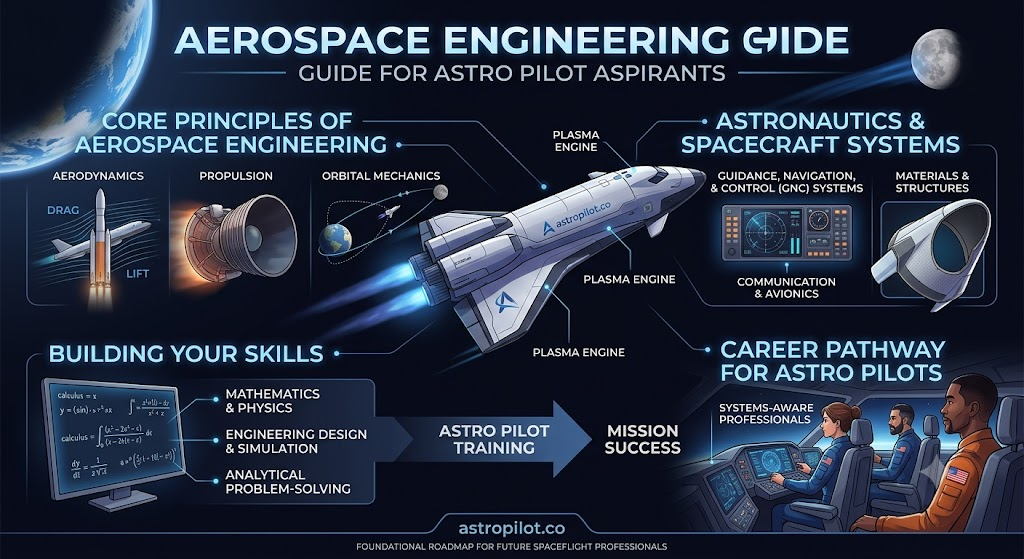
Aerospace engineering is the science and technology behind everything that flies within and beyond Earth’s atmosphere. From commercial aircraft to advanced spacecraft, this discipline combines physics, mathematics, materials science, and systems engineering to make flight possible.
In the context of modern space careers, an astro pilot refers to a trained professional capable of operating and navigating spacecraft in space missions. This role demands a deep understanding of aerospace engineering principles because every spacecraft system—from propulsion to navigation—is designed using engineering fundamentals.
For aspiring astro pilots, aerospace engineering is not just a subject; it is the foundation of space exploration. It teaches how machines overcome gravity, survive extreme environments, and perform precise operations in orbit and deep space.
Real-World Applications of Aerospace Engineering
Aerospace engineering is applied in every phase of space missions and aviation systems. Below are its key real-world uses:
Rocket Propulsion Systems
Aerospace engineers design rocket engines that generate thrust powerful enough to escape Earth’s gravity. This involves fuel combustion, nozzle design, and energy optimization.
Spacecraft Design and Structural Engineering
Spacecraft must be lightweight yet extremely strong. Engineers ensure structural stability to withstand launch pressure, vibration, radiation, and thermal extremes.
Orbital Mechanics and Trajectory Planning
Aerospace engineering is used to calculate spacecraft trajectories, orbital paths, and interplanetary transfers with extreme precision.
Satellite Systems and Communication
Satellites rely on aerospace engineering for positioning, signal transmission, and long-term orbital stability, enabling GPS, weather forecasting, and global communication.
Space Mission Safety Systems
Engineering ensures astronaut safety through life-support systems, emergency protocols, and redundant system designs.
Core Aerospace Engineering Basics for Astro Pilot Aspirants
To build a strong foundation in aerospace engineering, students must understand the following core areas:
Aerodynamics and Flight Mechanics
Aerodynamics explains how air and gas flow around objects. In aerospace engineering, it helps design efficient aircraft and spacecraft shapes that reduce drag and improve performance.
Propulsion Systems
Propulsion is the heart of space travel. It includes chemical rockets, jet engines, and advanced propulsion systems that generate thrust for movement in space.
Spacecraft Structural Design
Structures must withstand extreme conditions such as vibration during launch and zero-gravity environments in orbit.
Control Systems and Automation
τ=rFsin(θ)
τ=(3)(6)sin(90∘)=18N m
Only the perpendicular part of F turns the lever.
F
N
r
m
θ
degpivotr = 3 mθ = 90°F⊥ = 6 NFτ = 18 N m
Control systems use principles like torque and rotational force to stabilize spacecraft orientation and ensure accurate navigation.
Avionics and Onboard Electronics
Avionics systems handle communication, navigation, and onboard computing. These systems ensure real-time decision-making in space missions.
Materials Science in Aerospace
Special materials such as heat-resistant alloys and composites are used to withstand radiation, temperature variations, and mechanical stress.
Evaluation Criteria for Aspiring Astro Pilot Engineers
Students aiming for aerospace careers should evaluate their readiness based on the following skills:
Strong Mathematical Foundation
Aerospace engineering relies heavily on calculus, algebra, and differential equations for modeling flight and motion.
Physics Understanding
Concepts like force, motion, energy, and thermodynamics are essential for spacecraft design and operation.
Engineering Design Thinking
Students must be able to design systems that are efficient, safe, and reliable under extreme conditions.
Simulation and Modeling Skills
Modern aerospace systems are tested using simulations before real-world deployment.
Analytical Reasoning
Astro pilots must interpret system data and make quick technical decisions during missions.
Systems Thinking
Understanding how multiple subsystems interact is crucial in spacecraft design and operation.
Best For / Not Ideal For
Best For
This field is ideal for:
- Students passionate about space exploration and aircraft systems
- Learners strong in mathematics and physics
- Aspiring aerospace engineers and astro pilots
- Individuals interested in complex technical problem-solving
Not Ideal For
This path may not suit:
- Students avoiding technical subjects like physics or math
- Learners preferring purely creative or non-technical careers
- Individuals uncomfortable with analytical problem-solving
Aerospace Engineering Skill Breakdown
Lift, Thrust, Drag, and Gravity
These four forces define flight behavior. Understanding their interaction is essential for designing aircraft and spacecraft.
Rocket Propulsion and Fuel Efficiency
Efficient propulsion systems determine mission success, fuel usage, and spacecraft range.
Structural Integrity of Spacecraft
Engineering ensures spacecraft can survive intense mechanical stress during launch and re-entry.
Electrical Systems in Spacecraft
Electrical engineering powers communication, navigation, and life-support systems.
Navigation and Control Engineering
Control systems maintain spacecraft stability, orientation, and precise trajectory adjustments.
Career Path Connection: Where Aerospace Engineering Leads
Aerospace engineering opens doors to multiple advanced space careers:
Astro Pilots
Operate spacecraft and manage navigation systems during space missions.
Aerospace Engineers
Design and develop aircraft, rockets, satellites, and propulsion systems.
Space Mission Designers
Plan trajectories, fuel requirements, and mission architecture.
Satellite Engineers
Manage satellite deployment, orbit control, and communication systems.
Space Research Scientists
Study space environments, planetary systems, and advanced aerospace technologies.
FAQs
1. What is aerospace engineering in simple terms?
Aerospace engineering is the study of designing and building aircraft and spacecraft that can fly in air and space environments.
2. Why is aerospace engineering important for astro pilots?
It provides the technical knowledge needed to understand spacecraft systems and control space missions safely.
3. Do I need strong math skills for aerospace engineering?
Yes, mathematics is essential for calculations related to motion, forces, trajectories, and system design.
4. What subjects should I study for aerospace engineering?
Physics, mathematics, computer science, and engineering fundamentals are key subjects.
5. Is coding important in aerospace engineering?
Yes, coding is widely used for simulations, control systems, and spacecraft modeling.
6. What is the hardest part of aerospace engineering?
Many students find orbital mechanics and propulsion systems challenging due to their complexity.
7. Can beginners learn aerospace engineering basics?
Yes, beginners can start with basic physics and gradually move into advanced engineering concepts.
8. How does aerospace engineering help in space missions?
It ensures spacecraft are designed, launched, and operated efficiently and safely.
9. What tools do aerospace engineers use?
They use simulation software, CAD tools, and control system modeling platforms.
10. What careers can I get after aerospace engineering?
Careers include astro pilot, aerospace engineer, satellite specialist, and mission planner.
Conclusion
Aerospace engineering is the backbone of all space exploration and the most important discipline for aspiring astro pilots. It brings together physics, mathematics, materials science, and systems thinking to design and operate spacecraft that can travel beyond Earth.
For students aiming to enter the world of spaceflight, mastering aerospace engineering fundamentals is the first step toward turning ambition into achievement. From propulsion systems to orbital navigation, every concept plays a critical role in shaping the future of space missions.
At astropilot.co, the journey toward becoming an astro pilot begins with understanding how aerospace engineering transforms scientific ideas into real-world space exploration.