Introduction
Human spaceflight is the process of sending people beyond Earth’s atmosphere aboard specially designed spacecraft. It combines science, engineering, medicine, aviation, communication, and teamwork.
Unlike robotic missions, human spaceflight must protect living crew members throughout every stage. Astronauts need oxygen, water, food, temperature control, medical support, radiation protection, communication, and a safe way to return home.
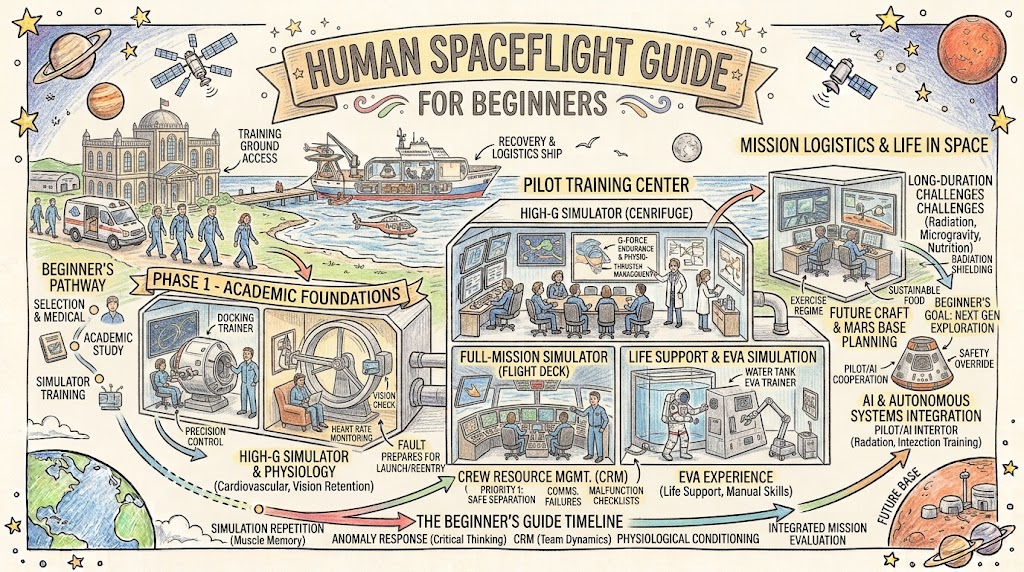
A crewed mission normally includes several major stages: planning, astronaut training, launch, travel through space, orbital operations, reentry, landing, recovery, and post-mission evaluation.
For beginners, human spaceflight may appear extremely complicated. However, its main principles can be understood by studying how spacecraft move, how astronauts live in microgravity, how mission teams manage risk, and how crews return safely to Earth.
This guide explains the essential parts of human spaceflight in clear and simple language.
What Is Human Spaceflight?
Human spaceflight refers to any space mission that carries one or more people beyond Earth’s atmosphere.
The people travelling aboard the spacecraft may be:
- Professional astronauts
- Military astronauts
- Scientists
- Engineers
- Medical specialists
- Mission commanders
- Space tourists
- Commercial spaceflight participants
Human spaceflight differs from robotic exploration because the spacecraft must support human life.
A robotic probe can operate without food, air, sleep, or medical care. A crewed spacecraft must maintain a safe environment every second of the mission.
Why Human Spaceflight Is Important
Human spaceflight helps scientists and engineers study both space and the human body.
Astronauts can repair equipment, conduct complex experiments, make decisions, respond to unexpected problems, and adapt tasks in ways that robots may not always manage.
Human space missions support:
- Scientific research
- Space medicine
- Earth observation
- Technology development
- International cooperation
- Spacecraft testing
- Moon exploration
- Mars mission preparation
- Commercial spaceflight
- Education and inspiration
Human spaceflight also pushes industries to create safer materials, better medical systems, advanced communication tools, and improved navigation technologies.
A Brief History of Human Spaceflight
Human spaceflight began during the twentieth century.
Early missions focused on answering basic questions:
- Can humans survive launch?
- Can people live in weightlessness?
- Can astronauts control a spacecraft?
- Can a crew return safely?
- Can humans work outside a spacecraft?
As experience increased, missions became longer and more complex.
Human spaceflight gradually developed from short solo flights to:
- Multi-person missions
- Spacewalks
- Moon landings
- Space stations
- Long-duration orbital missions
- Reusable spacecraft
- Commercial crew missions
Today, human spaceflight includes government programmes, international partnerships, and private space companies.
Main Stages of a Human Space Mission
A human space mission can be divided into several stages.
Mission Planning
Teams define the mission goals, destination, duration, crew requirements, spacecraft design, experiments, emergency plans, and landing method.
Astronaut Selection and Training
Crew members are selected and trained for technical operations, medical emergencies, teamwork, spacecraft control, and survival.
Launch Preparation
The spacecraft, rocket, launch site, crew, weather, and communication systems are checked.
Launch
The rocket carries the crew beyond Earth’s atmosphere.
Space Operations
Astronauts perform experiments, maintain systems, exercise, communicate, and complete mission tasks.
Return Preparation
The crew secures equipment, checks systems, and prepares for reentry.
Reentry and Landing
The spacecraft enters Earth’s atmosphere, slows down, and lands on water, land, or a runway.
Recovery and Debriefing
Astronauts receive medical checks, and engineers inspect the spacecraft and mission data.
How Astronauts Are Selected
Astronaut selection is highly competitive.
Space agencies look for people who can remain calm, learn complex systems, work in teams, and perform under pressure.
Requirements vary, but astronaut candidates often have backgrounds in:
- Aviation
- Engineering
- Medicine
- Physics
- Biology
- Mathematics
- Computer science
- Military operations
- Scientific research
Important personal qualities include:
- Good judgment
- Emotional stability
- Communication ability
- Teamwork
- Physical fitness
- Adaptability
- Technical discipline
- Problem-solving skills
Astronauts must be capable of handling both normal duties and emergencies.
Astronaut Training
Astronaut training can take several years.
The programme prepares crew members for spacecraft operations, scientific work, physical challenges, and emergency situations.
Spacecraft Systems Training
Astronauts learn how every important spacecraft system works.
Training covers:
- Navigation
- Propulsion
- Electrical power
- Life support
- Communication
- Computers
- Temperature control
- Cabin pressure
- Emergency systems
- Landing equipment
Crew members must understand how to operate these systems and respond when something fails.
Simulator Training
Simulators recreate spacecraft operations without leaving Earth.
Astronauts practise:
- Launch
- Docking
- Orbital manoeuvres
- System failures
- Reentry
- Landing
- Communication problems
- Fire emergencies
- Pressure loss
- Medical events
Simulators allow crews to repeat difficult situations until their responses become organised and reliable.
Survival Training
A spacecraft may land far from the planned recovery zone.
Astronauts therefore receive survival training for environments such as:
- Oceans
- Deserts
- Forests
- Cold regions
- Mountains
- Remote areas
Training may include shelter building, emergency communication, medical care, flotation, and food management.
Physical Training
Spaceflight places unusual demands on the body.
Astronauts build strength, endurance, flexibility, and cardiovascular fitness before launch.
Physical preparation supports:
- High launch forces
- Long periods in microgravity
- Spacewalks
- Emergency movement
- Post-mission recovery
Teamwork Training
Astronauts spend long periods working in small spaces.
They must communicate clearly, share tasks, solve disagreements, and support each other.
Crew Resource Management principles are often used to improve:
- Leadership
- Decision-making
- Communication
- Workload distribution
- Situational awareness
- Conflict resolution
How a Spacecraft Supports Human Life
A crewed spacecraft must create a safe artificial environment.
Outside the spacecraft, there is no breathable air, atmospheric pressure, or protection from extreme conditions.
The spacecraft therefore needs a life-support system.
Oxygen Supply
Astronauts need oxygen for breathing.
A spacecraft may store oxygen in tanks or produce it using onboard systems.
Sensors continuously monitor oxygen levels.
Too little oxygen can cause unconsciousness, while too much oxygen can increase fire risk.
Carbon Dioxide Removal
Astronauts breathe out carbon dioxide.
In a closed spacecraft, carbon dioxide can quickly build up to dangerous levels.
Filters and chemical systems remove it from the cabin air.
Cabin Pressure
The spacecraft cabin must maintain safe pressure.
Without pressure, body fluids and gases would behave dangerously.
Pressure systems include sensors, seals, valves, and emergency oxygen supplies.
Temperature Control
Spacecraft can experience extreme heating and cooling.
Thermal-control systems keep the cabin and equipment within safe temperature limits.
These systems may use:
- Insulation
- Cooling loops
- Radiators
- Heaters
- Ventilation fans
- Reflective surfaces
Water Supply
Astronauts need water for drinking, food preparation, hygiene, and experiments.
Water is heavy, so spacecraft try to use it efficiently.
Long-duration missions may recycle moisture from cabin air and other sources.
Food in Space
Space food must be nutritious, safe, easy to store, and simple to prepare.
Astronaut meals may include:
- Dehydrated foods
- Packaged meals
- Snacks
- Drinks
- Thermally processed food
- Fresh food during early mission days
Food packaging must prevent crumbs and liquids from floating into equipment.
Waste Management
Spacecraft need systems for collecting human waste.
Waste systems must work in microgravity, control odours, prevent contamination, and protect crew health.
How Rockets Carry Humans Into Space
A spacecraft cannot reach orbit using ordinary aircraft engines.
Aircraft engines depend on atmospheric oxygen, while rockets carry both fuel and an oxidiser.
During launch, rocket engines produce thrust by pushing hot gases downward.
The equal and opposite reaction pushes the rocket upward.
Rocket Stages
Many launch vehicles use multiple stages.
Each stage contains engines and fuel.
When one stage uses its fuel, it may separate. Removing the empty section reduces weight and allows the remaining vehicle to accelerate more efficiently.
Launch Forces
Astronauts experience vibration, noise, acceleration, and increased gravitational force during launch.
They sit in specially designed seats that support the body.
Crew members wear pressure suits and remain secured until the spacecraft reaches a safer flight phase.
Launch Abort Systems
A crewed launch vehicle usually includes emergency escape capability.
If a serious rocket problem occurs, an abort system may pull or push the crew capsule away from danger.
Abort systems are designed for different stages of launch.
They represent an important difference between many crewed and uncrewed missions.
Reaching Orbit
Reaching space is not the same as reaching orbit.
A spacecraft must travel fast enough sideways to continuously fall around Earth without hitting the surface.
In low Earth orbit, spacecraft travel at extremely high speed.
The result is a continuous free-fall condition commonly described as microgravity.
What Is Microgravity?
Microgravity is a condition in which people and objects appear almost weightless.
Gravity still exists in orbit. The spacecraft and everything inside it are falling around Earth together.
Because they fall at the same rate, astronauts float inside the cabin.
Microgravity affects:
- Movement
- Eating
- Sleeping
- Exercise
- Scientific experiments
- Blood circulation
- Bones
- Muscles
- Balance
How Astronauts Move in Space
Astronauts move by pushing against walls, handrails, or other fixed surfaces.
A small push can carry a person across the cabin.
Crew members must control their movement carefully to avoid hitting equipment or other people.
Handrails, foot restraints, and straps help astronauts work safely.
Sleeping in Space
Astronauts use sleeping bags attached to walls, floors, or ceilings.
In microgravity, these directions feel almost the same.
Sleeping areas provide some privacy and help prevent astronauts from floating into equipment.
Sleep can be affected by:
- Noise
- Light
- Work schedules
- Stress
- Temperature
- Frequent sunrises and sunsets
Personal Hygiene in Space
Water does not flow normally in microgravity.
Astronauts use special methods for washing, brushing teeth, shaving, and cleaning clothing.
Water forms floating droplets, so it must be controlled carefully.
Exercise in Space
Exercise is essential during long missions.
Without normal gravity, muscles and bones receive less load.
Astronauts use specially designed equipment for:
- Running
- Cycling
- Resistance training
- Strength exercise
- Cardiovascular fitness
Regular exercise reduces, but may not completely prevent, physical decline.
Main Health Effects of Spaceflight
Spaceflight changes the human body in several ways.
Muscle Loss
Muscles used for standing and walking may weaken because they do not work normally in microgravity.
Bone Loss
Bones may lose mineral density when they are not regularly loaded by gravity.
Fluid Shifts
Body fluids move toward the upper body and head.
Astronauts may experience facial puffiness and changes in pressure around the eyes.
Balance Changes
The inner ear and brain must adapt to the lack of normal gravitational signals.
This can cause space motion sickness during the early mission.
Cardiovascular Changes
The heart and blood vessels adjust to microgravity.
After returning to Earth, astronauts may feel dizzy or weak when standing.
Radiation Exposure
Earth’s atmosphere and magnetic field protect people from much of the radiation found in space.
Astronauts may receive higher radiation exposure, especially beyond low Earth orbit.
Psychological Effects
Isolation, workload, limited privacy, distance from family, and confinement can affect mental well-being.
Crew support, communication, rest, recreation, and psychological preparation are important.
Spacecraft Navigation
Spacecraft navigation determines position, speed, orientation, and future path.
Navigation systems may use:
- Star trackers
- Sun sensors
- Gyroscopes
- Inertial measurement units
- Satellites
- Ground tracking
- Radar
- Computers
- Radio signals
Astronauts and mission control continuously monitor the spacecraft’s trajectory.
Spacecraft Attitude Control
Attitude means the direction a spacecraft is facing.
A spacecraft must point correctly for:
- Engine burns
- Solar power
- Communication
- Docking
- Reentry
- Scientific observation
Small thrusters, reaction wheels, or other control systems rotate the vehicle.
Docking With a Space Station
Docking is the process of connecting one spacecraft to another.
The approaching spacecraft must carefully match the station’s:
- Orbit
- Speed
- Direction
- Position
Docking systems may operate automatically, but astronauts and mission controllers monitor the process.
After docking, pressure checks are completed before the hatch opens.
Working Outside the Spacecraft
A spacewalk is also called extravehicular activity.
During a spacewalk, astronauts leave the protected cabin while wearing a spacesuit.
They may perform:
- Repairs
- Equipment installation
- Scientific experiments
- Inspections
- Maintenance
- Construction
How Spacesuits Protect Astronauts
A spacesuit functions like a small personal spacecraft.
It provides:
- Oxygen
- Pressure
- Cooling
- Communication
- Radiation protection
- Limited micrometeoroid protection
- Carbon dioxide removal
- Mobility
Astronauts use safety tethers so they do not drift away.
Communication During Human Spaceflight
Communication connects the crew with mission control.
Astronauts use voice, video, data, and text systems.
Mission control helps with:
- Navigation
- System monitoring
- Medical support
- Scientific planning
- Emergency response
- Weather updates
- Landing preparation
Communication with distant spacecraft becomes more difficult because signals take time to travel.
Future Mars crews may need to make more decisions without immediate help from Earth.
The Role of Mission Control
Mission control is a team of specialists who monitor the spacecraft.
Different controllers may be responsible for:
- Flight direction
- Navigation
- Electrical systems
- Life support
- Communication
- Crew health
- Experiments
- Propulsion
- Landing
- Recovery
Mission control analyses data, supports decisions, and helps crews manage abnormal situations.
Common Risks in Human Spaceflight
Human spaceflight involves serious hazards.
Launch Failure
Rocket engines, fuel systems, structures, or navigation equipment may fail.
Fire
Fire is especially dangerous in a sealed spacecraft.
Smoke, heat, and toxic gases can quickly threaten the crew.
Cabin Pressure Loss
A leak can reduce pressure and oxygen.
Crew members may need pressure suits or emergency shelter.
Life-Support Failure
Failure of oxygen, carbon dioxide removal, cooling, or water systems can create an emergency.
Space Debris
Small objects moving at high speed can damage spacecraft.
Radiation
Long missions may expose astronauts to increased radiation.
Medical Emergencies
Illness or injury can be difficult to manage far from Earth.
Navigation Error
Incorrect calculations can affect orbit, docking, reentry, or landing.
Reentry Damage
The heat shield and spacecraft structure must survive intense heating.
How Space Agencies Reduce Risk
Space agencies use multiple layers of protection.
Safety methods include:
- Redundant systems
- Emergency checklists
- Crew training
- Ground testing
- Launch escape systems
- Medical screening
- Simulations
- Backup communication
- Independent inspections
- Survival equipment
- Mission control support
Redundancy means having more than one way to complete an essential task.
For example, a spacecraft may carry backup computers, oxygen supplies, or communication systems.
Preparing to Return to Earth
Before reentry, astronauts secure equipment and prepare the spacecraft.
The crew may:
- Pack scientific samples
- Store loose objects
- Wear pressure suits
- Check seats and restraints
- Review emergency procedures
- Confirm navigation data
- Test communication systems
- Close hatches
- Separate unnecessary modules
The spacecraft then performs a deorbit burn to leave orbit.
Atmospheric Reentry
During reentry, the spacecraft enters Earth’s atmosphere at high speed.
Air resistance slows it down and creates intense heating.
A heat shield protects the crew and structure.
The reentry angle must be carefully controlled.
A very steep entry can create excessive heat and gravitational force. A shallow entry may cause the spacecraft to travel beyond the planned landing area.
Spacecraft Landing Methods
Crewed spacecraft use different landing systems.
Ocean Splashdown
A capsule descends under parachutes and lands in water.
Ships, divers, helicopters, and medical teams support recovery.
Land Landing
A capsule lands on the ground using parachutes, shock absorbers, airbags, or small rockets.
Runway Landing
A spaceplane glides through the atmosphere and lands on a runway.
Powered Landing
Some vehicles use engines and landing legs to touch down.
Each method has different advantages, risks, and recovery requirements.
Astronaut Recovery After Landing
Recovery teams locate and secure the spacecraft.
They check for:
- Fire
- Fuel leaks
- Electrical hazards
- Water entry
- Structural damage
- Crew injuries
Astronauts may need help leaving the spacecraft because their bodies have adapted to microgravity.
Medical teams check heart rate, blood pressure, oxygen level, hydration, strength, balance, and overall condition.
Post-Mission Rehabilitation
After long missions, astronauts may need rehabilitation.
Programmes may include:
- Strength training
- Balance exercises
- Walking practice
- Cardiovascular exercise
- Flexibility work
- Medical monitoring
- Nutritional support
The body may take days or weeks to readjust fully to Earth’s gravity.
Astronaut Debriefing
Astronauts participate in detailed reviews after the mission.
They discuss:
- Spacecraft performance
- Training quality
- Scientific work
- Health effects
- Communication
- Teamwork
- Emergency events
- Reentry
- Landing
- Recovery
Their observations help improve future spacecraft, procedures, and training.
Human Spaceflight Versus Robotic Missions
| Feature | Human Spaceflight | Robotic Mission |
|---|---|---|
| Crew onboard | Yes | No |
| Life-support systems | Required | Not required |
| Human decision-making | Immediate onboard decisions | Controlled by programming or Earth |
| Mission cost | Usually higher | Often lower |
| Health risks | Significant | No direct human health risk |
| Flexibility | High for complex tasks | Depends on design and programming |
| Mission duration | Limited by human needs | May continue for many years |
| Return requirement | Usually planned | Not always required |
Both mission types are important.
Robots can travel to dangerous or distant places, while humans can adapt quickly and perform complex work.
Commercial Human Spaceflight
Commercial spaceflight allows private companies to develop crewed spacecraft and launch services.
Possible activities include:
- Space tourism
- Private research
- Commercial space stations
- Crew transport
- Suborbital flights
- Private astronaut missions
- Industrial activity in orbit
Commercial missions must still meet strict technical and safety requirements.
Future Human Missions to the Moon
Future lunar missions may involve:
- Long stays near or on the Moon
- Scientific research
- Habitat construction
- Resource studies
- Surface vehicles
- Communication networks
- Preparation for Mars missions
The Moon has no breathable atmosphere and much lower gravity than Earth.
Astronauts will need reliable spacesuits, habitats, power systems, and landing vehicles.
Future Human Missions to Mars
Mars missions will be much more difficult than orbital or lunar missions.
Challenges include:
- Long travel time
- Communication delays
- Radiation exposure
- Limited emergency return options
- Isolation
- Medical independence
- Entry and landing difficulty
- Food and water supply
- Surface dust
- Psychological stress
Mars crews will need to operate more independently than astronauts near Earth.
Skills Needed for Future Human Spaceflight
Future astronauts and aerospace professionals will need knowledge in areas such as:
- Engineering
- Aviation
- Robotics
- Medicine
- Computer science
- Geology
- Biology
- Communication
- Leadership
- Emergency response
Pilots may also play an important role in reusable spacecraft, spaceplanes, and commercial human spaceflight.
Common Misunderstandings About Human Spaceflight
Astronauts Are Not Completely Free From Gravity
They appear weightless because they are continuously falling around Earth.
Spacecraft Do Not Travel Straight Up Forever
They must gain enough sideways speed to enter orbit.
Space Is Not Completely Empty
It contains radiation, particles, dust, and debris.
Astronauts Do Not Spend All Their Time Looking at Earth
They follow strict schedules involving experiments, maintenance, exercise, and training.
Automation Does Not Remove the Need for Astronauts
Crew members still monitor systems, make decisions, and respond to failures.
Best Practices in Human Spaceflight
Safe human spaceflight depends on disciplined preparation.
Important practices include:
- Detailed mission planning
- Repeated emergency training
- Clear communication
- Crew teamwork
- Continuous system monitoring
- Medical preparation
- Backup systems
- Accurate checklists
- Honest reporting
- Post-mission review
Key Takeaways
- Human spaceflight carries people beyond Earth’s atmosphere.
- Crewed spacecraft require life-support and safety systems.
- Astronauts receive extensive technical, physical, and emergency training.
- Rockets provide the speed needed to reach orbit.
- Microgravity affects movement, muscles, bones, circulation, and balance.
- Mission control supports the crew throughout the flight.
- Spacewalks require protective suits and safety tethers.
- Human spaceflight includes risks from fire, pressure loss, debris, radiation, and system failure.
- Reentry, landing, recovery, and rehabilitation are essential mission stages.
- Future Moon, Mars, and commercial missions will require new skills and technologies.
Frequently Asked Questions
What is human spaceflight?
Human spaceflight is any mission that carries people beyond Earth’s atmosphere aboard a crewed spacecraft.
How do astronauts breathe in space?
Spacecraft and spacesuits provide oxygen while removing carbon dioxide from the air.
Why do astronauts float?
They float because the spacecraft and crew are continuously falling around Earth together.
How long does astronaut training take?
Training length varies, but professional astronaut preparation can take several years.
How do astronauts eat in space?
They eat specially packaged food designed to remain safe and manageable in microgravity.
Why must astronauts exercise?
Exercise helps reduce muscle loss, bone weakening, and cardiovascular decline.
How do spacecraft return to Earth?
They perform a deorbit burn, enter the atmosphere, slow down, and land using parachutes, wings, or engines.
Is human spaceflight dangerous?
Yes. It involves risks including launch failure, fire, pressure loss, radiation, system failure, and reentry heating.
Can ordinary people travel to space?
Commercial missions are making civilian spaceflight possible, although participants require training and medical preparation.
Will humans travel to Mars?
Human Mars missions are a major future goal, but they require solutions for radiation, life support, communication delays, health, and long-duration travel.
Conclusion
Human spaceflight combines powerful rockets, advanced spacecraft, life-support technology, astronaut training, medical science, and careful mission control. From launch and orbital operations to reentry and recovery, every stage must protect the crew while achieving the mission’s goals. Understanding these basics gives beginners a strong foundation for learning about astronaut careers, commercial spaceflight, lunar exploration, and future human missions to Mars.