Introduction
Launching a spacecraft into orbit requires enormous power, accurate navigation, and carefully timed rocket stages. Bringing that spacecraft safely back to Earth presents a completely different set of challenges.
A returning spacecraft may be moving many times faster than a rifle bullet. It must enter the atmosphere at a carefully selected angle, survive extreme heating, slow down without placing dangerous forces on its occupants, and reach a planned landing area.
This Spacecraft Reentry Guide for Beginners explains the entire process in simple language. You will learn how a deorbit burn works, why heat shields are necessary, how plasma affects communication, what astronauts experience, and how capsules and spaceplanes complete their landings.
What Is Spacecraft Reentry?
Spacecraft reentry is the process of returning a vehicle from space into a planet’s atmosphere.
For a spacecraft orbiting Earth, reentry usually begins when its orbit is deliberately changed so that its path enters the upper atmosphere. The spacecraft then uses atmospheric resistance to lose most of its enormous orbital speed.
Earth’s atmosphere does not have a perfectly sharp edge. It becomes thinner gradually as altitude increases. Mission planners therefore use an operational point called the entry interface to mark the beginning of the main atmospheric-entry phase. The exact altitude used can differ by mission and vehicle.
A spacecraft returning from orbit cannot simply stop and fall vertically. It is already travelling sideways around Earth at very high speed. Reentry is therefore a controlled conversion of orbital energy into heat, atmospheric motion, and reduced speed.
A successful reentry must achieve four main goals:
- Keep the spacecraft on a safe trajectory
- Protect it from intense heating
- Control the forces placed on the structure and crew
- Reduce its speed enough for a safe landing
Low-Earth-orbit vehicles commonly begin reentry at speeds close to 17,500 miles per hour, or roughly 28,000 kilometres per hour.
Why Spacecraft Reentry Is So Difficult
Reentry is difficult because several extreme conditions occur within a short period.
Extremely High Speed
A spacecraft in orbit is continuously falling toward Earth while moving sideways fast enough to keep missing the surface. To return, it must lose this orbital energy.
The atmosphere becomes the spacecraft’s main braking system. However, slowing from orbital speed creates heat, pressure, vibration, and powerful deceleration forces.
Intense Heating
As the spacecraft enters thicker air, a shock wave forms ahead of it. The air behind this shock wave is strongly compressed, causing pressure and temperature to rise rapidly.
Without suitable thermal protection, the spacecraft’s structure, electronics, cargo, and occupants would not survive.
Narrow Reentry Corridor
A returning spacecraft must enter through a limited range of acceptable flight paths known as the reentry corridor.
An excessively steep path can produce severe heating and high deceleration. A path that is too shallow may cause the spacecraft to travel farther than planned, fail to descend properly, or climb back toward space before making another atmospheric pass.
Accurate Landing Requirements
The spacecraft must reach a recovery zone that may be only a small part of the planet. Mission controllers must account for navigation errors, atmospheric density, wind, weather, vehicle performance, and timing.
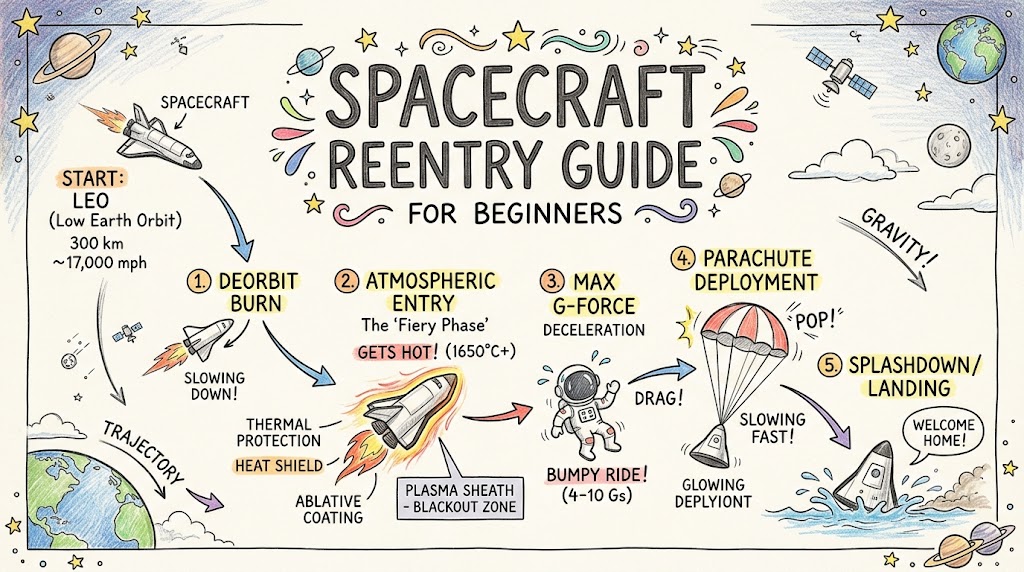
Main Stages of Spacecraft Reentry
Although procedures vary by spacecraft, a typical Earth-return mission follows these stages:
| Stage | What Happens | Main Purpose |
|---|---|---|
| Reentry preparation | Systems, weather, navigation and landing areas are checked | Confirm that the spacecraft is ready |
| Deorbit burn | Engines reduce orbital speed | Lower the spacecraft’s path into the atmosphere |
| Module separation | Unneeded sections may be released | Prepare the reentry vehicle |
| Entry interface | The spacecraft reaches the upper atmosphere | Begin atmospheric flight |
| Peak heating | Shock waves and compressed gases create extreme temperatures | Dissipate orbital energy safely |
| Peak deceleration | Atmospheric drag slows the vehicle rapidly | Reduce speed |
| Plasma phase | Ionized gas forms around the spacecraft | Protect vehicle while communications may weaken |
| Guided descent | The spacecraft adjusts its orientation and path | Reach the planned landing region |
| Parachute or aerodynamic descent | Parachutes, wings or engines reduce speed further | Prepare for touchdown |
| Landing and recovery | The vehicle reaches land or water | Recover the crew, cargo or scientific samples |
Reentry is therefore not a single moment. It is a carefully managed sequence involving propulsion, aerodynamics, thermal protection, navigation, descent and recovery.
Understanding the Deorbit Burn
A spacecraft in a stable orbit will usually remain in that orbit unless a force changes its speed or direction.
To begin returning to Earth, the spacecraft normally performs a deorbit burn. During this manoeuvre, its engines fire generally opposite to the direction of travel. This reduces the spacecraft’s forward speed.
The spacecraft does not stop moving. Instead, the slower speed changes the shape of its orbit. The lowest part of the new path is moved into Earth’s atmosphere.
Once the spacecraft begins encountering enough atmospheric resistance, drag continues the braking process.
Why the Burn Must Be Accurate
The deorbit burn must begin at the correct place and last for the planned duration.
A burn that is too weak may leave the spacecraft’s path too high. A burn that is too strong may produce a steeper entry, shift the landing point or increase stress on the spacecraft.
Mission teams calculate the burn by considering:
- Current orbital altitude
- Spacecraft mass
- Engine performance
- Planned entry angle
- Atmospheric conditions
- Landing-zone location
- Available fuel
- Emergency landing options
After the burn, many spacecraft separate from service modules or propulsion sections that are not designed to survive reentry.
Spacecraft Reentry Speed
Speed is one of the most important differences between ordinary flight and spacecraft reentry.
A passenger aircraft may travel at approximately 900 kilometres per hour. A spacecraft returning from low Earth orbit may enter the atmosphere at around 28,000 kilometres per hour.
Vehicles returning from the Moon arrive even faster. Orion, for example, was designed for atmospheric entry at speeds of about 25,000 miles per hour.
The atmosphere cannot stop the spacecraft instantly. Instead, the vehicle loses speed over a planned path through increasingly dense air.
Different missions produce different entry speeds:
- Suborbital missions: Generally slower than orbital reentry
- Low-Earth-orbit missions: Approximately 7.8 kilometres per second before major atmospheric slowing
- Lunar returns: Roughly 11 kilometres per second
- Deep-space sample returns: Speed depends on the arrival trajectory and mission design
Higher entry speed usually means greater thermal and structural demands. This is why a heat shield designed for a low-Earth-orbit spacecraft may not automatically be suitable for a lunar or interplanetary return.
The Importance of the Reentry Angle
The reentry angle describes how steeply the spacecraft approaches the atmosphere relative to the local horizon.
The correct angle depends on the spacecraft’s shape, speed, mass, thermal protection system, guidance capability and mission profile.
| Entry Condition | Likely Result | Main Risk |
|---|---|---|
| Too shallow | Long atmospheric path or temporary climb back upward | Overshooting the landing area or failing to descend as planned |
| Correct corridor | Controlled heating and deceleration | Manageable with designed safety margins |
| Too steep | Rapid descent through dense atmosphere | Excessive heat flux, high forces or structural failure |
A steep entry forces the spacecraft to lose speed over a shorter distance. This can increase both heat flow into the thermal protection system and deceleration forces. ESA notes that an overly steep entry may expose a vehicle to loads and heat flux beyond its design limits.
A shallow entry does not necessarily mean the spacecraft literally bounces from a solid atmospheric surface. Instead, its speed, lift and flight path can cause it to climb back into thinner air.
Orion uses a planned skip-entry technique for lunar returns. It first enters the upper atmosphere, uses drag to slow down, climbs into thinner air and then makes a final descent. This technique can increase landing-range flexibility and divide the deceleration into more manageable events.
How Heat Is Produced During Reentry
Reentry heating is often described simply as friction against the atmosphere. That explanation is incomplete.
At hypersonic speed, the spacecraft pushes into the air faster than pressure disturbances can move away. A strong shock wave forms ahead of the vehicle.
Air passing through the shock wave is:
- Strongly compressed
- Heated to very high temperatures
- Chemically changed as molecules break apart
- Partly ionized under the most severe conditions
The hot layer of gas around the spacecraft then transfers thermal energy toward its surface.
Surface friction and the behaviour of the boundary layer also contribute to heating, but compression and shock-wave effects are major parts of the process. NASA’s historical reentry studies describe the heating of atmospheric gas as it crosses the shock wave in front of an entry vehicle.
The spacecraft’s blunt shape is also important. A broad, rounded heat shield pushes the hottest shock layer slightly away from the vehicle’s surface, helping reduce direct heat transfer.
How Spacecraft Heat Shields Work
A heat shield is part of the spacecraft’s thermal protection system. Its job is to prevent dangerous heat from reaching the main structure, cabin and internal equipment.
There are several important approaches.
Ablative Heat Shields
An ablative material is designed to char, melt, vaporize or erode in a controlled way. As material is removed, it carries thermal energy away from the spacecraft.
Apollo and Orion use versions of an ablative material called Avcoat. NASA explains that controlled ablation transfers heat away while protecting the structure behind the shield.
Ablative shields are especially useful for:
- High-speed capsule entries
- Lunar returns
- Planetary probes
- Sample-return capsules
Their main limitation is that damaged or consumed material must normally be replaced before another flight.
Reusable Thermal Protection
Reusable spacecraft may use materials that absorb and radiate heat without being intentionally consumed.
The Space Shuttle used a combination of:
- Silica-based thermal tiles
- Flexible insulating blankets
- Reinforced carbon-carbon components on the hottest leading edges
Reusable protection can reduce replacement requirements, but individual components may be fragile and require careful inspection.
Ceramic and Composite Materials
Modern thermal protection systems may combine ceramic fibres, carbon materials, high-temperature coatings and insulating structures.
The material selected depends on:
- Peak surface temperature
- Heat duration
- Pressure
- Vehicle shape
- Reusability goals
- Weight limitations
- Manufacturing reliability
Deployable and Inflatable Heat Shields
Engineers are also developing larger heat shields that unfold or inflate before atmospheric entry.
A larger shield can create more drag at higher altitudes, allowing a spacecraft to slow down in thinner air. This may be useful for delivering heavy payloads to planets with atmospheres or returning large vehicles to Earth.
What Is Reentry Plasma?
During severe atmospheric entry, the gas around a spacecraft becomes hot enough for some atoms and molecules to lose electrons.
This electrically charged gas is called plasma.
Plasma does not form because the spacecraft itself has turned into fire. It forms mainly in the high-temperature shock layer surrounding the vehicle.
NASA research explains that air near an entry vehicle may dissociate and ionize as temperatures rise behind the shock wave.
Why Communication May Be Lost
The plasma layer can absorb, reflect or disturb radio signals at certain frequencies. This may create a temporary communications blackout.
During a blackout, mission control may temporarily lose:
- Voice communication
- Telemetry
- Tracking data
- Command capability
The spacecraft does not become uncontrolled simply because radio contact is interrupted. Guidance computers continue following stored instructions using onboard navigation sensors.
Not every reentry experiences the same blackout. Its duration and severity depend on speed, vehicle shape, plasma density, radio frequency, trajectory and communication geometry.
What Astronauts Experience During Reentry
Astronauts remain inside a pressurized cabin, protected by the spacecraft’s structure and thermal protection system. However, reentry can still be physically demanding.
They may experience:
- Increasing gravitational forces
- Strong vibration
- Structural noise
- Changes in body weight
- Limited movement because of restraints
- Temporary communication loss
- Rapid changes in vehicle orientation
The outside of the spacecraft may reach extreme temperatures while the cabin remains within survivable limits.
Astronauts usually lie in specially shaped seats that support the back and distribute forces across the body. They wear pressure suits during critical phases and are secured with strong restraints.
The amount of gravitational force depends on the trajectory and spacecraft. ESA describes Soyuz crews experiencing approximately four to five times normal body weight during a typical reentry.
Astronauts prepare through simulations, centrifuge training, emergency exercises and repeated practice of landing procedures.
Major Types of Spacecraft Reentry
| Reentry Type | Level of Control | Main Characteristic | Typical Application |
|---|---|---|---|
| Ballistic entry | Limited | Vehicle follows a drag-dominated path | Capsules and emergency modes |
| Guided entry | Moderate to high | Guidance system adjusts the path | Modern crew capsules |
| Lifting entry | High | Vehicle generates aerodynamic lift | Capsules with offset centres of mass and lifting vehicles |
| Skip entry | High | Vehicle temporarily climbs into thinner air | Long-range or lunar-return missions |
| Spaceplane entry | High | Wings or lifting body support atmospheric flight | Reusable runway-landing vehicles |
| Controlled disposal | Planned but usually uncrewed | Vehicle targets a remote region | Retired spacecraft and cargo vehicles |
| Uncontrolled reentry | Little or no active control | Final path depends on natural orbital decay | Inactive satellites and debris |
Ballistic Reentry
A ballistic vehicle depends mainly on drag rather than lift. It may be simple and stable but can create higher deceleration and a larger uncertainty in landing location.
Guided or Lifting Reentry
A guided capsule produces a small amount of lift by flying with its centre of mass slightly offset. Rolling the capsule changes the direction of that lift, allowing the guidance system to adjust range and direction.
Spaceplane Reentry
A spaceplane uses aerodynamic lift and control surfaces during atmospheric flight. The Space Shuttle entered as a spacecraft but completed its flight with an unpowered runway landing similar to a glider.
Different Spacecraft Landing Methods
Reentry reduces most of the vehicle’s speed, but landing requires additional systems.
Ocean Splashdown
Capsules such as Apollo, Orion and Crew Dragon descend under parachutes and land in the ocean.
Advantages include:
- Water absorbs some landing energy
- Heavy landing gear is unnecessary
- Large ocean recovery areas are available
Limitations include:
- Ships and helicopters may be required
- Waves and weather affect recovery
- Salt water can damage equipment
- Crew members may experience motion sickness
Ground Landing with Parachutes
A capsule can descend under parachutes and touch down on land.
This avoids ocean recovery but requires systems that absorb the final impact.
Retrorocket-Assisted Landing
Soyuz uses parachutes to reduce most of its speed and fires small soft-landing rockets shortly before ground contact. Its seats and landing structure also help absorb the remaining force.
Runway Landing
Winged spacecraft and lifting bodies can glide toward a runway.
A runway landing can simplify crew access and vehicle recovery. However, wings, landing gear and control surfaces add mass and must survive reentry heating.
Powered Vertical Landing
A vehicle may use engines to slow down and land vertically.
This provides precision and potential reusability but requires:
- Reliable engines
- Reserve fuel
- Accurate navigation
- Rapid control responses
- Backup strategies
Many orbital-class rocket boosters now use powered landing, although returning crew spacecraft more commonly use parachutes or runway systems.
Spacecraft Reentry Safety Systems
A safe reentry depends on multiple protective layers rather than one perfect component.
Important systems include:
- Redundant guidance computers
- Inertial navigation sensors
- Global navigation updates when available
- Attitude-control thrusters
- Thermal sensors
- Cabin pressure monitoring
- Backup electrical power
- Emergency oxygen
- Drogue and main parachutes
- Parachute redundancy
- Landing beacons
- Flotation equipment
- Recovery communications
- Alternative landing zones
Mission planners also establish rules for weather, ocean conditions, winds, system health and recovery-team availability.
A mission may delay departure from orbit when conditions are unacceptable. Once the deorbit burn is completed, however, the spacecraft is generally committed to atmospheric entry, making preparation essential.
Famous Spacecraft Reentry Examples
Apollo Command Module
Apollo capsules returned from the Moon at higher speeds than low-Earth-orbit vehicles. Their ablative heat shields protected the crew before parachutes carried the command modules to Pacific Ocean splashdowns.
Space Shuttle
The Space Shuttle used reusable thermal protection, generated lift during atmospheric entry and landed on a runway. It demonstrated that a large winged spacecraft could return from orbit and be used again.
Soyuz
Soyuz uses a compact descent module, an ablative heat shield, parachutes and soft-landing rockets. Its normal recovery takes place on land.
Crew Dragon
Crew Dragon uses an ablative heat shield, guided capsule entry, drogue parachutes and main parachutes before ocean splashdown.
Orion
Orion is designed for high-speed returns from lunar missions. It uses an ablative heat shield, guided skip entry and parachute-assisted ocean landing. NASA extensively tests its thermal protection and parachute systems because they perform different parts of the slowing process.
Sample-Return Capsules
Small capsules have returned material from comets and asteroids. Their heat shields protect scientifically valuable samples from atmospheric-entry conditions. NASA Ames has contributed thermal-protection expertise to missions including Stardust and OSIRIS-REx.
Controlled and Uncontrolled Reentry
A controlled reentry occurs when operators use propulsion and navigation to direct a spacecraft toward a planned area.
For an uncrewed vehicle that is intended to be destroyed, planners normally target a remote ocean region with very little air or sea traffic.
An uncontrolled reentry occurs when operators can no longer determine the exact time and location of atmospheric entry. This commonly happens when inactive satellites or rocket stages gradually lose altitude.
Tracking organisations monitor these objects and update the predicted reentry window as more observations become available. ESA explains that the possible time and impact region for an uncontrolled reentry can be estimated and continuously refined, although uncertainty remains until late in the descent.
Most small objects are destroyed by atmospheric heating. Larger or stronger components may sometimes survive and reach the surface.
Common Spacecraft Reentry Problems
Incorrect Trajectory
Navigation or propulsion errors may place the vehicle outside its safe reentry corridor.
Heat-Shield Damage
Cracks, gaps, missing material or manufacturing defects can allow excessive heat to reach the structure.
Loss of Attitude Control
The heat shield must remain pointed in the correct direction. A tumbling vehicle may expose unprotected surfaces to extreme heating.
Parachute Failure
Parachutes must deploy in a specific sequence and at suitable speeds. Redundancy, testing and backup modes reduce this risk.
Communication Failure
A planned plasma blackout is different from an unexpected equipment failure. Onboard guidance must continue safely even without contact with mission control.
Landing-Site Weather
High winds, thunderstorms, rough seas or poor visibility can complicate descent and recovery.
Delayed Recovery
After landing, crews may face heat, cold, waves, smoke, medical problems or cabin conditions that require a rapid response.
Engineers reduce these risks through redundancy, simulation, component testing, full-scale drop tests and carefully defined mission rules.
Common Reentry Myths and Facts
Myth: Reentry heat is produced only by friction
Fact: Shock-wave compression and the behaviour of extremely hot gases are major sources of heating.
Myth: A spacecraft falls vertically from orbit
Fact: It begins with enormous sideways speed and follows a curved path through the atmosphere.
Myth: Every spacecraft loses communication
Fact: Blackout conditions depend on the trajectory, plasma environment, communication frequency and vehicle design.
Myth: Spacecraft always use parachutes
Fact: Some use parachutes, while others use wings, retrorockets, powered engines or combinations of systems.
Myth: Reentry and landing are the same event
Fact: Reentry removes most orbital energy. Descent and landing systems then reduce the remaining speed and manage touchdown.
Myth: A shallow spacecraft literally bounces from the atmosphere
Fact: Lift and trajectory can cause it to climb into thinner air. There is no solid atmospheric surface.
How Engineers Prepare for Reentry
Reentry systems are tested long before a spacecraft flies.
Computer Simulations
Engineers model:
- Atmospheric density
- Aerodynamic forces
- Heating rates
- Material response
- Guidance performance
- Parachute deployment
- Landing conditions
Thousands of possible situations can be studied, including equipment failures and unusual weather.
Wind-Tunnel Testing
Models are exposed to controlled airflow to measure forces, pressure and stability.
Arc-Jet Testing
Arc-jet facilities create extremely hot, high-speed gas flows that reproduce important parts of atmospheric-entry heating. NASA’s Ames Research Center uses its Arc Jet Complex to evaluate heat-shield materials and entry systems.
Drop Testing
Full-size or scaled vehicles may be dropped from aircraft or balloons to test:
- Parachute deployment
- Stability
- Landing loads
- Flotation
- Separation systems
- Recovery procedures
Integrated Mission Simulations
Astronauts, flight controllers and recovery teams practise nominal and emergency situations together. These simulations test both the hardware and the people operating it.
Future Spacecraft Reentry Technology
Future systems are expected to focus on safer operations, improved reusability and greater landing accuracy.
Important areas of development include:
- More durable reusable heat shields
- Advanced ablative materials
- Deployable thermal-protection systems
- Inflatable heat shields
- Autonomous guidance
- More accurate landing systems
- Improved plasma communication methods
- Reusable lifting bodies
- Thermal protection for Mars and asteroid sample returns
- Systems for returning larger cargo loads from orbit
A larger deployable heat shield could allow a heavy spacecraft to begin slowing in thinner air. Better autonomous guidance could also help vehicles respond to changing atmospheric conditions without depending on constant ground commands.
These technologies must still pass extensive material, structural, flight and safety testing before regular operational use.
Beginner-Friendly Reentry Summary
The spacecraft reentry process can be understood in ten basic steps:
- Mission control checks the spacecraft and landing conditions.
- The spacecraft turns to the required orientation.
- Engines perform a deorbit burn.
- The new trajectory carries the spacecraft into the atmosphere.
- The heat shield faces the direction of travel.
- Atmospheric drag begins reducing speed.
- Shock waves create extreme heating around the vehicle.
- Guidance systems control the path toward the landing area.
- Parachutes, wings or engines reduce the remaining speed.
- Recovery teams locate and secure the spacecraft.
Each stage must work with the others. A strong heat shield alone cannot compensate for an unsafe trajectory, and an accurate trajectory cannot compensate for a failed landing system.
Frequently Asked Questions
What does spacecraft reentry mean?
Spacecraft reentry is the process of moving from space into a planet’s atmosphere. For an Earth-orbiting spacecraft, it normally begins after a deorbit burn lowers the vehicle’s path. Atmospheric drag then removes most of its orbital speed before parachutes, wings or engines complete the landing.
Why does a spacecraft become hot during reentry?
A spacecraft compresses the air ahead of it while travelling at hypersonic speed. A shock wave forms, and the compressed gas becomes extremely hot. Thermal energy from this shock layer and the surrounding flow transfers toward the vehicle, requiring a heat shield or other thermal protection.
How fast does a spacecraft travel during reentry?
A spacecraft returning from low Earth orbit may begin atmospheric entry at around 28,000 kilometres per hour. A vehicle returning from the Moon can arrive at roughly 40,000 kilometres per hour. Exact speed depends on the orbit, destination, vehicle and flight path.
Can a spacecraft burn up during reentry?
Yes. A spacecraft without suitable thermal protection may break apart, melt or burn up. Many satellites are intentionally allowed to disintegrate during reentry. Crew vehicles and sample-return capsules use carefully designed heat shields to survive.
Why is the reentry angle important?
The angle determines how quickly the spacecraft enters thicker air. A steep entry may create dangerous heating and deceleration. A shallow entry may carry the vehicle beyond its target or cause it to climb into thinner air before descending again.
What is a spacecraft heat shield made from?
Heat shields may use ablative resins, carbon-based materials, ceramic fibres, silica tiles, reinforced carbon composites and insulating blankets. Material selection depends on temperature, pressure, flight duration, spacecraft shape and whether the vehicle must be reused.
Why is communication sometimes lost during reentry?
Hot gas around the spacecraft can become ionized and form plasma. This plasma may interfere with radio waves, producing a temporary communications blackout. During this period, onboard computers continue controlling the spacecraft using stored instructions and navigation sensors.
How do astronauts survive reentry forces?
Astronauts use specially shaped seats, pressure suits and strong restraints. The trajectory is designed to keep gravitational forces within acceptable limits. Heat shields, cabin insulation, environmental controls and carefully tested guidance systems protect the crew throughout descent.
Can a spacecraft skip out of Earth’s atmosphere?
A sufficiently shallow vehicle with suitable lift may climb back into thinner air after its first atmospheric pass. This is called skip entry. It is normally a controlled trajectory rather than an uncontrolled bounce from a physical atmospheric surface.
What is the difference between reentry and landing?
Reentry is the high-speed atmospheric phase in which the spacecraft loses most of its orbital energy. Landing is the final phase when parachutes, wings, retrorockets or engines reduce the remaining speed and bring the vehicle safely to land or water.
Do all spacecraft use parachutes?
No. Capsules often use parachutes, but spaceplanes may glide to runways. Some vehicles use retrorockets or powered vertical landing. Other systems combine parachutes with airbags, shock absorbers or small landing rockets.
What happens to spacecraft during uncontrolled reentry?
The spacecraft encounters increasing atmospheric drag, heating and structural pressure. Most of it may disintegrate and burn up, although strong components can sometimes survive. Tracking organisations monitor larger objects and update their predicted reentry areas.
Conclusion
Spacecraft reentry is a carefully controlled process that combines orbital mechanics, atmospheric science, thermal protection, navigation and landing technology. A spacecraft must enter through the correct corridor, survive extreme heating, remain stable and reduce its speed before reaching land or water. By understanding these stages, beginners can better appreciate the engineering required to bring astronauts, cargo and scientific samples safely home. Astropilot.co can help readers continue exploring spacecraft systems, aviation, astronautics and modern aerospace technology.