Introduction
Space exploration is exciting, but it is also one of the most difficult and risky activities humans perform. A space mission includes rockets, spacecraft, astronauts, engineers, Mission Control, communication systems, life-support systems, and many safety procedures.
Before any rocket launches, every small detail must be checked carefully. A loose connection, weak communication signal, weather problem, oxygen issue, or computer error can create serious danger. This is why safety checklists are so important in space missions.
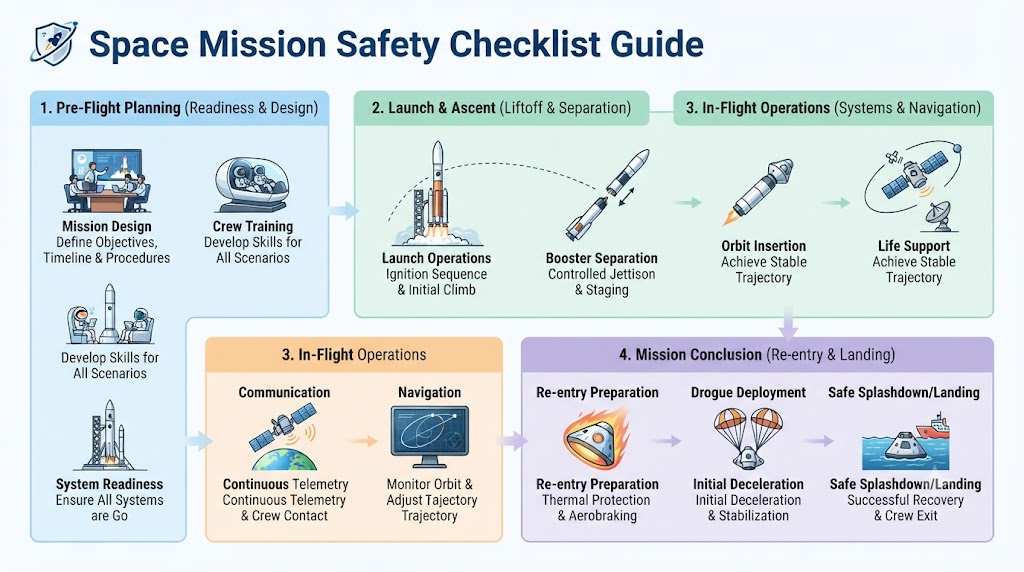
A Space Mission Safety Checklist Guide helps beginners understand how astronauts and ground teams prepare for safe spaceflight. These checklists are used before launch, during flight, while working in space, and during the return to Earth.
What Is a Space Mission Safety Checklist?
A space mission safety checklist is a structured list of safety steps used by astronauts, engineers, and Mission Control. It helps confirm that every important system, procedure, and emergency plan is ready before the mission continues.
These checklists may include spacecraft systems, astronaut health, communication, weather, fuel, oxygen, power, navigation, launch equipment, emergency tools, and landing preparation.
The main goal of a checklist is simple: make sure nothing important is missed.
In space missions, teams cannot depend only on memory. There are too many systems and too many risks. A checklist gives everyone a clear process to follow.
Why Safety Checklists Are Important in Space Missions
Space is not a normal working environment. Astronauts live and work far above Earth, where there is no natural air, no normal gravity, and no easy emergency exit.
Safety checklists help reduce risk by making sure each step is checked in the correct order.
They are important because they help:
- Protect astronaut lives
- Reduce human mistakes
- Improve teamwork
- Confirm spacecraft readiness
- Support emergency response
- Keep Mission Control informed
- Maintain clear communication
- Make complex missions easier to manage
A checklist also helps during stressful moments. When something goes wrong, astronauts and Mission Control can follow planned steps instead of guessing.
Pre-Launch Safety Checklist
The pre-launch stage is one of the most important parts of mission safety. Before astronauts enter space, many teams check the rocket, spacecraft, weather, crew condition, and mission systems.
A pre-launch safety checklist may include:
- Rocket system inspection
- Spacecraft readiness check
- Fuel and pressure checks
- Weather review
- Communication testing
- Crew health check
- Escape system readiness
- Mission Control readiness
- Emergency plan review
Each of these checks has a purpose. For example, weather checks help decide whether launch conditions are safe. Communication checks confirm that astronauts can speak with Mission Control. Fuel and pressure checks confirm that the rocket is ready for launch.
If any major issue is found, the launch can be delayed. This is not a failure. It is a safety decision.
Astronaut Safety Checklist
Astronaut safety is the center of every space mission. Astronauts must be physically ready, properly equipped, and fully trained before launch.
An astronaut safety checklist may include:
- Spacesuit condition
- Oxygen supply
- Medical fitness
- Food and water supplies
- Emergency training
- Communication equipment
- Seat and harness checks
- Personal safety tools
Spacesuits must be checked carefully because they protect astronauts in dangerous conditions. Oxygen systems must work properly because astronauts depend on them to breathe. Seat and harness checks are important because astronauts face strong forces during launch and re-entry.
Astronauts also receive emergency training before the mission. This helps them respond calmly if something unexpected happens.
Spacecraft System Safety Checklist
A spacecraft is a complex machine with many systems working together. If one important system fails, it can affect the whole mission.
A spacecraft system safety checklist usually includes:
- Life-support system
- Power system
- Navigation system
- Communication system
- Computer systems
- Temperature control
- Fuel system
- Docking system
- Backup systems
The life-support system is one of the most important systems because it provides air, pressure, temperature control, and other survival needs. The power system keeps equipment working. The navigation system helps the spacecraft stay on the correct path.
Backup systems are also checked because space missions need alternatives if the main system stops working.
Launch Day Safety Checklist
Launch day is exciting, but it is also very serious. The final checklist is followed during the countdown before liftoff.
Launch day safety checks may include:
- Final weather confirmation
- Rocket engine status
- Fuel loading status
- Communication with astronauts
- Ground support readiness
- Mission Control confirmation
- Escape system check
- Final go/no-go decision
The go/no-go decision is a key part of launch safety. Different teams report whether their systems are ready. If all important teams say “go,” the launch can continue. If any major system is not ready, the launch may be stopped or delayed.
This careful process helps protect astronauts and the mission.
In-Orbit Safety Checklist
After the spacecraft reaches orbit, safety checks continue. Reaching space does not mean the mission is automatically safe. Astronauts and Mission Control must confirm that the spacecraft is working properly.
An in-orbit safety checklist may include:
- Spacecraft condition
- Orbit stability
- Oxygen levels
- Cabin pressure
- Power supply
- Communication links
- Crew health
- Computer system status
- Temperature control
Mission Control watches data from Earth and helps astronauts confirm each system. If any reading looks unusual, the team studies it and gives instructions.
These checks help make sure astronauts can safely live and work in space.
Spacewalk Safety Checklist
A spacewalk is one of the most challenging activities astronauts perform. During a spacewalk, astronauts leave the spacecraft and work outside in space. This requires very careful preparation.
A spacewalk safety checklist may include:
- Spacesuit pressure check
- Oxygen level check
- Helmet and visor check
- Communication test
- Tool check
- Safety tether check
- Time limit review
- Emergency return plan
- Mission Control confirmation
The safety tether is important because it helps keep the astronaut connected to the spacecraft or space station. Communication is also critical because astronauts must stay in contact with Mission Control and other crew members.
Before a spacewalk begins, every step must be confirmed. Even a small mistake can become dangerous outside the spacecraft.
Emergency Safety Checklist
Space missions prepare for emergencies long before they happen. Emergency checklists help astronauts and Mission Control respond quickly and correctly.
Emergency situations may include:
- Fire inside the spacecraft
- Oxygen problem
- Power failure
- Communication loss
- Medical emergency
- Equipment failure
- Navigation issue
- Emergency return to Earth
For example, if there is a power failure, astronauts may need to switch to backup power and reduce energy use. If communication is lost, the crew may follow pre-planned steps until contact is restored.
Emergency checklists help teams avoid panic. They give clear instructions during difficult moments.
Landing and Re-Entry Safety Checklist
Returning to Earth is another critical stage of a space mission. The spacecraft must enter Earth’s atmosphere at the correct angle and speed. It must also protect astronauts from extreme heat during re-entry.
A landing and re-entry safety checklist may include:
- Re-entry path confirmation
- Heat shield condition
- Landing system readiness
- Weather at landing site
- Crew seating position
- Seat and harness checks
- Communication check
- Recovery team preparation
- Emergency landing plan
The heat shield is very important because it protects the spacecraft from high temperatures during re-entry. Landing systems must also be ready so the spacecraft can return safely.
Recovery teams wait on Earth to help astronauts after landing. They assist with opening the spacecraft, checking crew health, and transporting astronauts safely.
Role of Mission Control in Safety Checklists
Mission Control plays a major role in space mission safety. It monitors spacecraft data, checks system status, confirms checklist completion, and guides astronauts during every stage of the mission.
Mission Control helps with:
- Launch safety decisions
- Spacecraft system monitoring
- Astronaut health checks
- Emergency guidance
- Communication support
- Spacewalk monitoring
- Re-entry and landing support
Astronauts perform many tasks inside the spacecraft, but Mission Control supports them from Earth. This teamwork makes the mission safer and more organized.
Mission Control also helps decide whether a mission step should continue, pause, or change based on safety conditions.
Common Safety Mistakes Space Teams Try to Avoid
Space teams use strict checklists because they want to avoid mistakes. Even small mistakes can become serious in space.
Common safety mistakes include:
- Skipping checklist steps
- Poor communication
- Ignoring warning signs
- Rushing safety checks
- Failing to test backup systems
- Not reviewing emergency plans
- Assuming a system is working without confirmation
- Not sharing important updates clearly
Good space mission safety depends on patience, discipline, and teamwork. Every team member must take the checklist seriously.
Simple Example of a Space Mission Safety Checklist
Here is a beginner-friendly sample checklist:
| Safety Area | What Is Checked | Why It Matters |
|---|---|---|
| Oxygen System | Oxygen level and air quality | Astronauts need safe air to breathe. |
| Power System | Battery and solar power status | Spacecraft systems need electricity. |
| Communication | Voice and data links | Astronauts must stay connected with Mission Control. |
| Temperature Control | Cabin temperature and cooling | Astronauts and equipment need safe temperatures. |
| Spacesuit | Pressure, oxygen, and helmet | Protects astronauts during spacewalks. |
| Weather | Launch and landing conditions | Bad weather can delay launch or landing. |
| Navigation | Spacecraft path and direction | Keeps the mission on the correct route. |
| Emergency Plan | Backup steps and crew actions | Helps teams respond quickly during problems. |
This simple checklist shows how different safety areas work together. Space mission safety is not based on one system only. It depends on many systems working correctly at the same time.
Real-Life Importance of Safety Checklists
Space agencies use strict safety procedures because space missions leave very little room for error. Rockets are powerful machines, spacecraft are complex, and astronauts work in an environment that does not naturally support human life.
Safety checklists help teams stay organized. They also help astronauts and engineers follow proven steps instead of making rushed decisions.
During difficult situations, checklists can guide the team calmly. This is why astronauts train repeatedly with checklists before they ever go into space.
A checklist may look simple, but in spaceflight, it can protect lives.
Future of Space Mission Safety
Future space missions will travel farther and last longer. Missions to the Moon, Mars, and deep space will need even stronger safety planning.
Future safety checklists may include:
- Long-duration life-support checks
- Radiation protection checks
- Deep-space communication checks
- Mars landing safety steps
- Surface habitat safety checks
- Robotic system checks
- Emergency return planning
- Crew health monitoring for long missions
As missions become more complex, safety checklists will become even more important. Astronauts may be farther from Earth, so they will need clear procedures and strong support from Mission Control.
Why Students Should Learn About Space Mission Safety
Students and beginners often focus on rockets, astronauts, and planets. But safety is one of the most important parts of space exploration.
Learning about space mission safety helps students understand that space travel is not only about adventure. It is also about planning, discipline, science, engineering, and teamwork.
A good mission is not just a mission that reaches space. A good mission is one that keeps the crew safe and completes its goals responsibly.
Conclusion
A Space Mission Safety Checklist Guide helps explain how astronauts, engineers, and Mission Control prepare for safe space missions. These checklists are used before launch, during orbit, during spacewalks, in emergencies, and during the return to Earth.
Safety checklists help reduce mistakes, protect astronauts, support teamwork, and keep spacecraft systems under control. They make complex missions easier to manage and help teams respond calmly when problems appear.
Space exploration is exciting, but safety planning is what makes it possible. For students and beginners, astropilot.co helps explain these important space topics in simple language so everyone can understand how real space missions are planned and protected.