Introduction
The space industry is no longer limited to astronauts and rocket scientists. Today, it has become a growing career field that connects aviation, aerospace, engineering, technology, research, safety, training, and commercial travel. For students who are interested in flying, aircraft, spacecraft, and future exploration, the space industry offers exciting career opportunities beyond traditional airline jobs.
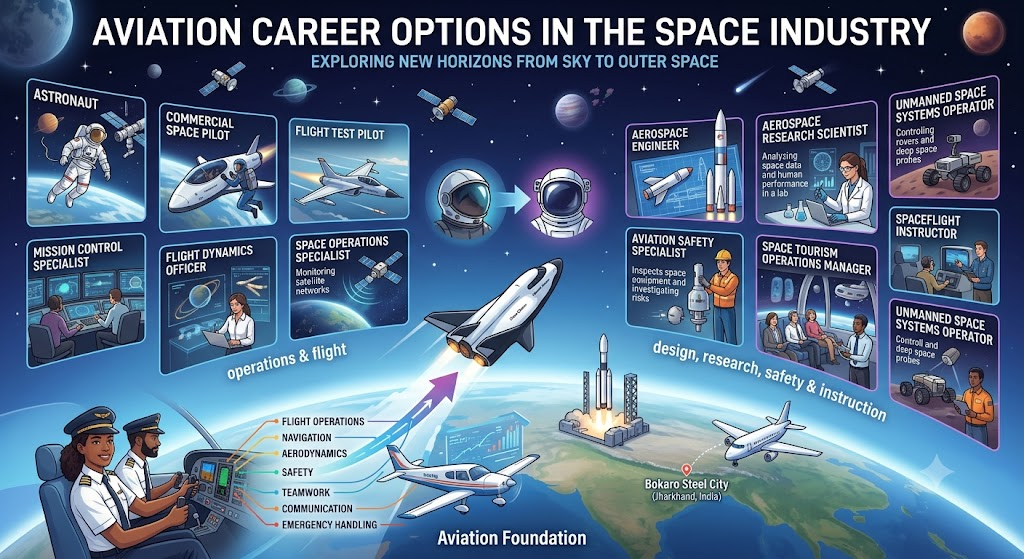
Aviation career options in the space industry are becoming more important because modern space missions need people who understand flight operations, navigation, aerodynamics, safety, communication, crew coordination, and emergency handling. These are the same skills that pilots and aviation professionals develop during their training.
For students, this means aviation can become a strong foundation for future space careers. Whether someone dreams of becoming an astronaut, commercial space pilot, mission control specialist, aerospace engineer, flight instructor, or space tourism professional, aviation knowledge can open many doors.
The future of aviation is not only in the sky. It is also moving toward space.
What Is the Space Industry?
The space industry includes all organizations, technologies, and professionals involved in space exploration, satellite operations, rocket launches, spacecraft design, space tourism, scientific research, and human spaceflight.
It includes government space agencies, private space companies, research institutions, satellite service providers, launch companies, aerospace manufacturers, and commercial spaceflight operators.
Many people think space careers are only for astronauts, but the industry needs many types of professionals, including pilots, engineers, technicians, instructors, safety experts, mission planners, operations managers, medical experts, software specialists, and communication officers.
As the space sector grows, aviation students and professionals can find new career paths that combine flying skills with advanced space technology.
How Aviation and Space Are Connected
Aviation and space are closely related because both involve controlled flight, advanced machines, human performance, navigation, safety systems, and mission planning.
Aircraft fly within Earth’s atmosphere, while spacecraft operate beyond it. However, many basic principles are connected. Pilots learn about aerodynamics, weather, navigation, communication, aircraft systems, emergency procedures, and decision-making. These skills are also useful in spaceflight operations.
Space missions require strong discipline, teamwork, technical knowledge, and the ability to stay calm under pressure. These qualities are already part of aviation training.
This is why aviation students often have an advantage when exploring space industry jobs.
Why Aviation Students Have an Advantage
Aviation students develop practical and technical skills that are valuable in the space industry.
They understand how flying machines work, how to manage risk, how to follow strict procedures, and how to communicate clearly during operations. They also learn the importance of safety, discipline, and teamwork.
Some useful aviation skills for space careers include:
- Flight planning
- Navigation
- Aerodynamics
- Aircraft systems knowledge
- Weather understanding
- Emergency handling
- Crew resource management
- Radio communication
- Decision-making
- Situational awareness
- Safety procedures
These skills help aviation students transition into roles related to spaceflight operations, astronaut training, mission planning, aerospace safety, and commercial space travel.
Top Aviation Career Options in the Space Industry
1- Astronaut
An astronaut is one of the most well-known space careers. Astronauts travel to space, perform scientific experiments, operate spacecraft systems, conduct spacewalks, and support mission objectives.
Pilots often have a strong background for astronaut selection because they are trained to handle complex machines, stressful situations, and emergency procedures. Military pilots, test pilots, engineers, scientists, and medical professionals may all pursue astronaut careers.
To become an astronaut, a person usually needs strong education in science, engineering, mathematics, aviation, medicine, or related fields. Physical fitness, mental strength, teamwork, and technical excellence are also important.
2- Commercial Space Pilot
Commercial space pilots may operate spaceplanes, reusable spacecraft, or suborbital vehicles designed for space tourism and private missions.
This career is still developing, but it may become more important as commercial space travel grows. A commercial space pilot needs advanced flight experience, strong technical knowledge, simulator training, and excellent decision-making ability.
Aviation students who dream of flying beyond traditional aircraft may find this career very exciting.
3- Flight Test Pilot
Flight test pilots test new aircraft, experimental vehicles, advanced aerospace systems, and sometimes spacecraft-related technologies.
This is a highly skilled aviation career. Test pilots must understand aircraft performance, engineering principles, flight behavior, and safety limits.
In the space industry, flight test pilots may work on high-speed aircraft, launch vehicles, spaceplanes, and reusable aerospace systems. This career is suitable for people who love aviation, engineering, and innovation.
4- Aerospace Engineer
Aerospace engineers design, develop, test, and improve aircraft, rockets, satellites, spacecraft, and propulsion systems.
This is one of the most important careers in the space industry. Aerospace engineers work on structures, engines, flight control systems, navigation systems, safety systems, and mission technologies.
Students interested in aviation and space can choose aerospace engineering as a strong academic path. It is ideal for those who enjoy mathematics, physics, design, and problem-solving.
5- Mission Control Specialist
Mission control specialists support space missions from the ground. They monitor spacecraft systems, communicate with crews, analyze mission data, and help solve real-time problems.
This role requires focus, teamwork, technical knowledge, and calm decision-making. Aviation students may find this career interesting because mission control work is similar to air traffic control and flight operations management.
Mission control specialists are essential for safe and successful space missions.
6- Flight Dynamics Officer
A flight dynamics officer works with spacecraft trajectories, orbital paths, navigation, and mission movement.
This role requires strong knowledge of physics, mathematics, space navigation, and computer systems. It is suitable for students who enjoy technical calculations and mission planning.
Flight dynamics specialists help ensure that spacecraft move accurately and safely during missions.
7- Space Operations Specialist
Space operations specialists manage and support day-to-day space mission activities. They may work with satellites, ground stations, launch operations, spacecraft monitoring, or mission planning.
This career is a good option for aviation students because it involves operational discipline, safety procedures, communication, and technical coordination.
Space operations professionals are needed in both government and private space organizations.
8- Aviation Safety Specialist
Safety is extremely important in both aviation and space. Aviation safety specialists study risks, investigate incidents, improve procedures, and help organizations follow safety standards.
In the space industry, safety specialists may work on launch safety, crew safety, spacecraft testing, passenger safety, and mission risk management.
Students with aviation safety knowledge can build strong careers in this field.
9- Space Tourism Operations Manager
Space tourism is creating new career opportunities for aviation and hospitality professionals. A space tourism operations manager may handle passenger training, safety briefings, scheduling, customer experience, and mission coordination.
This role combines aviation operations, customer service, safety management, and spaceflight preparation.
As commercial space travel grows, this career may become a popular option for aviation graduates.
10- Spaceflight Instructor
Spaceflight instructors train astronauts, commercial space passengers, mission crews, and spaceflight support teams.
They may use simulators, classroom sessions, emergency drills, and physical training programs. Aviation instructors already understand training methods, cockpit discipline, flight procedures, and human performance, making this a suitable career path.
This role is ideal for people who enjoy teaching and space operations.
11- Aerospace Research Scientist
Aerospace research scientists study advanced technologies related to aircraft, spacecraft, propulsion, human performance, robotics, artificial intelligence, and space environments.
They help develop future systems that may support lunar missions, Mars exploration, reusable spacecraft, and advanced aviation.
This career is best for students who enjoy research, innovation, science, and technology.
12- Unmanned Space Systems Operator
Many space missions use robotic spacecraft, satellites, probes, rovers, and autonomous systems. Unmanned space systems operators monitor and control these vehicles from Earth.
This role requires knowledge of remote operations, communication systems, robotics, software, and mission planning.
Aviation students familiar with drones, flight systems, and remote operations may find this career path attractive.
Skills Needed for Space Aviation Careers
Space aviation careers require a mix of technical, physical, and personal skills.
Important skills include:
- Mathematics
- Physics
- Computer knowledge
- Aviation fundamentals
- Aerodynamics
- Navigation
- Communication
- Problem-solving
- Leadership
- Physical fitness
- Teamwork
- Risk management
- Critical thinking
- Robotics awareness
- Artificial intelligence awareness
- Simulator training
- Emergency response
Students should focus on building both academic knowledge and practical skills. The space industry values people who can learn quickly, adapt to new technology, and work responsibly in high-pressure environments.
Educational Path for Space Aviation Careers
Students who want to enter the space industry through aviation should start early with science, mathematics, and technology subjects.
A strong educational path may include:
1- Study physics and mathematics seriously
2- Build basic aviation knowledge
3- Choose aviation, aerospace engineering, mechanical engineering, electronics, computer science, or related fields
4- Gain flight training if interested in pilot-based roles
5- Learn programming, robotics, and data systems
6- Join internships or research projects
7- Build simulator experience
8- Apply for aviation or aerospace organizations
9- Keep upgrading skills through certifications and training
There is no single path for everyone. Some students may become pilots first, while others may become engineers, researchers, instructors, or mission specialists.
Certifications That Can Help
Some certifications and licenses can support aviation careers in the space industry.
Helpful options may include:
- Private Pilot License
- Commercial Pilot License
- Instrument Rating
- Multi-Engine Rating
- Flight Instructor Rating
- Aviation Safety Certification
- Aerospace Engineering Programs
- Project Management Certification
- Drone Operation Certification
- Simulator Training Certification
- Human Factors Training
The right certification depends on the chosen career path.
Future of Aviation Careers in Space
The future of space aviation looks promising. Commercial space travel, reusable rockets, private space stations, satellite networks, lunar missions, Mars research, and advanced spacecraft are creating new job opportunities.
Aviation professionals may play an important role in:
- Space tourism
- Suborbital flights
- Spaceflight training
- Mission control
- Safety management
- Space vehicle testing
- Aerospace operations
- Satellite operations
- Human spaceflight support
As technology improves, the boundary between aviation and space may become smaller. Future pilots may not only fly aircraft but also help operate spaceplanes, reusable vehicles, and advanced aerospace systems.
Challenges in Space Aviation Careers
Space careers are exciting, but they are also challenging.
Students should be prepared for:
- Strong competition
- High training standards
- Continuous learning
- Technical complexity
- Physical fitness requirements
- Expensive training in some fields
- Strict safety rules
- Long preparation time
- Fast-changing technology
Success in this field requires patience, discipline, and a strong commitment to learning.
Salary Expectations
Salary in space aviation careers depends on country, company, role, experience, education, and responsibility level.
| Career Role | Approximate Salary Level |
|---|---|
| Astronaut | High, varies by agency and experience |
| Commercial Space Pilot | High, depends on company and mission type |
| Flight Test Pilot | High, based on experience and risk level |
| Aerospace Engineer | Medium to high |
| Mission Control Specialist | Medium to high |
| Flight Dynamics Officer | Medium to high |
| Space Operations Specialist | Medium |
| Aviation Safety Specialist | Medium to high |
| Space Tourism Operations Manager | Medium to high |
| Spaceflight Instructor | Medium to high |
| Aerospace Research Scientist | Medium to high |
| Unmanned Space Systems Operator | Medium |
Students should remember that passion, skills, and long-term growth matter more than starting salary.
Career Roadmap
A simple roadmap for students:
Student
↓
Focus on science and mathematics
↓
Learn aviation basics
↓
Choose pilot training or aerospace education
↓
Develop technical and computer skills
↓
Gain internships and project experience
↓
Build certifications
↓
Apply for aviation or aerospace roles
↓
Specialize in space operations
↓
Grow into leadership or mission roles
Starting early gives students a strong advantage.
Common Mistakes to Avoid
Many students make mistakes when planning space careers.
Avoid these common errors:
- Thinking only astronauts work in space
- Ignoring mathematics and physics
- Choosing aviation without understanding career options
- Not developing computer skills
- Avoiding internships and practical projects
- Focusing only on salary
- Not improving communication skills
- Ignoring physical fitness
- Not learning about aerospace technology
- Waiting too long to start preparation
A smart career plan should include education, skills, experience, and continuous improvement.
FAQs
1- Can pilots become astronauts?
Yes, pilots can become astronauts if they meet the required education, experience, medical, and training standards. Many astronauts have backgrounds in aviation, military flying, engineering, or test piloting. However, becoming an astronaut is highly competitive. A pilot should also build strong academic knowledge, technical skills, physical fitness, and teamwork ability.
2- Is aerospace engineering better than pilot training for space careers?
Both paths are valuable. Aerospace engineering is better for design, research, testing, and spacecraft development roles. Pilot training is useful for flight operations, test flying, crew training, and human spaceflight careers. The best choice depends on the student’s interest, strengths, and long-term career goal.
3- Can aviation students work in satellite operations?
Yes, aviation students can work in satellite operations if they develop additional knowledge in communication systems, orbital mechanics, remote operations, and mission control. Satellite operations require discipline, monitoring skills, technical understanding, and problem-solving ability, which are also important in aviation.
4- What is a commercial space pilot?
A commercial space pilot is a professional trained to operate space tourism vehicles, spaceplanes, or reusable spacecraft. This career is still developing, but it may become more important as private spaceflight expands. It requires advanced flying experience, simulator training, technical knowledge, and excellent safety awareness.
5- What degree is best for space aviation careers?
Useful degrees include aerospace engineering, mechanical engineering, aviation management, computer science, electronics, physics, robotics, and space science. For pilot-based roles, flight training and aviation qualifications are also important. The best degree depends on whether the student wants to fly, design, operate, research, or manage space systems.
6- Do space careers require flying experience?
Not all space careers require flying experience. Astronauts, test pilots, and commercial space pilots may need aviation experience, but engineers, mission specialists, researchers, safety experts, and operations professionals may not. However, aviation knowledge can still be helpful in many space-related roles.
7- Is space tourism a good career field?
Space tourism can become a strong career field as commercial space travel grows. It may create jobs in passenger training, safety management, operations, customer experience, flight support, and spaceflight instruction. Students interested in aviation, hospitality, and space operations may find this field exciting.
8- What skills should students learn for space careers?
Students should learn mathematics, physics, computer basics, communication, teamwork, leadership, problem-solving, and aviation fundamentals. Skills in robotics, artificial intelligence, data systems, and simulation can also be helpful. Space careers require both technical knowledge and strong personal discipline.
9- Are space industry jobs difficult to get?
Yes, many space industry jobs are competitive because they require strong education, technical skills, and practical experience. However, students who prepare early, build projects, complete internships, gain certifications, and keep learning can improve their chances. The industry needs many types of professionals, not only astronauts.
10- How can students start preparing today?
Students can start by studying science and mathematics seriously, reading about aviation and space, joining STEM projects, learning basic coding, exploring flight training options, and developing communication skills. They should also follow aerospace developments and understand different career paths before choosing a specialization.
Conclusion
Aviation career options in the space industry are expanding as the world moves toward commercial spaceflight, space tourism, satellite growth, and advanced exploration missions. For students who love flying, technology, and discovery, aviation can become a powerful gateway to space careers.
The space industry needs pilots, engineers, instructors, safety experts, mission specialists, researchers, and operations professionals. Students who build strong aviation knowledge, technical skills, discipline, and curiosity can prepare themselves for exciting future opportunities.
The journey may be challenging, but for passionate learners, the sky is no longer the limit. Space is the next step.