Introduction
Robotic space missions allow scientists to explore places that are too distant, dangerous, expensive, or difficult for humans to reach.
These missions use satellites, probes, orbiters, landers, rovers, and other automated spacecraft. They can observe planets, study moons, collect images, measure radiation, analyse soil, monitor weather, and investigate the origin of the solar system.
Unlike human spaceflight, robotic missions do not need oxygen, food, water, sleep, or protection for a living crew. This allows them to travel farther and operate for longer periods.
However, robotic spacecraft still require careful planning, reliable technology, precise navigation, strong communication systems, and enough power to complete their tasks.
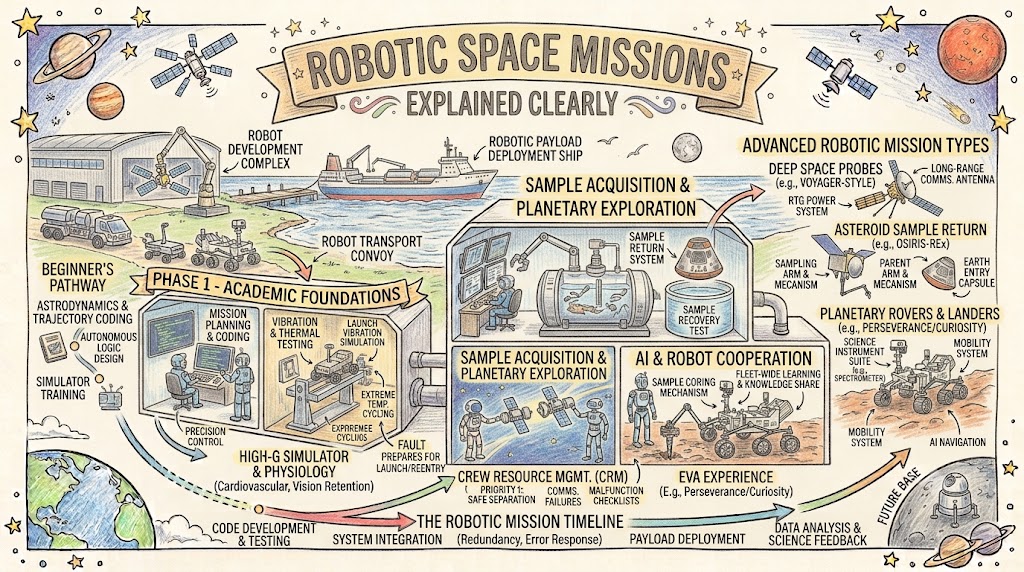
This beginner-friendly guide explains how robotic space missions work, why they are important, and how different types of spacecraft explore space.
What Is a Robotic Space Mission?
A robotic space mission is a mission in which an uncrewed spacecraft performs scientific, technical, or observational work in space.
The spacecraft is controlled by computers, programmed instructions, and mission teams on Earth.
Some robotic spacecraft remain close to Earth, while others travel to distant planets, moons, asteroids, comets, or deep-space regions.
Robotic missions may perform tasks such as:
- Taking photographs
- Measuring temperature
- Studying atmospheres
- Mapping surfaces
- Detecting radiation
- Analysing rocks and soil
- Monitoring weather
- Searching for water
- Testing new technology
- Carrying communication equipment
Why Robotic Missions Are Important
Robotic missions make space exploration safer and more practical.
Sending humans into deep space requires large amounts of food, water, oxygen, radiation protection, medical support, and return equipment.
A robot does not need these systems.
This makes robotic exploration useful for:
- Extremely distant destinations
- Dangerous environments
- Long-duration missions
- Early investigation of unknown locations
- Scientific observation
- Technology testing
- Future human mission preparation
- Lower-cost exploration
Robotic spacecraft often travel first so that scientists can understand a destination before sending astronauts.
Main Types of Robotic Space Missions
Robotic missions can be divided into several major categories.
Earth Observation Satellites
Earth observation satellites monitor our planet from orbit.
They may study:
- Weather
- Climate
- Oceans
- Forests
- Agriculture
- Natural disasters
- Air pollution
- Ice coverage
- Land use
- Urban growth
These satellites provide valuable information for scientists, governments, farmers, rescue teams, and environmental organisations.
Communication Satellites
Communication satellites relay signals between distant locations on Earth.
They support:
- Television
- Internet
- Telephone services
- Military communication
- Emergency communication
- Remote education
- Maritime communication
- Aviation communication
Some communication satellites remain in positions that allow them to serve the same region continuously.
Navigation Satellites
Navigation satellites provide location, direction, speed, and timing information.
They support:
- Aircraft navigation
- Ship navigation
- Road transport
- Smartphones
- Surveying
- Emergency rescue
- Military operations
- Scientific research
Navigation systems depend on accurate timing and communication between several satellites and ground receivers.
Space Telescopes
Space telescopes observe the universe from above Earth’s atmosphere.
Earth’s atmosphere can block or distort some forms of light. A space telescope can therefore collect clearer information.
Space telescopes may study:
- Stars
- Galaxies
- Planets
- Black holes
- Nebulae
- Exoplanets
- Cosmic radiation
- The early universe
Different telescopes observe different types of light, including visible, infrared, ultraviolet, and X-ray radiation.
Flyby Spacecraft
A flyby spacecraft passes near a planet, moon, asteroid, or comet without entering orbit.
During the short encounter, it collects images and scientific measurements.
Flyby missions are useful because they require less fuel than orbiting missions.
However, scientists have only a limited time to collect close-range data.
Orbiters
An orbiter travels around a planet, moon, or another celestial body.
Orbiters can study the same destination for months or years.
They may:
- Map the surface
- Observe weather
- Measure gravity
- Study the atmosphere
- Search for water
- Support landers and rovers
- Monitor seasonal changes
- Relay communication
Orbiters often provide the first detailed maps used to choose landing locations.
Landers
A lander reaches the surface of another world and remains in one location.
It may study:
- Soil
- Rocks
- Temperature
- Seismic activity
- Atmospheric pressure
- Wind
- Radiation
- Magnetic fields
A lander does not normally travel far after touchdown.
Its main advantage is that it can perform detailed measurements at one location.
Rovers
A rover is a mobile robotic vehicle designed to travel across the surface of another world.
Rovers may use:
- Wheels
- Tracks
- Robotic legs
- Special suspension systems
They can move between different scientific locations, inspect rocks, take photographs, drill surfaces, and analyse samples.
Rovers are more flexible than stationary landers, but they require more complex navigation and power systems.
Atmospheric Probes
An atmospheric probe enters the atmosphere of a planet or moon.
It collects information while descending.
Measurements may include:
- Temperature
- Pressure
- Wind
- Gas composition
- Clouds
- Radiation
- Atmospheric density
Some probes are destroyed by heat or pressure after transmitting their data.
Sample-Return Missions
A sample-return mission collects material from space and brings it back to Earth.
Samples may come from:
- The Moon
- Asteroids
- Comets
- Planetary surfaces
- Solar particles
Scientists can study returned samples using powerful laboratory equipment that cannot be carried aboard a spacecraft.
These missions are technically difficult because the spacecraft must collect, store, protect, and return the material safely.
Space Drones and Flying Robots
Some future robotic missions may use aircraft-like vehicles on other planets or moons.
Flying robots can explore areas that rovers cannot easily reach.
They may investigate:
- Cliffs
- Canyons
- Craters
- Rough terrain
- Distant regions
- Atmospheric conditions
Flying on another world requires understanding its gravity, atmospheric density, wind, and temperature.
Main Stages of a Robotic Space Mission
A robotic mission normally follows several major stages.
Mission Goal Selection
Scientists first decide what they want to learn.
Possible goals include:
- Searching for water
- Studying climate
- Mapping a surface
- Examining an atmosphere
- Investigating possible life
- Testing new technology
- Measuring radiation
- Collecting samples
Clear goals help engineers design the correct spacecraft.
Spacecraft Design
Engineers design the spacecraft around the mission requirements.
They must consider:
- Destination
- Travel distance
- Mission duration
- Temperature
- Radiation
- Gravity
- Communication delay
- Power needs
- Scientific instruments
- Landing method
A spacecraft designed for Earth orbit is very different from one designed for a distant planet.
Building and Testing
The spacecraft is assembled in a controlled environment.
Before launch, it is tested for:
- Vibration
- Noise
- Heat
- Cold
- Vacuum
- Radiation
- Electrical performance
- Communication
- Software reliability
Testing helps engineers identify failures before the mission begins.
Launch
A rocket carries the robotic spacecraft away from Earth.
The spacecraft may enter Earth orbit first or begin travelling directly toward its destination.
The launch vehicle must provide the speed and direction required for the mission.
Cruise Phase
The cruise phase is the journey between Earth and the destination.
During this period, mission teams may:
- Check spacecraft health
- Adjust the trajectory
- Test instruments
- Update software
- Monitor power
- Communicate with the spacecraft
Some cruise phases last months or years.
Arrival
When the spacecraft reaches its destination, it may perform a flyby, enter orbit, descend through an atmosphere, or prepare to land.
Arrival is often one of the most difficult mission stages.
Navigation must be extremely accurate.
Scientific Operations
After arrival, the spacecraft begins its main work.
It may take images, analyse materials, measure the environment, or travel across the surface.
Scientific data is stored onboard and transmitted to Earth.
Mission Extension or End
Some robotic missions continue beyond their original planned duration.
A mission may be extended when:
- The spacecraft remains healthy
- Enough power is available
- Communication still works
- Additional science is possible
A mission may end because of power loss, system failure, harsh conditions, or communication loss.
How Robotic Spacecraft Communicate With Earth
Robotic spacecraft use radio signals to communicate with mission teams.
Commands are sent from Earth, and scientific data is transmitted back.
Communication systems include:
- Antennas
- Radio transmitters
- Receivers
- Ground stations
- Deep-space communication networks
- Relay satellites
The farther the spacecraft travels, the longer the communication delay becomes.
Mission teams cannot always control distant robots in real time.
Understanding Communication Delay
Radio signals travel at the speed of light, but space is extremely large.
A command sent to a nearby satellite may arrive almost immediately.
A command sent to a distant planet may take several minutes or longer.
This means robotic spacecraft must sometimes make basic decisions independently.
They may need to:
- Avoid obstacles
- Enter safe mode
- Control temperature
- Protect instruments
- Adjust their orientation
- Manage power
Autonomous software is therefore an important part of deep-space exploration.
How Robotic Spacecraft Get Power
Spacecraft need electrical power for communication, computers, scientific instruments, heaters, and movement.
Common power sources include:
Solar Panels
Solar panels convert sunlight into electricity.
They are widely used near the Sun.
Their performance depends on:
- Distance from the Sun
- Panel size
- Dust
- Orientation
- Surface damage
Solar-powered spacecraft usually store extra energy in batteries.
Batteries
Batteries provide stored electrical power.
They may be used during:
- Launch
- Darkness
- Emergency operations
- Short missions
- High-power activities
Batteries alone may not support very long missions unless they can be recharged.
Radioisotope Power Systems
Some deep-space spacecraft use heat produced by the natural decay of radioactive material.
This heat is converted into electricity.
These systems can operate far from the Sun and in dark or cold environments.
They are useful for long-duration missions where solar power is weak or unreliable.
Scientific Instruments on Robotic Spacecraft
The instruments depend on the mission goals.
Common instruments include:
- Cameras
- Spectrometers
- Radar
- Magnetometers
- Radiation detectors
- Thermometers
- Pressure sensors
- Seismometers
- Drills
- Microscopes
- Laser instruments
- Weather sensors
Each instrument collects a specific type of information.
A camera shows what a surface looks like, while a spectrometer helps identify the materials present.
Cameras and Imaging Systems
Cameras are among the most recognisable spacecraft instruments.
They may produce:
- Surface maps
- Weather images
- Landing-site photographs
- Close-up rock images
- Navigation images
- Colour panoramas
- Scientific observations
Some cameras are designed for scientific measurement rather than ordinary photography.
Spectrometers
A spectrometer studies how matter interacts with light.
It can help scientists identify:
- Minerals
- Gases
- Ice
- Chemicals
- Surface composition
Different materials produce different light patterns.
These patterns allow scientists to study a distant object without physically touching it.
Radar Instruments
Radar sends radio waves toward a surface and measures the returning signal.
It can be used to:
- Map surfaces
- Study terrain
- Detect buried structures
- Measure ice
- Observe through clouds
- Estimate altitude
Radar is especially useful when normal cameras cannot clearly view the surface.
Robotic Arms
Landers and rovers may carry robotic arms.
These arms can:
- Move instruments
- Collect samples
- Drill rocks
- Inspect surfaces
- Place sensors
- Handle equipment
Robotic arms must operate accurately under unusual gravity and temperature conditions.
How Robotic Spacecraft Navigate
Spacecraft navigation determines position, speed, direction, and future path.
Navigation methods may include:
- Star trackers
- Sun sensors
- Gyroscopes
- Radio tracking
- Inertial systems
- Optical cameras
- Ground-based calculations
- Onboard computers
Small engine burns can correct the trajectory during flight.
Even a small error early in the journey can produce a large position difference later.
Attitude Control
Attitude describes the direction a spacecraft is facing.
Correct orientation is important for:
- Pointing antennas toward Earth
- Aiming instruments
- Receiving sunlight
- Firing engines
- Entering an atmosphere
- Landing safely
Spacecraft may use thrusters, reaction wheels, control moment systems, or magnetic devices to change orientation.
Entering Orbit Around Another World
An orbiter must reduce its speed when it reaches its destination.
If it does not slow down, it may fly past the planet.
The spacecraft usually fires its engine to enter orbit.
The timing, direction, and duration of this burn must be precise.
After entering orbit, additional manoeuvres may adjust altitude and shape.
Atmospheric Entry for Robotic Missions
A lander or rover may need to enter an atmosphere at high speed.
The spacecraft uses a heat shield to survive intense heating.
It then slows down using one or more methods:
- Atmospheric drag
- Parachutes
- Engines
- Airbags
- Landing legs
- Sky-crane systems
Different worlds require different landing strategies.
Why Robotic Landings Are Difficult
Landing on another world is challenging because the spacecraft must act with limited help from Earth.
Difficulties include:
- Communication delay
- Unknown terrain
- Strong winds
- Thin atmosphere
- Low visibility
- Limited fuel
- Navigation error
- Software failure
- Rough surfaces
The spacecraft may have only one chance to land successfully.
Rover Mobility Systems
Rovers need special systems to move across difficult terrain.
Design features may include:
- Large wheels
- Flexible suspension
- Strong motors
- Hazard cameras
- Navigation software
- Ground-clearance systems
- Slip detection
A rover must avoid rocks, steep slopes, soft soil, and deep sand.
Mission teams usually choose safe routes based on images and terrain data.
Autonomous Navigation
Because communication with Earth is delayed, some rovers use autonomous navigation.
The rover can:
- Take images
- Detect obstacles
- Select a safe path
- Stop when conditions are uncertain
- Protect itself from danger
Human controllers still choose the general destination, but the robot may make local driving decisions.
How Scientific Data Reaches Earth
Scientific instruments collect data and send it to onboard computers.
The spacecraft may transmit the data directly to Earth or through an orbiter.
A rover may send information to a spacecraft orbiting above it. The orbiter then relays the data to Earth.
Mission teams process and study the information.
Data may include:
- Images
- Temperature records
- Chemical measurements
- Weather information
- Navigation details
- Engineering health reports
Safe Mode
Safe mode is a protective condition used when a spacecraft detects a serious problem.
In safe mode, the spacecraft may:
- Stop scientific operations
- Reduce power use
- Point its solar panels correctly
- Point its antenna toward Earth
- Maintain a safe temperature
- Wait for instructions
Safe mode gives mission teams time to understand and solve the problem.
Main Risks in Robotic Space Missions
Robotic missions face many technical risks.
Launch Failure
The rocket may fail before the spacecraft reaches its planned path.
Communication Loss
A damaged antenna, power problem, software error, or incorrect orientation may interrupt communication.
Power Failure
Solar panels, batteries, or power systems may stop functioning.
Navigation Error
Incorrect calculations may cause the spacecraft to miss its destination.
Landing Failure
The spacecraft may crash because of terrain, software, engine, parachute, or sensor problems.
Radiation Damage
Radiation can damage computers and electronics.
Extreme Temperature
Very hot or cold conditions can affect instruments and batteries.
Mechanical Failure
Wheels, arms, drills, motors, or valves may stop working.
Dust
Dust can cover solar panels, damage moving parts, or reduce instrument performance.
How Engineers Improve Mission Reliability
Robotic spacecraft are designed with safety and reliability in mind.
Engineers may use:
- Backup computers
- Redundant communication systems
- Multiple sensors
- Protective shielding
- Safe-mode software
- Fault detection
- Extensive testing
- Simple mechanical designs
- Emergency power settings
However, adding too many backup systems increases weight, cost, and complexity.
Engineers must balance reliability with mission limits.
Robotic Missions Versus Human Missions
| Feature | Robotic Mission | Human Mission |
|---|---|---|
| Crew onboard | No | Yes |
| Life support needed | No | Yes |
| Mission risk to people | None onboard | High |
| Mission duration | Can be very long | Limited by human needs |
| Cost | Often lower | Usually higher |
| Real-time decision-making | Limited by software and delay | Strong human judgment onboard |
| Repair ability | Usually limited | Crew may repair equipment |
| Destination range | Can reach extreme environments | More restricted |
| Scientific flexibility | Depends on programming | Humans can adapt quickly |
| Return to Earth | Not always required | Usually required |
Robotic and human missions are not competitors. They support each other.
Robots often explore first, while humans later perform more flexible work.
How Robotic Missions Support Future Astronauts
Robotic spacecraft help prepare destinations for human exploration.
They may:
- Map landing areas
- Measure radiation
- Search for water
- Study dust
- Test communication
- Analyse soil
- Monitor weather
- Identify hazards
- Test power systems
- Demonstrate new landing technology
This information helps mission planners reduce risk for future crews.
Role of Artificial Intelligence
Artificial intelligence can help robotic spacecraft operate more independently.
AI systems may support:
- Image analysis
- Hazard detection
- Route selection
- Equipment monitoring
- Scientific target selection
- Fault diagnosis
- Data prioritisation
A distant spacecraft cannot send every piece of information to Earth immediately.
AI may help select the most important data for transmission.
Student-Friendly Example
Imagine sending a remote-controlled vehicle into a dangerous cave.
The vehicle carries cameras, lights, sensors, and communication equipment.
It can travel where people may not be able to go safely.
Operators outside the cave study the information and give the vehicle new instructions.
A robotic space mission follows a similar idea, but the distances are much greater and communication may be delayed.
Common Misunderstandings About Robotic Missions
Robotic Missions Are Not Fully Independent
Most still depend on mission teams for planning, commands, and data analysis.
Robots Do Not Think Exactly Like Humans
They follow programming, sensor input, and limited autonomous systems.
Uncrewed Does Not Mean Simple
Robotic missions can be extremely complex.
A Rover Is Not Controlled Like a Toy Car
Communication delays prevent continuous real-time control on distant worlds.
Mission Failure Does Not Always Mean Total Loss
A spacecraft may lose one instrument but continue performing other tasks.
Benefits of Robotic Space Missions
Robotic missions provide several major advantages.
- They can travel into dangerous environments.
- They do not require human life-support systems.
- They can operate for long periods.
- They help prepare for crewed missions.
- They can study distant worlds.
- They reduce direct risk to astronauts.
- They support Earth science and communication.
- They test new technology.
Limitations of Robotic Space Missions
Robotic missions also have limitations.
- Communication delays reduce direct control.
- Robots may struggle with unexpected situations.
- Repairs are usually difficult or impossible.
- Scientific instruments are limited by spacecraft size.
- Landing failures can end the mission.
- Power may decrease over time.
- Software errors can create major problems.
Humans remain better at flexible reasoning, adaptation, and complex manual work.
Careers Related to Robotic Space Missions
Robotic exploration requires professionals from many fields.
Possible careers include:
- Aerospace engineer
- Robotics engineer
- Software developer
- Mission planner
- Planetary scientist
- Data analyst
- Communication engineer
- Electrical engineer
- Mechanical engineer
- Navigation specialist
- Remote-sensing expert
- Spacecraft controller
Students interested in these careers can study mathematics, physics, programming, electronics, robotics, and engineering.
Future of Robotic Space Exploration
Future robotic missions may become more intelligent, mobile, and cooperative.
Possible developments include:
- Swarms of small robots
- Autonomous flying vehicles
- Deep-space telescopes
- Advanced sample-return missions
- Robots that build habitats
- Ice-mining systems
- Subsurface exploration robots
- Ocean-exploration probes for icy moons
- Robotic assistants for astronauts
- AI-controlled scientific laboratories
Future robots may prepare landing sites, construct shelters, and produce resources before astronauts arrive.
Key Takeaways
- Robotic space missions explore space without carrying people.
- Main mission types include satellites, probes, orbiters, landers, and rovers.
- Robots can reach dangerous and distant environments.
- Spacecraft need power, communication, navigation, and scientific instruments.
- Communication delay requires some autonomous operation.
- Solar panels, batteries, and radioisotope systems provide power.
- Landing on another world is one of the most difficult mission stages.
- Robotic missions help prepare for future human exploration.
- Artificial intelligence may make future spacecraft more independent.
- Robotic and human missions work together to expand space exploration.
Frequently Asked Questions
What is a robotic space mission?
It is an uncrewed mission that uses an automated spacecraft to explore, observe, communicate, or perform scientific work.
What is the difference between a probe and a rover?
A probe is a general term for a robotic spacecraft, while a rover is specifically designed to move across a surface.
How are robotic spacecraft controlled?
They receive programmed commands from mission teams and may also use onboard autonomous systems.
Why are robots used instead of astronauts?
Robots can travel to dangerous, distant, or extreme environments without risking human life.
How do robotic spacecraft communicate with Earth?
They use radio transmitters, antennas, ground stations, and sometimes relay satellites.
What powers a robotic spacecraft?
Common power sources include solar panels, batteries, and radioisotope power systems.
Can robotic spacecraft repair themselves?
Most cannot perform major repairs, but some can restart systems, switch to backups, or enter safe mode.
Why is landing on another planet difficult?
The spacecraft must handle high speed, uncertain terrain, atmosphere, gravity, communication delay, and limited fuel.
How do rovers avoid obstacles?
They use cameras, sensors, navigation software, and instructions from mission teams.
Will robots replace astronauts?
No. Robots and astronauts have different strengths and will continue to support each other in future exploration.
Conclusion
Robotic space missions are essential tools for exploring the universe safely and efficiently. Satellites, probes, orbiters, landers, and rovers help scientists study Earth, planets, moons, asteroids, and deep space. Although these spacecraft do not carry people, they require advanced navigation, communication, power, software, and scientific systems. By exploring first and collecting critical information, robotic missions help prepare the way for future human journeys.