Introduction
Space missions may look like they are handled only by astronauts inside a spacecraft, but that is not true. Behind every astronaut, there is a large team on Earth working day and night to keep the mission safe and successful. This team is known as Mission Control.
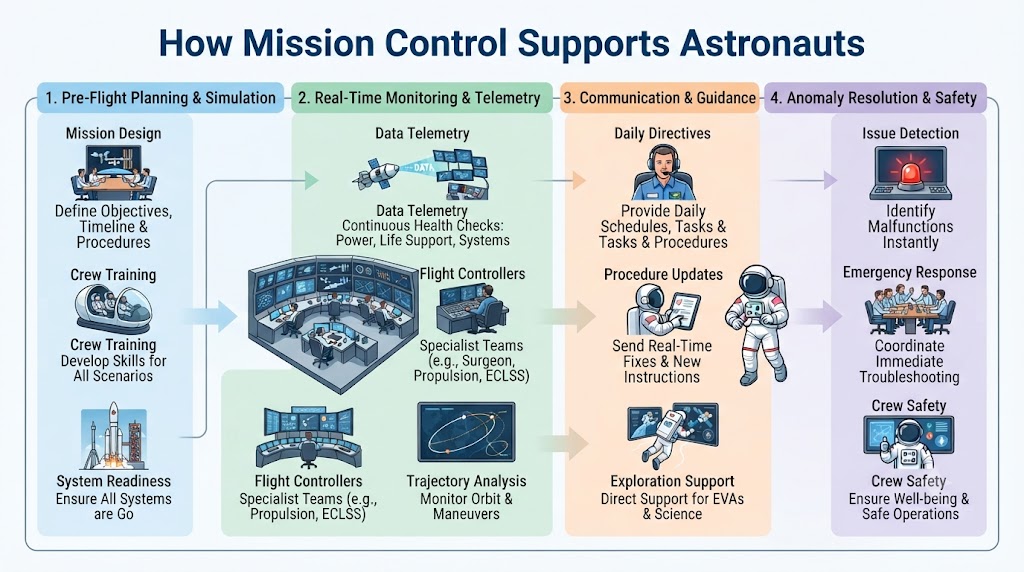
Mission Control is the main support center for astronauts during space missions. It helps astronauts before launch, during flight, while living or working in space, and during the return to Earth. The team watches spacecraft systems, sends instructions, solves problems, monitors astronaut health, and makes sure the mission follows the correct plan.
For beginners, How Mission Control Supports Astronauts can be understood in a simple way: astronauts work in space, but Mission Control guides and supports them from Earth. Astronauts may be far away from home, but they are never truly alone.
What Is Mission Control?
Mission Control is a ground-based center where trained experts manage and support space missions. These experts do not travel inside the spacecraft, but they play a very important role from Earth.
Mission Control includes different types of specialists, such as:
- Flight directors
- Engineers
- Communication officers
- Medical experts
- Navigation specialists
- Safety teams
- Computer system experts
- Mission planners
Each person has a specific job. Some experts check the spacecraft’s power system. Some monitor oxygen, temperature, and life-support systems. Others help with communication, navigation, medical support, or mission timing.
The main goal of Mission Control is to keep the mission safe, organized, and successful.
Why Mission Control Is Important
Space is not an easy place to work. Astronauts face many challenges, such as zero gravity, limited supplies, technical systems, and distance from Earth. Even a small problem can become serious if it is not handled quickly.
Mission Control helps reduce these risks. It watches the spacecraft carefully and gives astronauts the support they need at every stage of the mission.
Mission Control is important because it helps with:
- Spacecraft safety
- Astronaut communication
- Emergency response
- Medical support
- Mission planning
- Daily schedule management
- Navigation guidance
- Spacewalk support
- Safe return to Earth
Without Mission Control, astronauts would have to manage too many complex tasks alone. That would make space missions much more difficult and risky.
Role of Mission Control Before Launch
Mission Control starts supporting astronauts long before the rocket leaves Earth. Before launch, the team checks every part of the mission plan.
The spacecraft, rocket, weather, communication systems, crew readiness, and emergency plans are reviewed carefully. Nothing is left to guesswork.
Before launch, Mission Control helps with:
- Checking rocket systems
- Reviewing spacecraft readiness
- Testing communication links
- Monitoring weather conditions
- Confirming astronaut safety
- Preparing emergency procedures
- Checking fuel, power, and pressure systems
- Reviewing the launch timeline
If any serious problem is found, the launch may be delayed. This is done to protect the astronauts and the mission. In spaceflight, safety is always more important than rushing.
Support During Launch
Launch is one of the most exciting and dangerous parts of a space mission. During launch, the rocket moves at very high speed and passes through different layers of the atmosphere.
Mission Control watches every important detail during this stage. The team checks rocket engines, speed, altitude, fuel levels, pressure, and communication signals.
During launch, Mission Control monitors:
- Engine performance
- Rocket speed
- Altitude
- Fuel use
- Pressure levels
- Flight path
- Communication quality
- Crew safety
If something unusual happens, Mission Control quickly studies the data and decides what action is needed. Astronauts inside the spacecraft cannot monitor every system alone, so they depend on the ground control team for support.
Communication Between Astronauts and Earth
One of the biggest responsibilities of Mission Control is communication. Astronauts need to stay connected with Earth throughout the mission.
Mission Control sends instructions, updates, warnings, and schedule changes to astronauts. Astronauts also report their condition, work progress, observations, and problems back to the ground team.
Clear communication is very important in space. A confusing message can create risk, so Mission Control uses simple, direct, and carefully planned communication.
Communication support includes:
- Giving mission updates
- Sending technical instructions
- Sharing safety alerts
- Receiving astronaut reports
- Helping with daily tasks
- Supporting docking operations
- Guiding landing preparation
This communication link helps astronauts feel supported and keeps the mission moving in the right direction.
Monitoring Spacecraft Systems
A spacecraft is a very complex machine. It has many systems that must work properly to keep astronauts alive and safe.
Mission Control constantly monitors spacecraft systems from Earth. If any system shows unusual data, the team studies it and helps astronauts take action.
Important spacecraft systems include:
- Oxygen supply
- Power system
- Temperature control
- Water system
- Communication system
- Navigation system
- Computers
- Fuel levels
- Life-support systems
For example, if the spacecraft temperature becomes too high or too low, Mission Control can detect it and guide astronauts on what to do. If power use is too high, the team can suggest ways to save energy.
This constant monitoring helps catch problems early before they become serious.
Life-Support System Monitoring
Life-support systems are among the most important parts of any space mission. Astronauts need air, water, pressure, and safe temperature to live and work in space.
Mission Control keeps track of these systems carefully.
The team monitors:
- Oxygen levels
- Carbon dioxide levels
- Cabin pressure
- Air quality
- Temperature
- Humidity
- Water supply
- Waste systems
If oxygen levels drop or carbon dioxide rises, the situation can become dangerous. Mission Control helps astronauts manage these systems and respond quickly if something changes.
This is one of the main reasons astronauts can safely live and work in space for long periods.
Emergency Support and Problem Solving
Space missions can face unexpected problems. A machine may stop working, communication may become weak, a medical concern may appear, or the mission plan may need to change suddenly.
In these moments, Mission Control becomes the main problem-solving team.
The experts on Earth study the issue, check the available data, discuss possible solutions, and guide astronauts step by step.
Emergency support may include:
- Fixing technical failures
- Handling power problems
- Managing communication issues
- Supporting medical concerns
- Changing mission plans
- Preparing backup procedures
- Guiding astronauts during urgent tasks
Mission Control teams are trained to stay calm under pressure. Their careful thinking and teamwork can help protect astronauts during serious situations.
Medical Support for Astronauts
Astronaut health is another major responsibility of Mission Control. Space can affect the human body in many ways. Astronauts may face sleep problems, stress, muscle weakness, bone loss, or changes in balance due to microgravity.
Medical experts on Earth help monitor astronaut health during the mission.
They may check:
- Sleep quality
- Exercise routine
- Food and hydration
- Stress levels
- Heart rate
- Physical condition
- Medical symptoms
- Mental well-being
Astronauts also follow exercise plans to keep their muscles and bones strong. Mission Control helps manage these routines and provides medical guidance when needed.
This medical support helps astronauts stay healthy and ready to complete mission tasks.
Navigation and Mission Guidance
Mission Control also helps guide spacecraft movement. Spacecraft navigation must be very accurate because even a small mistake can affect the mission.
Mission Control supports astronauts during important activities such as:
- Orbit changes
- Docking with a space station
- Course correction
- Spacecraft movement
- Landing preparation
- Re-entry planning
- Safe return to Earth
For example, when a spacecraft needs to dock with the International Space Station, Mission Control helps monitor speed, distance, direction, and timing. This makes the operation safer and more controlled.
Support During Spacewalks
Spacewalks are some of the most difficult tasks astronauts perform. During a spacewalk, astronauts leave the spacecraft and work outside in space.
Mission Control plays a key role during these activities. The team helps plan the spacewalk, monitor astronaut safety, and guide each step of the task.
Mission Control helps with:
- Spacesuit checks
- Oxygen monitoring
- Tool instructions
- Time management
- Safety procedures
- Emergency support
- Communication during the spacewalk
Astronauts working outside the spacecraft face a risky environment. Mission Control gives them the support they need to complete the work safely.
Daily Life and Work Support in Space
Astronauts follow a planned daily schedule in space. Their day may include science experiments, repairs, exercise, meals, rest, and communication with Earth.
Mission Control helps create and manage this schedule.
Daily support includes:
- Planning experiments
- Scheduling maintenance work
- Organizing exercise time
- Managing rest periods
- Updating task lists
- Supporting video calls or reports
- Adjusting plans when needed
If a task takes longer than expected, Mission Control can change the schedule. If a technical problem appears, the team may pause other work and focus on safety.
This planning helps astronauts stay organized and productive.
Teamwork Between Astronauts and Mission Control
A space mission depends on strong teamwork. Astronauts and Mission Control must trust each other completely.
Astronauts perform the work in space, while Mission Control provides information, planning, and technical support from Earth. Both sides must communicate clearly and make decisions carefully.
Good teamwork helps with:
- Avoiding confusion
- Solving problems faster
- Improving mission safety
- Completing science work
- Handling emergencies calmly
- Making better decisions
Mission Control does not replace astronauts. It supports them like a strong partner on Earth.
Real-Life Example: Apollo 13
One of the most famous examples of Mission Control support is the Apollo 13 mission. During this mission, an oxygen tank problem created a serious emergency in space.
The astronauts and Mission Control worked together to bring the crew safely back to Earth. Engineers on the ground created solutions using the limited tools available inside the spacecraft.
This mission showed how important Mission Control is during emergencies. It also proved that teamwork, calm thinking, and expert guidance can save lives in space.
Mission Control and the International Space Station
Mission Control also supports astronauts on the International Space Station. Since astronauts live and work there for long periods, they need regular support every day.
Mission Control helps with:
- Science experiments
- Equipment repairs
- Spacecraft docking
- Health checks
- Communication
- Safety monitoring
- Supply mission planning
The International Space Station works like a large science laboratory in orbit. Mission Control helps keep this laboratory safe, active, and organized.
Why Mission Control Matters for Future Space Exploration
Mission Control will become even more important for future missions to the Moon, Mars, and deep space.
Future missions will be longer and more complex. Astronauts may travel farther from Earth, which can create communication delays and new challenges.
Mission Control will help future space missions by supporting:
- Deep-space navigation
- Long-term astronaut health
- Advanced spacecraft systems
- Moon and Mars surface missions
- Emergency planning
- Scientific research
- Safe return to Earth
As humans explore farther into space, Mission Control will continue to be a key part of astronaut safety and mission success.
Simple Example to Understand Mission Control
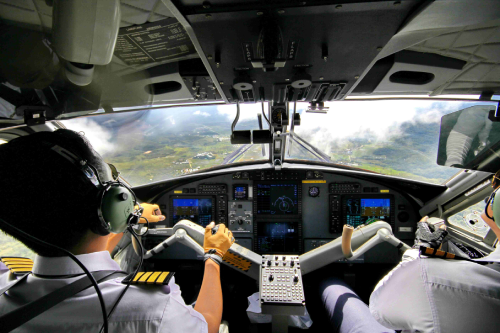
A simple way to understand Mission Control is to compare it with a support team for a pilot. A pilot controls the aircraft, but air traffic controllers, weather experts, engineers, and safety teams provide important information from the ground.
Mission Control works in a similar way, but for space missions. Astronauts operate the spacecraft, while Mission Control supports them from Earth.
This makes space missions safer, more organized, and easier to manage.
Frequently Asked Questions
1. What is Mission Control?
Mission Control is a ground-based support center that manages and monitors space missions. It helps astronauts with communication, spacecraft systems, safety checks, navigation, medical support, and emergency guidance during the mission.
2. How does Mission Control support astronauts in space?
Mission Control supports astronauts by watching spacecraft data, sending instructions, solving technical problems, checking astronaut health, planning daily tasks, and helping during emergencies. It acts as the main support team on Earth.
3. Why is Mission Control important for astronauts?
Mission Control is important because space missions are complex and risky. Astronauts cannot manage every system alone, so Mission Control provides expert help, safety monitoring, and quick decision-making from Earth.
4. Does Mission Control talk to astronauts all the time?
Mission Control stays in regular contact with astronauts throughout the mission. The communication may not be constant every second, but astronauts receive updates, instructions, safety alerts, and mission guidance whenever needed.
5. What does Mission Control check during a space mission?
Mission Control checks oxygen levels, power supply, temperature, communication systems, navigation, computers, fuel, life-support systems, and astronaut health. These checks help keep the spacecraft and crew safe.
6. How does Mission Control help during emergencies?
During emergencies, Mission Control studies the problem, reviews spacecraft data, creates safe solutions, and guides astronauts step by step. The team works calmly and quickly to reduce risk and protect the crew.
7. Who works inside Mission Control?
Mission Control includes flight directors, engineers, communication officers, medical experts, navigation specialists, safety teams, computer experts, and mission planners. Each person has a specific role in supporting the mission.
8. How does Mission Control help during spacewalks?
Mission Control helps astronauts during spacewalks by checking spacesuit systems, oxygen levels, tools, time limits, safety steps, and communication. It guides astronauts carefully while they work outside the spacecraft.
9. Does Mission Control help astronauts return to Earth?
Yes, Mission Control plays a major role during return to Earth. It helps with re-entry planning, spacecraft navigation, landing preparation, weather checks, and safety decisions to support a safe return.
10. What is the best example of Mission Control helping astronauts?
One famous example is the Apollo 13 mission. After a serious oxygen tank problem, Mission Control worked with the astronauts to solve problems and bring the crew safely back to Earth.
11. How does Mission Control support astronauts on the International Space Station?
Mission Control supports astronauts on the International Space Station by helping with experiments, repairs, docking operations, health checks, daily schedules, communication, and safety monitoring.
12. Will Mission Control be needed for future Mars missions?
Yes, Mission Control will be very important for future Mars missions. It will help astronauts with long-distance communication, deep-space navigation, health monitoring, emergency planning, and mission safety.
Conclusion
Mission Control is one of the most important parts of any space mission. It supports astronauts before launch, during flight, while working in space, and during the return to Earth.
It monitors spacecraft systems, manages communication, checks astronaut health, supports emergencies, guides navigation, and helps astronauts complete mission tasks safely.
As explained in How Mission Control Supports Astronauts, space exploration is not only about rockets and astronauts. It is also about teamwork, planning, science, safety, and expert support from Earth.
Astronauts may travel far from our planet, but they are never truly alone. Mission Control stays connected with them, guiding and supporting every important step of the journey.