Introduction
Spaceflight Training Basics is an essential topic for anyone who dreams of traveling beyond Earth. Human spaceflight is no longer limited only to government astronauts. With growing interest in commercial space travel, space tourism, private space missions, and advanced aerospace careers, more people are becoming curious about how humans prepare for space.
Spaceflight is exciting, but it is also physically demanding, mentally challenging, and technically complex. A person entering space must understand how the body reacts to microgravity, how spacecraft systems work, how to respond during emergencies, and how to cooperate with a crew in a high-risk environment.
For beginners, spaceflight training may sound difficult at first. However, when explained step by step, it becomes easier to understand. This guide explains the foundation of astronaut preparation, physical fitness, mission simulations, zero gravity training, survival skills, and the technologies used in modern space training.
What Is Spaceflight Training
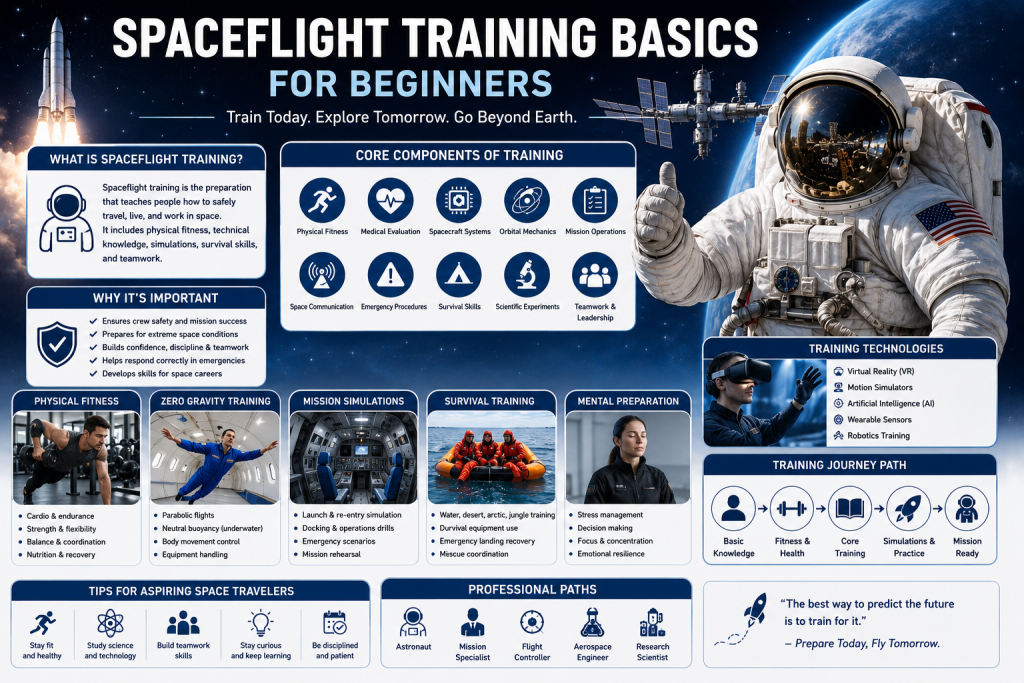
Spaceflight training is the structured preparation process that teaches humans how to safely participate in a space mission. It includes physical conditioning, medical checks, spacecraft system knowledge, emergency training, mission simulation, communication practice, and teamwork development.
The main purpose of spaceflight training is to prepare people for the unique conditions of space. Unlike normal travel, spaceflight involves launch forces, microgravity, confined living areas, limited resources, technical systems, and mission-critical procedures.
Professional astronauts usually go through long and detailed training because they may operate spacecraft systems, conduct scientific experiments, perform spacewalks, control robotics, and respond to complex emergencies. Commercial spaceflight participants may receive shorter training focused mainly on safety, launch preparation, cabin behavior, emergency awareness, and basic space adaptation.
Both types of training are important because spaceflight requires discipline, awareness, and respect for safety.
Why Spaceflight Training Is Important
Spaceflight training is important because space is an extreme environment. Even a simple mistake can affect crew safety or mission success.
Training helps participants understand what to expect before, during, and after the mission. It reduces fear, builds confidence, and prepares the body and mind for unusual conditions.
Spaceflight training supports:
- Crew safety
- Mission success
- Emergency preparedness
- Physical adaptation
- Mental resilience
- Team coordination
- Technical understanding
- Communication discipline
A trained participant is more likely to stay calm during launch, follow instructions in microgravity, respond correctly during emergencies, and work effectively with the crew.
Core Components of Spaceflight Training
Spaceflight training includes several important areas. Each component prepares the participant for a different part of the mission.
Physical Fitness
Spaceflight places stress on the human body. During launch and re-entry, the body may experience strong acceleration forces. In microgravity, muscles and bones are affected because the body no longer works against normal gravity.
Physical training helps improve strength, endurance, balance, flexibility, and cardiovascular health.
Medical Evaluation
Medical evaluation checks whether a person is physically and mentally fit for spaceflight. Doctors review heart health, blood pressure, vision, hearing, neurological condition, fitness level, and medical history.
Medical screening is essential because spaceflight can increase stress on the body.
Spacecraft Systems
Participants must understand basic spacecraft systems. This may include cabin layout, seats, displays, oxygen systems, communication tools, emergency equipment, and safety controls.
Professional astronauts learn these systems in great detail, while commercial participants learn the most important safety-related information.
Orbital Mechanics Basics
Orbital mechanics explains how spacecraft move in space. Beginners do not need to become experts, but they should understand basic ideas such as orbit, velocity, altitude, docking, and re-entry.
This knowledge helps participants understand the mission better.
Space Mission Operations
Mission operations include launch sequence, flight phases, orbit activities, docking, experiment timelines, return procedures, and recovery operations.
Training helps participants know what happens at each stage of the mission.
Space Communication
Clear communication is critical in spaceflight. Crew members must communicate with each other and with mission control using precise language.
Communication training helps avoid confusion during normal and emergency situations.
Space Survival Skills
Survival training prepares astronauts for unexpected landing situations. A spacecraft may land in water, desert, forest, snow, or another remote area.
Survival training teaches crew members how to stay safe until rescue teams arrive.
Emergency Procedures
Emergency training covers fire, cabin pressure issues, oxygen problems, system failures, medical emergencies, launch aborts, and evacuation procedures.
The goal is to make correct actions automatic under pressure.
Scientific Experiments
Many space missions include research. Astronauts may conduct experiments related to biology, physics, medicine, materials, or Earth observation.
Training teaches participants how to handle equipment and record results properly.
Teamwork and Leadership
Space crews live and work in small spaces. Good teamwork, leadership, patience, and emotional control are essential.
Training helps crew members build trust and cooperation.
Physical Fitness Requirements
Physical fitness is a major part of spaceflight preparation. A person does not need to look like an athlete, but they must have strong overall health and stamina.
Cardiovascular Fitness
Cardiovascular training improves heart and lung function. Running, cycling, swimming, rowing, and brisk walking can help build endurance.
Good cardiovascular fitness helps the body handle launch stress and mission workload.
Strength Training
Strength training supports muscles and joints. Astronauts need strong core muscles, legs, arms, and back to manage training tasks, equipment handling, and recovery after spaceflight.
Flexibility
Flexibility helps reduce injury risk. Stretching, mobility exercises, and yoga-like movements can improve body control and comfort during training.
Endurance
Endurance helps participants manage long training sessions, simulations, and mission activities without getting tired quickly.
Balance
Balance training is important because the body’s sense of direction can change in microgravity. After returning to Earth, balance may also feel different for some time.
Nutrition
Good nutrition supports energy, immunity, muscle health, and recovery. Spaceflight candidates need balanced meals, hydration, and healthy eating habits.
Recovery
Rest and recovery are important. Overtraining can cause fatigue, injury, and poor performance.
Medical Monitoring
Regular medical monitoring helps trainers track health, fitness progress, and readiness for mission conditions.
Mental Preparation for Spaceflight
Spaceflight is not only a physical challenge. It is also a mental test. Astronauts must stay calm, focused, and disciplined in unusual situations.
Decision Making
Space missions require quick and accurate decisions. Training uses scenarios to help participants think clearly under pressure.
Stress Management
Launch, confined spaces, emergencies, and mission responsibility can create stress. Breathing techniques, mental rehearsal, and preparation help reduce anxiety.
Isolation
Space missions may involve separation from family, limited privacy, and small living spaces. Mental training helps participants adjust to isolation and confinement.
Problem Solving
Astronauts often solve technical and operational problems. Training improves logical thinking and calm troubleshooting.
Situational Awareness
Situational awareness means understanding what is happening around you. In spaceflight, this includes monitoring systems, crew actions, mission timeline, and safety conditions.
Cognitive Performance
Space missions require memory, focus, attention, and clear thinking. Training helps maintain cognitive performance during fatigue or pressure.
Emotional Resilience
Emotional resilience helps participants manage fear, frustration, homesickness, and unexpected challenges.
Communication Skills
Strong communication prevents mistakes and builds crew trust. Participants learn to speak clearly, listen carefully, and confirm instructions.
Space Mission Simulations
Mission simulations are one of the most important parts of spaceflight training. A simulator allows participants to practice mission tasks without real mission risk.
Mission Simulators
Mission simulators recreate spacecraft systems, controls, displays, alarms, and procedures. They help participants understand what they will experience during real flight.
Cockpit Procedures
Crew members practice how to sit, strap in, monitor displays, follow checklists, and respond to commands.
Launch Simulation
Launch simulations prepare participants for countdown, engine ignition, acceleration, vibration, noise, and communication procedures.
Docking Simulation
Docking is the process of connecting one spacecraft with another spacecraft or space station. Professional astronauts may practice docking many times in simulators.
Emergency Drills
Emergency drills prepare crew members for unexpected events such as cabin pressure loss, fire warning, communication failure, or medical problems.
Crew Coordination
Crew members practice roles and responsibilities. Everyone must know who does what during normal and emergency operations.
Mission Rehearsals
Mission rehearsals follow the full mission timeline. They help participants become familiar with every phase from launch to landing.
Zero Gravity Training
Zero gravity training helps participants understand how the body moves when weight is reduced or absent. In space, people and objects float because they are in microgravity.
Purpose of Zero Gravity Training
The purpose is to teach body control, equipment handling, orientation, and movement techniques in microgravity-like conditions.
Parabolic Flights
Parabolic flights use aircraft flight paths that create short periods of reduced gravity. During these moments, participants experience floating and practice basic movement.
Neutral Buoyancy Training
Neutral buoyancy training is usually done underwater. Astronauts train in large pools while wearing special suits to simulate some movement challenges of spacewalks.
Body Movement in Microgravity
In microgravity, small pushes can move the body across the cabin. Participants must learn gentle movement, handholds, and controlled motion.
Equipment Handling
Objects float in microgravity. Training teaches participants how to secure tools, manage equipment, and prevent items from drifting away.
Motion Sickness Adaptation
Some people experience space motion sickness. Training helps participants understand symptoms and adaptation strategies.
Space Survival Training
Space survival training prepares crew members for unexpected landing or recovery situations. Although missions are carefully planned, crews must be ready for different environments.
Water Survival
Water survival training prepares astronauts for ocean or water landings. It may include flotation devices, raft entry, suit handling, and rescue signals.
Desert Survival
Desert survival teaches heat management, hydration, shelter, navigation, and rescue coordination.
Arctic Survival
Arctic survival prepares participants for cold weather, snow, ice, wind, and limited visibility.
Jungle Survival
Jungle survival focuses on heat, humidity, insects, shelter, water safety, and rescue signaling.
Spacecraft Evacuation
Crew members learn how to exit the spacecraft safely after landing or during emergency procedures.
Landing Recovery
Landing recovery training teaches participants what to do while waiting for rescue teams.
Rescue Coordination
Clear communication with recovery teams is important. Crew members learn signals, emergency communication, and safety steps.
Technology Used During Spaceflight Training
Modern spaceflight training uses advanced technology to make learning safer, smarter, and more realistic.
Virtual Reality
Virtual Reality allows trainees to experience spacecraft cabins, mission tasks, emergency procedures, and spacewalk environments in a simulated setting.
Augmented Reality
Augmented Reality can overlay digital instructions onto real training environments. It helps trainees learn systems and procedures more interactively.
Artificial Intelligence
Artificial Intelligence can personalize training, analyze performance, suggest improvements, and create realistic mission scenarios.
Motion Simulators
Motion simulators recreate launch, landing, vibration, acceleration, and spacecraft movement.
Robotics
Robotics training helps astronauts operate robotic arms, remote systems, and automated mission equipment.
Digital Mission Planning
Digital planning tools help crews understand timelines, procedures, experiments, and mission changes.
Wearable Sensors
Wearable sensors track heart rate, movement, stress, sleep, and physical performance during training.
Biomedical Monitoring
Biomedical systems help doctors monitor health before, during, and after training.
Beginner Tips for Aspiring Astronauts
Beginners can start preparing for a space-related future long before entering an official astronaut training program.
Helpful tips include:
- Build strong knowledge in science, technology, engineering, and mathematics.
- Improve physical fitness through regular exercise.
- Practice clear communication.
- Learn teamwork through group projects and sports.
- Stay curious about space science and aviation.
- Practice problem solving every day.
- Read about spacecraft, rockets, planets, and human spaceflight.
- Develop discipline and consistency.
- Improve swimming and survival awareness.
- Learn basic coding, robotics, or engineering concepts.
- Build emotional resilience.
- Stay medically healthy.
A strong foundation matters more than rushing. Space careers require patience, learning, and long-term commitment.
Common Challenges During Training
Spaceflight training can be exciting, but it also comes with challenges.
Physical Fatigue
Long training sessions, exercise routines, simulations, and survival practice can be tiring. Candidates must build stamina gradually.
Motion Sickness
Some trainees experience nausea during parabolic flights, simulators, or microgravity adaptation. Trainers help candidates manage symptoms safely.
Psychological Pressure
High expectations, emergency drills, isolation, and complex tasks can create mental pressure. Preparation and support help trainees stay balanced.
Information Overload
Spaceflight involves many systems, procedures, and safety rules. Beginners may feel overwhelmed at first.
Technical Complexity
Spacecraft systems can be difficult to understand. Step-by-step learning makes technical subjects easier.
Team Adaptation
Working with a crew requires patience, respect, trust, and clear communication. Team training helps develop these qualities.
Professional Astronaut Training vs Commercial Spaceflight Training
| Point | Professional Astronaut Training | Commercial Spaceflight Training |
|---|---|---|
| Purpose | Prepare astronauts for complex missions | Prepare participants for safe space travel |
| Training Depth | Highly detailed and technical | Focused on safety and basic mission awareness |
| Training Duration | Usually long and intensive | Usually shorter and mission-specific |
| Physical Requirements | High fitness and medical standards | Fitness standards depend on mission type |
| Technical Knowledge | Advanced spacecraft and mission knowledge | Basic spacecraft and safety knowledge |
| Simulations | Extensive mission simulations | Limited but important simulations |
| Mission Responsibility | Operate systems, experiments, and procedures | Follow instructions and participate safely |
| Emergency Training | Detailed emergency response training | Basic emergency awareness and response |
| Career Path | Space agency, research, mission roles | Space tourism or private mission participation |
| Skill Focus | Operations, science, engineering, leadership | Safety, adaptation, awareness, communication |
Career Opportunities in Human Spaceflight
Human spaceflight creates opportunities beyond becoming an astronaut. Many professionals work together to make space missions successful.
Professional Astronaut
Professional astronauts train for space missions, scientific research, spacecraft operations, and mission leadership.
Commercial Astronaut
Commercial astronauts may participate in private missions, commercial space operations, or specialized research flights.
Payload Specialist
Payload specialists focus on specific experiments or mission equipment.
Aerospace Engineer
Aerospace engineers design, test, and improve spacecraft, rockets, systems, and mission hardware.
Flight Controller
Flight controllers support missions from the ground. They monitor systems, guide crew members, and help solve mission problems.
Mission Planner
Mission planners design timelines, procedures, training plans, and operational steps.
Space Operations Specialist
Space operations specialists help manage spacecraft systems, crew support, mission logistics, and safety procedures.
Research Scientist
Research scientists use space missions to study biology, physics, medicine, materials, Earth science, and space environments.
Frequently Asked Questions
1. What is spaceflight training?
Spaceflight training is the preparation process that teaches people how to safely participate in a space mission. It includes physical fitness, medical checks, spacecraft knowledge, emergency procedures, mission simulations, and teamwork. The goal is to prepare the body and mind for space conditions. Beginners can start by learning basic science, fitness, and space mission concepts.
2. Is spaceflight training only for astronauts?
No, spaceflight training is not only for professional astronauts. Commercial space travelers, researchers, payload specialists, and private mission participants may also need training. The depth of training depends on the mission role. Professional astronauts receive more technical and long-term preparation than space tourists.
3. Do I need to be extremely fit for spaceflight?
You need good health and fitness, but requirements depend on the mission type. Professional astronauts usually need stronger fitness and medical standards. Commercial participants may need to pass mission-specific medical checks. Regular exercise, good nutrition, and medical fitness are important for everyone.
4. What is zero gravity training?
Zero gravity training teaches participants how to move and work in reduced gravity or microgravity conditions. It may include parabolic flights, underwater training, or simulated environments. The goal is to help trainees control body movement, handle equipment, and adapt to floating. It also prepares them for possible motion sickness.
5. Why do astronauts do survival training?
Survival training prepares astronauts for unexpected landing situations. A spacecraft may land in water, desert, snow, forest, or another remote area. Crew members learn how to stay safe, communicate with rescue teams, and manage emergency supplies. This training improves confidence and safety after landing.
6. What subjects should beginners study for spaceflight?
Beginners should study physics, mathematics, biology, engineering basics, space science, astronomy, and computer science. Communication, teamwork, and problem-solving are also important. A strong STEM foundation helps future astronauts and aerospace professionals understand spacecraft systems and mission operations better.
7. Is commercial spaceflight training difficult?
Commercial spaceflight training is usually less technical than professional astronaut training, but it still requires focus and discipline. Participants may learn safety procedures, cabin behavior, launch experience, emergency awareness, and microgravity adaptation. The goal is to prepare them for a safe and confident mission experience.
8. How does mental training help in spaceflight?
Mental training helps participants manage stress, isolation, pressure, and unexpected problems. Space missions require calm decision-making and clear communication. Trainees learn emotional control, situational awareness, and teamwork. Strong mental preparation is just as important as physical fitness.
9. Can beginners prepare for space careers at home?
Yes, beginners can start at home by studying STEM subjects, exercising regularly, reading about space missions, practicing communication, and learning basic coding or robotics. They can also follow space science topics and build problem-solving habits. Early preparation creates a strong foundation for future opportunities.
10. What is the future of spaceflight training?
The future of spaceflight training will include more virtual reality, artificial intelligence, advanced simulators, wearable sensors, and personalized learning systems. Commercial space travel may make training more accessible to non-professional astronauts. However, safety, discipline, and expert instruction will remain essential.
Conclusion
Spaceflight Training Basics gives beginners a clear understanding of how humans prepare for missions beyond Earth. Spaceflight is inspiring, but it requires serious preparation in physical fitness, medical readiness, technical knowledge, emergency response, teamwork, and mental resilience.
Whether someone wants to become a professional astronaut, join a commercial space mission, study aerospace engineering, or simply understand human space exploration, strong foundational training is the first step. Space missions depend on preparation, discipline, safety awareness, and continuous learning.
As human spaceflight continues to expand, training will become even more advanced with simulators, artificial intelligence, virtual reality, biomedical monitoring, and personalized mission preparation. Every successful space traveler begins with the basics, and those basics create the confidence and readiness needed for the extraordinary journey beyond Earth.