Introduction
Commercial space travel is no longer just a dream seen in science fiction. It is becoming a real part of the modern aviation and aerospace industry. Private companies, advanced spacecraft, space tourism programs, and commercial launch services are opening new possibilities for people who want careers beyond traditional flying.
For many years, space careers were mainly connected with government agencies, astronauts, scientists, and military-trained pilots. Today, the commercial space industry is creating opportunities for pilots, engineers, technicians, flight instructors, mission planners, safety experts, software professionals, and operations specialists.
This change is especially important for pilot aspirants and aviation students. The future of aviation is not limited to airlines, cargo flights, helicopters, or private jets. Commercial spaceflight is adding a new career path where aviation knowledge, technical skill, discipline, and innovation come together.
What Is Commercial Space Travel?
Commercial space travel refers to space-related travel, missions, and services operated by private companies instead of only government space agencies. These missions may include passenger spaceflights, satellite launches, research missions, cargo transport, space tourism, and future orbital travel services.
Traditional space missions were mostly handled by national space organizations. Commercial space travel is different because private companies are investing in spacecraft, launch systems, training programs, and space services for business, tourism, science, and transportation.
This industry includes many activities, such as:
- Space tourism flights
- Commercial astronaut training
- Private spacecraft operations
- Satellite launch services
- Space research missions
- Cargo delivery to space stations
- Future lunar and orbital travel support
Commercial space travel is not only about sending tourists into space. It is also about building a complete space economy with new jobs, new technology, and new career pathways.
Why Commercial Space Travel Is Growing
Commercial space travel is growing because technology is becoming more advanced and private investment is increasing. Reusable rockets, better spacecraft design, automation, and improved safety systems are making space missions more practical than before.
Another major reason is the rising interest in space tourism. Many people want to experience space travel, weightlessness, and views of Earth from above. This demand is encouraging companies to build passenger-focused spaceflight services.
The satellite industry is also driving growth. Communication, navigation, weather monitoring, defense, agriculture, and internet services depend heavily on satellites. As satellite demand increases, more commercial launches are needed.
Commercial space travel is growing because of:
- Lower launch costs
- Reusable spacecraft technology
- Private company investment
- Growing demand for satellite services
- Interest in space tourism
- Advanced flight automation
- International business opportunities
- Research and scientific missions
As the industry expands, it needs skilled professionals from many fields.
How Commercial Space Travel Is Creating New Careers
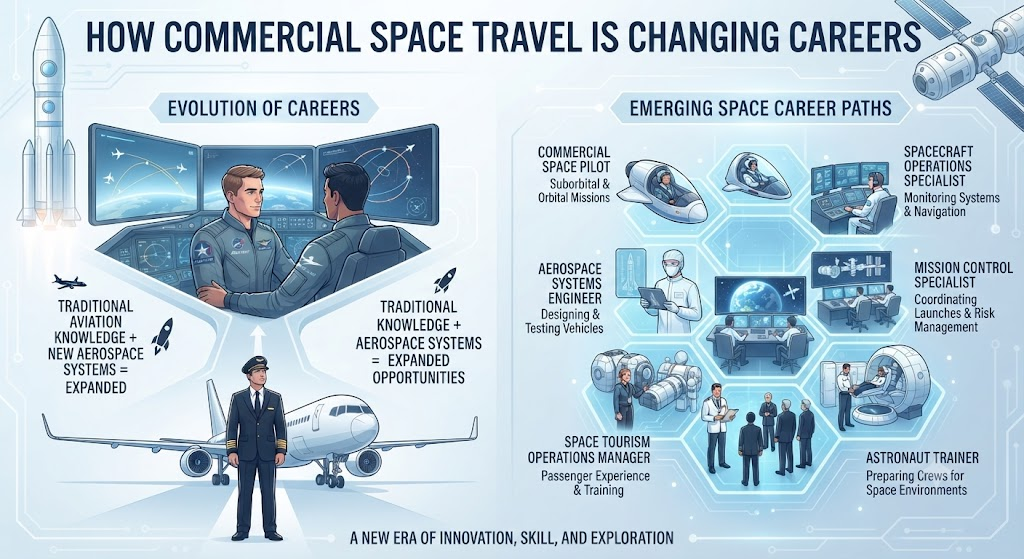
Commercial space travel is creating careers that did not exist widely before. These roles combine aviation, engineering, science, operations, safety, training, and customer experience.
Commercial Space Pilot
A commercial space pilot may operate or support spacecraft during suborbital or orbital missions. This role requires strong knowledge of flight systems, navigation, safety procedures, and emergency response.
Future space pilots may need experience in aviation, flight simulation, high-performance aircraft, and advanced aerospace systems. They must also understand how spacecraft behave differently from aircraft.
Spacecraft Operations Specialist
Spacecraft operations specialists help monitor and manage spacecraft systems before, during, and after missions. They may work with navigation, communication, propulsion, life-support systems, and onboard controls.
This role is important because commercial space vehicles depend on precise coordination and technical accuracy.
Mission Control Specialist
Mission control specialists support flight teams from the ground. They monitor spacecraft performance, communicate with crew members, review mission data, and help manage emergencies.
This career requires attention to detail, calm decision-making, teamwork, and strong technical understanding.
Aerospace Systems Engineer
Aerospace systems engineers design, test, and improve spacecraft systems. They may work on propulsion, structures, avionics, safety systems, or environmental controls.
Their work helps make commercial space vehicles safer, more efficient, and more reliable.
Space Tourism Operations Manager
Space tourism operations managers focus on the passenger experience. They may handle training schedules, safety briefings, travel planning, customer support, and coordination between technical and hospitality teams.
As space tourism grows, this role will become more important.
Astronaut Trainer
Astronaut trainers prepare passengers and crew members for spaceflight. Training may include emergency procedures, communication protocols, physical preparation, simulation exercises, and weightlessness awareness.
This career is suitable for professionals with aviation, fitness, education, or aerospace training experience.
Space Safety Specialist
Space safety specialists focus on risk management. They help design safety procedures, emergency plans, crew protection systems, and mission readiness checks.
Safety is one of the most important areas in commercial space travel because every mission involves high technical and physical risk.
Flight Simulation Instructor
Flight simulation instructors train pilots, crew members, and operations teams using advanced simulators. These simulators help people practice real mission situations before actual flight.
This role is ideal for those who enjoy teaching, aviation systems, and technology.
Space Communications Specialist
Space communications specialists manage communication between spacecraft, ground stations, mission control, and crew members. Clear communication is critical during launch, flight, re-entry, and landing.
This job requires technical knowledge, accuracy, and strong communication skills.
How Pilot Careers Are Evolving
Pilot careers are changing because future flight is becoming more connected with automation, spacecraft technology, and advanced aerospace systems. Traditional pilots focus mainly on aircraft operations within Earth’s atmosphere. Spaceflight introduces new challenges such as microgravity, high-speed travel, re-entry, and spacecraft system monitoring.
Future pilots may need to understand:
- Aircraft and spacecraft systems
- Automated flight controls
- Advanced navigation
- Emergency procedures
- High-altitude flight behavior
- Space mission operations
- Crew coordination
- Passenger safety in unusual environments
Commercial space travel may not replace traditional aviation careers, but it will expand them. A pilot may begin in aviation and later move into spaceflight training, spacecraft operations, simulation instruction, safety management, or aerospace consulting.
Skills Needed for Future Space Careers
Commercial space careers require a mix of technical, physical, and personal skills. Not every role requires becoming an astronaut, but most roles need strong discipline and continuous learning.
Important skills include:
- Strong science and mathematics knowledge
- Understanding of aviation basics
- Problem-solving ability
- Communication skills
- Leadership
- Teamwork
- Decision-making under pressure
- Adaptability
- Computer and software knowledge
- Physical fitness
- Mental resilience
- Safety awareness
Space careers are not only for engineers. The industry also needs managers, trainers, medical professionals, legal experts, communication specialists, customer experience teams, and operations professionals.
Education Pathways for Commercial Space Careers
There are many ways to prepare for a career in commercial space travel. The right pathway depends on the role a person wants.
Pilot aspirants may begin with aviation training, flight school, simulator experience, and strong knowledge of aircraft systems. Engineering students may choose aerospace engineering, mechanical engineering, electrical engineering, robotics, or computer science.
Useful educational areas include:
- Pilot training
- Aerospace engineering
- Aviation management
- Space science
- Physics
- Mathematics
- Computer science
- Robotics
- Artificial intelligence
- Mechanical engineering
- Electrical engineering
- Safety management
- Flight simulation training
Internships, workshops, research projects, and aerospace clubs can also help students gain practical exposure.
Emerging Technologies Driving Career Growth
Commercial space travel is growing because of powerful new technologies. These technologies are also creating new jobs.
Reusable Spacecraft
Reusable spacecraft reduce mission costs and make frequent launches more practical. This creates demand for maintenance engineers, inspection teams, launch crews, and operations specialists.
Artificial Intelligence
AI can support mission planning, spacecraft monitoring, predictive maintenance, and automated decision-making. Professionals with AI and aviation knowledge may find strong opportunities.
Autonomous Flight Systems
Many modern spacecraft use automated systems for navigation, landing, and safety checks. This creates careers in software development, avionics, control systems, and testing.
Robotics
Robots may support spacecraft maintenance, lunar missions, cargo handling, and space station operations. Robotics professionals will play an important role in future space missions.
Satellite Technology
The growing satellite industry needs launch specialists, data analysts, communications experts, and mission planners.
Commercial Space Stations
Future commercial space stations may create careers in hospitality, research, engineering, logistics, safety, and space operations.
Challenges of Working in Commercial Space
Commercial space careers are exciting, but they are also challenging. The industry requires high safety standards, advanced training, and strong technical knowledge.
Some major challenges include:
- Competitive job market
- Strict safety requirements
- Long training periods
- Physical and mental pressure
- Rapid technology changes
- Complex regulations
- High responsibility
- Need for continuous learning
People interested in space careers must be patient and prepared for long-term skill development.
Benefits of Choosing a Commercial Space Career
Commercial space travel offers many benefits for students and professionals who want future-focused careers.
Key benefits include:
- Work in a fast-growing industry
- Exposure to advanced technology
- Global career opportunities
- High-value professional skills
- Diverse job roles
- Strong innovation environment
- Opportunity to contribute to space exploration
- Career growth beyond traditional aviation
For pilot aspirants, commercial space travel adds a new direction to aviation dreams. It shows that flying careers can extend beyond airports and aircraft into spacecraft, spaceports, and mission control centers.
Tips for Students Interested in Space Careers
Students who want to enter commercial space careers should start early and build a strong foundation.
Helpful tips include:
- Focus on science and mathematics
- Learn aviation basics
- Improve English communication
- Practice problem-solving
- Learn programming basics
- Join aerospace or aviation clubs
- Attend aviation and space workshops
- Gain internship experience
- Follow space industry developments
- Build leadership and teamwork skills
- Stay physically and mentally fit
A successful space career is built step by step. Strong fundamentals matter more than shortcuts.
Common Myths About Space Careers
Myth 1: Only Astronauts Can Work in Space
This is not true. The space industry needs thousands of people on the ground, including engineers, trainers, technicians, analysts, managers, doctors, and safety experts.
Myth 2: Only Engineers Are Needed
Engineering is important, but commercial space travel also needs pilots, operations teams, customer service professionals, legal experts, medical teams, and educators.
Myth 3: Space Careers Are Impossible to Enter
Space careers are competitive, but not impossible. With the right education, training, internships, and skills, students can prepare for future opportunities.
Myth 4: Commercial Space Travel Is Only About Tourism
Space tourism is one part of the industry. Commercial space also includes satellites, research, logistics, manufacturing, communication, and exploration.
Myth 5: Pilots Have No Role in Future Spaceflight
Pilots will continue to play an important role, especially in safety, training, flight operations, simulation, and spacecraft mission support.
The Future of Commercial Space Careers
The future of commercial space careers looks promising. As space tourism expands and private companies develop new spacecraft, more professionals will be needed across different departments.
Future opportunities may grow in:
- Space tourism operations
- Commercial astronaut training
- Orbital travel support
- Space station management
- Lunar mission planning
- Space logistics
- Satellite operations
- Space manufacturing
- Aerospace safety
- AI-driven spacecraft systems
Commercial space travel will create a bridge between aviation and space exploration. This means pilot aspirants, engineers, and students will have more career choices than ever before.
FAQs
1. What is commercial space travel?
Commercial space travel means space missions, passenger flights, satellite launches, and other space services operated by private companies. It includes space tourism, cargo missions, research flights, and commercial spacecraft operations.
2. How is commercial space travel changing careers?
It is creating new jobs in spacecraft operations, mission control, astronaut training, safety management, aerospace engineering, and space tourism. It is also expanding opportunities for pilots and aviation professionals.
3. Can pilots become commercial space pilots?
Yes, pilots with strong aviation experience, technical knowledge, and advanced training may move toward commercial spaceflight careers. They may also work in simulation, mission operations, training, or safety roles.
4. Is aerospace engineering required for space careers?
Aerospace engineering is helpful for technical roles, but it is not required for every space career. The industry also needs professionals in operations, training, communication, safety, software, medicine, and management.
5. What skills are most important for commercial space careers?
Important skills include science knowledge, problem-solving, communication, teamwork, leadership, adaptability, technical understanding, and safety awareness. Continuous learning is also very important.
6. Are commercial space careers only for astronauts?
No. Astronauts are only one part of the space industry. Many professionals work behind the scenes in engineering, mission control, training, maintenance, data analysis, and operations.
7. How can students prepare for space careers?
Students should focus on STEM subjects, aviation basics, programming, communication, internships, and practical projects. Joining aerospace clubs and attending workshops can also help.
8. What role does technology play in commercial space careers?
Technology drives almost every part of commercial space travel. Reusable spacecraft, AI, robotics, automation, satellite systems, and advanced simulations are creating new career opportunities.
9. Is commercial space travel a good career field?
Yes, it can be a strong career field for people interested in aviation, science, engineering, and future technology. It offers growth, innovation, and diverse professional opportunities.
10. What is the future of pilot careers in space travel?
Pilot careers may expand into spacecraft operations, spaceflight training, mission planning, simulation instruction, and safety management. Future pilots may need both aviation and aerospace knowledge.
Conclusion
Commercial space travel is changing the meaning of aviation and aerospace careers. It is creating a new world where pilots, engineers, trainers, technicians, software experts, safety specialists, and mission planners can all contribute to space exploration.
For students and pilot aspirants, this is an exciting time to prepare for the future. The journey may require strong education, patience, discipline, and continuous learning, but the opportunities are growing. Commercial space travel is not only changing how people reach space; it is also changing how future careers are built.