
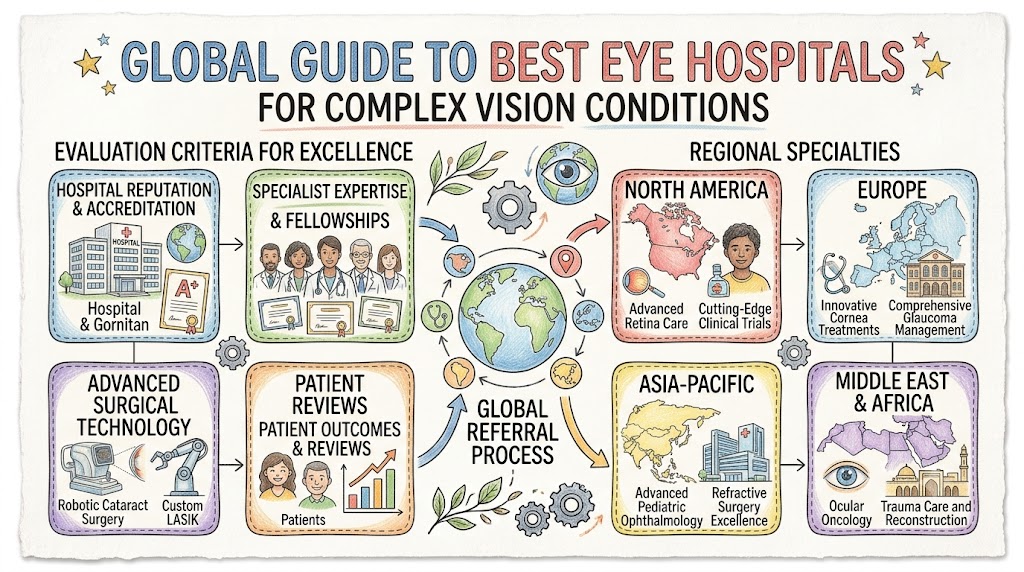
Finding appropriate care for a complex vision condition can be difficult. Patients may need to compare ophthalmologists, diagnostic technology, surgical departments, treatment costs, safety standards, recovery services, and long-term follow-up arrangements across several hospitals or countries.
The World Health Organization reports that at least 2.2 billion people globally have near or distance vision impairment. It identifies refractive errors, cataracts, diabetic retinopathy, glaucoma, and age-related macular degeneration among the leading causes of vision impairment and blindness. Timely access to suitable eye care can therefore be important for protecting vision and managing long-term conditions.
However, the term best eye hospitals should not be treated as a universal ranking. A hospital may be highly experienced in retinal surgery but may not be the most suitable centre for pediatric ophthalmology, corneal transplantation, ocular cancer, or neuro-ophthalmology.
The right choice depends on the patient’s diagnosis, disease severity, required specialist, available treatment options, overall health, budget, location, and follow-up needs. This guide explains how patients can compare eye hospitals around the world without relying only on advertising, reputation, or treatment prices.
What Are Complex Vision Conditions?
Complex vision conditions are eye disorders that may require advanced testing, subspecialist care, surgery, long-term treatment, or coordination between ophthalmology and other medical departments.
A condition may be considered complex when:
- The diagnosis is uncertain.
- More than one part of the eye is affected.
- Vision is deteriorating despite treatment.
- Previous surgery has caused complications.
- The condition is rare or inherited.
- Treatment requires highly specialized equipment.
- The eye problem is connected to another disease.
- The patient needs repeated surgery or long-term monitoring.
- Both eyes are affected differently.
- The patient is a child, elderly, or medically high-risk.
The National Eye Institute provides information on a wide range of common and uncommon disorders, including glaucoma, diabetic retinopathy, retinal detachment, corneal diseases, inherited retinal conditions, retinoblastoma, uveitis, and retinopathy of prematurity. This variety illustrates why complex cases may require access to several ophthalmology subspecialties.
Examples of Complex Eye Conditions
Patients may need specialized hospital care for conditions such as:
- Advanced or rapidly progressing glaucoma
- Diabetic retinopathy and diabetic macular edema
- Retinal detachment
- Macular holes or retinal membrane disorders
- Age-related macular degeneration
- Retinal vein or artery occlusion
- Keratoconus
- Corneal infections or severe scarring
- Corneal dystrophies
- Uveitis and ocular inflammation
- Inherited retinal diseases
- Optic nerve disorders
- Neuro-ophthalmic conditions
- Complicated cataracts
- Congenital eye disorders
- Retinopathy of prematurity
- Retinoblastoma and other eye tumours
- Serious eye trauma
- Complications from previous LASIK or cataract surgery
- Combined retina, cornea, and glaucoma conditions
These conditions do not always require surgery. Depending on the diagnosis, management may involve observation, medication, injections, laser treatment, surgery, rehabilitation, or a combination of approaches.
Why Choosing the Right Eye Hospital Matters
Complex eye care often involves more than selecting a well-known hospital. Patients must identify whether the institution has the appropriate department, specialists, testing facilities, surgical support, and follow-up services for their specific condition.
Selecting a suitable hospital can support:
- More complete diagnostic evaluation
- Access to the correct ophthalmology subspecialist
- Coordinated treatment planning
- Availability of medical and surgical alternatives
- Management of unexpected complications
- Emergency eye care
- Long-term disease monitoring
- Vision rehabilitation
- Communication with the patient’s local doctor
A hospital’s overall reputation does not guarantee equal expertise in every eye condition. Patients should investigate the strength of the specific department they need.
Important Ophthalmology Specialties
Retina and Vitreous Care
Retina specialists manage diseases affecting the retina and vitreous, including diabetic retinopathy, retinal detachment, macular disorders, retinal vascular disease, and some inherited conditions.
Services may include:
- Retinal imaging
- Eye injections
- Retinal laser treatment
- Vitrectomy
- Retinal-detachment repair
- Macular hole surgery
- Long-term disease monitoring
Some retinal symptoms may require urgent assessment. Patients should ask whether emergency retina services are available outside normal clinic hours.
Glaucoma Care
Glaucoma can damage the optic nerve and may progress without obvious symptoms in its early stages. Complex cases may require detailed pressure assessment, optic-nerve imaging, visual-field testing, medication, laser treatment, surgery, or combined management.
A suitable glaucoma department should be able to manage:
- Primary glaucoma
- Angle-closure glaucoma
- Childhood glaucoma
- Secondary glaucoma
- Advanced optic-nerve damage
- Glaucoma following previous surgery
- Patients who cannot tolerate standard medicines
Cornea and External Eye Disease
Cornea specialists treat conditions affecting the transparent front surface of the eye.
Relevant services may include:
- Corneal topography and tomography
- Keratoconus management
- Corneal cross-linking
- Treatment of corneal infections
- Specialty contact-lens services
- Corneal transplantation
- Management of severe dry eye
- Treatment of previous surgical complications
Patients considering corneal transplantation should ask about donor-tissue availability, waiting periods, transplant methods, rejection monitoring, and follow-up requirements.
Neuro-Ophthalmology
Neuro-ophthalmology focuses on visual problems related to the optic nerves, brain, eye movement, and nervous system.
Patients may require coordinated evaluation involving:
- Ophthalmologists
- Neurologists
- Neurosurgeons
- Radiologists
- Endocrinologists
- Internal-medicine specialists
Symptoms such as unexplained vision loss, double vision, optic-nerve swelling, or unusual visual-field changes may require this type of combined assessment.
Pediatric Ophthalmology
Children require age-appropriate testing and treatment. Pediatric eye conditions may affect visual development, education, mobility, and quality of life.
Patients should check whether the hospital offers:
- Pediatric ophthalmologists
- Squint and amblyopia care
- Childhood cataract treatment
- Retinopathy-of-prematurity services
- Pediatric glaucoma care
- Genetic evaluation
- Child-friendly diagnostic facilities
- Pediatric anaesthesia support
- Long-term visual-development monitoring
Uveitis and Ocular Inflammation
Uveitis may be linked to infection, autoimmune disease, inflammatory disorders, or an unknown cause.
A specialist hospital may coordinate ophthalmology treatment with rheumatology, infectious-disease care, or internal medicine. Treatment often requires regular monitoring because both the condition and some medicines can produce complications.
Ocular Oncology
Eye tumours require highly specialized assessment. Care may involve ophthalmologists, oncologists, radiologists, pathologists, pediatric specialists, and rehabilitation professionals.
Patients should evaluate whether the hospital provides:
- Accurate tumour imaging
- Biopsy or pathology support
- Radiation or surgical treatment
- Childhood cancer services
- Genetic counselling
- Prosthetic and rehabilitation support
- Long-term cancer surveillance
Main Criteria for Comparing the Best Eye Hospitals
Patients should use a structured comparison rather than selecting a hospital based on one feature.
| Comparison Factor | What to Check | Why It Matters |
|---|---|---|
| Relevant specialty | A dedicated department for the diagnosed condition | Complex cases require condition-specific experience |
| Ophthalmologist’s training | Subspecialty qualifications and professional registration | General experience may not be enough for rare conditions |
| Similar-case experience | Frequency of treating comparable cases | Familiarity may support realistic planning |
| Diagnostic facilities | Appropriate scans, measurements, and laboratory support | Detailed testing may be necessary before treatment |
| Treatment range | Medication, laser, injection, and surgical options | Multiple options allow more individualized planning |
| Multidisciplinary support | Access to neurology, oncology, diabetes, or pediatric teams | Some eye diseases are connected to wider health conditions |
| Surgical safety | Infection control, anaesthesia, emergency, and complication protocols | Complex procedures require coordinated safety systems |
| Follow-up services | Reviews, imaging, rehabilitation, and remote coordination | Long-term monitoring may be essential |
| Cost transparency | Written estimates and clear exclusions | Helps reduce unexpected expenses |
| Communication | Language support and clear informed consent | Patients must understand risks, benefits, and alternatives |
Specialist Expertise and Experience
The doctor’s experience should be assessed separately from the hospital’s overall reputation.
Patients can ask:
- Is the doctor a general ophthalmologist or a subspecialist?
- Does the specialist regularly treat this condition?
- How frequently is the proposed procedure performed?
- Does the doctor manage complicated or previously treated cases?
- Who will perform the surgery?
- Will trainees or other doctors participate?
- Who will manage follow-up appointments?
- What happens if a complication develops?
Procedure numbers alone do not confirm quality. Experience should be considered together with clinical judgment, communication, transparency, safety practices, and the hospital’s support services.
Advanced Diagnostic Technology
Complex vision conditions may require several tests before treatment can be planned.
Depending on the condition, a hospital may use:
- Optical coherence tomography
- OCT angiography
- Fundus photography
- Fluorescein angiography
- Visual-field testing
- Corneal topography
- Corneal tomography
- Pachymetry
- Optical biometry
- Eye ultrasound
- Retinal electrophysiology
- Wavefront analysis
- Genetic testing
- Neurological imaging
Advanced technology does not automatically make one hospital better than another. Equipment should be modern, properly maintained, and used by trained professionals who can interpret the results accurately.
Patients should ask why each test is needed and how its findings may affect treatment.
Multidisciplinary Treatment Support
Some eye conditions are related to broader medical problems.
Examples include:
- Diabetes and diabetic retinopathy
- Autoimmune disease and uveitis
- Neurological disease and optic-nerve problems
- Thyroid disease and eye complications
- Cancer and ocular tumours
- Genetic disorders and inherited retinal disease
- Premature birth and retinal development
- Trauma affecting the eye, face, or brain
A multidisciplinary hospital may offer faster communication between departments. This can be valuable when medical conditions, medicines, anaesthesia risks, or other treatments influence eye care.
Accreditation and Quality Standards
Hospital accreditation can be a useful starting point when comparing facilities. Joint Commission International describes its standards as part of an evaluation process intended to help healthcare organizations measure, assess, and improve performance, quality, and patient safety.
Patients may check for recognized national or international accreditation, but accreditation should not be treated as a guarantee of successful treatment.
Other quality indicators include:
- Valid professional registration of doctors
- Clear patient-identification procedures
- Infection-control policies
- Surgical safety checks
- Medication-management systems
- Emergency response arrangements
- Documented informed consent
- Complication-reporting systems
- Secure medical records
- Patient feedback and complaint procedures
The relevant department’s expertise remains as important as institutional accreditation.
Comparing Hospitals Across Different Countries
International treatment may be considered because of specialist availability, waiting times, technology, treatment cost, or access to procedures not readily available locally.
However, patients should not assume that travelling abroad automatically provides better care.
Compare the following factors:
Medical Expertise
Check whether the hospital has established experience in the required subspecialty rather than relying on general claims about international standards.
Waiting Time
Some conditions require prompt care. Ask how quickly consultation, testing, and treatment can be arranged.
Travel Fitness
Long-distance travel may not be advisable immediately before or after certain procedures. The treating ophthalmologist should provide individualized guidance.
Language Support
Medical interpretation should be accurate. Family members may not always be suitable substitutes for trained interpreters during complex consultations.
Legal and Regulatory Standards
Medical licensing, informed consent, complaint procedures, and patient rights vary between countries.
Follow-Up Arrangements
The hospital should explain how care will continue after the patient returns home.
Emergency Planning
Patients should know whom to contact if pain, redness, reduced vision, discharge, or another urgent symptom develops after treatment.
Understanding Eye Treatment Costs
Treatment prices vary by country, city, hospital, doctor, diagnosis, procedure, technology, admission requirements, and follow-up schedule.
A quoted surgery price may not represent the total expense.
| Cost Component | Possible Inclusions | Important Question |
|---|---|---|
| Specialist consultation | Examination and initial opinion | Are additional specialist opinions charged separately? |
| Diagnostic testing | Scans, imaging, measurements, and laboratory tests | Which tests are included in the estimate? |
| Surgeon’s fee | Treatment planning and procedure | Is the named specialist performing the surgery? |
| Hospital charges | Operating room, nursing, and recovery services | Is overnight admission included? |
| Anaesthesia | Anaesthetist, monitoring, and medicines | Which type of anaesthesia is planned? |
| Implant or medical device | Lens, drainage device, graft, or disposable equipment | Are different options available at different prices? |
| Medicines | Eye drops, injections, and postoperative drugs | Are take-home medicines included? |
| Follow-up care | Reviews, scans, and dressing changes | How many visits are covered? |
| Additional treatment | Unexpected tests or procedures | How are complications billed? |
| Travel and stay | Transport, accommodation, food, and caregiver expenses | How long must the patient remain nearby? |
Patients should request a written estimate that explains:
- Included services
- Excluded services
- Possible additional charges
- Refund and cancellation rules
- Payment schedule
- Insurance requirements
- Currency used
- Expected length of stay
- Cost of further treatment
- Cost of complication management
Medical Tourism for Complex Eye Care
International patients should prepare carefully before travelling.
Collect Complete Medical Records
Records may include:
- Recent eye examination reports
- Scans and images
- Visual-field results
- Previous surgical notes
- Current prescriptions
- Medicine and allergy lists
- Diabetes and blood-pressure records
- Relevant neurological or genetic reports
Request a Preliminary Medical Review
Some hospitals may provide an initial review based on records. This does not replace an in-person examination, but it may help determine whether the hospital has appropriate expertise.
Confirm the Required Stay
The patient may need to remain near the hospital for several days or weeks, depending on the procedure and follow-up schedule.
Arrange Local Follow-Up
Before travelling, identify an ophthalmologist near home who can manage continued care after the patient returns.
Plan for a Caregiver
Patients with limited vision, mobility issues, language difficulties, or major surgery may need a responsible companion.
Questions Patients Should Ask the Hospital
Before making a decision, patients should ask:
- Which subspecialist will manage my condition?
- How frequently does the doctor treat similar cases?
- Which tests are required before confirming treatment?
- Are non-surgical or alternative options available?
- What are the expected benefits and limitations?
- What are the important short-term and long-term risks?
- Who will perform the procedure?
- How long may recovery take?
- How many follow-up visits will be needed?
- What symptoms require emergency attention?
- Who will provide care after I return home?
- What is included in the written cost estimate?
- How are unexpected complications managed?
- Can I obtain a second opinion before treatment?
- Will my complete medical records be provided afterward?
Common Mistakes to Avoid
Depending Only on Rankings
Hospital rankings may use different criteria and may not measure expertise in the patient’s particular condition.
Choosing Only by Price
The least expensive quotation may exclude diagnostic tests, devices, medicines, admission, or follow-up care.
Focusing Only on Technology
Modern equipment is useful, but trained specialists, accurate interpretation, and appropriate treatment planning are equally important.
Ignoring the Treating Doctor
A well-known hospital may not always assign its most experienced specialist to every patient. Confirm who will personally manage the case.
Assuming Surgery Is the Only Option
Some complex conditions may be treated with medicines, injections, laser therapy, observation, or rehabilitation.
Travelling Without a Recovery Plan
The patient may need repeated reviews, restrictions on travel, caregiver assistance, or extended accommodation.
Believing Guaranteed-Result Claims
No responsible hospital can guarantee perfect vision, permanent correction, painless treatment, or zero complications.
Skipping a Second Opinion
Another specialist’s assessment may confirm the recommendation or identify alternative options.
Hiding Medical Information
Patients should disclose medicines, allergies, previous surgery, diabetes, blood pressure, pregnancy, and other relevant conditions.
Ignoring Long-Term Follow-Up
Complex conditions may require monitoring for months or years, even after technically successful treatment.
Step-by-Step Hospital Selection Process
Step 1: Confirm the Diagnosis
Obtain a complete eye examination and request copies of all reports, scans, prescriptions, and previous treatment records.
Step 2: Identify the Required Specialty
Determine whether the condition requires retina, glaucoma, cornea, pediatric, neuro-ophthalmology, uveitis, or another service.
Step 3: Shortlist Suitable Hospitals
Choose hospitals with dedicated expertise in the relevant condition.
Step 4: Review the Specialist
Check the treating ophthalmologist’s qualifications, registration, subspecialty, and experience.
Step 5: Compare Diagnostic Facilities
Confirm that the hospital can perform the tests required for accurate treatment planning.
Step 6: Compare Treatment Recommendations
Evaluate the proposed procedure, alternatives, limitations, risks, recovery, and urgency.
Step 7: Request a Written Cost Estimate
Compare the complete cost rather than only the advertised procedure fee.
Step 8: Review Safety and Accreditation
Check institutional standards, infection control, surgical safety, and emergency support.
Step 9: Obtain a Second Opinion
A second opinion may be valuable before major, expensive, or irreversible treatment.
Step 10: Plan Follow-Up Care
Confirm where reviews will take place and who will manage care after the patient returns home.
Key Takeaways
- The best eye hospital depends on the patient’s specific condition.
- Complex cases often require an ophthalmology subspecialist.
- Hospital reputation should be evaluated together with doctor experience.
- Advanced technology should support, not replace, clinical judgment.
- Accreditation is useful but does not guarantee successful results.
- Patients should compare complete treatment costs.
- A second opinion may support better-informed decisions.
- International patients need travel and recovery planning.
- Follow-up arrangements should be confirmed before treatment.
- Guaranteed-result claims should be treated cautiously.
Frequently Asked Questions
1. What makes an eye hospital suitable for complex vision conditions?
A suitable hospital should have relevant subspecialists, advanced diagnostic facilities, appropriate medical and surgical options, emergency support, and organized follow-up care. The hospital should also be able to coordinate with neurology, diabetes, oncology, pediatrics, or other departments when the eye condition is connected to a wider medical problem.
2. How can patients identify the best eye hospitals in the world?
Patients should compare hospitals according to their specific diagnosis rather than relying on one global ranking. Important factors include subspecialist experience, diagnostic facilities, treatment range, accreditation, safety systems, cost transparency, communication, complication management, and follow-up support.
3. Is a famous eye hospital always the right choice?
Not necessarily. A famous hospital may have an excellent general reputation but limited expertise in a particular rare or complex condition. Patients should investigate the relevant department and treating ophthalmologist instead of choosing only through brand recognition.
4. Should patients choose a hospital with the newest technology?
Technology is one consideration, but it should not be the only deciding factor. Modern equipment must be used and interpreted by qualified professionals. Specialist expertise, accurate diagnosis, treatment alternatives, safety systems, and long-term support are equally important.
5. Is accreditation enough to confirm hospital quality?
Accreditation indicates that a hospital has been evaluated against defined organizational and safety standards. It does not guarantee that every department has equal expertise or that treatment will be successful. Patients should also assess the specialist, facilities, treatment experience, and follow-up services.
6. When should a patient obtain a second opinion?
A second opinion may be useful before major surgery, irreversible treatment, expensive care, international travel, or when the diagnosis is uncertain. It may confirm the original recommendation, provide another option, or help the patient understand risks and realistic expectations.
7. What records should international patients provide?
Patients should provide examination reports, scans, visual-field tests, prescriptions, previous surgical notes, medicine lists, allergies, and relevant medical records. Complete information helps the hospital understand the case, although an in-person examination may still be required before finalizing treatment.
8. How should treatment costs be compared?
Compare the complete estimated cost, including consultation, diagnostic testing, surgeon’s fee, hospital charges, anaesthesia, medical devices, medicines, follow-up visits, travel, accommodation, and possible additional treatment. Request written clarification about included and excluded services.
9. How important is follow-up after complex eye treatment?
Follow-up can be essential for monitoring healing, eye pressure, infection, inflammation, retinal changes, implant position, or disease progression. Some patients need reviews for weeks, while chronic conditions may require lifelong monitoring. Follow-up arrangements should be confirmed before treatment begins.
10. How can BestEyeHospitals.com help patients?
BestEyeHospitals.com can help patients research hospitals, ophthalmologists, treatments, technology, costs, locations, and recovery services. It should be used as an informational comparison resource rather than a replacement for medical examination or personalized guidance from a qualified ophthalmologist.
Conclusion
Choosing among the best eye hospitals for a complex vision condition requires careful comparison of subspecialist expertise, diagnostic services, treatment options, hospital safety, costs, communication, and follow-up support. Patients should not select a hospital only because it is famous, highly ranked, internationally located, or less expensive. The most suitable choice is generally the hospital that can manage the patient’s specific condition with appropriate expertise and coordinated care. BestEyeHospitals.com can support the research process by helping patients understand hospitals, doctors, procedures, costs, technology, and treatment destinations. Final decisions should be made after a complete examination and personalized consultation with a qualified ophthalmologist.