Introduction
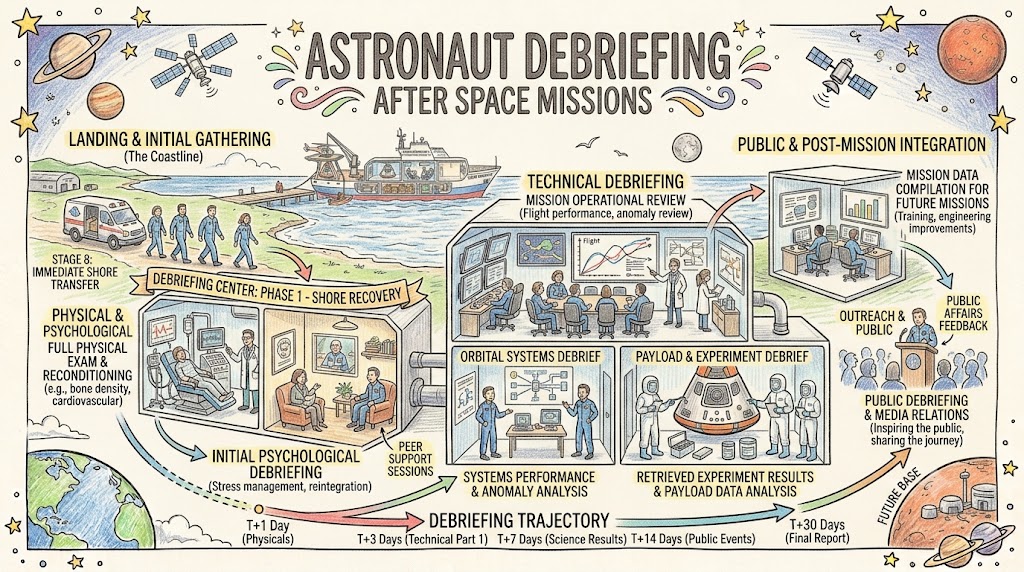
When astronauts return to Earth, their mission is not finished. After landing, recovery, and medical checks, they take part in a detailed debriefing process.
Astronaut debriefing after space missions allows space agencies to understand what happened during the flight from the crew’s perspective. Astronauts describe spacecraft performance, living conditions, technical problems, physical effects, communication quality, emergency responses, and scientific activities.
Sensors and computers collect large amounts of mission data, but they cannot fully explain what astronauts saw, heard, felt, or experienced. Human observations often reveal details that instruments may miss.
Debriefing helps engineers improve spacecraft, doctors study the effects of spaceflight, trainers update procedures, and mission planners prepare future crews more effectively.
This guide explains the complete astronaut debriefing process in simple language for students and spaceflight learners.
What Is Astronaut Debriefing?
Astronaut debriefing is a structured review conducted after a space mission.
During the review, astronauts answer questions about their experiences before launch, during flight, and after landing.
The process may include:
- Individual interviews
- Full-crew discussions
- Technical system reviews
- Medical evaluations
- Psychological assessments
- Scientific experiment reports
- Emergency procedure reviews
- Training effectiveness discussions
The purpose is not simply to ask whether the mission was successful. The goal is to understand exactly what worked, what failed, what was difficult, and what should change.
Why Astronaut Debriefing Is Important
Space missions are complex and expensive. Small improvements can make future flights safer and more efficient.
Debriefing is important because astronauts may notice problems that do not appear clearly in technical data.
For example, an instrument may show that a switch worked correctly, but the astronaut may report that it was difficult to reach while wearing gloves.
A communication system may function normally, but the crew may explain that instructions were confusing during a stressful situation.
Astronaut feedback helps improve:
- Spacecraft design
- Crew training
- Emergency procedures
- Mission schedules
- Communication systems
- Living conditions
- Medical preparation
- Scientific operations
- Landing and recovery plans
When Does the Debriefing Process Begin?
The first debriefing usually begins shortly after landing, but only after immediate crew safety and medical needs are addressed.
The complete process may continue for days, weeks, or even months.
Different stages may include:
Immediate Debriefing
This happens soon after recovery.
Astronauts report urgent information such as:
- Crew injuries
- Landing problems
- Smoke or unusual smells
- System failures
- Communication loss
- Unexpected spacecraft movement
- Emergency events
Early Post-Flight Debriefing
This usually occurs after the crew has rested and completed initial medical checks.
The astronauts discuss major mission events while memories are still fresh.
Detailed Technical Debriefing
Engineers and specialists ask detailed questions about individual spacecraft systems and procedures.
Long-Term Follow-Up
Doctors, psychologists, and researchers continue monitoring astronauts over time.
Long-term debriefing may focus on health, recovery, sleep, stress, and adjustment to Earth.
Who Participates in Astronaut Debriefing?
Many specialists may take part in the process.
Participants can include:
- Astronauts
- Mission commanders
- Flight directors
- Engineers
- Doctors
- Psychologists
- Scientists
- Trainers
- Safety specialists
- Communication teams
- Spacecraft manufacturers
- Recovery personnel
Each group asks questions related to its area of responsibility.
An engineer may ask about a control panel, while a doctor may ask about dizziness or sleep.
Main Types of Astronaut Debriefing
Astronaut debriefing is divided into several categories.
Crew Operations Debriefing
This review focuses on how the astronauts worked together.
Topics may include:
- Leadership
- Decision-making
- Task sharing
- Communication
- Conflict management
- Workload distribution
- Team coordination
- Fatigue management
Crew teamwork is especially important during long missions.
Spacecraft Systems Debriefing
Astronauts describe how spacecraft systems performed.
Systems may include:
- Navigation
- Life support
- Electrical power
- Communication
- Computers
- Propulsion
- Thermal control
- Waste management
- Cabin pressure
- Emergency equipment
The crew may report unusual sounds, delays, vibrations, smells, display problems, or difficult controls.
Scientific Experiment Debriefing
Astronauts explain how scientific tasks were performed.
They may discuss:
- Experiment instructions
- Equipment performance
- Sample handling
- Time available
- Unexpected results
- Problems caused by microgravity
- Storage conditions
- Data recording
Scientists use this information to improve future experiments.
Medical Debriefing
Doctors ask astronauts about physical changes during and after the mission.
Topics may include:
- Motion sickness
- Headaches
- Vision changes
- Muscle weakness
- Back pain
- Sleep quality
- Appetite
- Fatigue
- Balance problems
- Radiation exposure
Medical debriefing supports astronaut health and future mission planning.
Psychological Debriefing
Spaceflight can create emotional and mental pressure.
Astronauts may discuss:
- Stress
- Isolation
- Homesickness
- Anxiety
- Motivation
- Team relationships
- Workload
- Privacy
- Communication with family
- Emotional response to emergencies
Psychological debriefing is especially important after long-duration missions.
Launch Debriefing
Astronauts review the launch experience.
They may describe:
- Noise
- Vibration
- G-forces
- Seat comfort
- Communication
- Vehicle movement
- Emergency readiness
- Instrument visibility
Launch feedback helps engineers improve crew protection and training.
Reentry and Landing Debriefing
The crew describes the return to Earth.
Topics may include:
- Reentry heating
- Spacecraft orientation
- G-forces
- Communication blackout
- Parachute deployment
- Landing impact
- Splashdown movement
- Recovery delays
- Crew discomfort
This information improves future landing systems.
Emergency Procedure Debriefing
Any unusual event receives special attention.
Astronauts may explain:
- What happened
- When it happened
- What warnings appeared
- How the crew responded
- Which procedures were followed
- Whether instructions were clear
- How mission control helped
- What should be changed
Emergency debriefing is focused on learning, not blaming.
How the Debriefing Process Works
Astronaut debriefing usually follows a structured process.
Step One: Collect Immediate Observations
Astronauts report urgent problems immediately after landing.
Step Two: Separate Medical and Technical Reviews
Medical information is reviewed privately, while technical information is shared with engineering teams.
Step Three: Conduct Individual Interviews
Each astronaut is interviewed separately.
This helps specialists collect personal observations without influence from other crew members.
Step Four: Conduct Group Discussions
The crew then discusses the mission together.
Group discussions help compare different viewpoints.
Step Five: Review Mission Data
Astronaut reports are compared with:
- Sensor data
- Video recordings
- Audio communication
- Computer logs
- Medical records
- Engineering measurements
Step Six: Identify Lessons Learned
Teams determine which problems require changes.
Step Seven: Prepare Recommendations
Recommendations may affect spacecraft design, training, procedures, or mission planning.
Why Astronauts Are Interviewed Separately
Individual interviews help collect independent memories.
Two astronauts may experience the same event differently.
For example:
- One astronaut may notice a strong vibration.
- Another may notice a delayed warning.
- A third may focus on communication confusion.
Separate interviews help investigators avoid group influence.
Later, the crew compares experiences during a group session.
How Human Memory Affects Debriefing
Human memory is useful but not perfect.
Stress, fatigue, fear, excitement, and time can affect how events are remembered.
For this reason, debriefing begins as soon as practical.
Specialists compare astronaut statements with technical data.
They may use:
- Mission timelines
- Audio recordings
- Video footage
- Computer logs
- Sensor records
- Written notes
- Photographs
This helps create a more accurate understanding of the mission.
What Questions Are Asked During Debriefing?
Questions are usually detailed and organised by mission phase.
Examples include:
- Was the spacecraft easy to control?
- Were warning messages clear?
- Did any equipment feel difficult to use?
- Was the crew workload manageable?
- Were emergency procedures realistic?
- Did the crew have enough rest?
- Were scientific instructions easy to follow?
- Did communication with mission control work well?
- Were there any unusual sounds or smells?
- How did the crew feel during reentry and landing?
Open questions are often used so astronauts can explain events fully.
Reviewing Crew Workload
Mission planners study whether astronauts had too much or too little work.
Excessive workload can cause:
- Fatigue
- Stress
- Errors
- Missed tasks
- Reduced communication
- Poor decision-making
Astronauts may explain which activities took longer than expected.
This helps planners create more realistic schedules.
Reviewing Spacecraft Habitability
Astronauts live in small spaces for long periods.
Debriefing may examine:
- Sleeping areas
- Lighting
- Noise
- Temperature
- Food
- Hygiene
- Privacy
- Storage
- Exercise equipment
- Cabin layout
Habitability affects health, comfort, and mission performance.
Reviewing Food and Nutrition
Astronauts may discuss:
- Food taste
- Portion size
- Packaging
- Preparation time
- Menu variety
- Appetite changes
- Crumbs or spills
- Nutritional needs
Food quality can strongly affect morale during long missions.
Reviewing Sleep Quality
Sleep is a major topic in post-mission reviews.
Astronauts may experience difficulty sleeping because of:
- Noise
- Light
- Work schedules
- Stress
- Microgravity
- Temperature
- Emergency alarms
- Changing day-night cycles
Poor sleep can reduce concentration and decision-making ability.
Reviewing Communication With Mission Control
Clear communication is essential during spaceflight.
Astronauts evaluate:
- Radio quality
- Instruction clarity
- Communication delays
- Information overload
- Emergency guidance
- Decision authority
- Schedule updates
Future missions to distant locations may experience long communication delays.
Debriefing helps prepare crews for more independent decision-making.
Reviewing Training Effectiveness
Astronauts compare actual mission conditions with their pre-flight training.
They may answer:
- Which simulations were realistic?
- Which procedures were missing?
- Which training exercises were most useful?
- Were emergency scenarios accurate?
- Was equipment training sufficient?
- Did physical training prepare the crew?
Training programmes are updated using this feedback.
Reviewing Spacesuits
Astronauts may report on spacesuit performance.
Topics can include:
- Fit
- Mobility
- Glove control
- Cooling
- Pressure
- Visibility
- Communication
- Fatigue
- Joint movement
- Emergency performance
Even small design problems can become serious during spacewalks.
Reviewing Spacewalks
Spacewalk debriefing is especially detailed.
Astronauts may describe:
- Movement difficulty
- Tool handling
- Hand fatigue
- Suit pressure
- Lighting
- Safety tethers
- Communication
- Task timing
- Unexpected hazards
This information improves future spacewalk training and equipment.
Reviewing Scientific Work
Scientists want to know whether experiments were practical in microgravity.
Astronauts may explain:
- Whether instructions were clear
- Whether tools floated away
- Whether samples were difficult to handle
- Whether time was sufficient
- Whether equipment failed
- Whether unexpected results occurred
Human feedback can be as important as scientific measurements.
Reviewing Robotic Operations
Astronauts may control robotic arms, vehicles, or docking systems.
Debriefing can examine:
- Camera visibility
- Control sensitivity
- Display clarity
- Response time
- Automation
- Manual backup systems
- Training quality
Robotic feedback supports future missions to the Moon, Mars, and asteroids.
Reviewing Medical Events
Any medical issue during the mission is carefully reviewed.
Doctors may study:
- Symptoms
- Treatment
- Medication effectiveness
- Medical equipment
- Communication with doctors
- Privacy
- Emergency response
Future crews may travel far from Earth, so medical independence will become more important.
Reviewing Crew Psychology
Long missions can create psychological challenges.
Debriefing may examine:
- Group stress
- Isolation
- Leadership
- Personality differences
- Conflict
- Motivation
- Privacy needs
- Communication with family
This information helps agencies select and train future crews.
Confidentiality During Debriefing
Some astronaut debriefing information is private.
Medical and psychological details are usually protected.
Technical information may also be restricted if it involves security or spacecraft design.
However, general lessons may be shared with engineers, researchers, and future astronauts.
Confidentiality helps astronauts speak honestly.
How Debriefing Improves Spacecraft Design
Astronaut feedback can lead to physical changes in spacecraft.
Examples may include:
- Moving switches
- Enlarging labels
- Improving seat support
- Reducing noise
- Changing lighting
- Redesigning storage
- Improving displays
- Adding handholds
- Updating emergency equipment
Crew feedback ensures that spacecraft are designed for real human use.
How Debriefing Improves Safety Procedures
Safety procedures are reviewed after every mission.
If a procedure was difficult or confusing, it may be rewritten.
Changes may include:
- Simpler instructions
- Clearer warning messages
- Better checklists
- Improved emergency training
- Additional backup systems
- Better crew communication
Small procedural changes can prevent major accidents.
How Debriefing Supports Future Missions
Lessons learned from one mission are used to improve the next.
Debriefing may influence:
- Crew selection
- Mission duration
- Training schedules
- Equipment design
- Medical planning
- Scientific experiments
- Landing procedures
- Food systems
- Communication methods
Knowledge is passed from experienced astronauts to future crews.
Difference Between Debriefing and Investigation
Debriefing and investigation are related but different.
A debriefing collects crew experiences and observations.
An investigation examines a specific failure, accident, or serious incident.
Investigations may involve:
- Independent experts
- Engineering analysis
- Hardware testing
- Computer simulations
- Formal reports
Astronaut debriefing often provides important evidence for an investigation.
Common Challenges During Astronaut Debriefing
Fatigue
Astronauts may be physically and mentally exhausted after landing.
Memory Differences
Crew members may remember the same event differently.
Emotional Stress
Difficult missions can be emotionally challenging to discuss.
Technical Complexity
A single issue may involve many connected systems.
Information Volume
Long missions produce enormous amounts of data.
Confidentiality
Some information cannot be widely shared.
Best Practices for Effective Debriefing
A useful astronaut debriefing should:
- Begin soon after landing
- Allow the crew to rest
- Use trained interviewers
- Include individual and group sessions
- Compare memories with technical data
- Avoid blame
- Protect medical privacy
- Record lessons clearly
- Assign responsibility for improvements
- Share findings with future crews
Why Debriefing Should Avoid Blame
The main purpose of debriefing is learning.
If astronauts fear punishment, they may avoid discussing mistakes or problems.
A strong safety culture encourages honest reporting.
Teams focus on questions such as:
- Why did the situation occur?
- Was the procedure clear?
- Was the equipment difficult to use?
- Was the crew overloaded?
- Could training be improved?
This approach creates safer future missions.
Student-Friendly Example of Debriefing
Imagine a school team completing a science competition.
After the event, the group discusses:
- What worked well
- What failed
- Which instructions were confusing
- Which tools were difficult to use
- How teamwork could improve
- What should change next time
Astronaut debriefing follows a similar idea, but the mission is much more complex.
The goal is to turn experience into practical improvements.
Common Misunderstandings About Astronaut Debriefing
Debriefing Is Not Just a Casual Conversation
It is a structured and detailed review.
It Does Not Happen Only Once
Debriefing may continue through several sessions.
It Is Not Limited to Technical Problems
Health, sleep, food, teamwork, and stress are also discussed.
Computers Cannot Replace Crew Feedback
Human observations provide information that sensors cannot capture.
Debriefing Is Not Mainly About Blame
Its main purpose is learning and improvement.
Future of Astronaut Debriefing
Future debriefing may use advanced technology.
Possible developments include:
- Artificial intelligence for transcript analysis
- Virtual mission replay
- Biometric data comparison
- Voice-stress analysis
- Immersive simulation
- Automated event timelines
- Digital crew journals
- Real-time psychological monitoring
Astronauts on future Moon and Mars missions may record debriefing notes during the mission because communication with Earth may be delayed.
Key Takeaways
- Astronaut debriefing begins after landing and medical recovery.
- Crews discuss technical, medical, scientific, and psychological experiences.
- Individual interviews collect independent observations.
- Group sessions compare crew perspectives.
- Astronaut reports are compared with spacecraft data.
- Debriefing helps improve spacecraft design and crew training.
- Medical and psychological information is handled confidentially.
- The process focuses on learning rather than blame.
- Lessons from one mission improve future spaceflight.
- Human feedback remains essential even in highly automated missions.
Frequently Asked Questions
What is astronaut debriefing?
Astronaut debriefing is a structured review in which crew members describe their experiences, problems, observations, and lessons after a space mission.
When does debriefing begin?
It usually begins after landing, recovery, and urgent medical checks. Detailed sessions may continue for weeks or months.
Why are astronauts interviewed separately?
Separate interviews help collect independent memories without influence from other crew members.
What topics are discussed?
Topics include spacecraft performance, health, teamwork, scientific tasks, communication, sleep, food, emergencies, reentry, and landing.
Is astronaut debriefing confidential?
Some medical, psychological, technical, and security information is confidential.
How is astronaut feedback checked?
Specialists compare astronaut statements with videos, audio, sensor data, computer logs, and mission timelines.
Can debriefing change spacecraft design?
Yes. Crew feedback can lead to changes in controls, seats, displays, lighting, storage, suits, and emergency systems.
Do astronauts discuss mistakes?
Yes. Honest reporting helps identify problems and prevent them from happening again.
How long does the debriefing process last?
Initial debriefing may take place within hours or days, while detailed medical and technical reviews can continue for months.
Why is human feedback still necessary?
Sensors record measurements, but astronauts can explain comfort, confusion, stress, visibility, sound, smell, and practical difficulties.
Conclusion
Astronaut debriefing after space missions is a vital learning process that turns crew experience into safer and more effective future missions. By reviewing spacecraft systems, health, teamwork, scientific work, training, reentry, and recovery, space agencies identify what worked and what needs improvement. Human observations remain essential because astronauts can describe details that technical instruments may not capture.