Introduction
Launching astronauts into space involves powerful rocket engines, large quantities of propellant, extreme vibration, rapidly changing air pressure, and complex guidance systems. Although launch vehicles are carefully designed and tested, mission planners must prepare for the possibility of a serious failure. Abort systems in spaceflight provide astronauts with a way to separate from a dangerous rocket, move to a safer distance, descend, and complete an emergency landing. These systems are among the most important safety features of a crewed spacecraft because launch emergencies can develop within seconds and may leave little time for human decision-making.
What Is an Abort System in Spaceflight?
An abort system is a collection of spacecraft hardware, software, sensors, operating procedures, and recovery arrangements intended to protect a crew when a mission can no longer continue safely.
A launch abort system, also called a launch escape system, normally protects astronauts while the spacecraft is on the launch pad or climbing toward space. It may use powerful rocket motors to separate the crew capsule from the launch vehicle.
A broader mission abort can happen after the launch escape system is no longer available. Depending on the spacecraft and mission phase, the crew may enter a lower orbit, return to Earth early, land at an alternative location, or use another safe-return procedure.
NASA describes Orion’s launch abort system as a safety system designed to carry the crew away from the rocket during a launch-pad or ascent emergency. It can activate extremely quickly, separate the crew module, control its orientation, and prepare it for a safe descent.
Why Abort Systems Are Important
A rocket contains fuel and oxidiser, high-pressure equipment, electrical systems, computers, engines, guidance hardware, and structural components. A major failure in any critical area could create an immediate danger for the crew.
Potential launch emergencies include:
- Engine failure
- Launch vehicle fire
- Propellant leakage
- Loss of guidance
- Structural breakup
- Booster separation failure
- Uncontrolled vehicle movement
- Electrical or computer failure
- Incorrect thrust
- Explosion risk
- Loss of communication
- Failure to reach the planned orbit
An abort system cannot prevent every rocket failure. Its purpose is to provide a separate protective capability that can move the astronauts away before the developing failure affects the crew capsule.
The system must operate quickly because some launch emergencies provide only seconds between the first warning and the loss of the vehicle.
Launch Abort, Mission Abort, and Flight Termination
These terms are related, but they do not mean exactly the same thing.
Launch Abort
A launch abort protects the astronauts during launch-pad operations or powered ascent. The spacecraft may separate from the rocket and descend under parachutes.
Mission Abort
A mission abort ends or changes the planned mission because continuing is no longer considered safe. It may happen during ascent, in orbit, near the Moon, or during another mission phase.
Flight Termination
A flight-termination system is primarily intended to protect people and property on the ground when an uncontrolled rocket becomes dangerous. It may destroy or disable the launch vehicle.
Flight termination is not the same as crew escape. In a crewed mission, the spacecraft’s abort system should separate the crew before a dangerous launch vehicle is terminated whenever the mission design allows it.
Emergency Return
An emergency return occurs after the spacecraft has already reached space. The crew may shorten the mission, perform a deorbit manoeuvre, and return to Earth earlier than planned.
Main Types of Spaceflight Abort Systems
Different spacecraft use different methods to protect their crews. The design depends on the capsule, rocket, mission destination, expected failure conditions, and landing method.
| Abort-system type | Basic method | Example programmes | Main characteristic |
|---|---|---|---|
| Tractor escape tower | Motors above the capsule pull it away | Mercury, Apollo, Soyuz and Orion | Powerful separation followed by tower jettison |
| Pusher abort system | Engines mounted on or below the capsule push it away | Crew Dragon and Starliner | Abort engines remain integrated with the spacecraft |
| Ejection seats | Individual seats remove astronauts | Gemini and early Space Shuttle flights | Protects individuals rather than the full spacecraft |
| Intact vehicle abort | The crew remains inside the spacecraft | Space Shuttle abort modes | Vehicle attempts orbit, runway return or another flight path |
| Ballistic capsule return | Capsule separates and follows a steep return path | Soyuz ascent aborts | High-force descent followed by parachute landing |
NASA technical studies describe tractor systems as designs that place abort motors above the spacecraft, while pusher systems position engines beside or below the crew vehicle. Each arrangement creates different aerodynamic, structural, mass, control, and engine-plume challenges.
How a Typical Launch Abort System Works
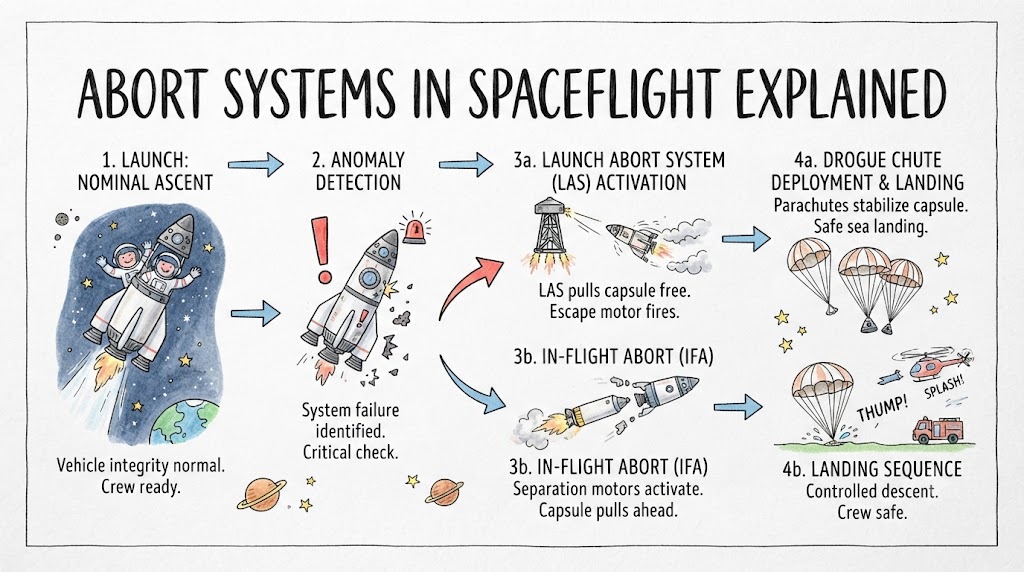
The exact sequence varies by spacecraft, but a capsule-based abort generally includes several important stages.
Emergency Detection
The spacecraft or launch vehicle detects a dangerous condition. Possible signals may include:
- Loss of engine thrust
- Unexpected vehicle rotation
- Structural failure
- Fire or explosion indicators
- Incorrect rocket staging
- Major guidance failure
- Loss of communication between critical computers
Some aborts can be commanded automatically, while others may be initiated by the crew or ground controllers. The available methods depend on the spacecraft design and mission phase.
Abort Activation
Once an abort is confirmed, high-powered motors or engines activate. They must produce enough acceleration to separate the crew capsule from the rocket before the hazard reaches it.
Vehicle Separation
Mechanical connections between the crew spacecraft and launch vehicle are released. The abort system then moves the capsule away from the rocket’s path.
Attitude Control
The capsule must be controlled so that it does not tumble dangerously. Thrusters, aerodynamic surfaces, or an attitude-control motor may steer and orient it.
Abort-System Separation
A tower system is normally removed after it has completed its work. This prevents unnecessary mass or hardware from interfering with parachute deployment.
Parachute Deployment
Drogue and main parachutes slow the capsule. Some spacecraft land in the ocean, while others are designed for a ground landing.
Recovery
Recovery forces locate the spacecraft, assist the astronauts, perform medical checks, and transport the crew away from the landing area.
Abort Coverage During Different Launch Phases
The safest escape method may change every few seconds as the vehicle gains speed and altitude.
| Flight phase | Possible response | Major planning challenge |
|---|---|---|
| Crew boarding | Pad evacuation or capsule abort | Removing the crew before conditions worsen |
| Final countdown | Launch tower or onboard abort engines | Escaping from a stationary but fuelled rocket |
| Liftoff | Rapid capsule separation | Clearing the launch tower and rocket exhaust |
| Early ascent | Powered abort and parachute landing | High acceleration and limited landing areas |
| Maximum aerodynamic pressure | High-speed separation | Strong aerodynamic forces on the capsule |
| Upper-stage flight | Capsule or spacecraft separation | Thin atmosphere and high vehicle speed |
| Near orbital insertion | Abort to orbit or emergency return | Choosing between orbit and immediate descent |
| After orbital insertion | Early deorbit or safe-haven plan | Landing opportunities and spacecraft resources |
Abort boundaries are carefully calculated because the correct response depends on altitude, speed, vehicle performance, weather, available landing regions, and the condition of the spacecraft.
Tractor Launch Escape Towers
A tractor system places a rocket-powered escape tower above the crew capsule. When activated, the tower pulls the capsule away from the failing launch vehicle.
The system normally includes:
- An abort motor
- An attitude-control or pitch-control motor
- A tower-jettison motor
- A protective cover
- Structural connections
- Electrical and command equipment
Tractor systems were used by NASA’s Mercury and Apollo programmes and remain part of the Soyuz and Orion spacecraft designs. Apollo’s launch escape propulsion subsystem used separate solid motors for escape, pitch control, and tower jettison.
Advantages of Escape Towers
- They can create strong separation quickly.
- Exhaust is directed away from the crew cabin.
- They can protect the crew while the rocket is still on the pad.
- The entire crew capsule escapes as one unit.
- The tower can be discarded when it is no longer required.
Limitations of Escape Towers
- The tower adds weight during the early part of launch.
- It is normally discarded and cannot be reused.
- Its aerodynamic shape affects the launch vehicle.
- The capsule requires protection from heat and exhaust.
- It must be removed safely during both normal flight and an abort.
Orion’s Launch Abort System
Orion uses a tower-like tractor system positioned above its crew module. Its three solid rocket motors perform different functions.
The abort motor rapidly pulls the crew module away from the rocket.
The attitude-control motor steers and properly orients the vehicle.
The jettison motor separates the abort tower from the crew module so that the capsule can continue toward parachute deployment.
During a normal launch, the tower is discarded after Orion passes the part of ascent for which it is needed. NASA states that the abort structure is designed to protect the crew during launch-pad and ascent emergencies.
Orion Pad Abort-1 Test
NASA conducted Orion’s Pad Abort-1 test on May 6, 2010, at White Sands Missile Range. The integrated abort system moved a test crew module away from a simulated pad emergency and completed the planned test sequence.
Orion Ascent Abort-2 Test
On July 2, 2019, NASA conducted the Ascent Abort-2 test under demanding aerodynamic conditions. The abort motor separated the test crew module from its booster, the attitude-control motor changed its orientation, and the jettison motor removed the tower. NASA used this test, combined with earlier testing and subsystem qualification, to evaluate Orion’s abort performance during ascent.
Pusher Abort Systems
A pusher abort system places its escape engines on the crew spacecraft instead of using a tower above it. When an emergency occurs, the engines push the spacecraft away from the launch vehicle.
One important advantage is that the abort engines can remain integrated with the spacecraft for a larger portion of the launch. Eliminating a separate tower can also reduce the need to discard a large escape structure.
However, a pusher system must carefully manage:
- Engine exhaust near the spacecraft
- Heat and vibration
- Aerodynamic stability
- Fuel storage
- Engine reliability
- Structural loads
- Separation from the launch vehicle
- Parachute or landing-system deployment
Crew Dragon’s Abort System
Crew Dragon uses eight SuperDraco engines integrated into the spacecraft. NASA describes the system as capable of rapidly separating the capsule from the Falcon 9 during a dangerous launch condition. The spacecraft then separates from its trunk and descends under parachutes.
Crew Dragon Pad Abort Test
SpaceX conducted a pad abort demonstration in May 2015. The test showed that Crew Dragon could use its onboard escape engines to move away from a simulated launch-pad emergency.
Crew Dragon In-Flight Abort Test
NASA and SpaceX completed an uncrewed in-flight abort demonstration on January 19, 2020. Crew Dragon separated from the Falcon 9 during ascent, completed its escape sequence, deployed parachutes, and splashed down. The demonstration was a major safety test before the spacecraft began transporting astronauts to the International Space Station.
Starliner’s Pusher Abort System
Boeing’s Starliner also uses a pusher-style escape system. Its abort engines are located in the spacecraft’s service module and are designed to move the crew module away during a dangerous launch-pad or ascent condition.
After separation, Starliner uses parachutes and airbags as part of its ground-landing system. NASA programme material describes the system as providing escape capability during launch and ascent.
The Crew Dragon and Starliner examples show that pusher systems can support different landing methods. Dragon is designed for ocean splashdowns, while Starliner uses a parachute-assisted ground landing.
Ejection Seats in Early Spacecraft
Not every crewed spacecraft has used a capsule escape tower. NASA’s Gemini spacecraft carried individual ejection seats instead.
During certain emergencies, hatches would open and the seats would propel the two astronauts out of the spacecraft. Each astronaut would then descend using a personal recovery system.
Gemini’s ejection seats were designed for limited portions of pad and early-flight emergencies. NASA performed sled tests, high-altitude ejection tests, and extensive astronaut training to examine the system under demanding conditions.
Ejection seats have significant limitations in spaceflight:
- Each astronaut must escape separately.
- The crew may be exposed to fire or debris.
- Safe performance depends strongly on speed and altitude.
- Ejection may be dangerous near a burning rocket.
- The seats cannot provide protection throughout the complete ascent.
For these reasons, modern crew capsules generally move the entire pressurised spacecraft away rather than ejecting individual astronauts.
Space Shuttle Abort Modes
The Space Shuttle did not use a conventional capsule escape tower. Instead, most of its planned ascent responses attempted to keep the crew inside the orbiter.
Major intact abort modes included:
- Return to launch site
- Transatlantic abort landing
- Abort once around
- Abort to orbit
The appropriate option depended on the timing of the failure and the remaining engine performance. NASA defined boundaries for each mode according to vehicle weight, trajectory, speed, and available landing sites.
Later Shuttle crews also had a bailout system for limited situations in which the orbiter remained under controlled gliding flight but could not reach a suitable runway. It did not provide the same immediate escape capability as a capsule-based launch abort system.
The Shuttle experience demonstrated that escape planning becomes more complicated when the crew vehicle is a large winged spacecraft connected to boosters and an external propellant tank.
How an Abort Is Detected and Commanded
An effective abort system requires fast and reliable decision-making. Waiting too long may allow a failure to reach the crew, while activating unnecessarily can expose astronauts to the forces and risks of the abort itself.
Abort initiation may involve:
Automatic Activation
Computers monitor critical launch-vehicle information. When values pass defined safety limits, the system may command an abort without waiting for the crew.
Automatic response is valuable when a failure develops faster than a person can recognise and react to it.
Crew Activation
The commander or another authorised crew member may initiate an abort after recognising a serious condition.
Ground-Control Activation
Ground controllers may command an abort when launch-site sensors or vehicle telemetry reveal a danger.
The Soyuz T-10-1 pad emergency in 1983 showed the importance of ground-initiated escape capability. A fire developed on the launch pad, and ground control activated the escape system, moving the crew capsule away before the rocket was destroyed.
What Happens to Astronauts During an Abort?
An abort can expose astronauts to greater acceleration, vibration, noise, and motion than a normal flight. The seats, restraints, pressure suits, helmets, capsule structure, and landing systems must therefore protect the crew throughout the event.
Astronauts may experience:
- Rapid acceleration
- Strong vibration
- High noise levels
- Sudden changes in direction
- Capsule rotation
- Steep atmospheric descent
- Harder-than-normal landing forces
- Limited communication
- Uncertainty about the landing location
Crew members are trained to recognise warnings, maintain the correct body position, follow emergency procedures, communicate clearly, and prepare for landing.
The spacecraft must also protect astronauts who may be unable to perform complex actions because of acceleration or injury.
Ballistic Abort Landings
Some aborts may result in a ballistic descent. Instead of producing a more gradual lifting trajectory, the capsule follows a steeper path through the atmosphere.
A ballistic return may expose the crew to stronger acceleration but can provide a reliable way to return when normal guidance or propulsion is unavailable.
During the Soyuz MS-10 launch in October 2018, a booster anomaly caused the ascent to be aborted. The spacecraft completed a ballistic landing, and both crew members returned safely.
This event demonstrated that abort capability is not only theoretical. A properly designed and trained system can protect a crew during a real launch-vehicle failure.
How Abort Systems Are Tested
A launch escape system cannot be evaluated using computer modelling alone. Engineers combine analysis, ground testing, simulations, component qualification, and flight demonstrations.
Motor Tests
Abort motors are fired under controlled conditions to confirm their thrust, burn duration, ignition behaviour, temperature tolerance, and structural performance.
Separation Tests
Engineers verify that mechanical connections release correctly and that the capsule moves away without colliding with the rocket or escape structure.
Aerodynamic Tests
Wind tunnels and computer simulations study airflow around the capsule at different speeds and angles.
Pad Abort Tests
A spacecraft begins from a stationary launch-pad position and demonstrates that it can reach a safe distance.
In-Flight Abort Tests
A test vehicle creates realistic ascent speed and aerodynamic pressure before the abort system activates.
Parachute Tests
Parachutes are tested under different weights, speeds, deployment conditions, and simulated failures.
Crew Simulations
Astronauts and flight controllers practise recognising emergencies, commanding an abort, communicating, landing, and coordinating recovery.
Testing must examine the entire sequence. A powerful abort motor is not enough if the capsule cannot remain stable or deploy its parachutes safely afterward.
Important Abort-System Design Requirements
A dependable system must satisfy several demanding requirements.
Fast Activation
The system must recognise and respond to a failure before the danger reaches the capsule.
Sufficient Separation
It must move the crew far enough from the launch vehicle, its debris, fire, and exhaust.
Controlled Flight
The spacecraft must remain stable and point in a suitable direction for the next stage of the abort.
Independent Operation
The escape system should not depend entirely on launch-vehicle equipment that may already be failing.
Crew Protection
Seats, restraints, structure, suits, and environmental controls must protect astronauts from acceleration and landing forces.
Reliable Landing
The abort sequence must end with a survivable parachute landing, splashdown, runway landing, or another planned recovery method.
Broad Flight Coverage
Designers attempt to reduce periods in which no safe abort option is available.
Safe Normal-Flight Removal
A tower or other temporary abort hardware must be jettisoned without damaging the spacecraft during a normal launch.
Limitations of Abort Systems
Abort systems reduce risk, but they cannot make launch completely safe.
Their limitations may include:
- Narrow response time during a rapidly developing explosion
- High acceleration forces
- Dangerous weather at emergency landing sites
- Debris following the capsule
- Parachute or landing-system failure
- Limited control over the final landing location
- Abort-engine failure
- Capsule instability
- Fire or toxic material entering the spacecraft
- Injuries caused by the original launch failure
An abort also creates a new series of technical events that must work correctly. Motors must ignite, connections must separate, the vehicle must remain stable, parachutes must open, and recovery teams must locate the crew.
Common Misunderstandings About Spaceflight Aborts
An Abort Always Means an Explosion Has Occurred
An abort may be commanded before an explosion. Early detection is intended to remove the crew while separation is still possible.
Every Abort Uses an Escape Tower
Crew Dragon and Starliner use pusher systems, while the Space Shuttle relied mainly on intact vehicle abort modes.
Astronauts Simply Jump From the Rocket
Modern capsules generally move the entire crew cabin away. Individual ejection was used only in selected earlier spacecraft designs.
An Abort Guarantees Complete Safety
It improves the crew’s chance of survival but introduces its own acceleration, aerodynamic, landing, and recovery risks.
Abort Systems Are Used After Reaching Deep Space
A launch escape system generally protects the crew during the launch phase. Emergencies later in a mission require different safe-haven, repair, return, or rescue strategies.
Common Abort-System Planning Mistakes
Weak emergency planning may result from:
- Depending on only one activation method
- Providing insufficient escape coverage
- Failing to test under high aerodynamic pressure
- Ignoring crew acceleration limits
- Using unrealistic simulations
- Underestimating debris and fire movement
- Providing unsuitable emergency landing areas
- Failing to coordinate recovery forces
- Treating parachutes as separate from the escape system
- Allowing unclear command authority
- Failing to update procedures after vehicle modifications
Engineers must examine the complete mission rather than evaluating the abort motor as an isolated component.
Best Practices for Crew Escape Safety
Effective abort planning should:
- Detect dangerous conditions as early as possible
- Provide automatic and authorised manual activation
- Keep abort functions independent from failing rocket systems
- Test the complete escape and landing sequence
- Evaluate pad, low-altitude, high-speed, and upper-stage failures
- Protect astronauts from acceleration and vibration
- Prepare several emergency landing zones
- Train crews and controllers together
- Keep emergency communication short and clear
- Conduct realistic recovery exercises
- Review every test anomaly
- Apply lessons from previous accidents and aborts
A strong safety culture is also essential. Engineers and operators must be able to report concerns without allowing cost or schedule pressure to weaken safety decisions.
Future of Spaceflight Abort Systems
Future crew spacecraft may use increasingly integrated and intelligent safety systems.
Improved Failure Detection
Advanced sensors and software may recognise subtle patterns indicating engine, structural, or guidance failure before the situation becomes obvious.
Greater Onboard Autonomy
Spacecraft computers may evaluate several data sources and select the safest abort response without waiting for ground control.
Reusable Abort Engines
Integrated pusher engines may remain with a reusable spacecraft instead of being discarded like a traditional escape tower.
Adaptive Guidance
Future capsules may calculate safer landing locations while the abort is taking place, considering weather, vehicle condition, and available recovery forces.
Digital-Twin Testing
Detailed virtual spacecraft models may help engineers simulate unusual combinations of failures before physical testing.
Abort Systems for Large Spacecraft
Future commercial stations, lunar landers, and reusable vehicles may require new forms of emergency separation, safe haven, rescue, or rapid-return capability.
Any new safety system will require extensive verification. Automation can support fast decisions, but it must not create new single points of failure.
Frequently Asked Questions
1. What is an abort system in spaceflight?
It is a safety system designed to protect astronauts when a launch or mission cannot continue safely. It may separate the crew spacecraft, control its flight, and support an emergency landing.
2. What is the difference between a launch abort and a mission abort?
A launch abort normally occurs on the pad or during ascent. A mission abort is a broader decision to end or modify a mission during launch, orbit, or another flight phase.
3. How quickly can a launch abort system activate?
Modern systems are designed to react extremely quickly, sometimes within milliseconds after an abort command. The exact response time depends on the spacecraft.
4. Can astronauts manually activate an abort?
Many systems include crew-command capability, but aborts may also be activated automatically or by ground control. The available methods are spacecraft-specific.
5. Why does Orion have a tower above its capsule?
The tower contains motors that can pull the crew module away from the rocket, control its orientation, and then separate before parachute deployment.
6. How does Crew Dragon escape without an abort tower?
Crew Dragon uses SuperDraco engines integrated into the spacecraft. These engines can push the capsule away from the Falcon 9 during a dangerous launch condition.
7. What happens after a capsule separates from the rocket?
The capsule moves to a safer distance, stabilises its orientation, discards unneeded hardware, deploys parachutes, lands, and waits for recovery teams.
8. Do all crewed spacecraft have the same abort system?
No. Spacecraft may use escape towers, integrated pusher engines, ejection seats, intact vehicle abort modes, or other mission-specific approaches.
9. Has a launch abort system ever saved astronauts?
Yes. The Soyuz T-10-1 crew escaped a launch-pad fire in 1983, and the Soyuz MS-10 crew returned safely after a booster anomaly triggered an ascent abort in 2018.
10. Can an abort system eliminate all launch risks?
No. It provides an important additional layer of protection, but a successful outcome still depends on detection, separation, stability, landing systems, crew protection, and recovery.
Key Takeaways
Abort systems in spaceflight are designed to move astronauts away from a dangerous launch vehicle or provide another safe response when a mission cannot continue normally.
The major designs include tractor escape towers, integrated pusher engines, individual ejection seats, and intact spacecraft abort modes.
A successful abort involves much more than firing an escape motor. Detection, vehicle separation, attitude control, parachutes, landing, communication, medical support, and recovery must all work together.
Real events involving Soyuz spacecraft show that well-designed abort systems can protect astronauts during serious launch-vehicle failures.
Modern systems are tested using simulations, motor firings, pad demonstrations, in-flight abort tests, parachute drops, and integrated crew training.
Conclusion
Abort systems in spaceflight provide astronauts with an essential layer of protection during some of the most dangerous minutes of a mission. Whether a spacecraft uses a tractor tower, integrated pusher engines, ejection seats, or intact vehicle abort procedures, the objective remains the same: detect a critical problem, separate the crew from danger, control the spacecraft, and complete a survivable landing. Systems such as Orion’s launch abort tower and Crew Dragon’s SuperDraco engines demonstrate how different engineering approaches can meet this safety requirement. However, hardware alone is not enough. Reliable sensors, independent controls, realistic testing, trained astronauts, clear command authority, and prepared recovery teams are equally important. Through educational resources such as Astropilot.co, beginners and future aerospace professionals can better understand how crew escape technology supports safer human spaceflight.