Introduction
Space careers represent some of the most challenging and demanding professional paths in the world. Whether someone dreams of becoming an astronaut, working in space research, supporting missions, or participating in commercial space activities, physical fitness plays an important role in career preparation.
Unlike many traditional careers, space-related professions require individuals to operate in environments where the human body experiences unique challenges. Microgravity, limited living space, high-pressure situations, and demanding mission activities require strong physical capability, endurance, coordination, and overall health.
Physical fitness for space careers is not only about building muscles or achieving athletic performance. It focuses on preparing the body to handle extreme conditions, maintain health during missions, and recover effectively after returning to Earth.
For future space professionals, developing physical fitness habits early can support better preparation for astronaut training programs and other opportunities in the expanding space industry.
Real-World Examples of Why Physical Fitness Matters in Space Careers
Physical fitness directly supports astronauts and space professionals in several real-world situations:
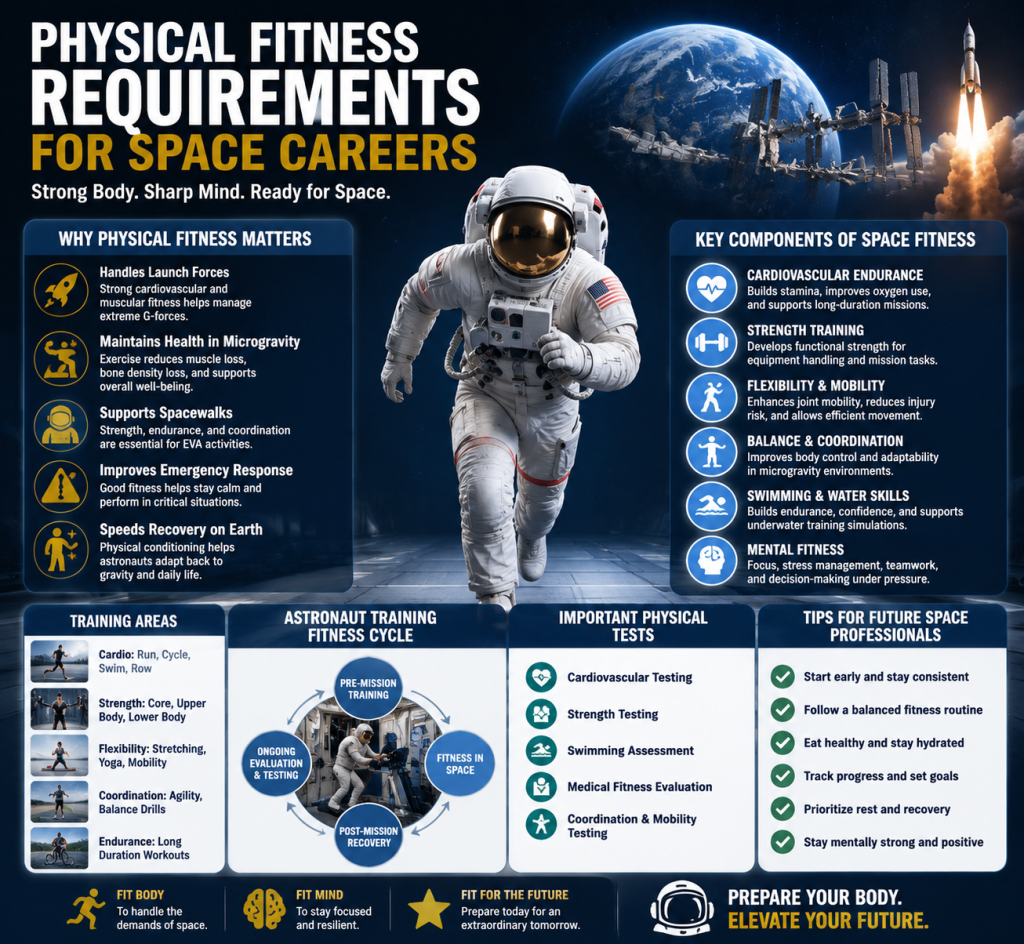
Handling Launch and Space Travel Conditions
During spacecraft launch, astronauts experience significant forces that require strong cardiovascular and muscular conditioning. Physical preparation helps the body manage the demanding conditions associated with spaceflight.
Maintaining Health During Microgravity
In space environments, astronauts experience reduced gravity, which can affect muscles, bones, and balance. Regular exercise helps reduce the impact of these changes.
Performing Spacewalk Activities
Astronauts conducting spacewalks must wear protective suits, operate equipment, and perform complex tasks outside spacecraft. These activities require strength, endurance, and coordination.
Responding During Emergencies
Space missions require professionals to remain calm and physically capable during unexpected situations. Good fitness supports better performance during demanding scenarios.
Recovering After Returning to Earth
After spending extended periods in space, astronauts must adapt back to Earth’s gravity. Physical conditioning helps support recovery and rehabilitation.
Evaluation Criteria for Future Space Candidates
Before beginning preparation for a space career, candidates should evaluate several important fitness factors:
Understanding Space Career Fitness Expectations
Future space professionals should understand that astronaut-level fitness involves endurance, strength, flexibility, coordination, and overall health management.
Building Cardiovascular Endurance
Strong heart and lung capacity help candidates handle physically demanding activities and long-duration mission requirements.
Developing Functional Strength
Space professionals need practical strength for movement, equipment handling, and operational tasks rather than only traditional bodybuilding goals.
Maintaining Healthy Body Composition
A healthy balance between body weight, muscle mass, and overall fitness supports mission performance.
Improving Flexibility and Mobility
Flexibility helps reduce injury risks and supports efficient movement in spacecraft environments.
Monitoring Physical and Mental Health
Space careers require continuous attention to both physical condition and psychological readiness.
What Is Physical Fitness for Space Careers?
Physical fitness for space careers refers to the level of physical capability required to safely perform professional activities in space-related environments.
It includes:
- Cardiovascular endurance
- Muscular strength
- Flexibility
- Balance and coordination
- Medical fitness
- Stress management ability
Astronaut fitness differs from general fitness because space professionals must prepare for conditions that do not exist on Earth.
A person preparing for a space career needs to develop a body that can adapt to changes in gravity, operate equipment, complete technical tasks, and maintain performance during long missions.
Why Physical Fitness Matters in Space Careers
Adapting to the Space Environment
The human body evolved under Earth’s gravity. When exposed to microgravity, several physical changes can occur.
Muscle Changes
Reduced gravity decreases the need for certain muscles to work continuously. Without proper exercise, astronauts may experience muscle weakness.
Bone Health Challenges
Lower mechanical stress on bones during space missions can affect bone strength over time.
Balance and Coordination Changes
The inner ear and body systems responsible for balance must adapt to new conditions in space.
Physical Workload Challenges
Tasks that appear simple on Earth may require different techniques and effort in space environments.
Mission Safety and Performance
Physical fitness contributes directly to mission success.
Astronauts and space professionals may need to:
- Operate complex equipment
- Perform scientific experiments
- Complete maintenance tasks
- Handle emergency procedures
- Work effectively as a team
Maintaining physical readiness allows professionals to perform their responsibilities efficiently.
Physical Fitness Requirements for Future Astronauts
Cardiovascular Endurance
Cardiovascular fitness is one of the most important aspects of astronaut preparation.
A strong cardiovascular system supports:
- Long-duration activities
- Efficient oxygen use
- Better stamina
- Recovery after physical effort
Common endurance activities include:
- Running
- Swimming
- Cycling
- Aerobic conditioning
Future space candidates should focus on building consistent endurance rather than short-term performance.
Strength Training
Strength is essential for many space-related activities.
Astronaut training commonly focuses on functional strength, including:
Core Strength
A strong core supports body control, posture, and movement efficiency.
Upper Body Strength
Upper body capability helps with equipment handling and operational tasks.
Lower Body Strength
Strong legs support movement, balance, and recovery after space missions.
Strength training should focus on controlled movements and overall physical capability.
Flexibility and Mobility
Flexibility helps space professionals move efficiently and reduce injury risks.
Important areas include:
- Joint mobility
- Muscle flexibility
- Body control
- Movement coordination
Inside spacecraft, astronauts often work in limited spaces where efficient movement is important.
Balance and Coordination Training
Space environments affect normal movement patterns.
Balance and coordination training helps candidates develop:
- Body awareness
- Movement control
- Adaptability
- Precision
Activities that support coordination include:
- Swimming
- Functional exercises
- Agility training
- Movement-based activities
Swimming and Water Survival Skills
Swimming ability is considered valuable for many astronaut preparation programs.
Water-based training helps develop:
- Endurance
- Breathing control
- Coordination
- Confidence in challenging environments
Some astronaut training activities use underwater environments to simulate aspects of space movement.
Astronaut Training Fitness Programs
Pre-Mission Physical Training
Before space missions, astronauts participate in structured preparation programs.
Training may include:
- Strength conditioning
- Cardiovascular workouts
- Mission simulations
- Survival preparation
- Mobility exercises
The goal is to prepare astronauts for the physical demands of space operations.
Fitness During Space Missions
Maintaining fitness does not stop after reaching space.
Astronauts often use specialized exercise equipment designed for microgravity environments.
Exercise helps support:
- Muscle maintenance
- Bone health
- Cardiovascular function
- Overall mission readiness
Post-Mission Recovery Training
Returning to Earth creates new physical challenges.
Astronauts may need support with:
- Rebuilding strength
- Improving balance
- Adjusting to Earth’s gravity
- Restoring normal movement patterns
Recovery programs help astronauts transition safely after missions.
Important Physical Tests for Space Career Candidates
Candidates may undergo different types of physical evaluations depending on the organization and career path.
Common assessment areas include:
Cardiovascular Testing
Measures endurance and overall heart and lung performance.
Strength Testing
Evaluates physical capability and functional strength.
Swimming Assessment
Checks water confidence and endurance skills.
Medical Fitness Evaluation
Reviews overall health suitability for demanding environments.
Coordination and Mobility Testing
Evaluates movement control and physical adaptability.
How to Prepare for a Space Career Fitness Journey
Start Training Early
Developing healthy habits early provides a strong foundation for future preparation.
Create a Balanced Exercise Routine
A complete fitness plan should include:
- Strength training
- Endurance exercises
- Flexibility activities
- Recovery periods
Maintain Healthy Nutrition
Proper nutrition supports energy levels, muscle development, and overall health.
Improve Physical Consistency
Long-term commitment is more valuable than short periods of intense training.
Track Progress
Monitoring improvements helps candidates identify strengths and areas requiring development.
Common Fitness Challenges for Future Space Candidates
Developing Required Endurance
Some candidates may need time to build the cardiovascular capacity required for demanding activities.
Balancing Training and Education
Future astronauts often combine academic preparation with physical training.
Maintaining Motivation
Space career preparation can take years, requiring patience and dedication.
Preventing Injuries
Training should be progressive to avoid unnecessary physical setbacks.
Managing Recovery
Rest and recovery are essential parts of effective fitness preparation.
Mental Fitness and Physical Performance in Space Careers
Physical fitness and mental readiness are closely connected.
Space professionals need the ability to:
- Stay focused under pressure
- Work in teams
- Manage isolation
- Make decisions during challenging situations
Mental resilience supports physical performance because space missions require both technical ability and emotional stability.
Training programs often include teamwork exercises, simulations, and stress management techniques.
Fitness Requirements Beyond Astronauts
Physical fitness is valuable for various space-related careers beyond astronauts.
Space Researchers
Researchers involved in field activities may benefit from strong endurance and physical readiness.
Aerospace Professionals
Engineers working in testing environments or mission support roles may require physical capability.
Space Tourism Professionals
Commercial space activities may require participants to meet certain health and fitness standards.
Mission Specialists
Specialized roles involving equipment operation or scientific tasks may require strong physical preparation.
Common Mistakes Future Space Candidates Should Avoid
Ignoring Physical Preparation
Academic knowledge alone is not enough for many space careers.
Training Without Consistency
Successful preparation requires regular and structured effort.
Focusing Only on Strength
A complete fitness approach should include endurance, flexibility, and coordination.
Following Unrealistic Training Plans
Candidates should focus on sustainable progress rather than extreme methods.
Neglecting Recovery
Rest is important for improving performance and preventing injuries.
Frequently Asked Questions
1. Why is physical fitness important for astronauts?
Physical fitness helps astronauts handle space conditions, maintain health during missions, and perform operational tasks safely.
2. What fitness level is required for space careers?
Requirements vary depending on the role and organization, but candidates generally need strong endurance, strength, coordination, and overall health.
3. Do astronauts need strength training?
Yes, strength training helps maintain muscle capability and supports tasks performed during space missions.
4. Is swimming required for astronaut training?
Swimming skills are valuable because they support endurance, coordination, and water survival preparation.
5. How do astronauts exercise in space?
Astronauts use specialized exercise equipment designed to support physical training in microgravity environments.
6. Can anyone prepare for an astronaut fitness program?
Many people can improve their fitness through structured training, although astronaut selection requirements vary by organization.
7. What physical skills help future astronauts?
Important skills include endurance, strength, flexibility, balance, coordination, and adaptability.
8. How does microgravity affect the human body?
Microgravity can affect muscles, bones, balance, and cardiovascular systems, making fitness training important.
9. How long does astronaut fitness preparation take?
Preparation timelines vary depending on career goals, training programs, and individual development.
10. Are physical requirements different for commercial space careers?
Yes, requirements may vary depending on the type of space activity and the responsibilities involved.
Conclusion
Physical fitness is a fundamental part of preparing for space careers. Whether someone wants to become an astronaut, work in mission support, or participate in commercial space activities, maintaining strong physical health is essential.
Space environments create unique challenges that require endurance, strength, flexibility, coordination, and mental resilience. Future space professionals who develop consistent fitness habits can better prepare themselves for the demands of space exploration.
A successful space career requires more than technical knowledge. It requires discipline, preparation, and a commitment to maintaining peak physical and mental readiness.