Introduction
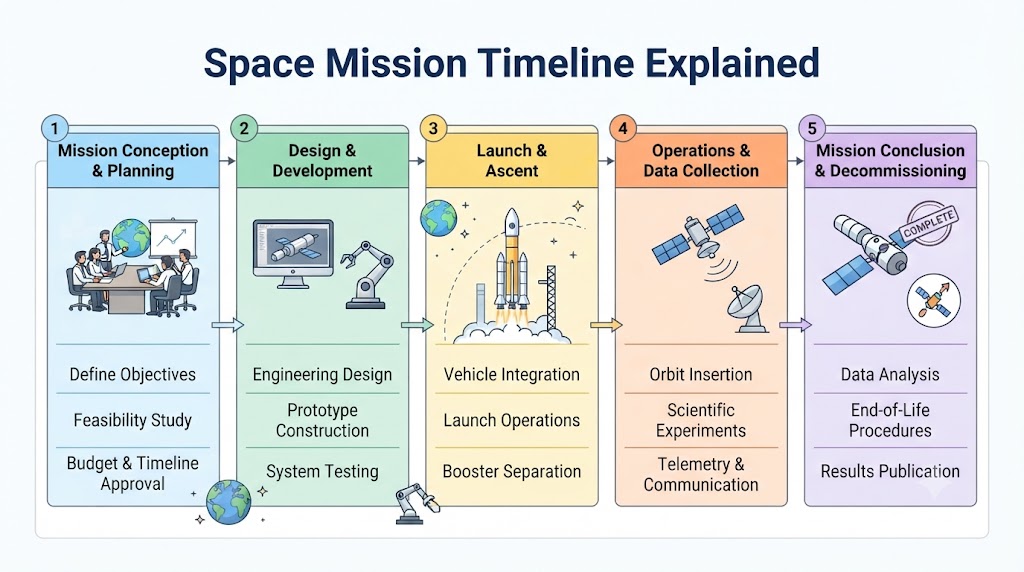
Space Mission Timeline Explained helps students and beginners understand how a space mission works from start to finish. Many people think a space mission begins when a rocket launches, but the real process starts years before liftoff.
A space mission includes planning, spacecraft design, testing, launch preparation, rocket launch, orbital insertion, spacecraft operations, data collection, and mission ending.
In this guide for astropilot.co, we will explain the full space mission timeline in simple language.
What Is a Space Mission Timeline?
A space mission timeline is a planned sequence of steps followed during a mission.
It shows what happens before launch, during launch, after launch, and at the end of the mission. Every step is planned carefully because space missions are expensive, complex, and risky.
A timeline helps scientists, engineers, astronauts, and mission control teams work together.
Stage 1: Mission Idea and Goal Planning
Every space mission starts with a goal.
Scientists and space agencies first ask: What do we want to learn or achieve?
A mission goal may include:
- Studying Earth’s weather
- Sending a satellite into orbit
- Exploring the Moon
- Studying Mars
- Testing new space technology
- Improving communication
- Observing stars and galaxies
Once the goal is clear, the mission team decides what type of spacecraft is needed.
Stage 2: Spacecraft Design and Development
After planning, engineers begin designing the spacecraft.
A spacecraft may include:
- Power systems
- Solar panels
- Batteries
- Communication systems
- Cameras
- Scientific instruments
- Computers
- Fuel tanks
- Small engines
- Thermal protection
The spacecraft must survive launch vibration, space temperature, radiation, and long-distance communication challenges.
Stage 3: Testing and Safety Checks
Before launch, the spacecraft is tested many times.
Testing helps engineers make sure the spacecraft can survive space conditions.
Common tests include:
- Vibration testing
- Heat and cold testing
- Software testing
- Communication testing
- Battery testing
- Solar panel testing
- Instrument testing
If any problem is found, engineers fix it before launch.
Stage 4: Launch Vehicle Selection
A launch vehicle means the rocket that carries the spacecraft into space.
The rocket is selected based on:
- Spacecraft weight
- Target orbit
- Mission distance
- Launch cost
- Safety needs
- Mission destination
A small satellite may need a smaller rocket, while a Moon or Mars mission may need a more powerful rocket.
Stage 5: Launch Preparation
Launch preparation begins before the rocket leaves the ground.
During this stage, teams check:
- Weather conditions
- Fuel systems
- Rocket engines
- Spacecraft health
- Ground systems
- Mission control readiness
- Launch pad safety
The countdown also happens during this phase. The countdown helps teams follow every final step in the correct order.
Stage 6: Liftoff and Ascent
Liftoff happens when the rocket engines produce enough power to lift the rocket from the launch pad.
After liftoff, the rocket begins its ascent through Earth’s atmosphere.
During ascent:
- Engines fire
- The rocket gains speed
- The rocket follows a curved path
- Stages may separate
- The spacecraft moves closer to space
This is one of the most exciting parts of the mission, but it is only one stage of the full timeline.
Stage 7: Reaching Space and Orbital Insertion
Reaching space means the rocket has passed above most of Earth’s atmosphere.
But reaching space is not the same as entering orbit.
Orbital insertion happens when the spacecraft reaches the correct speed, direction, and path to stay in orbit.
A spacecraft needs sideways speed to keep moving around Earth instead of falling back.
Stage 8: Spacecraft Separation
After the rocket reaches the planned position, the spacecraft separates from the rocket or upper stage.
This is called spacecraft separation.
The rocket has completed its delivery job. Now the spacecraft begins its independent mission.
After separation, the spacecraft may:
- Send its first signal
- Open solar panels
- Check power systems
- Stabilize direction
- Begin early mission checks
Stage 9: Early Orbit Operations
Early orbit operations happen soon after spacecraft separation.
This is like a health check for the spacecraft.
Mission control checks:
- Communication
- Power
- Temperature
- Battery status
- Solar panel deployment
- Spacecraft direction
- Orbit position
- Computer systems
This phase is very important because the spacecraft must prove it is healthy before starting full work.
Stage 10: Main Mission Operations
After early checks, the spacecraft begins its main mission.
Depending on the mission, it may:
- Take images of Earth
- Send communication signals
- Study weather
- Observe stars
- Explore planets
- Collect scientific data
- Support navigation systems
This phase can last for days, months, or many years.
Stage 11: Orbit Adjustments and Maintenance
Spacecraft sometimes need small corrections after entering orbit.
These corrections help maintain the correct path.
Small engine burns may be used to:
- Adjust orbit
- Avoid space debris
- Save fuel
- Improve mission accuracy
- Keep the spacecraft stable
Mission control carefully plans these adjustments.
Stage 12: Data Collection and Communication
Spacecraft collect data and send it back to Earth.
This data may include:
- Images
- Weather information
- Scientific readings
- Communication signals
- Navigation data
- Space environment measurements
Ground stations on Earth receive the signals. Scientists then study the data and use it for research or public services.
Stage 13: Mission Extension or End of Mission
Some missions last longer than expected.
If the spacecraft is healthy and still has power and fuel, the mission may be extended.
A mission may end when:
- Fuel runs low
- Power systems weaken
- Main goals are completed
- Instruments stop working
- Communication is lost
- The spacecraft becomes unsafe to operate
Mission teams plan the end carefully.
Stage 14: Safe Disposal or Re-entry
At the end of a mission, spacecraft must be handled safely.
Depending on the orbit and mission type, the spacecraft may:
- Re-enter Earth’s atmosphere
- Burn up during re-entry
- Move to a graveyard orbit
- Be shut down safely
- Crash into a planned area
- Stay in a safe disposal path
This step helps reduce space debris and protect future missions.
Simple Satellite Mission Timeline Example
Here is a simple example of a satellite mission:
- Scientists decide the satellite will study Earth’s weather.
- Engineers design the satellite.
- The satellite is tested for heat, vibration, and communication.
- A rocket is selected.
- The satellite is prepared for launch.
- The rocket launches.
- The rocket reaches space.
- The satellite separates from the rocket.
- Solar panels open.
- Mission control checks the satellite.
- The satellite begins collecting weather data.
- Data is sent back to Earth.
- The mission continues for years.
- The satellite is safely retired.
Common Misunderstandings About Space Missions
A Space Mission Does Not Start on Launch Day
A mission begins long before launch. Planning, design, and testing may take years.
Launch Is Not the Full Mission
Launch is only one part of the timeline. The main mission often happens after the spacecraft reaches orbit.
Reaching Space and Entering Orbit Are Different
A spacecraft must gain the correct speed and direction to enter orbit.
Satellites Do Not Start Full Work Immediately
Most satellites first complete health checks before beginning full operations.
Mission Control Remains Active After Launch
Mission control continues tracking and supporting the spacecraft throughout the mission.
Why Space Mission Timelines Matter
Space mission timelines are important because every step must happen in the correct order.
A small mistake in timing can affect the mission. That is why teams plan every stage carefully, from early design to final shutdown.
Timelines help space teams stay organized, safe, and prepared.
FAQs About Space Mission Timeline
1. What is a space mission timeline?
A space mission timeline is a planned sequence of events from mission planning to mission completion.
2. When does a space mission actually begin?
A space mission begins during the planning stage, long before the rocket launch.
3. What happens before a rocket launch?
Before launch, teams design, build, test, and prepare the spacecraft and rocket.
4. What happens during launch?
During launch, the rocket lifts off, climbs through the atmosphere, separates stages, and carries the spacecraft toward space.
5. What happens after the spacecraft reaches space?
The spacecraft may enter orbit, separate from the rocket, open solar panels, and begin system checks.
6. What is early orbit operation?
Early orbit operation is the first health-check phase after spacecraft separation.
7. How does mission control support a space mission?
Mission control tracks the spacecraft, checks data, sends commands, and helps manage mission operations.
8. What happens during the main mission phase?
During the main mission, the spacecraft performs its planned work, such as collecting data, sending signals, or observing space.
9. How does a space mission end?
A mission may end with shutdown, re-entry, safe disposal, or movement to a graveyard orbit.
10. Why is mission planning important?
Mission planning helps teams avoid mistakes, reduce risk, and complete the mission successfully.
Final Thoughts
Space Mission Timeline Explained shows that a space mission is much more than a rocket launch. It is a complete journey that begins with an idea and ends with safe mission completion.
For students and beginners, understanding the timeline makes space missions easier to follow. The next time you watch a rocket launch, remember that the mission started years earlier and will continue long after liftoff.
Space exploration is a step-by-step process, and each stage plays an important role in mission success.