
Introduction
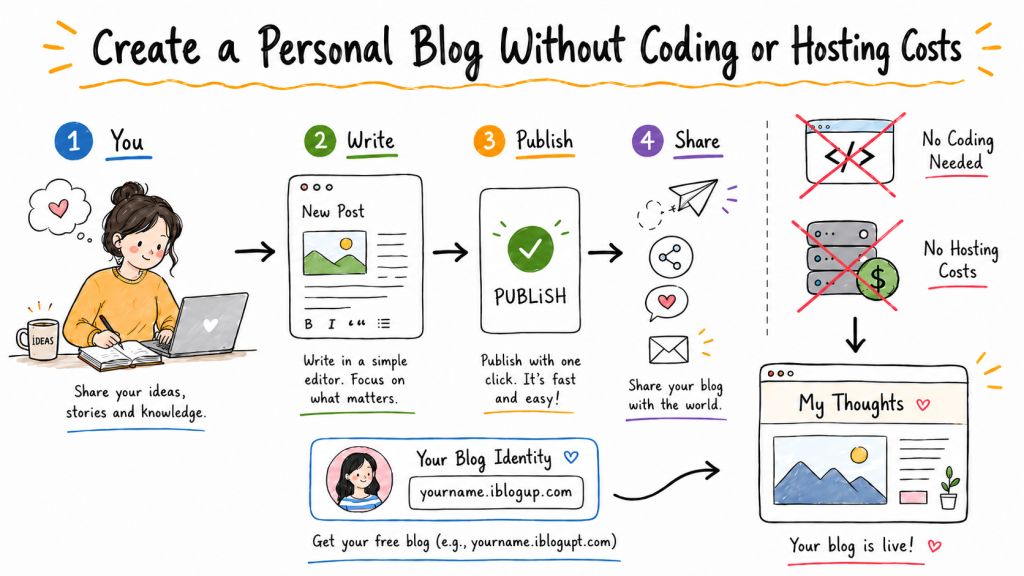
Starting a personal blog no longer requires programming knowledge, expensive hosting, or complicated website-management skills. Today, a beginner can use a free blogging platform to publish ideas, experiences, professional knowledge, stories, and creative work without building a website from the ground up.
This makes blogging more accessible to students, professionals, educators, travellers, storytellers, and independent writers. Instead of worrying about servers, software installation, security updates, or technical maintenance, writers can focus on planning useful content and developing their voice.
A no-code blogging platform provides the essential tools needed to create, write, edit, and publish content through a simple interface. Some platforms also provide a personal subdomain, allowing each writer to establish a recognisable online publishing identity.
This guide explains how to create a personal blog without coding or hosting costs, select a suitable topic, prepare your first article, avoid common mistakes, and build a consistent writing routine.
Understanding Personal Blogs, Coding, and Hosting
A personal blog is an online space where an individual publishes content under their own identity or chosen blog name. It may include educational articles, professional opinions, personal experiences, travel stories, poetry, tutorials, career lessons, or reflections on everyday life.
Traditional website creation often involves several technical steps. A website owner may need to:
- Purchase a domain name
- Pay for web hosting
- Install publishing software
- Select and configure a theme
- Manage security settings
- Install updates
- Fix technical problems
- Monitor website performance
These responsibilities can be difficult for someone who simply wants to write.
A no-code blogging platform reduces these barriers. It provides an existing publishing system where users can create an account, prepare a profile, choose a blog identity, and start publishing without writing programming code.
Free blog hosting means that the platform stores and displays the blog content. The writer does not have to purchase a separate hosting plan to make articles available online.
The Meaning of a Personal Blog Subdomain
A subdomain is a web address connected to the main address of a publishing platform. It gives an individual blog its own identifiable location within the larger platform.
For example, a writer may select a name based on a personal identity, subject area, profession, or creative project. That chosen name becomes part of the blog’s subdomain.
A free blog with subdomain can be useful for beginners because it provides a clear publishing identity without requiring them to purchase and configure a separate domain immediately.
A suitable subdomain should be:
- Short and easy to remember
- Simple to spell
- Relevant to the writer or topic
- Flexible enough for future content
- Free from unnecessary numbers or symbols
Writers should think carefully before choosing a blog name. A very narrow name may become limiting if the blog later expands into different subjects.
Why Starting Without Coding Matters
Many people delay blogging because they believe that creating a blog requires technical knowledge. They may assume that they need to understand HTML, website design, hosting dashboards, databases, or server configuration.
For most beginner bloggers, these skills are not necessary when using a simple blogging platform.
Removing the coding requirement creates several practical benefits.
Faster Setup
A writer can begin preparing content soon after creating an account. There is no need to spend days learning website-development tools before publishing the first article.
Greater Focus on Writing
Without technical distractions, more time can be spent researching ideas, improving explanations, editing paragraphs, and understanding readers.
Easier Content Management
A no-code editor usually allows writers to add titles, paragraphs, headings, lists, and other basic formatting through familiar controls.
Lower Entry Barrier
Students, educators, professionals, and hobby writers can participate in online publishing even if they have never managed a website before.
More Confidence for Beginners
A straightforward writing and publishing process makes blogging feel manageable. Beginners can learn through regular practice instead of feeling overwhelmed by technical tasks.
Why Avoiding Hosting Costs Helps New Writers
Paid hosting can be useful for some advanced website projects, but it is not always necessary for someone who is testing a blog idea or beginning a writing journey.
Using free blog hosting can help beginners in several ways.
First, it removes the pressure to recover an early financial investment. A new writer can experiment with subjects and formats without worrying about monthly hosting bills.
Second, it allows the writer to understand whether blogging fits their goals. Some people enjoy publishing personal stories, while others prefer professional tutorials or educational articles. Starting free provides room to explore.
Third, a free blogging site makes it easier for students, new professionals, and independent creators with limited budgets to establish an online presence.
However, cost should not be the only consideration. Writers should also review the platform’s publishing process, community environment, subdomain options, reading experience, and support for future needs.
Benefits of Creating a Personal Blog
A personal blog can serve many purposes beyond publishing occasional thoughts.
Build an Online Writing Identity
Regular publishing helps readers understand the subjects a writer cares about and the type of knowledge or stories they share. Over time, the collection of articles creates a recognisable body of work.
Develop a Public Portfolio
Students, freelancers, educators, consultants, and professionals can use a blog to demonstrate their communication skills and subject knowledge.
A portfolio does not need to contain only formal work. Helpful explainers, thoughtful opinions, project reflections, and practical guides can also show expertise.
Improve Writing Skills
Writing regularly encourages clearer thinking. Bloggers learn how to organise ideas, explain difficult topics, use descriptive headings, and remove unnecessary wording.
Share Useful Knowledge
A personal blogging platform allows people to publish lessons based on education, employment, hobbies, travel, research, or personal experience.
Document Experiences
Blogging can help writers preserve meaningful events, learning journeys, career changes, creative projects, or observations.
Connect With Other Writers
A community blogging platform may help writers discover different perspectives and participate in a broader publishing environment.
Important Qualities in a Free Blogging Platform
Not every online blogging platform offers the same experience. Beginners should examine the qualities that directly affect writing and publishing.
Simple Account Creation
The registration process should be clear and should not require unnecessary technical configuration.
No-Code Publishing
The editor should allow users to write and format articles without programming knowledge.
Personal Publishing Identity
A personal profile or subdomain can help readers identify the writer and locate their published work.
Clear Writing Interface
The editor should keep the writing process understandable. Too many complicated controls can distract beginners.
Readability Across Devices
Articles should remain readable on desktop computers, tablets, and mobile devices. Many readers access online content through different screen sizes.
Content Discovery
A shared feed or community area can help readers discover articles from independent writers.
Multi-Author Support
Some writers may eventually want to invite colleagues, classmates, or creative partners to contribute to one publication. Multi-author support is useful for collaborative projects.
Suitable Community Environment
The platform should support the type of content the writer plans to publish, whether that includes professional knowledge, personal stories, poetry, education, travel, or creative writing.
Steps to Create a Personal Blog for Free
Creating a blog becomes easier when the process is divided into manageable stages.
1. Define the Purpose of Your Blog
Begin by deciding why you want to publish.
Your purpose might be to:
- Share professional knowledge
- Build a writing portfolio
- Publish personal experiences
- Teach a subject
- Document a learning journey
- Publish stories or poetry
- Connect with people who share an interest
A clear purpose helps you select useful topics and maintain a consistent direction.
2. Identify Your Main Reader
Think about the person who may benefit from your content.
A career blog may serve students and working professionals. A travel blog may help first-time visitors. A technology blog may support beginners who need simple explanations.
Writing for a specific reader usually produces clearer and more practical content.
3. Select a Focused Subject
Your blog does not need to cover only one topic forever. However, beginning with a focused subject makes content planning easier.
Instead of choosing a broad subject such as “education,” you could focus on study habits, online learning, career preparation, or classroom resources.
A focused starting point also helps readers understand what they can expect from the blog.
4. Choose a Free Blogging Platform
Look for a free blogging platform for beginners that supports no-code publishing and does not require separate hosting.
Review its:
- Ease of use
- Blog identity options
- Publishing workflow
- Community features
- Reading experience
- Contributor support
- Content guidelines
Choose based on your real publishing needs rather than exaggerated promotional promises.
5. Create Your Account
Follow the platform’s account-creation process. Use accurate information and select a secure account where required.
After signing in, review the available publishing controls before writing your first article.
6. Choose Your Blog Name and Subdomain
Your blog name should represent your identity, subject, or creative direction.
Possible approaches include:
- Your personal name
- A professional subject
- A memorable phrase
- A project name
- A combination of your name and niche
Keep the name understandable and avoid copying an existing publication.
7. Prepare Your Writer Profile
A short profile helps readers understand who you are and what you publish.
A useful profile may include:
- Your name or chosen writing name
- Your area of interest
- The purpose of your blog
- The type of content readers can expect
- A brief statement about your background
Avoid making claims you cannot support. A clear and honest introduction is more valuable than exaggerated credentials.
8. Plan Your First Article
Choose a topic that you understand well enough to explain clearly.
Your first article does not need to cover everything about the subject. It should solve one specific problem, answer one important question, or share one focused experience.
Create a simple outline before writing:
- Introduction
- Main idea
- Important details
- Practical advice or examples
- Conclusion
9. Write in Clear Sections
Use descriptive headings to divide the article into readable parts. Keep paragraphs short and explain unfamiliar terms.
Write the first draft without trying to make every sentence perfect. Editing becomes easier after the full idea is visible.
10. Edit Before Publishing
Review the article for:
- Grammar and spelling
- Repeated information
- Long sentences
- Unclear explanations
- Missing examples
- Misleading statements
- Unnatural keyword use
- Weak headings
Reading the article aloud can help reveal awkward wording.
11. Publish and Review the Final Page
After publishing, check how the article appears to readers. Confirm that the title, headings, paragraphs, and lists are displayed correctly.
Correct any visible mistakes when editing is available.
12. Create a Realistic Publishing Routine
A beginner does not need to publish every day. A manageable routine is more valuable than an ambitious schedule that quickly becomes exhausting.
You might publish once a week, twice a month, or whenever you can prepare a genuinely useful article.
Personal Blog Ideas for Different Writers
A personal blog can adapt to many interests and professional goals.
Students
Students can publish study notes, project summaries, book reflections, research explanations, internship experiences, and career preparation tips.
These articles can gradually form a public writing portfolio.
Professionals
Professionals can explain industry concepts, share lessons from projects, discuss workplace practices, or write beginner-friendly guides related to their field.
Confidential company information should never be shared without permission.
Educators
Teachers and trainers can publish learning resources, lesson explanations, study strategies, subject guides, and educational observations.
Travellers
Travellers can document routes, cultural experiences, planning lessons, practical tips, and personal reflections.
They should present experiences honestly and avoid treating personal opinions as universal facts.
Creative Writers
Storytellers and poets can use a story publishing platform to share fiction, short stories, poetry, character sketches, and creative experiments.
Hobbyists
People interested in gardening, cooking, photography, books, fitness, crafts, or other hobbies can explain what they learn and share practical experiences.
Collaborative Teams
A multi-author blogging platform can support classmates, colleagues, community groups, or creative teams that want to publish under one shared identity.
Common Challenges and Practical Solutions
Not Knowing What to Write
Beginners often wait for a perfect idea.
Start by listing questions people regularly ask about your subject. Each useful question can become an article topic.
Choosing a Subject That Is Too Broad
A broad topic makes it difficult to write a focused article.
Narrow the subject to one reader, problem, task, or experience. Instead of “career advice,” write about preparing a first professional portfolio.
Publishing Inconsistently
An unrealistic schedule often causes frustration.
Select a publishing frequency that matches your available time. Quality and sustainability matter more than daily activity.
Expecting Immediate Attention
A new blog may not attract many readers immediately.
Focus first on creating useful, original work. A strong collection of articles takes time to develop.
Writing Without a Clear Reader
Content becomes vague when it tries to serve everyone.
Before writing, identify the reader’s knowledge level, problem, and expected outcome.
Ignoring Proofreading
Small mistakes can reduce readability and credibility.
Set the draft aside briefly, return with fresh attention, and edit before publishing.
Copying Other Writers
Copying damages originality and trust.
Research can support your understanding, but explain the subject using your own structure, wording, examples, and experience.
Forcing Keywords Into Every Paragraph
Keyword stuffing makes an article difficult to read.
Use only phrases that fit naturally. The reader’s understanding should remain the main priority.
Practical Tips for Building a Strong Personal Blog
Begin with three to five related article ideas so you are not planning from the beginning after every publication.
Use titles that clearly describe the content. A reader should understand the article’s subject before opening it.
Open each article by explaining the reader’s situation or problem. Avoid long introductions that delay the useful information.
Use examples when explaining unfamiliar ideas. Examples make educational content easier to understand.
Keep paragraphs readable. Large blocks of text can discourage readers, especially on mobile devices.
Develop your natural writing voice. You do not need to copy the tone of popular creators.
Publish original work that provides a lesson, explanation, experience, or useful perspective.
Participate respectfully in the wider writing community. Read other writers, understand different viewpoints, and avoid leaving irrelevant promotional comments.
Review older articles occasionally. You may notice unclear sections, outdated wording, or opportunities to improve the structure.
iBlogUp as a No-Code Publishing Option
iBlogUp provides a practical option for people who want to create a personal blog without coding or separate hosting costs.
Writers can use the platform to establish an individual publishing identity through a personal iBlogUp subdomain. Its no-code publishing environment is designed to help users concentrate on writing instead of technical website management.
The platform supports Google-based sign-in and provides a shared discovery feed where readers can explore work from different independent voices. It also supports multiple contributors, which can be useful when a personal publication develops into a collaborative or multi-author blog.
iBlogUp can be used for subjects such as technology, education, business, travel, lifestyle, professional knowledge, poetry, personal experiences, and storytelling.
As with any free online publishing platform, writers should begin with a clear purpose, follow the platform’s content standards, publish original material, and build their blog patiently.
Frequently Asked Questions
Can a complete beginner create a personal blog for free?
Yes. A beginner can use a free blogging platform that includes hosting and a no-code publishing editor. The writer generally needs to create an account, choose a blog identity or subdomain, prepare a profile, and write the first article. Programming knowledge is not required when the platform manages the technical publishing system.
Is coding required to write and publish blog articles?
Coding is not required on a no-code blogging platform. Writers can usually create titles, paragraphs, headings, and lists through a visual editor. Coding may be useful for advanced custom website development, but it is unnecessary for beginners who mainly want to publish written content through an existing platform.
Does free blog hosting mean I own a separate hosting account?
Usually, no. Free blog hosting means that the blogging platform stores and displays your content as part of its publishing service. You do not need to purchase a separate hosting plan. However, the blog remains subject to the platform’s terms, technical structure, and content policies.
What should I publish on my first personal blog?
Start with a subject you understand and can explain clearly. You could share a practical lesson, personal experience, beginner guide, professional insight, book reflection, travel story, tutorial, poem, or educational article. Keep the first post focused on one main idea rather than trying to introduce every possible topic.
Can a personal blog support a professional portfolio?
Yes. A blog can demonstrate writing ability, communication skills, subject knowledge, consistency, and independent thinking. Students and professionals can publish project reflections, industry explanations, educational guides, and career lessons. The quality and relevance of the articles matter more than the total number of posts.
How often should a beginner publish?
A beginner should choose a schedule that can be maintained without reducing quality. Publishing weekly, twice a month, or even monthly can work when the content is thoughtful and useful. A realistic routine supports long-term progress better than publishing frequently for a short period and then abandoning the blog.
Can several people contribute to one blog?
They can when the selected platform supports multiple contributors. A multi-author publication may include classmates, colleagues, educators, subject experts, or creative partners. The team should define its purpose, writing standards, review process, topic responsibilities, and publishing schedule before inviting contributors.
How can a new blogger attract readers?
Begin by publishing original content for a clearly defined audience. Use descriptive titles, readable formatting, practical examples, and accurate information. Share articles appropriately with relevant communities and continue improving based on genuine reader interests. Audience development usually requires patience, useful content, and consistent participation rather than shortcuts.
Conclusion
Creating a personal blog no longer needs to begin with coding lessons, hosting payments, or complex website setup. A free blogging platform can provide the basic publishing environment, allowing beginners to focus on ideas, writing quality, reader needs, and consistent improvement.
The most important first step is not choosing a perfect design. It is defining the purpose of the blog. Decide what you want to share, who you want to help, and what type of writing you can continue producing realistically.
Choose a focused subject, prepare a clear profile, select a memorable blog identity, and publish one useful article at a time. Avoid expecting immediate results. A meaningful personal blog develops through original work, thoughtful editing, and regular practice.