Introduction
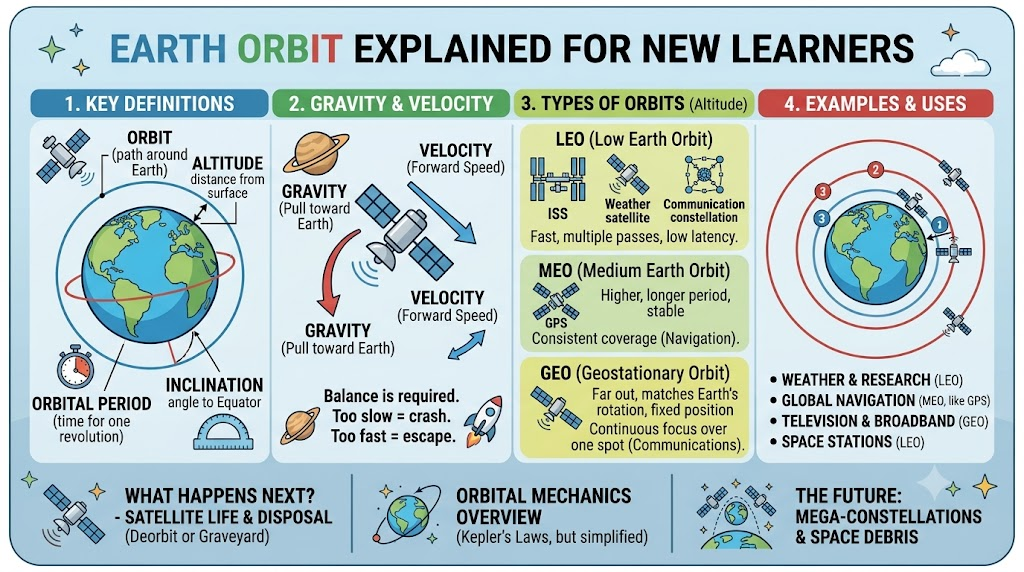
Earth orbit is the path an object follows as it moves around our planet under the influence of gravity. Satellites, spacecraft, and even crewed space stations can travel in orbit without continuously using their engines. Understanding orbit helps beginners see how modern space missions, communication systems, navigation satellites, and scientific research work. This guide explains the basic ideas behind Earth orbit in simple terms and introduces the major types of orbits used around our planet.
What Is an Earth Orbit?
An Earth orbit is the curved path followed by an object as it travels around Earth. The object could be a communication satellite, weather satellite, scientific spacecraft, or a crewed vehicle.
Gravity is the main force that keeps an orbiting object connected to Earth. At the same time, the object has forward motion that prevents it from simply dropping straight toward the surface.
A useful way to understand an orbit is to imagine throwing a ball horizontally. If you throw it gently, it travels a short distance before falling to the ground. If you could throw it much faster and far enough, the surface of Earth would curve away beneath it.
An object in orbit is essentially moving forward while continuously falling toward Earth. Because Earth curves away beneath the object, it can keep traveling around the planet rather than immediately reaching the surface.
An orbit does not have to be a perfect circle. Many spacecraft travel along slightly or highly elliptical paths, meaning their distance from Earth changes during the orbit.
How Does an Object Stay in Orbit?
Two basic ideas help explain orbital motion: gravity and velocity.
Earth’s gravity continuously pulls a satellite toward the planet. Without forward motion, the satellite would eventually fall toward Earth.
However, a satellite moving at the right speed has enough forward velocity to keep missing the surface as it falls. Its path curves around Earth, creating an orbit.
This does not mean gravity disappears in space. In fact, gravity is essential to keeping an Earth-orbiting object in its path.
The combination of gravitational attraction and the object’s motion determines the shape and altitude of its orbit.
Why Doesn’t a Satellite Fall to Earth?
A satellite is technically always falling toward Earth because gravity is pulling on it. However, its sideways or forward velocity is high enough that it keeps moving around the planet.
This is why an orbit can be described as continuous free fall.
The satellite is not suspended in one place. It is moving extremely quickly while following a curved path around Earth.
Does an Object Need Engines to Stay in Orbit?
A common beginner misconception is that a satellite must continuously fire its engines to remain in orbit.
Normally, it does not.
Once a spacecraft reaches the appropriate orbital velocity and altitude, it can continue moving around Earth without constantly using its main engines. In space, there is very little atmospheric resistance at many orbital altitudes, so the spacecraft can maintain its motion for long periods.
Spacecraft do carry propulsion systems, however. They may use small thrusters or engines to make orbital corrections, change altitude, adjust their trajectory, avoid certain hazards, or prepare for another part of a mission.
Satellites operating in very low orbits can also experience atmospheric drag. Their operators may periodically raise the orbit to compensate for this gradual loss of altitude.
Different Types of Earth Orbit
Not every satellite needs the same orbit. Mission designers choose an orbit according to the purpose of the spacecraft.
A weather satellite may need an orbit that provides regular coverage of Earth. A navigation satellite may operate much farther away. A communication satellite may be placed in a position that allows it to appear nearly stationary over a particular region.
Low Earth Orbit (LEO)
Low Earth Orbit, commonly called LEO, is relatively close to Earth’s surface. It generally extends from roughly 160 kilometers to 2,000 kilometers above Earth, although the exact boundaries used can vary by context.
Many Earth observation satellites operate in LEO because being relatively close to the planet can provide detailed observations.
The International Space Station also operates in low Earth orbit.
Objects in LEO travel at very high speeds and can complete an orbit in roughly 90 minutes to a couple of hours, depending on their altitude.
Medium Earth Orbit (MEO)
Medium Earth Orbit lies above LEO and below geostationary orbit.
MEO is useful for missions that need broader coverage than a typical low-orbit satellite can provide.
Many navigation satellite systems use medium Earth orbits. Because these satellites are farther from Earth, they take longer to complete an orbit than objects in LEO.
Geostationary Orbit (GEO)
A geostationary orbit is a special circular orbit located approximately 35,786 kilometers above Earth’s equator.
A satellite in this orbit travels around Earth at the same rotational rate that Earth turns on its axis. When the orbit is properly aligned, the satellite appears to remain above nearly the same point on Earth’s surface.
This characteristic makes geostationary orbit particularly useful for communications and weather monitoring.
A ground antenna can remain pointed toward the satellite rather than constantly tracking its movement across the sky.
Geosynchronous Orbit
A geosynchronous orbit has an orbital period equal to Earth’s rotation period, approximately one sidereal day.
A geosynchronous satellite does not necessarily appear stationary from the ground. Its inclination or orbital shape can cause it to appear to move north and south or follow a more complex pattern.
A geostationary orbit is therefore a specific type of geosynchronous orbit.
Polar Orbit
A polar orbit takes a spacecraft over or near Earth’s polar regions.
As Earth rotates beneath the spacecraft, the satellite can eventually observe large portions of the planet. Polar orbits are useful for Earth observation, environmental monitoring, mapping, and scientific missions.
Sun-Synchronous Orbit
A sun-synchronous orbit is designed so that a satellite passes over particular areas at approximately the same local solar time during successive observations.
This provides relatively consistent lighting conditions for images of Earth’s surface.
Such orbits are valuable for environmental monitoring, agriculture, mapping, climate studies, and other Earth observation activities.
Highly Elliptical Orbit
A highly elliptical orbit has a much more elongated shape than a circular orbit.
The spacecraft moves closer to Earth at one part of its orbit and much farther away at another. It also travels at different speeds along different parts of the orbit.
These orbits can be useful when a mission requires extended coverage over particular high-latitude regions.
Comparing Major Earth Orbit Types
The following table provides a simple overview of several important Earth orbits.
| Orbit Type | Typical Altitude | Main Characteristics | Common Uses |
|---|---|---|---|
| Low Earth Orbit (LEO) | About 160–2,000 km | Close to Earth and high orbital speed | Earth observation, science, crewed spacecraft |
| Medium Earth Orbit (MEO) | Above LEO and below GEO | Greater coverage and longer orbital period | Navigation satellites |
| Geostationary Orbit (GEO) | About 35,786 km | Appears fixed above the equator | Communications, weather monitoring |
| Geosynchronous Orbit | Around GEO altitude, depending on orbit | Orbital period matches Earth’s rotation | Communications and other satellite missions |
| Polar Orbit | Varies | Passes over or near the poles | Mapping, observation, environmental monitoring |
| Sun-Synchronous Orbit | Usually in LEO | Maintains similar local solar time for passes | Earth imaging and scientific observation |
| Highly Elliptical Orbit | Varies significantly | Large difference between closest and farthest points | Specialized communications and observation |
How Altitude Affects an Orbit
Altitude has a major effect on how an object travels around Earth.
In general, an object in a lower circular orbit must travel faster than an object in a higher circular orbit. This allows it to maintain its path against Earth’s stronger gravitational influence at lower altitude.
As orbital altitude increases, the orbital speed required for a circular orbit decreases, while the time required to complete one orbit increases.
Altitude also affects the area a satellite can observe or communicate with. A higher satellite can generally see a larger portion of Earth at once, although greater distance can introduce other challenges, such as signal delay and reduced observation detail.
How Fast Do Objects Travel Around Earth?
Objects in Earth orbit can travel at remarkable speeds.
A spacecraft in low Earth orbit typically travels at around 7.8 kilometers per second, or approximately 28,000 kilometers per hour.
At this speed, a spacecraft can circle Earth in roughly 90 minutes, depending on its exact orbit.
Satellites in higher circular orbits generally travel more slowly. This does not mean they are moving slowly by everyday standards. Even a high-orbit satellite is traveling thousands of kilometers per hour.
Orbital speed is one of the most important factors in determining whether an object remains in a particular orbit.
How Long Does It Take to Orbit Earth?
The time required to complete one orbit is called the orbital period.
Orbital period depends strongly on the distance between the spacecraft and the center of Earth. Lower circular orbits have shorter orbital periods, while higher circular orbits take longer.
For example, a spacecraft in low Earth orbit can complete several trips around Earth in a single day.
A satellite in geostationary orbit takes approximately one sidereal day to complete one orbit. Its movement is synchronized with Earth’s rotation, allowing it to remain over approximately the same longitude.
Highly elliptical orbits can have much longer orbital periods, depending on their design.
Earth Orbit and Satellites
Earth orbit supports many services that people use every day, even when they do not realize it.
Communication Satellites
Communication satellites can relay signals over large distances. They support services such as television broadcasting, telecommunications, and certain types of internet connectivity.
Higher orbits can provide wide coverage, while lower orbits can offer shorter signal paths but may require larger satellite networks for continuous global coverage.
Weather Satellites
Weather satellites monitor clouds, storms, atmospheric conditions, and other features of Earth’s environment.
Different orbital positions provide different advantages. Some satellites provide frequent views of the same broad region, while others scan large portions of Earth as they move around the planet.
Navigation Satellites
Navigation systems depend on satellites that broadcast precisely timed signals.
Receivers on Earth use signals from multiple satellites to estimate their location. This technology supports navigation in vehicles, aircraft, ships, smartphones, and many other applications.
Earth Observation
Earth observation satellites collect information about land, oceans, vegetation, ice, and atmospheric conditions.
Scientists and organizations use this information for environmental monitoring, disaster assessment, agriculture, mapping, and research.
Scientific Research
Spacecraft in orbit allow scientists to study Earth and the space environment from a unique position.
Orbital missions can investigate the atmosphere, radiation, the effects of microgravity, and many other scientific questions.
Earth Orbit and Human Spaceflight
Human spaceflight depends heavily on understanding orbital mechanics.
When astronauts travel to an orbital spacecraft, a launch vehicle must provide enough velocity to place the spacecraft on the required trajectory.
The International Space Station is one of the best-known examples of a human-made object operating in Earth orbit. Astronauts aboard the station experience microgravity while continuously moving around Earth.
The station is not beyond Earth’s gravity. Instead, it and its crew are in continuous free fall around the planet.
Crewed spacecraft also need to perform carefully planned orbital maneuvers when approaching or leaving an orbital station.
For astronauts, understanding orbital motion is therefore not simply an academic topic. It is an important part of spaceflight operations.
What Happens When a Satellite Leaves Its Orbit?
Satellites do not necessarily remain in their original orbit forever.
One important factor is atmospheric drag. Even at relatively high altitudes, Earth’s atmosphere becomes extremely thin rather than disappearing completely. Molecules in this thin atmosphere can gradually slow a satellite.
When a satellite loses orbital energy, its orbit can decrease over time. This process is called orbital decay.
As the spacecraft moves into denser parts of the atmosphere, drag can increase. Eventually, a spacecraft may re-enter the atmosphere and experience intense heating.
Some spacecraft are designed to perform controlled re-entry. Operators can also move certain satellites into planned disposal orbits at the end of their useful lives.
Managing spacecraft at the end of a mission is increasingly important because Earth orbit contains a growing number of human-made objects.
A Simple Way to Understand Earth Orbit
Imagine standing on a very tall mountain and throwing a ball horizontally.
If you throw it slowly, it follows a short curved path and reaches the ground.
If you could throw it much faster, the ball would travel farther before falling.
Now imagine throwing it fast enough that, as it falls, Earth’s curved surface keeps moving away beneath it. The ball could continue traveling around Earth.
This simplified idea helps explain orbital motion.
The important point is that orbit depends on both gravity and forward velocity. Gravity pulls the object toward Earth, while its forward motion carries it around the planet.
Real orbital mechanics is more complex than this analogy, but the concept provides a useful starting point for beginners.
Common Misunderstandings About Earth Orbit
“There Is No Gravity in Orbit”
There is still significant gravity in Earth orbit. Gravity is actually what keeps satellites in orbit.
Astronauts experience microgravity because they and their spacecraft are in continuous free fall, not because Earth’s gravity has disappeared.
“Satellites Stay Completely Still”
Satellites are constantly moving.
Even a geostationary satellite is traveling around Earth at a very high speed. It only appears stationary relative to a particular location on the ground because its orbital motion matches Earth’s rotation.
“Satellites Need Engines Running All the Time”
They generally do not. Once a spacecraft reaches the correct orbit, it can continue moving without continuously firing its engines.
Thrusters are mainly used for corrections and planned maneuvers.
“All Satellites Use the Same Orbit”
Different missions require different orbital conditions.
A navigation satellite, weather satellite, Earth observation spacecraft, and communication satellite may all use different orbital strategies.
“Higher Orbit Always Means Faster”
For circular Earth orbits, orbital speed generally decreases as altitude increases. However, elliptical orbits behave differently because spacecraft change speed as they move closer to and farther from Earth.
Important Considerations
Several factors help determine the behavior and usefulness of an Earth orbit.
Gravity: Earth’s gravitational field provides the force that keeps an orbiting object bound to the planet.
Orbital velocity: The spacecraft needs an appropriate velocity for the desired orbit. A small change in velocity can significantly change the spacecraft’s path.
Altitude: The distance from Earth affects orbital speed, orbital period, coverage, and atmospheric drag.
Orbital period: Different altitudes and orbital shapes result in different times required to complete an orbit.
Atmospheric drag: Low-orbit spacecraft can gradually lose energy because of interaction with the thin upper atmosphere.
Orbital inclination: The angle of an orbit relative to Earth’s equator determines which parts of Earth the spacecraft can pass over.
Spacecraft maneuvering: Satellites may need propulsion to correct their orbits, avoid hazards, or support mission operations.
Mission requirements: Engineers select an orbit based on what the spacecraft needs to accomplish rather than simply choosing the highest or lowest possible altitude.
Key Earth Orbit Concepts at a Glance
| Concept | Simple Meaning | Why It Matters |
|---|---|---|
| Gravity | Earth’s attraction pulling objects toward the planet | Provides the main force responsible for orbital motion |
| Orbital Velocity | Speed needed for a particular orbital path | Helps determine whether a spacecraft can maintain its orbit |
| Altitude | Distance above Earth’s surface | Affects speed, coverage, drag, and orbital period |
| Orbital Period | Time needed to complete one orbit | Changes according to orbital size and shape |
| Orbital Inclination | Angle of an orbit relative to the equator | Determines the regions a satellite can pass over |
| Atmospheric Drag | Resistance from Earth’s thin upper atmosphere | Can gradually reduce a low satellite’s altitude |
| Orbital Decay | Gradual lowering of an orbit | Can eventually lead to atmospheric re-entry |
| Geostationary Orbit | Orbit synchronized with Earth’s rotation over the equator | Allows a satellite to appear fixed over one region |
Frequently Asked Questions
1. What is Earth orbit?
Earth orbit is the path an object follows around Earth because of the interaction between its forward motion and Earth’s gravity. Satellites and spacecraft can remain in orbit when they have the appropriate velocity for their trajectory.
2. Why don’t satellites fall directly to Earth?
Satellites are continuously pulled toward Earth by gravity, but they are also moving forward at very high speeds. Their forward motion causes them to keep moving around Earth’s curved surface instead of falling directly onto it.
3. How fast does a satellite travel around Earth?
A typical spacecraft in low Earth orbit travels at approximately 7.8 kilometers per second, or about 28,000 kilometers per hour. The exact speed depends on the spacecraft’s orbit.
4. What is Low Earth Orbit?
Low Earth Orbit is a region relatively close to Earth’s surface, generally extending from about 160 to 2,000 kilometers in altitude. Many Earth observation satellites and crewed spacecraft operate in this region.
5. What is the difference between LEO and GEO?
LEO is much closer to Earth and requires a higher orbital speed, while GEO is approximately 35,786 kilometers above the equator. A properly positioned geostationary satellite appears to remain above nearly the same location on Earth.
6. How long does a satellite take to orbit Earth?
The time varies according to the orbit. A spacecraft in low Earth orbit can take roughly 90 minutes to a couple of hours, while a geostationary satellite takes approximately one sidereal day.
7. Do satellites need engines to remain in orbit?
Satellites generally do not need to continuously fire their engines once they reach their intended orbit. They may use propulsion periodically for orbital corrections, maneuvering, or maintaining their planned trajectory.
8. What happens when a satellite loses its orbit?
A satellite that loses orbital energy can gradually move into a lower orbit. Atmospheric drag can increase as it descends, eventually causing the spacecraft to re-enter Earth’s atmosphere.
9. Can humans live in Earth orbit?
Yes. Humans can live in Earth orbit for extended periods aboard specially designed spacecraft and space stations. The International Space Station is an example of a continuously occupied orbital facility.
10. Why are different satellites placed at different altitudes?
Different missions need different combinations of coverage, speed, orbital period, communication characteristics, observation detail, and environmental conditions. Engineers therefore select an orbit based on the spacecraft’s purpose.
Conclusion
Earth orbit may seem complicated at first, but its basic idea is easier to understand when gravity and forward motion are considered together. An orbiting spacecraft is continuously affected by Earth’s gravity while moving forward fast enough to follow a curved path around the planet.
Altitude, velocity, orbital period, inclination, and atmospheric drag all influence how an orbit behaves. Different types of orbit provide different advantages, which is why satellites, spacecraft, and space stations do not all travel along the same paths.
For new learners, understanding these fundamentals provides a strong starting point for exploring satellite technology, astronomy, spacecraft operations, orbital mechanics, and the wider field of space exploration.