
Introduction
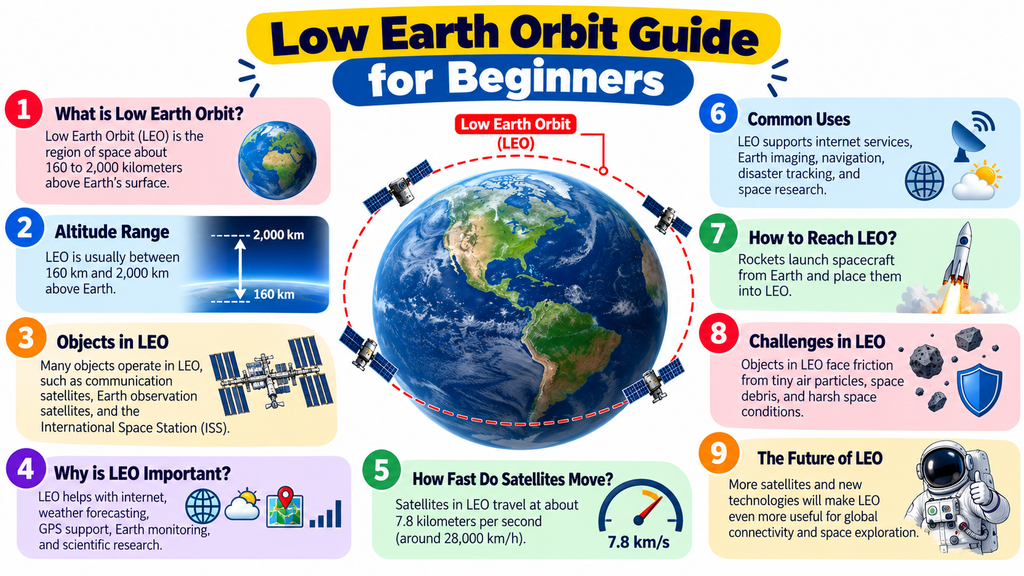
Low Earth Orbit (LEO) is an important region of space around Earth. Many satellites and the International Space Station operate in this region. It supports scientific research, communication, Earth observation, and human spaceflight. Understanding LEO helps beginners learn how spacecraft move and work in space.
What Is Low Earth Orbit (LEO)?
Low Earth Orbit is a region of space relatively close to Earth. It is commonly defined as an orbit with an altitude below approximately 2,000 kilometers above Earth’s surface. Many spacecraft operate at altitudes of a few hundred kilometers.
An orbit is the path an object follows around another object in space. Earth’s gravity pulls satellites toward the planet. Their forward speed allows them to keep moving around Earth instead of falling straight to the ground.
LEO is not a separate layer of the atmosphere. It is an orbital region where spacecraft travel around Earth. Although the atmosphere becomes extremely thin at these heights, small amounts of gas remain. These particles can create drag and slowly change a spacecraft’s orbit.
Many spacecraft use LEO because it offers several practical benefits. Satellites can observe Earth’s surface in detail from relatively close distances. Spacecraft can also reach this region without the energy requirements of many higher orbits. These advantages make LEO useful for research, communications, and human spaceflight.
Where Is Low Earth Orbit Located?
Low Earth Orbit is generally classified as extending from the lower orbital region to around 2,000 kilometers above Earth’s surface. These boundaries are commonly used for classification, but they are not physical walls in space.
Earth has an average radius of approximately 6,371 kilometers. A spacecraft flying 400 kilometers above the surface is therefore about 6,771 kilometers from Earth’s center. This distinction matters because orbital calculations depend on the distance from Earth’s center.
LEO contains spacecraft at different altitudes. Some satellites operate a few hundred kilometers above Earth, while others travel at higher altitudes within this region. Their operating heights depend on their mission, equipment, and expected lifetime.
For example, an Earth observation satellite may use a low orbit to capture detailed images. A broadband satellite may follow a different orbit to support communication services. Engineers consider altitude, coverage, atmospheric drag, and mission requirements before choosing an orbit.
How Does Low Earth Orbit Work?
A spacecraft stays in orbit because of the relationship between its forward motion and Earth’s gravity. Gravity pulls the spacecraft toward Earth, while its sideways motion carries it forward. Together, these effects create a curved path around the planet.
Imagine throwing a ball horizontally. The ball moves forward while gravity pulls it downward. An orbit follows a similar principle, but the spacecraft moves fast enough for Earth’s surface to curve away beneath its falling path.
This is why satellites do not simply fall straight to the ground. They are constantly falling toward Earth while moving forward. When their speed and direction are suitable, they continue following an orbital path.
Astronauts aboard spacecraft also experience continuous free fall. They appear to float because they and their spacecraft fall together. Earth’s gravity still acts on them, even though they experience apparent weightlessness.
Orbital speed also depends on altitude. A spacecraft in a lower circular orbit generally travels faster than one in a higher circular orbit. Higher circular orbits take longer to complete because the spacecraft follows a larger path at a lower orbital speed.
Not every orbit is circular. Some spacecraft follow elliptical orbits, which bring them closer to Earth at one point and farther away at another. Their speeds change along the path, increasing as they approach Earth and decreasing as they move farther away.
How Fast Do Objects Travel in Low Earth Orbit?
Objects in LEO travel at very high speeds. Many satellites in circular orbits move at approximately 7.5 to 8 kilometers per second. This equals roughly 27,000 to 29,000 kilometers per hour.
At these speeds, a satellite can travel across a large part of Earth in a short time. However, the area it can observe depends on its altitude, orbital inclination, instruments, and direction of travel.
The International Space Station is a useful example. It travels at approximately 28,000 kilometers per hour while orbiting Earth. At this speed, it completes one orbit in roughly 90 minutes.
Such high speeds help spacecraft maintain their orbital paths. A spacecraft needs enough sideways speed to keep moving around Earth while gravity pulls it toward the planet. If its orbital energy decreases, its path may change.
The exact speed varies between spacecraft. Lower circular orbits generally require higher orbital speeds than higher circular orbits. In elliptical orbits, speed changes depending on the spacecraft’s position along its path.
How Long Does One Orbit Take?
An orbital period is the time a spacecraft needs to complete one full trip around Earth. In LEO, many spacecraft complete an orbit in approximately 90 to 120 minutes.
Lower circular orbits generally have shorter orbital periods. Higher circular orbits take longer because spacecraft follow larger paths at lower orbital speeds. The exact period depends on the spacecraft’s altitude and orbit.
The International Space Station completes approximately 16 orbits around Earth each day. During these trips, it passes over many different regions. However, it does not pass directly above every location during every orbit.
A satellite’s ground track is the path it appears to follow across Earth’s surface. This path changes because Earth rotates beneath the spacecraft. The orbit’s altitude and inclination also influence which areas the satellite can observe.
Some Earth observation satellites use near-polar orbits. These allow them to pass over different regions as Earth rotates. Over time, this can provide repeated coverage of much of the planet.
Understanding orbital periods helps explain how satellite operators plan observations and communications. It also shows why a single LEO satellite cannot remain above one location continuously.
What Is the International Space Station’s Orbit?
The International Space Station (ISS) is one of the best-known examples of a spacecraft operating in LEO. It serves as a research laboratory where astronauts conduct experiments in space.
The station usually orbits at an altitude of around 400 kilometers, although its altitude changes over time. Even at this height, traces of the atmosphere create drag. Periodic reboost maneuvers help maintain its orbit.
The ISS travels at approximately 28,000 kilometers per hour. It completes one orbit in about 90 minutes. As a result, astronauts can experience around 16 sunrises and sunsets during a typical 24-hour period.
Astronauts appear to float because they and the station are in continuous free fall around Earth. Gravity remains strong enough to keep the station in orbit. Their apparent weightlessness comes from their shared motion rather than the absence of gravity.
The ISS supports research in biology, physics, materials science, and human health. Scientists use these experiments to understand how living things and equipment behave in space. This knowledge also helps prepare for longer missions beyond Earth orbit.
Why Is Low Earth Orbit Important?
LEO supports many activities that benefit science, technology, and everyday life. Its relatively close distance to Earth makes it useful for observation, research, and several types of satellite services.
1. Earth Observation
Satellites in LEO capture images of forests, oceans, farmland, and cities. Researchers use these images to monitor environmental changes, map terrain, and assess damage after natural disasters.
Earth observation also helps track changes in glaciers, coastlines, and land use. These measurements support environmental research and planning.
2. Weather and Environmental Monitoring
Satellites collect information about clouds, ice, vegetation, and Earth’s surface. This data supports weather research, climate studies, and disaster response.
Not all weather satellites operate in LEO. Some use higher orbits because their missions require different types of coverage.
3. Scientific Research
Space laboratories allow scientists to study materials, fluids, and living organisms in microgravity. These experiments can reveal how physical and biological processes change in space.
Researchers can also test scientific instruments and equipment before using them on more distant missions.
4. Satellite Communications
Some broadband networks use groups of LEO satellites to provide internet access. Their shorter distance from Earth can reduce signal travel time compared with higher-orbit systems.
However, a single LEO satellite cannot provide continuous coverage everywhere. Communication networks often need multiple satellites and supporting ground systems.
5. Human Spaceflight
LEO provides an important region for crewed missions. Astronauts can live and work aboard orbital laboratories, conduct experiments, and test equipment.
These missions help scientists study the effects of spaceflight on the human body. They also provide experience that can support future exploration missions.
6. Technology Testing
Engineers use LEO to test spacecraft components, sensors, communication equipment, and other technologies. Operating in space helps reveal how equipment performs under real conditions.
These tests can help improve the design and reliability of future spacecraft.
Low Earth Orbit vs. Medium Earth Orbit vs. Geostationary Orbit
Satellites operate at different altitudes because their missions have different requirements. Three commonly discussed orbital regions are Low Earth Orbit, Medium Earth Orbit, and Geostationary Orbit.
| Feature | LEO | MEO | GEO |
|---|---|---|---|
| Typical altitude | Below about 2,000 km | About 2,000–35,786 km | About 35,786 km |
| Orbital period | Roughly 90–120 minutes for many circular orbits | Several hours to nearly 24 hours | About one sidereal day |
| Common uses | Earth imaging, crewed missions, broadband | Navigation systems | Communications and weather observation |
| Coverage per satellite | Relatively small | Larger | Very large |
| Signal travel time | Generally lower | Generally higher | Generally higher |
| Main limitation | Frequent passes and possible need for many satellites | Greater distance and signal delay | Higher signal delay and launch energy requirements |
These altitude ranges are approximate classifications. The boundary between LEO and MEO is commonly placed near 2,000 kilometers. Geostationary orbit lies approximately 35,786 kilometers above Earth’s equator.
A geostationary satellite takes about one sidereal day to orbit Earth. It appears stationary relative to the ground because it moves in the same direction and at the same angular rate as Earth’s rotation.
MEO is widely used by navigation systems, including GPS. LEO is useful for detailed Earth observation, crewed missions, and communication services that benefit from lower signal delay.
No single orbit is best for every mission. Engineers select an orbit based on coverage, cost, equipment needs, mission duration, and the service a satellite must provide.
What Are the Advantages of Low Earth Orbit?
LEO offers several benefits for satellite operators, researchers, and space agencies.
- Detailed Earth observation: Satellites can capture relatively detailed images because they operate closer to Earth’s surface.
- Lower communication delay: Shorter distances can reduce signal travel time for many communication services.
- Access for crewed missions: Spacecraft can carry astronauts and supplies to orbital laboratories such as the ISS.
- Technology testing: Engineers can test instruments, materials, and spacecraft systems in the space environment.
- Repeated observations: Selected orbital paths allow satellites to revisit areas at useful intervals.
- Mission flexibility: Different altitudes and orbital inclinations support many scientific and commercial activities.
These advantages depend on the mission design. For example, a satellite in LEO does not automatically provide continuous coverage of one location. Communication networks may require several satellites working together to provide reliable service.
LEO also offers opportunities to develop and test new space technologies. However, the benefits must be balanced against operating costs, environmental conditions, and the need for responsible orbital management.
What Are the Challenges of Low Earth Orbit?
Despite its benefits, LEO presents several engineering and operational challenges. Spacecraft must be designed to operate safely in a demanding environment.
Atmospheric Drag
The atmosphere becomes extremely thin at LEO altitudes, but traces of gas remain. These particles create drag that can reduce a spacecraft’s orbital energy.
Lower spacecraft may experience stronger drag than those in higher orbits. Depending on the mission, operators may need to adjust the orbit to maintain the required altitude.
Space Debris and Collision Risks
Inactive satellites, discarded rocket stages, and fragments from collisions can remain in orbit. These objects can damage spacecraft because of their high relative speeds.
Operators may need to track debris and adjust a satellite’s path to avoid a potential collision. However, very small fragments can be difficult to track reliably.
Limited Coverage from Individual Satellites
A satellite in LEO moves quickly around Earth. It may remain within range of a ground station for only a limited period.
Some communication services therefore require multiple satellites and coordinated ground infrastructure. Network operators must also manage handovers as satellites move across the sky.
Radiation and Temperature Changes
Spacecraft face radiation from the Sun and other sources. They also experience changing temperatures as they move between sunlight and Earth’s shadow.
Engineers use protective materials, suitable components, and thermal control systems to manage these conditions. The level of protection required depends on the mission.
Orbit Maintenance and Mission Costs
Some spacecraft need propulsion systems to adjust their orbits. Operators must also manage power, communications, software, and equipment reliability.
These requirements can increase mission complexity and cost. Engineers must balance the benefits of a chosen orbit against the resources needed to maintain it.
End-of-Mission Disposal
Satellite operators need plans for safely ending a mission. Depending on the orbit and spacecraft design, this may involve controlled atmospheric reentry or another suitable disposal method.
Responsible disposal helps limit the growth of space debris. It is an important part of planning a satellite’s full operational life.
What Is Space Debris in Low Earth Orbit?
Space debris refers to human-made objects in orbit that no longer serve a useful purpose. Examples include inactive satellites, discarded rocket stages, and fragments created by collisions or explosions.
LEO is an important area for debris management because many active satellites and crewed spacecraft operate there. Debris can travel at several kilometers per second relative to other objects. Even a small fragment can damage spacecraft during a collision.
Space agencies and satellite operators use tracking systems to monitor many larger objects. When a possible collision is identified, operators assess the risk and may adjust a spacecraft’s path.
However, not every fragment can be tracked reliably. Small pieces of debris may still pose a risk to satellites and crewed missions.
Responsible space operations involve preventing debris wherever possible. Operators can reduce the release of fragments, avoid accidental explosions, and plan for satellite disposal. These measures help protect the orbital environment for future missions.
Common Misconceptions About Low Earth Orbit
Several misunderstandings can make orbital science confusing for beginners. Knowing the facts makes the subject easier to understand.
- LEO is outside Earth’s gravity. Gravity remains significant in LEO and keeps satellites in orbit.
- Astronauts float because there is no gravity. They float because they and their spacecraft are in continuous free fall.
- Every LEO satellite moves at the same speed. Orbital speed varies with altitude and orbital shape.
- Every orbit takes 90 minutes. Many LEO spacecraft complete an orbit in roughly 90–120 minutes, but the exact period varies.
- Satellites can remain in low orbit forever without adjustments. Atmospheric drag can lower an orbit, especially at lower altitudes.
- All communication satellites operate in LEO. Communication systems also use MEO and GEO, depending on their needs.
- Space debris is harmless because space is large. Fast-moving debris can damage active spacecraft and threaten crewed missions.
Understanding these points provides a stronger foundation for learning about satellites, space exploration, and orbital safety.
Important Considerations for Beginners
When learning about LEO, focus on a few core ideas rather than memorizing every technical detail.
First, altitude affects orbital speed and period. Lower circular orbits generally require higher speeds and have shorter orbital periods. Higher circular orbits usually take longer to complete one trip around Earth.
Second, different missions require different orbital paths. An Earth imaging satellite may use a different altitude and inclination from a satellite designed to provide broadband service. The best orbit depends on the task.
Third, LEO is not an empty region without environmental effects. Atmospheric drag, radiation, temperature changes, and space debris all influence spacecraft design and operation.
Finally, consider the full life of a satellite. Engineers must plan its launch, orbital operations, communication needs, possible maneuvers, and end-of-mission disposal. Responsible planning helps keep space useful for future missions.
Frequently Asked Questions (FAQs)
1. What is Low Earth Orbit in simple terms?
Low Earth Orbit is a region of space relatively close to Earth. Satellites and crewed spacecraft use it to travel around the planet. It commonly extends to around 2,000 kilometers above Earth’s surface.
2. How high is Low Earth Orbit above Earth?
LEO is generally classified as extending up to approximately 2,000 kilometers in altitude. Many satellites operate a few hundred kilometers above Earth. The exact altitude depends on the mission.
3. How fast do satellites travel in LEO?
Many satellites in circular LEO travel at approximately 7.5–8 kilometers per second. This equals roughly 27,000–29,000 kilometers per hour. Actual speed depends on altitude and orbital shape.
4. How long does one orbit around Earth take?
Many LEO spacecraft complete one orbit in roughly 90–120 minutes. Lower circular orbits generally have shorter orbital periods than higher circular orbits. The exact time depends on the spacecraft’s path.
5. Why does the International Space Station use Low Earth Orbit?
LEO allows the ISS to support human spaceflight and scientific research without the demands of traveling to much higher orbits. Its location also allows regular resupply and crew missions. The station’s orbit is periodically adjusted to account for atmospheric drag.
6. Do satellites in LEO experience Earth’s gravity?
Yes. Earth’s gravity keeps satellites in orbit. They continue falling toward Earth while moving forward fast enough to follow a curved path around the planet.
7. What is the difference between LEO and GEO?
LEO is relatively close to Earth, while GEO is about 35,786 kilometers above the equator. LEO generally offers lower signal travel time and detailed Earth observation. GEO satellites can provide broad coverage and appear stationary relative to Earth’s surface.
8. Can satellites fall out of Low Earth Orbit?
Yes. Atmospheric drag can gradually reduce a satellite’s orbital altitude. If its orbit becomes low enough, the spacecraft may reenter the atmosphere. The time required depends on altitude, atmospheric conditions, spacecraft shape, and other factors.
9. Why is space debris dangerous in LEO?
Space debris can travel at very high speeds relative to active spacecraft. Even small fragments can damage equipment or threaten a crewed mission. Tracking, collision avoidance, and responsible disposal help reduce these risks.
10. What are the main uses of Low Earth Orbit?
LEO supports Earth observation, scientific research, human spaceflight, satellite communications, and technology testing. It also helps researchers monitor environmental changes and map Earth’s surface. Different missions use different orbital altitudes and paths.
Conclusion
Low Earth Orbit plays an important role in modern space activities. It supports satellites, scientific experiments, human spaceflight, and several communication services.
The basic idea is that spacecraft move forward fast enough for Earth’s gravity to keep them following an orbital path. Their altitude influences their speed, orbital period, and operating conditions.
LEO also presents challenges, including atmospheric drag and space debris. Understanding these factors explains why spacecraft need careful design and responsible operation.
For beginners, the most useful starting point is to understand how altitude, speed, and gravity work together. These concepts provide a strong foundation for learning about satellites, orbital mechanics, and future space missions.