Introduction
Aircraft engines are among the most important systems that make powered flight possible. They provide the power or thrust needed for an aircraft to move, take off, climb, and maintain flight. For aviation students, understanding the basics of aircraft engines provides a strong foundation for learning about aircraft systems and flight operations. Although engine technology can be complex, the fundamental principles can be understood step by step.
What Is an Aircraft Engine?
An aircraft engine is a machine designed to convert stored energy, usually from fuel, into useful mechanical power or thrust that enables an aircraft to move through the air.
Different aircraft use different types of engines depending on their size, speed, altitude, and operational purpose. A small training aircraft may use a piston engine connected to a propeller, while a commercial airliner commonly uses turbofan engines.
The main purpose of an aircraft engine is to provide propulsion. However, the way this propulsion is produced differs between engine types.
In simple terms:
- A piston engine mainly produces mechanical power that turns a propeller.
- A jet engine accelerates air and exhaust gases to generate thrust.
Both systems help create the force required to move an aircraft forward.
Why Are Aircraft Engines Important?
Aircraft engines are essential because they provide the energy required for almost every stage of powered flight.
Aircraft Movement
An engine provides the force needed to move an aircraft forward on the ground and through the air.
Takeoff
During takeoff, the engine must generate sufficient power or thrust to accelerate the aircraft until it reaches flying speed.
Climbing
After takeoff, the engine continues producing enough power to help the aircraft gain altitude.
Cruising
During cruise flight, the engine provides the propulsion required to overcome aerodynamic drag and maintain the desired speed.
Supporting Aircraft Systems
In many aircraft, engines also help provide power for important systems such as electrical generation and other onboard functions.
Flight Safety
Engine reliability is extremely important in aviation. Aircraft engines are designed, operated, inspected, and maintained according to strict procedures to ensure dependable performance.
Main Types of Aircraft Engines
Several types of engines are used in modern aviation.
Piston Engines
Piston engines are commonly used in smaller aircraft and training airplanes. They operate using cylinders, pistons, fuel, air, and combustion.
The mechanical movement of the pistons turns a crankshaft, which is usually connected to a propeller.
Turboprop Engines
A turboprop engine uses a gas turbine to drive a propeller. It combines turbine engine technology with propeller-based propulsion.
Turboprops are commonly used in regional aircraft and aircraft designed for efficient operation at moderate speeds.
Turbojet Engines
A turbojet produces thrust primarily by accelerating air and exhaust gases through the engine.
Turbojets were widely used in early jet aircraft and are suitable for high-speed applications.
Turbofan Engines
Turbofan engines are widely used in modern commercial aviation. A large fan at the front moves a significant amount of air, improving efficiency and producing additional thrust.
Turboshaft Engines
Turboshaft engines are primarily designed to produce shaft power rather than direct jet thrust. They are commonly used in helicopters.
Table 1: Major Types of Aircraft Engines
| Engine Type | Basic Working Principle | Common Application |
|---|---|---|
| Piston Engine | Converts combustion energy into mechanical movement to drive a propeller | Small aircraft and training aircraft |
| Turboprop | Uses a gas turbine to drive a propeller | Regional and utility aircraft |
| Turbojet | Produces thrust mainly through high-speed exhaust gases | High-speed and specialized aircraft |
| Turbofan | Uses a turbine engine and large fan to generate efficient thrust | Commercial passenger aircraft |
| Turboshaft | Produces rotational shaft power | Helicopters |
How Does a Piston Aircraft Engine Work?
A piston aircraft engine works by converting chemical energy from fuel into mechanical energy.
Most basic piston engine explanations use a four-stroke cycle.
1. Intake
During the intake stage, the engine draws a mixture of air and fuel into the cylinder.
2. Compression
The piston moves upward and compresses the mixture. Compressing the mixture prepares it for efficient combustion.
3. Power
The compressed mixture is ignited, creating a rapid release of energy. The expanding gases push the piston downward.
This movement produces mechanical power.
4. Exhaust
After the power stroke, the remaining exhaust gases are pushed out of the cylinder.
The cycle then repeats continuously.
The movement of multiple pistons is transferred to a crankshaft. The crankshaft converts the up-and-down movement into rotational motion, which can drive a propeller.
How Does a Jet Engine Work?
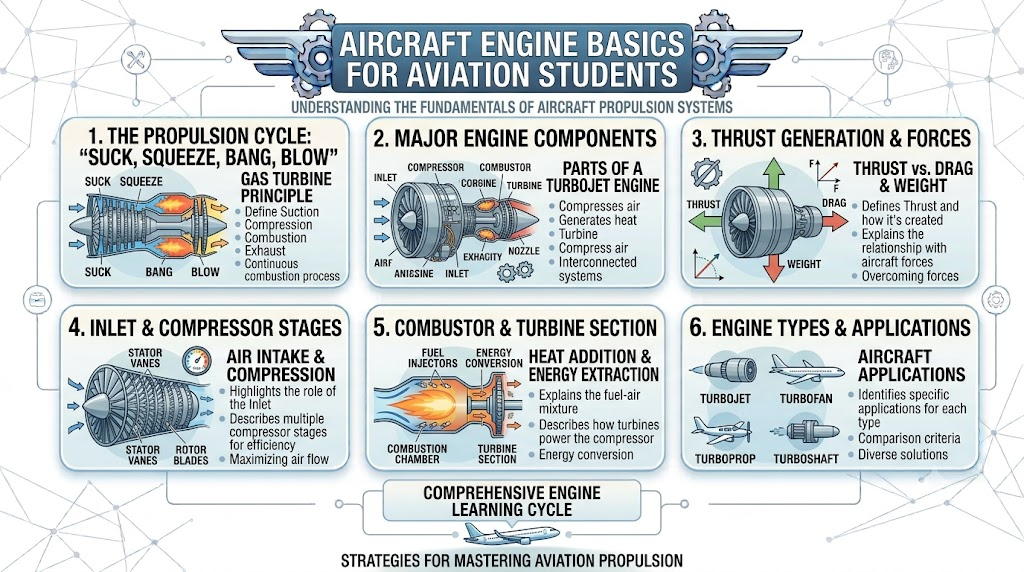
Jet engines operate using a continuous flow of air through the engine.
The basic process can be understood in five stages.
1. Air Intake
Air enters the front of the engine through the intake.
2. Compression
The compressor increases the pressure of the incoming air.
3. Combustion
Fuel is added to the compressed air and ignited in the combustion chamber. This produces hot, high-energy gases.
4. Turbine Operation
The hot gases pass through turbine stages. The turbine extracts some of the energy to drive the compressor and other engine systems.
5. Exhaust
The remaining gases leave the engine at high speed through the exhaust system, contributing to thrust.
This continuous process is commonly associated with the Brayton cycle, which describes the basic thermodynamic principles behind gas turbine engines.
Main Components of an Aircraft Engine
Aircraft engines contain many components, each with a specific function.
Air Intake
The air intake directs air into the engine.
Compressor
In a gas turbine engine, the compressor increases the pressure of incoming air before combustion.
Combustion Chamber
The combustion chamber is where fuel mixes with compressed air and releases energy through combustion.
Turbine
The turbine extracts energy from hot gases and helps drive the compressor.
Exhaust Nozzle
The exhaust nozzle directs gases leaving the engine and helps accelerate the exhaust flow.
Fan
A turbofan engine has a large fan at the front. It moves a large amount of air and contributes significantly to thrust.
Cylinders
In piston engines, cylinders provide the space where the piston moves and combustion takes place.
Pistons
Pistons move up and down inside cylinders and convert combustion pressure into mechanical movement.
Crankshaft
The crankshaft converts the linear movement of pistons into rotational motion.
Propeller Reduction System
Some aircraft engines use a reduction system to ensure that the propeller rotates at an efficient speed.
Understanding Thrust and Power
Aviation students often hear the terms power and thrust, but they are not exactly the same.
Power
Power refers to the rate at which work is done or energy is transferred.
In a piston engine, mechanical power is produced and used to rotate the propeller.
Thrust
Thrust is a forward force produced by a propulsion system.
Jet engines generate thrust by accelerating air and exhaust gases backward.
Torque
Torque is a turning force. In aircraft engines, torque is important because engines produce rotational motion that can drive components such as propellers.
Propulsion
Propulsion refers to the overall process of producing force that moves an aircraft forward.
These concepts are connected but should not be confused. Power is related to energy output, while thrust is the force that directly pushes an aircraft forward.
Fuel and Combustion in Aircraft Engines
Fuel provides the stored chemical energy needed to operate an aircraft engine.
For combustion to occur efficiently, the engine must manage the relationship between fuel and air. In piston engines, the air-fuel mixture enters the cylinders before combustion. In gas turbine engines, compressed air enters the combustion chamber, where fuel is added and burned.
Efficient combustion is important because it affects:
- Engine performance
- Fuel consumption
- Operating temperature
- Engine reliability
- Overall efficiency
Aircraft engines must carefully control combustion conditions to ensure stable and reliable operation.
Why Do Different Aircraft Use Different Engines?
There is no single engine type suitable for every aircraft.
Engine selection depends on several factors.
Aircraft Size
Larger aircraft generally require more powerful propulsion systems.
Flight Speed
Different engines are designed to operate efficiently at different speed ranges.
Operating Altitude
Aircraft operating at higher altitudes may require engines designed to perform efficiently in thinner air.
Mission Requirements
A training aircraft, regional transport aircraft, helicopter, and high-speed jet all have different operational needs.
Fuel Efficiency
Engine efficiency plays an important role in aircraft operating performance.
Aircraft Design
The overall design of an aircraft influences which propulsion system is most suitable.
Common Challenges Faced by Aircraft Engines
Aircraft engines operate under demanding conditions and must overcome several engineering challenges.
High Operating Temperatures
Combustion produces extremely high temperatures, particularly inside gas turbine engines. Engine materials and cooling systems must handle these conditions.
Mechanical Stress
Engines experience continuous forces, pressure changes, and rotational loads.
Fuel Efficiency
Aircraft must balance the need for power with the need to reduce fuel consumption.
Vibration
Mechanical movement can create vibration, which must be controlled to protect engine components.
Component Wear
Continuous operation can gradually wear engine parts, making regular inspection and maintenance essential.
Foreign Object Damage
Objects entering an engine can damage important components, especially compressor and fan sections.
Engine Icing
Under certain atmospheric conditions, ice can affect engine components and airflow.
Maintenance Requirements
Aircraft engines require scheduled inspections and maintenance to maintain safety and performance.
Table 2: Basic Aircraft Engine Components and Their Functions
| Component | Primary Function |
|---|---|
| Compressor | Increases the pressure of incoming air |
| Combustion Chamber | Mixes fuel and air and releases energy through combustion |
| Turbine | Extracts energy from hot gases to drive engine systems |
| Exhaust Nozzle | Directs and accelerates exhaust gases |
| Fan | Moves a large volume of air to contribute to thrust |
| Cylinder | Contains the piston and supports the combustion process |
| Piston | Converts combustion pressure into mechanical movement |
| Crankshaft | Converts piston movement into rotational motion |
Practical Explanation: How Aviation Students Can Learn Aircraft Engines
Learning aircraft engines becomes easier when concepts are studied in a logical order.
1. Learn Basic Principles of Flight
Start by understanding the forces involved in flight, including thrust, drag, lift, and weight.
2. Understand Force, Thrust, and Power
Learn how engines create energy and how propulsion systems convert that energy into aircraft movement.
3. Study Basic Mechanical Components
Become familiar with components such as pistons, cylinders, compressors, turbines, and propellers.
4. Learn the Four-Stroke Piston Engine Cycle
Understand intake, compression, power, and exhaust before moving to more advanced engine concepts.
5. Understand the Basic Jet Engine Process
Study the sequence of intake, compression, combustion, turbine operation, and exhaust.
6. Compare Different Engine Types
Compare piston engines, turboprops, turbojets, turbofans, and turboshaft engines to understand their different applications.
7. Study Engine Instruments and Operating Limitations
Learn how pilots and engineers monitor engine performance through temperature, pressure, speed, and other operating parameters.
8. Connect Theory With Real Aircraft Examples
Studying actual aircraft engine layouts can help students understand how theoretical concepts are applied in practice.
Common Mistakes Aviation Students Should Avoid
Memorizing Engine Parts Without Understanding Their Function
Simply remembering component names is not enough. Students should understand how each part contributes to the complete engine cycle.
Confusing Thrust With Power
Power and thrust are related concepts but have different meanings.
Assuming All Aircraft Engines Work in the Same Way
Different propulsion systems use different methods to produce useful propulsion.
Ignoring the Importance of Airflow
Airflow is essential for combustion, cooling, compression, and thrust generation.
Overlooking Temperature Limitations
Aircraft engines operate within specific temperature ranges. Excessive temperatures can affect engine performance and component life.
Learning Complex Concepts Before Basic Principles
Students should first understand fundamental concepts before studying advanced thermodynamics and engine design.
Important Considerations for Aviation Students
Students learning about aircraft engines should keep several important points in mind:
- Build strong fundamentals before studying advanced engine systems.
- Understand the function of each component instead of only memorizing names.
- Learn how airflow moves through different engine sections.
- Understand how energy is converted from fuel into mechanical power or thrust.
- Study basic engine limitations and operating parameters.
- Connect theoretical concepts with practical aircraft systems.
- Develop technical knowledge gradually.
- Understand the relationship between engine performance and flight operations.
A strong foundation in engine basics can make advanced aviation subjects easier to understand later.
Frequently Asked Questions
1. What is the main purpose of an aircraft engine?
The main purpose of an aircraft engine is to produce the power or thrust needed to propel an aircraft.
2. What is the difference between a piston engine and a jet engine?
A piston engine mainly produces mechanical power to drive a propeller, while a jet engine produces thrust by accelerating air and exhaust gases.
3. How does a jet engine produce thrust?
A jet engine compresses air, adds fuel, produces high-energy gases through combustion, and accelerates those gases through the engine to generate thrust.
4. What are the main parts of a jet engine?
Major components include the intake, compressor, combustion chamber, turbine, and exhaust system. Turbofan engines also include a large fan.
5. Why do aircraft engines operate at high temperatures?
High temperatures are produced during combustion, where fuel releases chemical energy that is converted into useful engine power.
6. What is the difference between a turbofan and a turbojet?
A turbofan uses a large fan to move additional air around the engine core, while a turbojet produces most of its thrust directly from the engine’s exhaust flow.
7. Why is engine maintenance important in aviation?
Maintenance helps identify wear, damage, and performance issues before they affect engine reliability and safety.
8. What does a compressor do in a jet engine?
The compressor increases the pressure of incoming air before it enters the combustion chamber.
9. Which engine types are commonly used in small aircraft?
Many small aircraft use piston engines, while some larger regional aircraft use turboprop engines.
10. Is aircraft engine knowledge important for pilots?
Yes. Pilots benefit from understanding basic engine operation, performance limitations, engine indications, and abnormal situations.
Conclusion
Understanding aircraft engine basics is an important part of aviation education. Engines provide the power and thrust required to move aircraft through every stage of flight, from takeoff and climb to cruise operations.
Aviation students should begin by learning the differences between major engine types and understanding how key components work together. Piston engines, turboprops, turbojets, turbofans, and turboshaft engines may operate differently, but all are designed to convert energy into useful propulsion.
Students do not need to master advanced engineering concepts immediately. A strong understanding of airflow, combustion, mechanical movement, thrust, power, and engine components provides an excellent foundation for further learning in aviation and aerospace technology.