
Introduction
Modern companies depend on technology for almost everything. Employees use applications, customers visit websites, and businesses rely on cloud services and databases. Behind all of this work, IT teams watch systems and solve problems.
However, IT environments can produce huge amounts of information. Logs, metrics, traces, alerts, and events arrive from many places. Engineers must quickly decide what matters and what needs action.
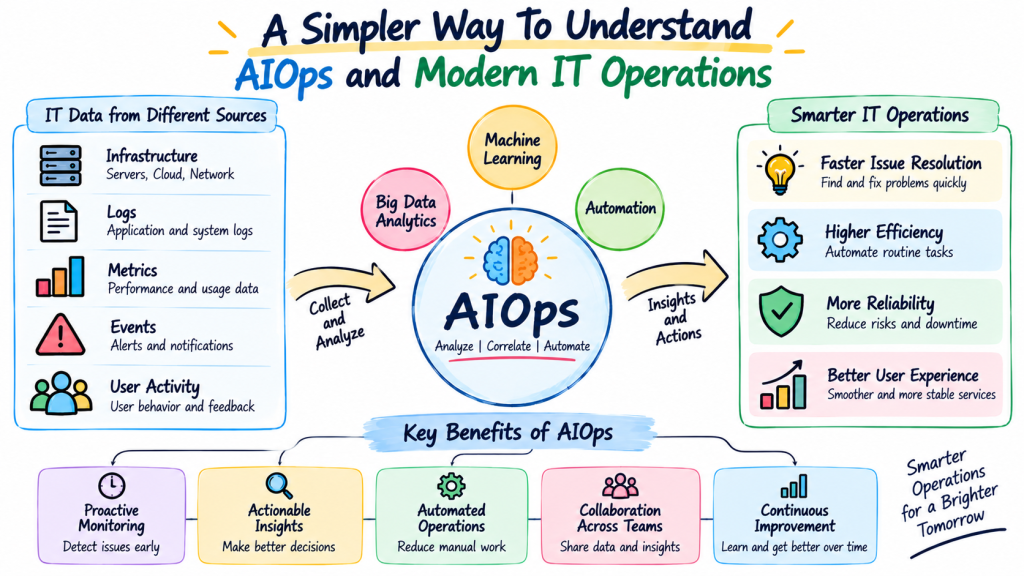
AIOps helps bring order to this information. It uses Artificial Intelligence for IT Operations along with machine learning, analytics, observability, and automation.
TheAIOps.com helps professionals understand these concepts through practical learning, technology explanations, implementation knowledge, and career-focused resources.
Why IT Operations Become Difficult
Growing IT environments create more systems to monitor. Each new application, server, cloud service, or database can add more alerts and operational data.
When teams handle every alert separately, they can lose time. Several alerts may describe different symptoms of the same incident.
For example, a website may become slow because one database reaches its limit. The team may see database alerts, application alerts, and server alerts at the same time.
AIOps can examine these signals together. This wider view helps engineers understand relationships and focus their investigation.
How AIOps Connects Different Signals
AIOps starts with data. Systems can send logs, metrics, events, traces, and other operational information into an analysis environment.
The system then looks for patterns. It can compare current behavior with previous behavior and identify unusual changes.
Event correlation adds another useful layer. It can connect events that occur around the same time or affect related services.
For example, ten alerts may appear after one network problem. Instead of treating all ten alerts as separate incidents, AIOps can help show that they may share one cause.
This gives engineers more context and can reduce unnecessary investigation.
Building a Strong Foundation with AIOps Training
Anyone entering this field can start with AIOps Training. Beginners should learn the basic building blocks before moving into advanced automation.
Training can cover monitoring, observability, operational data, event correlation, anomaly detection, root-cause analysis, incident management, predictive analytics, and remediation.
Practical exercises can make these ideas easier to understand. A learner might compare normal server behavior with unusual activity and then explain what changed.
A useful learning path can include:
- IT operations basics
- Linux and infrastructure
- Monitoring
- Observability
- Logs, metrics, and traces
- Event correlation
- Anomaly detection
- Incident management
- Automation
Learners can build confidence by studying one area at a time.
Turning Learning Into Professional Growth with AIOps Certification
An AIOps Certification can help professionals demonstrate their knowledge. However, people should combine certification study with practical learning.
Candidates can review the subjects covered by a certification before choosing a program. They should look for useful topics such as AIOps architecture, operational data, monitoring, analytics, anomaly detection, event correlation, and automation.
Hands-on projects can add more value. For example, a learner can study a sample incident, identify connected events, and explain how the team could respond.
Certification can provide a structured target. Practical work can help turn that knowledge into useful skills.
Therefore, learners should treat certification as part of a wider learning journey.
Following a Structured AIOps Course
An AIOps Course can help students move from simple ideas to practical concepts in an organized way.
A beginner can first learn why teams use AIOps. Next, the course can introduce monitoring, observability, and operational data.
Later lessons can explore machine learning, anomaly detection, event correlation, root-cause analysis, predictive analytics, and automation.
A strong course should also discuss problems that teams may face. For example, poor data quality can reduce analysis accuracy, while weak integrations can leave important systems outside the AIOps view.
Real examples and small projects make the learning process more useful because students can connect theory with actual IT operations.
Selecting the Right AIOps Tools
The number of AIOps Tools can make tool selection confusing. Teams should avoid choosing a product simply because it has a long feature list.
Instead, they should begin with a clear operational problem. For example, a team may want to reduce repeated alerts or improve visibility across cloud applications.
Before selecting a tool, teams can ask:
- Which data sources can it collect?
- Can it connect with current systems?
- Does it support observability?
- Can it identify unusual behavior?
- Can it correlate events?
- Does it support incident workflows?
- Can it automate safe tasks?
- Can engineers understand its results?
Teams should test important features with real examples. A tool should fit the team’s needs, skills, systems, and budget.
Understanding What an AIOps Platform Does
An AIOps Platform can bring information from different IT systems into one operational view.
It may collect data from applications, infrastructure, networks, databases, cloud services, monitoring products, and other sources.
After collecting the information, the platform can analyze relationships and patterns. It may identify unusual activity, connect related events, and support root-cause investigation.
Some platforms also provide predictive analytics and automated remediation.
| Feature | Simple explanation |
|---|---|
| Data collection | Brings information together |
| Observability | Shows system behavior |
| Event correlation | Connects related events |
| Anomaly detection | Finds unusual activity |
| Analytics | Helps explain patterns |
| Incident management | Organizes response work |
| Automation | Handles selected tasks |
Teams should introduce automation carefully, especially when automated actions can affect important services.
Making AIOps Implementation Practical
AIOps Implementation does not need to start with a huge transformation. A small, focused project can provide useful lessons.
Suppose a company struggles with repeated alerts from one application. The team can start by studying those alerts and identifying common patterns.
Next, engineers can connect related events. After testing the results, they can introduce a safe automated action for a known situation.
A practical implementation process can include:
- Identify one problem.
- Set a clear target.
- Review the current workflow.
- Collect useful operational data.
- Improve data quality.
- Connect important systems.
- Test the analysis.
- Add low-risk automation.
- Measure the outcome.
Teams can expand the project after they understand what works.
When AIOps Consulting Can Help
Organizations may understand the value of AIOps but still struggle to create a practical plan. AIOps Consulting can provide support during this stage.
Consultants can review current monitoring, data sources, incident processes, integrations, and automation opportunities.
For example, a company may have several monitoring systems that produce separate alerts. A consultant can help map the environment and identify areas where better connections could improve visibility.
Good consulting should focus on the organization’s actual problems. It should explain priorities, dependencies, risks, expected changes, and ways to measure progress.
Organizations should also ask clear questions before selecting a consulting partner.
Understanding AIOps Services
AIOps Services can support different parts of an organization’s operational journey. Teams may need help with planning, assessment, integration, analytics, automation, or implementation.
Possible service areas include:
- Environment assessment
- Technology integration
- Monitoring improvement
- Observability
- Event analysis
- Incident workflows
- Automation
- Implementation support
The right service depends on the problem.
For example, a company with poor visibility may need observability improvements before it considers advanced automation.
A company with strong monitoring but too many repeated alerts may focus on event correlation.
Clear goals help organizations use services in a more focused way.
Preparing for an AIOps Engineer Career
An AIOps Engineer works across several technical areas. The role can involve cloud systems, monitoring, automation, data analysis, observability, and incident management.
People preparing for this career can build skills gradually. They can begin with Linux, networking, and troubleshooting. Then, they can learn cloud platforms, monitoring, scripting, and automation.
After building those foundations, learners can study AIOps concepts in greater depth.
| Skill | Why it helps |
|---|---|
| Linux | Helps understand infrastructure |
| Networking | Explains system communication |
| Cloud | Supports modern services |
| Monitoring | Tracks system health |
| Observability | Provides deeper visibility |
| Scripting | Supports repeatable work |
| Automation | Reduces manual tasks |
| Data analysis | Finds operational patterns |
| Troubleshooting | Helps solve incidents |
Small projects can help learners connect these skills in a practical way.
A Real Use Case: Connecting a Service Problem
Imagine an online service starts responding slowly. Customers notice the problem before the company understands its cause.
The monitoring system shows several events. Server usage rises, database requests increase, and application errors appear.
AIOps can examine these signals together. The system may identify a relationship between the events and give engineers a stronger starting point for investigation.
The team can then check whether database pressure causes the application slowdown.
Once engineers confirm the cause, they can choose an appropriate response. If a safe automated action exists, the team can test it before adding it to the production workflow.
This example shows how connected information can improve incident investigation.
Lessons from Real Experience and Case Studies
Real projects can teach lessons that classroom examples cannot. Teams often discover unexpected issues after they start working with operational data.
For example, duplicate alerts may make event correlation difficult. Missing logs may hide important evidence. Different systems may also use inconsistent timestamps.
These issues show why teams should build a strong data foundation.
Case studies can help learners understand how organizations handle these challenges. Useful case studies should explain the original problem, the approach, the results, and the lessons.
Teams should also discuss failures and limitations. Learning what did not work can prevent others from repeating the same mistake.
Using Research Data in a Smart Way
Industry statistics can provide useful background about IT operations, incidents, alert volumes, and automation. However, readers should always look at the context behind each statistic.
Research may use different company sizes, industries, systems, and definitions. Therefore, one result may not apply directly to every organization.
Teams can also collect their own measurements. Useful metrics include:
- Alert volume
- Incident frequency
- Detection time
- Resolution time
- Manual effort
- False alerts
- Automation success
- Service availability
These measurements can show whether a specific AIOps project creates meaningful improvement.
A Simple Method for AIOps Planning
Teams can use a simple Find, Understand, Improve, Measure method.
First, Find a real operational problem. Next, Understand the data and processes connected to it.
Then, Improve one part of the workflow with better analysis, correlation, or automation. Finally, Measure the result.
This method keeps the project connected to a real need.
Expert interviews can add useful practical knowledge. Professionals can explain common mistakes, implementation challenges, and lessons from their work.
Still, teams should compare expert opinions with their own data before making major decisions.
Making AIOps Content Clear for Modern Search
People increasingly search for answers through traditional search engines, answer systems, and generative tools. Clear content can help readers find and understand useful information.
AEO, or Answer Engine Optimization, encourages direct answers to common questions. GEO, or Generative Engine Optimization, focuses on useful content for generative search experiences.
LLMO, or Large Language Model Optimization, supports clear structure, strong context, and easy-to-understand explanations. AISEO, or AI Search Optimization, also focuses on content discovery in modern search environments.
Meanwhile, E-E-A-T stands for experience, expertise, authoritativeness, and trust.
A strong AIOps article can support these principles through real examples, research data, case studies, comparisons, tutorials, expert insights, and original observations.
Frequently Asked Questions
What does AIOps mean?
AIOps means using artificial intelligence, machine learning, data, analytics, and automation to support IT operations.
Why do companies use AIOps?
Companies can use AIOps to understand operational data, reduce alert noise, connect related events, investigate incidents, and automate selected tasks.
Is AIOps suitable for beginners?
Yes. Beginners can start with basic IT operations and gradually learn monitoring, observability, cloud, automation, and AIOps concepts.
What topics should AIOps Training cover?
Training can cover monitoring, observability, logs, metrics, event correlation, anomaly detection, root-cause analysis, incident management, analytics, and automation.
What does an AIOps Certification show?
An AIOps Certification can demonstrate knowledge of important AIOps concepts. Practical projects can provide additional evidence of hands-on ability.
How should teams select AIOps Tools?
Teams should start with a clear problem and compare data support, integrations, analytics, event correlation, automation, usability, security, and operational fit.
What is an AIOps Platform?
An AIOps Platform brings operational data and analysis capabilities together so teams can understand events and system behavior more effectively.
How can teams start AIOps Implementation?
Teams can choose one focused problem, collect useful data, test a solution, introduce safe automation, and measure the results.
What can AIOps Consulting support?
AIOps Consulting can support assessment, planning, technology integration, implementation decisions, workflow improvements, and automation planning.
What does an AIOps Engineer do?
An AIOps Engineer works with IT operations, cloud systems, monitoring, observability, data, automation, and troubleshooting.
What does TheAIOps.com provide?
TheAIOps.com provides learning and knowledge resources covering AIOps Training, AIOps Certification, AIOps Course, AIOps Tools, AIOps Platform, AIOps Implementation, AIOps Consulting, and AIOps Services.
Final Thought
Technology keeps changing, but the basic goal of IT operations remains simple: keep important systems working and help people solve problems quickly.
AIOps can support that goal by connecting data, finding patterns, reducing repeated investigation, and supporting carefully selected automation.
Learners can build their foundation through AIOps Training and an AIOps Course. Professionals can use AIOps Certification to demonstrate structured knowledge. Organizations can explore AIOps Tools, AIOps Platform options, AIOps Consulting, and AIOps Services based on their needs.
TheAIOps.com brings these learning areas together for people who want to understand the field more clearly.
The smartest path does not require doing everything at once. Start with one problem, learn from the data, test small changes, measure the outcome, and grow from there.