Introduction
A splashdown is one of the most exciting moments in a space mission. After travelling through space and reentering Earth’s atmosphere at extremely high speed, a spacecraft capsule slows down with parachutes and lands in the ocean.
Splashdown landings have been used for many crewed space missions because oceans provide a large and relatively open landing area. However, landing in water is not as simple as dropping a capsule into the sea. Mission teams must carefully calculate the reentry path, monitor weather conditions, deploy parachutes, locate the spacecraft, secure the capsule, and safely remove the astronauts.
For students learning about spaceflight, splashdown is an excellent example of how physics, engineering, navigation, medicine, communication, and teamwork come together during a mission.
This guide explains the complete splashdown landing process in simple language.
What Is a Splashdown Landing?
A splashdown landing occurs when a spacecraft returns to Earth and lands in an ocean, sea, or another large body of water.
The spacecraft usually enters the atmosphere inside a strong crew capsule. Atmospheric drag slows it down, parachutes reduce its speed further, and the capsule finally touches the water.
After landing, recovery ships, helicopters, divers, engineers, and medical teams move toward the spacecraft.
The main goals are to:
- Keep the astronauts safe
- Prevent the capsule from sinking
- Protect scientific samples
- Secure spacecraft data
- Recover the vehicle
- Transport the crew for medical checks
Why Spacecraft Land in the Ocean
Oceans cover most of Earth’s surface, which makes them useful landing zones.
A water landing also provides a large target area. Even when a spacecraft lands several kilometres away from the planned point, recovery teams may still reach it safely.
The ocean can absorb some of the impact energy, although splashdown can still feel strong for the astronauts.
Space agencies may choose water landings because they offer:
- Large open recovery zones
- Fewer buildings and people nearby
- Reduced risk of hitting hard terrain
- Flexible landing locations
- Space for ships and helicopters
- Easier planning for emergency deviations
Water landings also avoid the need for a long runway.
How Splashdown Differs From Land Landing
Spacecraft can return to Earth in different ways.
Some capsules land on the ground using parachutes, airbags, or small rockets. Spaceplanes land on runways, while some vehicles use engines for powered landings.
Splashdown is different because the spacecraft lands directly in water.
| Feature | Splashdown Landing | Land Landing |
|---|---|---|
| Landing surface | Ocean or sea | Ground or runway |
| Final impact | Absorbed partly by water | Absorbed by landing systems |
| Recovery teams | Ships, helicopters, divers | Ground vehicles and medical teams |
| Main risks | Waves, water entry, sinking | Rough terrain, dust, hard impact |
| Capsule movement | May float and rock | Usually remains stationary |
| Recovery time | Depends on sea conditions | Often faster on accessible ground |
Both methods require accurate navigation and strong safety systems.
Preparing for Splashdown
Splashdown planning begins long before the spacecraft returns to Earth.
Mission controllers study the landing area and check:
- Wind speed
- Wave height
- Ocean currents
- Storm activity
- Visibility
- Ship positions
- Helicopter readiness
- Medical-team availability
Astronauts prepare the spacecraft by securing loose objects, checking pressure suits, reviewing emergency procedures, and positioning their seats for reentry.
The crew also confirms that communication equipment, parachutes, flotation systems, and emergency supplies are ready.
The Deorbit Burn
A spacecraft cannot simply stop moving and fall toward Earth.
While orbiting, it travels sideways at very high speed. To return, the spacecraft performs a deorbit burn.
During this manoeuvre, engines fire in a direction that reduces the spacecraft’s orbital speed. This changes its path and allows gravity to pull it toward the atmosphere.
The burn must be carefully timed because it determines where the spacecraft will reenter and where it is expected to splash down.
If the burn occurs too early or too late, the landing point may change significantly.
Separating the Return Capsule
Many spacecraft contain more than one section.
Before reentry, the crew capsule may separate from a service module or propulsion section. These extra sections provide power, fuel, life support, or storage while the spacecraft is in orbit.
Only the part designed for atmospheric reentry returns with the astronauts.
The return capsule contains:
- Crew seats
- Control systems
- Communication equipment
- Emergency supplies
- Heat shielding
- Parachutes
- Flotation devices
The discarded sections may burn up in the atmosphere or follow another planned disposal path.
Entering Earth’s Atmosphere
Atmospheric reentry is one of the most dangerous stages of splashdown.
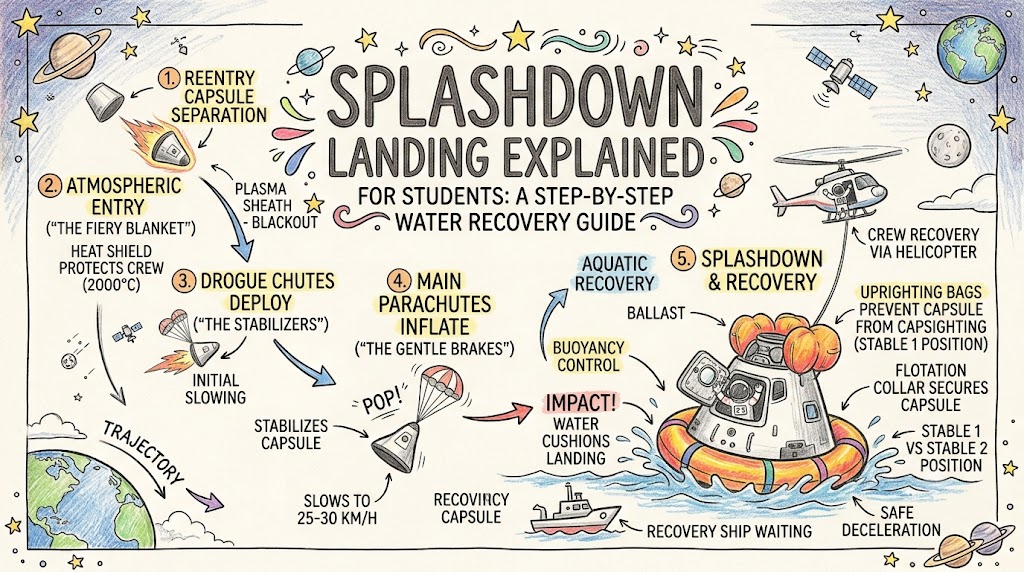
The spacecraft enters the atmosphere at extremely high speed. Air in front of the capsule becomes compressed and heated.
The outside temperature may rise to several thousand degrees Celsius.
A heat shield protects the spacecraft by absorbing, reflecting, or carrying away the heat.
The capsule must enter at the correct angle.
If the angle is too steep, the spacecraft may experience extreme heating and high gravitational forces.
If it is too shallow, the capsule may skip away from the atmosphere or travel beyond the intended landing zone.
How the Spacecraft Slows Down
The spacecraft loses speed in several stages.
Atmospheric Drag
The atmosphere creates resistance against the moving capsule. This drag removes most of its speed.
Stable Capsule Position
The shape of the capsule helps keep it correctly oriented, with the heat shield facing the direction of travel.
Drogue Parachutes
Smaller parachutes deploy first. They stabilise the capsule and begin slowing it.
Main Parachutes
Larger parachutes deploy after the capsule has slowed enough. They reduce the descent speed before water contact.
This sequence is necessary because opening a large parachute too early could damage it.
How Parachutes Work During Splashdown
Parachutes are among the most important splashdown systems.
A spacecraft may carry several parachutes so that it can still land safely if one system has a problem.
The parachute sequence generally includes:
Pilot Chutes
Small pilot chutes pull out the larger drogue parachutes.
Drogue Chutes
Drogue parachutes stabilise the capsule and reduce speed.
Main Parachutes
Main parachutes provide the final major reduction in descent speed.
The parachutes may open gradually in stages. This reduces sudden forces on the capsule and crew.
Engineers test parachutes repeatedly through aircraft drop tests and computer simulations.
What Astronauts Experience During Descent
Astronauts are strapped tightly into specially designed seats.
During reentry, they may experience several times normal Earth gravity. Their bodies feel heavier as the spacecraft slows rapidly.
When the parachutes open, the crew may feel sudden changes in movement.
As the capsule approaches the ocean, astronauts prepare for impact by:
- Keeping their bodies firmly supported
- Following the correct breathing method
- Securing their arms and legs
- Monitoring spacecraft instruments
- Confirming landing-system status
Splashdown can feel similar to a strong impact or sudden stop, even though water helps absorb some energy.
The Moment of Splashdown
Splashdown occurs when the capsule contacts the ocean surface.
The spacecraft usually enters the water with its heat shield facing downward.
The impact creates a large splash and causes the capsule to move sharply.
After contact, the parachutes may collapse into the water. The capsule may rock, tilt, or temporarily turn into an uncomfortable position.
The crew immediately checks:
- Cabin pressure
- Crew condition
- Communication systems
- Water leakage
- Electrical safety
- Capsule stability
- Emergency warnings
Landing is complete, but the recovery process has only begun.
How the Capsule Stays Afloat
A crew capsule is designed to float after landing.
It may use:
- Built-in buoyant materials
- Inflatable flotation bags
- Sealed compartments
- Stability balloons
- Automatic recovery beacons
Some capsules may initially float at an angle. Inflatable bags can help move the spacecraft into an upright position.
A stable capsule makes it easier for astronauts to remain safe and for recovery teams to reach the hatch.
What Happens if the Capsule Turns Over?
A capsule can sometimes land upside down or tilt heavily because of waves and parachute movement.
This condition is not always an emergency because capsules are designed with recovery systems.
Inflatable balloons may be activated to rotate the capsule into the correct position.
The crew remains strapped into their seats until the spacecraft is stable.
Recovery teams monitor the capsule and prepare to assist if the automatic system does not work properly.
How Recovery Teams Find the Spacecraft
The exact splashdown point may differ from the planned location.
Wind, atmospheric conditions, parachute movement, and ocean currents can affect the final position.
Recovery teams locate the capsule using:
- GPS coordinates
- Radio beacons
- Satellite tracking
- Aircraft observations
- Flashing lights
- Coloured markers
- Communication signals
Ships and helicopters are positioned near the expected landing area before reentry begins.
Role of Recovery Ships
Recovery ships serve as mobile mission-support centres.
They carry:
- Medical teams
- Engineers
- Divers
- Capsule-lifting equipment
- Communication systems
- Helicopter facilities
- Emergency supplies
The ship moves toward the capsule after splashdown.
Once close enough, boats or divers approach the spacecraft, secure it, and prepare for crew recovery.
Role of Recovery Divers
Divers are usually among the first people to reach the capsule.
They must approach carefully because the spacecraft may be unstable or surrounded by parachute lines.
Divers may:
- Attach flotation collars
- Secure safety ropes
- Inspect the capsule
- Confirm there is no fuel leak
- Clear parachute lines
- Prepare the hatch
- Communicate with the astronauts
They are specially trained for spacecraft recovery and emergency rescue.
Opening the Capsule Hatch
The hatch is opened only when recovery teams confirm that the spacecraft is safe.
Before opening it, teams may check for:
- Toxic fuel vapours
- Fire risk
- Electrical hazards
- Water leakage
- Pressure differences
- Structural damage
Once the hatch is opened, fresh air enters the capsule.
Medical personnel communicate with the astronauts and help them prepare to leave.
How Astronauts Exit the Capsule
Astronauts may leave the capsule in different ways.
They may climb onto a recovery platform, move into a small boat, or be lifted into a helicopter.
After long space missions, astronauts may need assistance because their bodies have adapted to microgravity.
They may experience:
- Dizziness
- Weak muscles
- Balance problems
- Low blood pressure
- Motion sickness
- Fatigue
Recovery personnel help them move slowly and safely.
Medical Checks After Splashdown
Astronauts receive immediate medical attention after leaving the spacecraft.
Medical teams check:
- Heart rate
- Blood pressure
- Oxygen level
- Body temperature
- Hydration
- Muscle strength
- Balance
- Alertness
Astronauts may then be transported to a shipboard medical area or taken by helicopter to a medical facility.
These checks are especially important after long-duration missions.
Recovering Scientific Samples
Spacecraft often carry valuable scientific samples and equipment.
These may include:
- Biological experiments
- Space-grown plants
- Medical samples
- Materials exposed to space
- Computer storage devices
- Research instruments
Some items must be kept at a controlled temperature.
Recovery teams remove these materials quickly and transport them to laboratories.
Recovering the Spacecraft
After the crew exits, the capsule itself must be recovered.
Cranes or lifting systems pull the spacecraft onto the recovery ship.
Engineers then inspect the vehicle for:
- Heat-shield damage
- Parachute performance
- Water entry
- Structural stress
- Electronics condition
- Landing-system performance
The data collected helps engineers improve future spacecraft.
Reusable capsules may be repaired and prepared for another mission.
Main Risks During Splashdown
Although splashdowns are carefully planned, several risks remain.
Rough Seas
High waves can make the capsule unstable and delay recovery.
Strong Winds
Wind can move the spacecraft away from the expected landing area.
Parachute Failure
A parachute problem can increase the landing speed.
Water Leakage
Damage to seals or the capsule structure may allow water inside.
Capsule Rollover
The spacecraft may float upside down or at an uncomfortable angle.
Delayed Recovery
Bad weather or inaccurate landing coordinates may slow recovery operations.
Hazardous Chemicals
Some spacecraft contain fuels or materials that can be dangerous to recovery teams.
How Space Agencies Improve Splashdown Safety
Space agencies use testing and training to reduce risk.
Safety methods include:
- Parachute drop tests
- Ocean recovery exercises
- Crew survival training
- Weather forecasting
- Backup communication systems
- Multiple flotation devices
- Emergency beacons
- Medical preparation
- Recovery ship rehearsals
- Computer simulations
Every mission provides new information that can improve future splashdowns.
Student-Friendly Example of Splashdown Physics
Imagine dropping a ball into a swimming pool.
If the ball falls from a low height, the water slows it safely. If it falls from a much greater height, the impact becomes stronger.
A spacecraft behaves differently because it begins at orbital speed.
Before reaching the ocean, it must lose most of that speed through atmospheric drag and parachutes.
The ocean only handles the final part of the landing.
This means the complete slowing process is:
- Deorbit burn changes the spacecraft’s path.
- Atmospheric drag removes most of its speed.
- Drogue parachutes stabilise the capsule.
- Main parachutes slow the descent.
- Water absorbs part of the remaining impact.
Common Misunderstandings About Splashdown
The Ocean Does Not Stop a Spacecraft Moving at Orbital Speed
The atmosphere and parachutes slow the spacecraft long before it reaches the water.
Splashdown Is Not Always Gentle
The impact can still be strong, especially in rough water.
Astronauts Are Not Immediately Free to Leave
They must wait until the capsule is stable and recovery teams arrive.
Parachutes Are Not the Only Safety System
Heat shields, navigation computers, flotation bags, beacons, and recovery teams are also essential.
The Mission Does Not End at Water Contact
Crew recovery, medical checks, sample collection, and vehicle inspection continue afterward.
Splashdown Landing on Other Worlds
Splashdown is mainly used on Earth because Earth has large oceans.
Other worlds may not have suitable liquid surfaces.
The Moon has no oceans and almost no atmosphere, so spacecraft must use engines for landing.
Mars has a thin atmosphere and no large surface oceans. Mars landers may use parachutes, rockets, airbags, or sky-crane systems.
Future missions to ocean worlds could use different landing methods, but these environments would require entirely new spacecraft designs.
Future of Splashdown Technology
Future splashdown systems may become safer and more accurate.
Possible improvements include:
- Smarter navigation computers
- More reliable parachutes
- Better capsule stability systems
- Faster recovery ships
- Improved weather forecasting
- Reusable flotation devices
- Advanced astronaut monitoring
- More accurate landing predictions
Autonomous ships and drones may also support future spacecraft recovery operations.
Key Takeaways
- Splashdown means landing a spacecraft in water.
- The spacecraft slows through atmospheric drag and parachutes.
- A heat shield protects the capsule during reentry.
- Oceans provide large and flexible landing zones.
- Flotation systems keep the capsule above water.
- Divers, ships, helicopters, engineers, and medical teams support recovery.
- Astronauts may need physical assistance after landing.
- Scientific samples and spacecraft data are recovered after the crew.
- Weather and sea conditions strongly affect splashdown safety.
- Testing and training make water landings more reliable.
Frequently Asked Questions
What is a splashdown landing?
A splashdown is a spacecraft landing in an ocean or another large body of water.
Why do space capsules land in the ocean?
Oceans provide large open landing areas and reduce the risk of hitting buildings or hard terrain.
Do spacecraft use parachutes during splashdown?
Yes. Most crew capsules use drogue and main parachutes to slow down before reaching the water.
Is splashdown completely safe?
No landing method is completely risk-free, but testing, backup systems, and trained recovery teams reduce the danger.
Can the capsule sink?
Capsules are designed to float and usually include inflatable flotation systems. Recovery teams are also prepared for emergencies.
How quickly are astronauts rescued?
Recovery time depends on the landing location, sea conditions, and the position of recovery ships and helicopters.
Why do divers approach the capsule first?
Divers stabilise the spacecraft, inspect it, attach flotation devices, and prepare the hatch for crew recovery.
Does water make the landing soft?
Water reduces some impact energy, but astronauts may still experience a strong landing force.
What happens to the capsule after recovery?
Engineers inspect it, download mission data, study any damage, and prepare reusable spacecraft for future missions.
Why do astronauts sometimes need help walking?
Their muscles, balance system, and circulation adapt to microgravity, so returning to Earth’s gravity can temporarily make movement difficult.
Conclusion
A splashdown landing is a carefully controlled process that brings astronauts safely home after a space mission. The spacecraft must survive reentry heat, slow down with parachutes, land in the ocean, stay afloat, and wait for trained recovery teams. For students, splashdown demonstrates how science, engineering, teamwork, safety planning, and human health all play important roles in successful space exploration.