Introduction
Rocket launch day is one of the most exciting moments in any space mission. People see the countdown, hear the final calls, watch the engines ignite, and then see the rocket lift off into the sky. It looks fast, powerful, and dramatic.
But launch day is not just about pressing a button and sending a rocket into space. It is a carefully planned process where every second matters. Many teams work together to check the rocket, spacecraft, fuel systems, weather, communication, mission control, safety systems, and final launch approval.
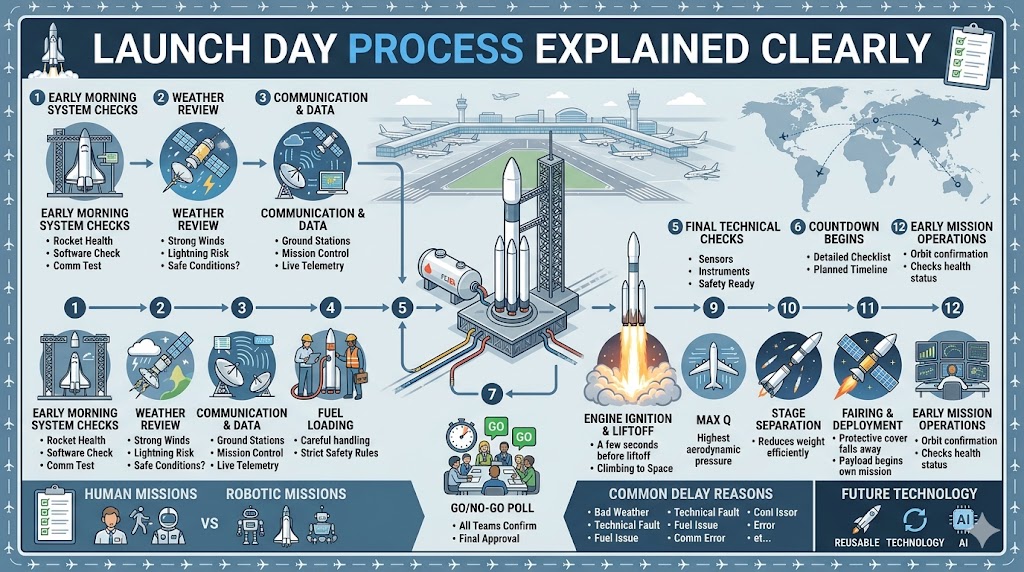
For beginners, the launch day process may seem complex. However, when we understand it step by step, it becomes much easier. This guide explains what happens on launch day from early checks to liftoff, stage separation, spacecraft deployment, and early mission operations.
What Is Launch Day in a Space Mission?
Launch day is the day when the rocket and spacecraft are finally sent into space.
It is the moment when months or years of planning, testing, preparation, and teamwork come together. On this day, the launch team checks whether the rocket, spacecraft, payload, ground systems, weather, safety systems, and mission control are ready.
In simple words, launch day is the final execution stage of a space mission.
It includes:
- Rocket system checks
- Spacecraft health checks
- Weather review
- Fuel loading
- Communication testing
- Countdown operations
- Go/No-Go decision
- Engine ignition
- Liftoff
- Stage separation
- Spacecraft deployment
- Early mission monitoring
A successful launch depends on timing, teamwork, technology, and safety.
Why Launch Day Is So Important
Launch day is one of the most critical stages of a space mission because the rocket must perform correctly in a very short time.
During launch, the rocket faces strong forces, vibration, heat, pressure, and high speed. The spacecraft must also remain safe while being carried through Earth’s atmosphere.
Launch day is important because it affects:
- Mission success
- Rocket performance
- Spacecraft safety
- Payload protection
- Astronaut safety, if humans are onboard
- Fuel management
- Orbit accuracy
- Communication with Earth
- Scientific or commercial mission goals
Even a small problem can delay or stop the launch. That is why teams follow strict procedures and checklists before liftoff.
Main Teams Working on Launch Day
A space launch requires many expert teams. Each team is responsible for a different part of the launch process.
Launch Director
The launch director is responsible for the final launch decision. This person coordinates launch operations and gives final approval for liftoff.
Mission Control Team
Mission control monitors the spacecraft and mission after launch. They track data, communication, orbit status, and spacecraft health.
Rocket Engineers
Rocket engineers check engines, fuel systems, guidance systems, structure, and stage separation systems.
Spacecraft Engineers
Spacecraft engineers monitor the spacecraft’s power, communication, software, batteries, sensors, navigation, and thermal systems.
Ground Support Team
The ground support team manages launch pad equipment, fuel lines, power connections, cooling systems, and support tools.
Weather Team
Weather experts check wind, rain, lightning, clouds, storms, visibility, temperature, and upper-atmosphere conditions.
Safety Team
Safety teams protect workers, astronauts, the launch site, equipment, and nearby public areas.
Flight Dynamics Team
The flight dynamics team monitors the rocket’s path, speed, altitude, and orbit target.
Astronaut Support Team
For human missions, astronaut support teams help crew members prepare, suit up, enter the spacecraft, and follow safety procedures.
Step 1: Early Morning System Checks
Launch day usually starts with detailed system checks.
Teams check the rocket, spacecraft, payload, launch pad, communication systems, and mission control tools. These checks help confirm that everything is ready before the countdown continues.
Early system checks may include:
- Rocket health status
- Spacecraft power status
- Payload condition
- Ground equipment readiness
- Communication line testing
- Battery levels
- Software status
- Sensor readings
- Safety system checks
If any issue is found, teams study the problem and decide whether it can be fixed before launch.
Step 2: Weather Review
Weather is one of the biggest factors on launch day.
Even if the rocket and spacecraft are ready, unsafe weather can delay the launch. Rockets must pass through the lower and upper atmosphere, so weather conditions are checked at different heights.
Weather teams monitor:
- Strong winds
- Lightning risk
- Rain
- Thick clouds
- Storms
- Temperature
- Visibility
- Upper-level winds
Lightning is especially dangerous because it can affect rocket electronics. Strong winds can also disturb the rocket during flight.
If the weather is not safe, the launch may be delayed until conditions improve.
Step 3: Rocket and Spacecraft Communication Checks
Before launch, teams confirm that the rocket, spacecraft, ground stations, launch control, and mission control can communicate properly.
Communication is very important because teams must receive live data from the rocket and spacecraft during launch.
Communication checks include:
- Radio signal testing
- Data link testing
- Ground station readiness
- Antenna checks
- Command system checks
- Telemetry checks
Telemetry means the live data sent by the rocket or spacecraft. It can include speed, altitude, temperature, pressure, fuel status, battery levels, and system health.
Without proper communication, launch approval may not be given.
Step 4: Fuel Loading Process
Fuel loading is one of the most important and careful parts of launch day.
Rockets need a large amount of fuel to leave Earth and reach space. Some rocket fuels must be kept extremely cold or handled under high pressure. Because of this, fuel loading follows strict safety rules.
During fuel loading, teams check:
- Fuel temperature
- Fuel pressure
- Tank levels
- Valve operation
- Leak detection
- Safety zones
- Emergency systems
Fuel loading may happen hours before launch or closer to liftoff, depending on the rocket design.
This stage is closely monitored because fuel systems must work perfectly for a safe launch.
Step 5: Final Technical Checks
After fuel loading and system preparation, engineers perform final technical checks.
These checks confirm that the rocket and spacecraft are ready for the countdown to continue.
Final technical checks may include:
- Engine system status
- Guidance system readiness
- Software status
- Battery health
- Payload connection checks
- Sensor accuracy
- Fuel system pressure
- Safety system readiness
- Launch pad status
If any system gives an unusual reading, the countdown may pause while engineers investigate.
These checks help prevent avoidable problems during liftoff.
Step 6: Countdown Begins
The countdown is the planned sequence that leads to liftoff.
Many people think the countdown is only the final ten seconds, but the real countdown can begin many hours before launch. During this time, teams follow a detailed checklist.
The countdown helps organize:
- System checks
- Fuel loading
- Communication testing
- Weather review
- Launch team coordination
- Safety approval
- Final technical confirmation
The countdown gives every team a common timeline so they know exactly when each task must happen.
Step 7: Built-In Holds During Countdown
A countdown may include planned pauses called built-in holds.
A built-in hold gives teams extra time to review systems, confirm readiness, solve small problems, or wait for better conditions.
For example, a countdown may pause while teams review weather, fuel status, communication systems, or spacecraft health.
Built-in holds are normal. They help teams avoid rushing important decisions.
A launch can also be paused unexpectedly if a technical issue appears.
Step 8: Go/No-Go Poll
The Go/No-Go poll is one of the most important parts of launch day.
During this process, each major team reports whether their system is ready for launch.
If a team says “Go,” it means their area is ready.
If a team says “No-Go,” it means there is a problem that must be solved before launch.
Teams that may be included in the Go/No-Go poll include:
- Rocket team
- Spacecraft team
- Weather team
- Safety team
- Payload team
- Mission control team
- Ground support team
- Flight dynamics team
A launch can only continue when all required teams give a “Go.”
If any critical system is “No-Go,” the launch may be delayed or stopped.
Step 9: Final Minutes Before Launch
The final minutes before launch are highly controlled.
At this stage, computers begin handling many automatic checks because things happen very quickly. Human teams still monitor everything, but onboard and ground computers help manage the final sequence.
During the final minutes, teams check:
- Fuel pressure
- Engine readiness
- Rocket guidance system
- Launch pad clearance
- Weather status
- Communication signals
- Safety systems
- Final launch approval
The rocket is now very close to liftoff. If a major problem appears, the launch system can stop the countdown automatically.
Step 10: Engine Ignition
Engine ignition is the moment when the rocket engines start.
In many launches, engines ignite a few seconds before liftoff. During this short period, computers check whether the engines are producing the correct power and working safely.
If the engine performance is normal, the rocket is allowed to lift off.
If the engine performance is not correct, the launch can be stopped before the rocket leaves the pad.
Engine ignition is a powerful and carefully monitored stage of launch day.
Step 11: Liftoff
Liftoff happens when the rocket leaves the launch pad.
At liftoff, the rocket begins climbing through Earth’s atmosphere. It burns fuel rapidly and gains speed.
During this stage, the rocket must stay stable and follow the planned path. Mission teams monitor speed, altitude, engine performance, fuel use, and flight direction.
Liftoff is the most visible part of launch day, but it is only the beginning of the rocket’s journey.
Step 12: Max Q
Max Q is an important moment during rocket flight.
In simple words, Max Q is the point where the rocket experiences the highest aerodynamic pressure. This pressure comes from moving very fast through the atmosphere.
During Max Q, the rocket must handle strong forces from air pressure and speed.
After passing Max Q, the air becomes thinner as the rocket climbs higher, and aerodynamic pressure begins to reduce.
Max Q is important because the rocket structure must be strong enough to survive this stage.
Step 13: Stage Separation
Many rockets are built in stages.
A stage is a section of the rocket that contains engines and fuel. Once one stage uses its fuel, it separates from the rest of the rocket. The next stage then continues the journey.
Stage separation is important because it reduces weight. A lighter rocket can move faster and use fuel more efficiently.
For example:
- First stage lifts the rocket from the ground
- Second stage continues the journey toward orbit
- Upper stage may place the spacecraft on the correct path
Stage separation must happen at the correct time for the mission to succeed.
Step 14: Fairing Separation
The payload fairing is the protective cover around the spacecraft or satellite.
During the early part of launch, the fairing protects the payload from air pressure, heat, and vibration. Once the rocket reaches thinner air or space, the fairing is no longer needed.
At that point, the fairing separates and falls away.
Fairing separation reduces weight and exposes the spacecraft for the next stage of the mission.
This step is especially important for satellite launches and scientific missions.
Step 15: Spacecraft Deployment
Spacecraft deployment happens when the spacecraft or satellite separates from the rocket.
This is the moment when the payload begins its own mission.
After deployment, the spacecraft may:
- Open solar panels
- Start communication with Earth
- Check its systems
- Adjust its orbit
- Begin collecting data
- Prepare for further travel
For a satellite mission, deployment may place the satellite into orbit. For a deep space mission, deployment may send the spacecraft on a path toward the Moon, Mars, or another destination.
Step 16: Early Mission Operations
After deployment, early mission operations begin.
This stage is important because the spacecraft must prove that it is healthy and ready to work.
Mission control checks:
- First signal from spacecraft
- Battery status
- Solar panel deployment
- Communication health
- Orbit confirmation
- Temperature readings
- Computer status
- Payload status
This first stage after deployment is sometimes very tense because teams wait for confirmation that the spacecraft is working correctly.
Once the spacecraft is stable, the mission can move into its main operation phase.
Launch Day for Human Missions vs Robotic Missions
Human and robotic missions both follow launch day procedures, but human missions need extra safety checks because astronauts are onboard.
| Launch Day Area | Human Mission | Robotic Mission |
|---|---|---|
| Crew Involvement | Astronauts are onboard | No humans onboard |
| Safety Checks | Extra life-support and crew safety checks | Focus on spacecraft and payload safety |
| Communication | Crew communication is required | Machine data communication is required |
| Emergency Planning | More complex due to human life | Focuses on mission and equipment protection |
| Pre-Launch Steps | Crew suit-up and boarding included | Payload and system checks only |
| Risk Level | Higher because people are involved | Lower compared to crewed missions |
| Mission Support | Astronaut support team needed | Remote operations team needed |
Both mission types require precision, but human missions involve more careful planning for safety, health, and emergency response.
Common Reasons Launches Are Delayed
Launch delays are common in space missions. A delay does not mean failure. It usually means teams are protecting the mission from unnecessary risk.
Common reasons for launch delays include:
Bad Weather
Strong winds, lightning, storms, rain, or unsafe cloud conditions can stop a launch.
Technical Faults
A problem with the rocket, spacecraft, engine, sensor, or software can delay liftoff.
Fuel System Issues
Fuel pressure, temperature, valve problems, or leak warnings can stop the countdown.
Sensor Problems
Incorrect sensor readings may require extra checks before launch approval.
Communication Errors
If teams cannot communicate clearly with the rocket or spacecraft, launch may not continue.
Safety Concerns
Any risk to people, equipment, or mission success can delay the launch.
Ground Equipment Issues
Launch pad systems, power supplies, cooling systems, or support tools must work properly.
A safe delay is always better than a risky launch.
What Happens If Launch Is Stopped?
When a launch is stopped, it is often called a scrub or launch delay.
This means the launch will not happen at the planned time. The mission team investigates the issue and decides whether the launch can happen later the same day or on another date.
If launch is stopped, teams may:
- Safely stop the countdown
- Secure the rocket
- Review system data
- Remove or manage fuel if needed
- Fix the technical issue
- Recheck weather conditions
- Plan a new launch time
Stopping a launch can be disappointing, but it is a normal part of space operations. Safety always comes first.
Role of Mission Control After Liftoff
After liftoff, mission control becomes even more important.
Mission control tracks the rocket and spacecraft as they move through different stages of flight. Teams watch live data to make sure the mission is following the planned path.
Mission control monitors:
- Rocket speed
- Altitude
- Engine performance
- Stage separation
- Spacecraft deployment
- Communication signals
- Orbit status
- Spacecraft health
- Emergency alerts
Once the spacecraft is deployed, mission control continues tracking it and supporting early mission operations.
For human missions, mission control also communicates with astronauts and supports crew safety.
Beginner-Friendly Launch Day Timeline
Here is a simple example of a launch day timeline.
| Time | Main Activity |
|---|---|
| Several hours before launch | Rocket, spacecraft, and ground system checks |
| Hours before launch | Weather review and communication testing |
| Few hours before launch | Fuel loading begins |
| Around 1 hour before launch | Final technical checks and team coordination |
| Final 30 minutes | Countdown continues with system monitoring |
| Final 10 minutes | Go/No-Go poll and automatic launch sequence |
| Final seconds | Engine ignition and performance checks |
| Liftoff | Rocket leaves the launch pad |
| Few minutes after liftoff | Max Q and stage separation |
| Later in flight | Fairing separation and spacecraft deployment |
| After deployment | Early mission operations begin |
This timeline can change depending on the rocket, mission type, and launch organization.
Skills Needed to Work on Launch Day Operations
Launch day operations need people with strong technical knowledge and teamwork skills.
Important skills include:
Aerospace Engineering
Useful for understanding rockets, spacecraft, flight systems, and launch vehicles.
Mechanical Engineering
Important for engines, structures, moving parts, and mechanical systems.
Electrical Engineering
Needed for power systems, sensors, circuits, and communication hardware.
Computer Science
Useful for software systems, automation, simulations, and mission control tools.
Systems Engineering
Helps connect many different mission parts into one working launch system.
Mission Operations
Important for understanding launch procedures, timelines, and flight rules.
Weather Analysis
Helps teams decide whether weather conditions are safe for launch.
Communication Skills
Launch teams must speak clearly and quickly during important decisions.
Teamwork
Launch day depends on many teams working together under pressure.
Problem-Solving
Unexpected issues can happen, so teams must solve problems calmly and carefully.
Future of Launch Day Operations
Launch day operations are becoming smarter with new technology.
Automation is helping teams complete checks faster. Artificial intelligence may help detect problems early. Advanced sensors can provide better data about rocket health. Digital simulations help teams practice launch situations before the real day.
Reusable rockets are also changing launch operations. When rockets can be used again, teams must inspect and prepare them carefully for each new mission.
Future launch operations may include:
- AI-based monitoring
- More automated countdown systems
- Better weather prediction
- Advanced launch simulations
- Improved reusable rocket checks
- Smarter mission control software
- Faster communication systems
- Safer launch procedures
Even with modern technology, human decision-making will remain important. Space launches still need experienced teams to make final safety decisions.
FAQs About the Launch Day Process
1. What happens on rocket launch day?
On rocket launch day, teams check the rocket, spacecraft, weather, fuel systems, communication, mission control, safety systems, and countdown process before liftoff.
2. Why is the countdown important?
The countdown gives teams a clear timeline for final checks, fuel loading, communication testing, safety approval, engine ignition, and liftoff.
3. What is a Go/No-Go decision?
A Go/No-Go decision is when each mission team confirms whether their system is ready. “Go” means ready, while “No-Go” means launch should stop or pause.
4. Why do launches get delayed?
Launches may be delayed due to bad weather, technical faults, fuel system issues, sensor problems, communication errors, safety concerns, or ground equipment problems.
5. What happens during engine ignition?
During engine ignition, rocket engines start and computers check whether they are working correctly. If engine performance is normal, liftoff can continue.
6. What is liftoff?
Liftoff is the moment when the rocket leaves the launch pad and begins its journey into the sky and toward space.
7. What is stage separation?
Stage separation happens when an empty rocket stage separates from the rest of the rocket. This reduces weight and helps the rocket continue efficiently.
8. What is spacecraft deployment?
Spacecraft deployment is when the satellite, spacecraft, or payload separates from the rocket and begins its own mission.
9. What does mission control do after launch?
Mission control tracks the rocket and spacecraft, monitors live data, checks orbit status, watches spacecraft health, and responds to any problems.
10. Can beginners learn about launch operations?
Yes, beginners can learn launch operations by studying rockets, countdowns, mission control, weather checks, stage separation, and spacecraft deployment step by step.
Conclusion
Launch day may look like a short event, but it is actually a carefully controlled process.
Before liftoff, teams check the rocket, spacecraft, payload, weather, fuel systems, communication, ground support, mission control, and safety systems. Every step matters because space missions are complex and risky.
The countdown, Go/No-Go poll, engine ignition, liftoff, Max Q, stage separation, fairing separation, spacecraft deployment, and early mission operations all happen in a planned sequence.
For beginners, the easiest way to understand launch day is to see it as a step-by-step journey from preparation to space. The launch is not just about power. It is about precision, safety, teamwork, and timing.
A rocket may rise into the sky in minutes, but its success depends on careful planning and disciplined execution on launch day.