Introduction
Aeronautical Engineering Versus Aerospace Engineering is one of the most important comparisons for students who want to build a career in aviation, aircraft design, and space technology. Both fields are closely connected and share many similar principles, but they differ in scope, applications, and career direction.
With the rapid growth of the aviation industry and increasing space exploration missions, understanding these two engineering branches has become more important than ever. From commercial airplanes to satellites and rockets, both disciplines contribute to modern transportation, defense systems, and scientific innovation.
This blog explains the differences, similarities, career opportunities, and future scope of both fields in a simple and clear way to help students make better career decisions.
What is Aeronautical Engineering?
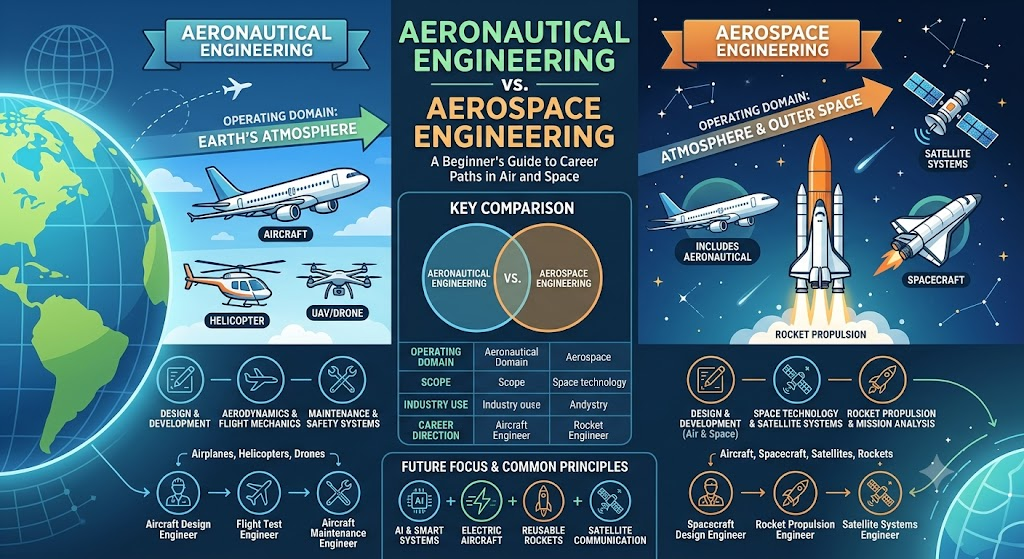
Aeronautical engineering is a specialized branch of engineering focused on the design, development, testing, and maintenance of aircraft that operate within the Earth’s atmosphere.
Scope of Aeronautical Engineering
Aeronautical engineering mainly includes:
- Design and development of airplanes
- Helicopters and UAVs (drones)
- Aircraft performance and testing
- Aerodynamics and flight mechanics
- Aircraft maintenance and safety systems
Applications of Aeronautical Engineering
Aeronautical engineers are required in:
- Commercial aviation companies
- Aircraft manufacturing industries
- Defense aviation sectors
- Maintenance and repair organizations
Their main responsibility is to ensure aircraft are safe, efficient, and capable of stable flight within the atmosphere.
What is Aerospace Engineering?
Aerospace engineering is a broader field that includes aeronautical engineering and extends beyond the Earth’s atmosphere into space technology.
Scope of Aerospace Engineering
This field covers:
- Aircraft design and development
- Spacecraft and satellite systems
- Rocket propulsion technology
- Space exploration vehicles
- Advanced navigation systems
Applications of Aerospace Engineering
Aerospace engineers work in:
- Space agencies and research organizations
- Satellite communication companies
- Defense and missile development sectors
- Private space technology companies
They contribute to both aviation systems and space exploration technologies.
Key Differences Between Aeronautical and Aerospace Engineering
Although both fields are related, their focus areas are different.
| Aspect | Aeronautical Engineering | Aerospace Engineering |
|---|---|---|
| Operating Domain | Within Earth’s atmosphere | Atmosphere and outer space |
| Scope | Aircraft, drones, helicopters | Aircraft, spacecraft, satellites, rockets |
| Complexity | Specialized and focused | Broader and more advanced |
| Industry Use | Aviation and defense aviation | Aviation, space, and defense |
| Career Direction | Aircraft-focused roles | Space and aviation combined roles |
Aeronautical engineering is actually a subset of aerospace engineering.
Similarities Between Both Fields
Despite differences, both engineering branches share many common foundations:
- Strong focus on physics and mathematics
- Aerodynamics and fluid mechanics principles
- Propulsion systems and engine technology
- Computer-aided design (CAD) tools
- Emphasis on safety, efficiency, and performance
- Opportunities in aviation and defense sectors
Both require strong analytical thinking and problem-solving skills.
Career Opportunities
Careers in Aeronautical Engineering
- Aircraft Design Engineer
- Flight Test Engineer
- Aircraft Maintenance Engineer
- Quality Assurance Engineer
- Avionics Engineer
Careers in Aerospace Engineering
- Spacecraft Design Engineer
- Rocket Propulsion Engineer
- Satellite Systems Engineer
- Mission Analysis Engineer
- Research Scientist in Space Technology
Industry Demand
Both fields have strong demand due to:
- Growth in air travel and aviation industry
- Expansion of space exploration programs
- Rise of private aerospace companies
- Increasing use of drones and satellites
Which One Should You Choose?
Your choice depends on your interest and long-term career goals.
Choose Aeronautical Engineering if:
- You are passionate about aircraft and aviation systems
- You want to work in airline or aircraft industries
- You prefer hands-on aviation engineering roles
Choose Aerospace Engineering if:
- You are interested in space exploration and rockets
- You want a broader career covering air and space technology
- You are interested in research and advanced technologies
Aerospace engineering generally offers a wider scope, while aeronautical engineering is more focused.
Future of Aviation and Space Engineering
The future of both fields is highly promising due to rapid technological advancement.
Key Future Trends:
- Electric and hybrid aircraft development
- Artificial intelligence in flight systems
- Autonomous drones and smart aviation systems
- Space tourism and commercial space travel
- Satellite-based global communication systems
- Reusable rocket technology
Both fields will play a key role in shaping the future of transportation and space exploration.
FAQs
1. What is the main difference between aeronautical and aerospace engineering?
Aeronautical engineering focuses on aircraft within the Earth’s atmosphere, while aerospace engineering includes both aircraft and spacecraft operating in space.
2. Is aeronautical engineering a part of aerospace engineering?
Yes, aeronautical engineering is considered a sub-branch of aerospace engineering.
3. Which field has better career opportunities?
Both fields have strong career opportunities, but aerospace engineering offers a wider scope including space technology.
4. Can aeronautical engineers work in space companies?
In some cases yes, but aerospace engineering graduates are preferred for space-related roles.
5. Which is harder, aeronautical or aerospace engineering?
Aerospace engineering is generally broader and may be considered more complex due to its wider scope.
6. What subjects are common in both fields?
Both include aerodynamics, propulsion systems, materials science, and engineering mathematics.
7. What industries hire aerospace engineers?
They are hired by aviation companies, space agencies, defense organizations, and satellite companies.
8. Is coding required in these fields?
Yes, basic programming and simulation tools are often used in both disciplines.
9. Can I switch from aeronautical to aerospace engineering?
Yes, since aeronautical is a part of aerospace, switching is possible with additional learning.
10. Which field is better for the future?
Both are future-proof, but aerospace engineering has more diverse opportunities in space exploration and advanced technologies.
Conclusion
Aeronautical Engineering Versus Aerospace Engineering represents two closely connected but distinct career paths in modern engineering. Aeronautical engineering focuses on aircraft within Earth’s atmosphere, while aerospace engineering expands into space technology and exploration.
Both fields offer exciting opportunities, strong industry demand, and the chance to work on advanced technologies that shape the future of transportation, defense, and space exploration. Aeronautical engineering is ideal for those passionate about aviation, while aerospace engineering is suitable for those who want a broader and more futuristic career path.
Choosing between them depends on your interest, goals, and curiosity about how far you want to explore—whether in the skies or beyond the atmosphere.