Introduction
Space missions have always captured human imagination. From launching satellites around Earth to sending astronauts into space and robots to Mars, every mission tells a story of science, teamwork, courage, planning, and discovery.
For beginners, space missions may look very complex. Rockets, spacecraft, mission control, orbit, payloads, satellites, astronauts, and deep space exploration can feel difficult to understand at first. But when we break the process into simple steps, a space mission becomes much easier to understand.
This beginner guide explains what a space mission is, how it works, why it matters, what happens during launch, and what skills are needed to build a career in this exciting field.
What Is a Space Mission?
A space mission is a planned journey or activity that sends a spacecraft, satellite, robot, or astronaut beyond Earth’s atmosphere for a specific purpose.
That purpose can be scientific, commercial, military, educational, or exploratory. Some missions study Earth. Some explore the Moon or Mars. Some place satellites in orbit for communication, GPS, weather forecasting, or internet services. Some missions send astronauts to space stations for research.
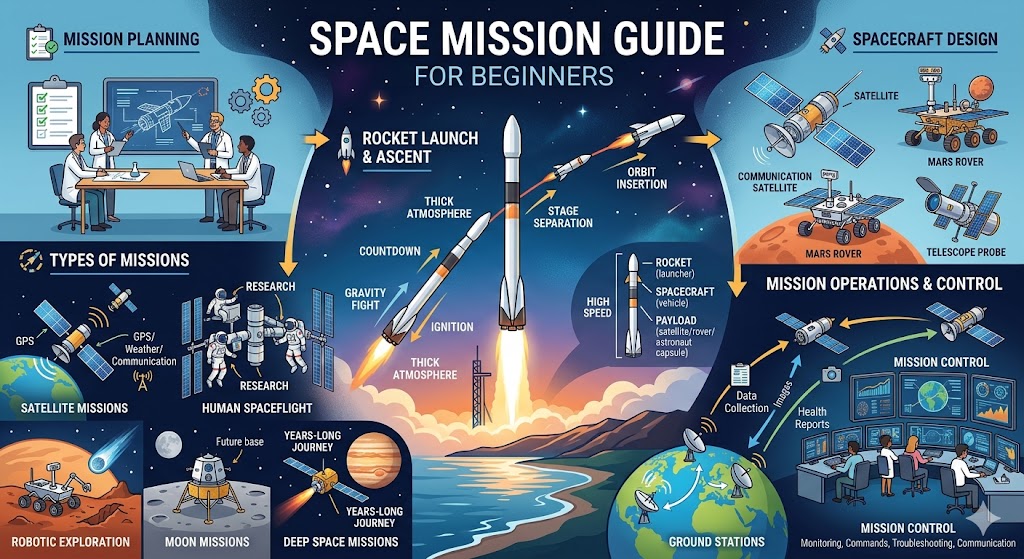
In simple words, a space mission is not just about launching a rocket. It includes planning, designing, testing, launching, operating, monitoring, collecting data, and completing the mission safely.
Why Space Missions Are Important
Space missions are important because they help people on Earth in many ways. Many things we use in daily life depend on space technology.
Weather reports, GPS navigation, live television, internet communication, disaster tracking, aircraft navigation, and global security all use satellites and space systems.
Space missions also help scientists understand the universe. They help us study planets, stars, galaxies, black holes, asteroids, and Earth’s environment. Without space missions, we would know much less about our planet and the space around us.
Space exploration also inspires students and future engineers. It teaches problem-solving, innovation, teamwork, and scientific thinking.
Main Types of Space Missions
Space missions are not all the same. Different missions have different goals. Here are the most common types.
1. Satellite Missions
Satellite missions place satellites into orbit around Earth. These satellites may be used for communication, weather monitoring, GPS, Earth observation, defense, research, or internet services.
For example, weather satellites help predict storms and cyclones. Communication satellites help with television, mobile networks, and internet coverage.
2. Human Spaceflight Missions
Human spaceflight missions send astronauts into space. These missions may go to a space station, orbit Earth, or travel beyond Earth’s orbit.
Astronauts perform experiments, repair equipment, test space technology, and study how humans live in space.
3. Robotic Exploration Missions
Robotic missions use machines instead of humans. These include rovers, landers, orbiters, and probes.
Robotic missions are often sent to planets, moons, asteroids, or deep space because they can travel long distances and survive dangerous conditions where humans cannot easily go.
4. Moon Missions
Moon missions are designed to study the Moon, land spacecraft on its surface, collect data, test technology, or prepare for future human settlements.
The Moon is also important because it can help scientists learn more about Earth’s history and the early solar system.
5. Mars Missions
Mars missions study the surface, atmosphere, soil, climate, and possibility of past life on Mars.
Rovers and orbiters are commonly used in Mars missions because sending humans to Mars is still very difficult and expensive.
6. Space Station Missions
Space station missions involve astronauts living and working in orbit. These missions help scientists understand microgravity, human health in space, material science, biology, and new technologies.
7. Deep Space Missions
Deep space missions travel far beyond Earth’s orbit. They may study planets like Jupiter and Saturn, asteroids, comets, or the outer solar system.
These missions often take many years and require advanced spacecraft systems.
Basic Parts of a Space Mission
A space mission has many important parts. Each part has a different role.
Rocket
A rocket is used to lift the spacecraft from Earth and carry it into space. Rockets are powerful because they must fight Earth’s gravity.
Spacecraft
The spacecraft is the vehicle or machine that travels in space. It may carry instruments, astronauts, robots, cameras, sensors, or communication systems.
Payload
The payload is the main object or equipment carried by the rocket. It can be a satellite, scientific instrument, rover, telescope, or astronaut capsule.
Mission Control
Mission control is the team on Earth that monitors and manages the mission. They track the spacecraft, send commands, solve problems, and make important decisions.
Ground Stations
Ground stations are communication centers on Earth. They send and receive signals from spacecraft and satellites.
Communication System
The communication system helps the spacecraft send data, images, health reports, and signals back to Earth.
Scientific Instruments
Scientific instruments collect information. These may include cameras, sensors, radars, spectrometers, or environmental monitors.
Step-by-Step Space Mission Process
A space mission takes years of planning and preparation. Let’s understand the process step by step.
1. Mission Idea and Objective
Every space mission begins with a goal. The team decides what the mission should achieve.
For example, the goal may be to study Mars, launch a weather satellite, test a new rocket engine, or send astronauts to a space station.
2. Mission Planning
After the goal is clear, experts create a mission plan. They decide the budget, timeline, spacecraft design, launch date, orbit, communication method, and mission duration.
Planning is one of the most important parts of any space mission.
3. Spacecraft Design
Engineers design the spacecraft based on the mission goal. A satellite used for communication will be different from a rover designed to move on Mars.
The spacecraft must survive launch vibration, space radiation, extreme temperatures, and long-distance communication challenges.
4. Rocket Selection
The mission team chooses a rocket based on the weight of the payload and the destination. A small satellite may need a smaller rocket, while a deep space mission may need a more powerful launch vehicle.
5. Testing and Safety Checks
Before launch, every part of the spacecraft and rocket is tested. Engineers check electronics, fuel systems, communication systems, solar panels, batteries, computers, and safety systems.
Testing reduces the risk of failure.
6. Launch Preparation
The spacecraft is attached to the rocket. Fuel is loaded. Weather is checked. Mission control teams prepare for launch. The launch pad becomes active.
This stage is very serious because even small mistakes can affect the mission.
7. Rocket Launch
During launch, the rocket engines start, and the rocket lifts off from the launch pad. It climbs through the atmosphere at very high speed.
The launch is one of the most powerful and risky parts of the mission.
8. Stage Separation
Many rockets have multiple stages. When one stage uses all its fuel, it separates from the rocket. The next stage continues the journey.
This helps reduce weight and allows the rocket to reach space more efficiently.
9. Orbit Insertion
If the mission is going into Earth orbit, the spacecraft must reach the correct speed and position. This is called orbit insertion.
A spacecraft in orbit does not simply “float.” It is moving very fast around Earth while gravity pulls it inward.
10. Mission Operations
After reaching space, the mission begins its main work. A satellite may start communication services. A rover may begin exploring. A telescope may start taking images. Astronauts may begin experiments.
11. Data Collection
The spacecraft collects data and sends it back to Earth. This data may include photos, measurements, signals, scientific readings, or system health reports.
12. Mission Completion
Some missions end after a few days, while others continue for years. When the mission ends, the spacecraft may be safely deorbited, moved to a safe orbit, or left in deep space depending on its design.
How Rockets Help Space Missions
Rockets are the starting point of most space missions. Their main job is to carry the spacecraft beyond Earth’s atmosphere and place it on the correct path.
Earth’s gravity is strong, so rockets need huge power. They burn fuel and push hot gases downward. This creates an upward force that lifts the rocket.
Most rockets use stages. Each stage contains engines and fuel. Once a stage finishes its job, it separates. This makes the rocket lighter and helps the remaining part move faster.
Without rockets, it would be impossible to send satellites, astronauts, or spacecraft into space.
What Happens During a Rocket Launch?
A rocket launch follows a carefully planned sequence.
First, the countdown begins. During this time, engineers check fuel, engines, weather, communication, and safety systems.
Then the engines ignite. If all systems are normal, the rocket lifts off.
As the rocket climbs, it passes through thick layers of the atmosphere. It faces strong pressure, vibration, and heat.
After some time, the first stage separates. The next stage continues carrying the spacecraft higher and faster.
Once the rocket reaches the correct altitude and speed, the spacecraft separates from the rocket. After separation, the spacecraft begins its mission.
This entire process may look quick from outside, but it requires years of planning and thousands of checks.
Role of Mission Control
Mission control is the brain of a space mission on Earth.
The mission control team watches every major activity. They monitor fuel levels, spacecraft temperature, battery power, communication signals, speed, direction, and system health.
If something goes wrong, mission control studies the problem and sends commands to fix it.
Mission control also talks to astronauts during human missions. For robotic missions, it sends instructions to the spacecraft or rover.
A successful mission depends heavily on the work of mission control.
Human Space Missions vs Robotic Space Missions
Both human and robotic missions are important. However, they are very different.
| Point | Human Space Mission | Robotic Space Mission |
|---|---|---|
| Crew | Carries astronauts | No humans onboard |
| Risk | Higher because human life is involved | Lower compared to human missions |
| Cost | Usually more expensive | Usually less expensive |
| Purpose | Research, repair, exploration, human experience | Data collection, exploration, testing |
| Duration | Often limited by human needs | Can last for months or years |
| Examples | Space station missions, Moon missions | Mars rovers, satellites, deep space probes |
Human missions help us understand how people can live and work in space. Robotic missions help us explore dangerous and distant places without risking human life.
What Beginners Should Know About Orbit
Orbit is one of the most important ideas in space missions.
An orbit is the curved path that a spacecraft follows around a planet, moon, or star. For example, Earth moves in orbit around the Sun. Satellites move in orbit around Earth.
A satellite stays in orbit because it is moving forward very fast while gravity pulls it toward Earth. Instead of falling straight down, it keeps falling around Earth.
Low Earth Orbit
Low Earth orbit is close to Earth. Many satellites and space stations operate here.
Geostationary Orbit
A satellite in geostationary orbit appears to stay above the same area of Earth. This is useful for communication and weather satellites.
Lunar Orbit
Lunar orbit is the path around the Moon. Moon missions may use lunar orbit before landing.
Interplanetary Path
An interplanetary path is used when a spacecraft travels from one planet to another, such as from Earth to Mars.
Common Challenges in Space Missions
Space missions are difficult because space is a harsh environment.
High Cost
Building rockets, spacecraft, instruments, and mission systems requires a large amount of money and expert work.
Extreme Temperatures
Spacecraft may face very high heat from the Sun and very cold conditions in shadow.
Radiation
Space has radiation that can damage electronics and harm humans.
Communication Delays
Signals take time to travel across space. For distant missions, communication delay can be several minutes or even longer.
Fuel Limitations
Spacecraft cannot carry unlimited fuel. Engineers must plan every movement carefully.
Launch Risks
Rocket launches are powerful and risky. A small technical issue can cause mission failure.
Technical Failures
Spacecraft parts must work for months or years without easy repair. This makes design and testing very important.
Famous Space Mission Examples
Beginners can understand space missions better by looking at common examples.
Moon Missions
Moon missions help scientists study the Moon’s surface, rocks, gravity, and history. They also help prepare for future human exploration.
Mars Rover Missions
Mars rovers are robotic vehicles that move on the surface of Mars. They study rocks, soil, weather, and signs of ancient water.
Satellite Missions
Satellite missions are among the most common space missions. They support communication, weather forecasting, navigation, Earth imaging, and scientific research.
Space Station Missions
Space station missions allow astronauts to live and work in orbit. They perform experiments that are not possible on Earth.
Deep Space Missions
Deep space missions explore distant planets, asteroids, comets, and outer space. These missions help us understand the solar system and beyond.
Skills Needed to Work on Space Missions
Space missions need experts from many fields. Beginners who want to build a career in space can start learning these skills.
Physics
Physics helps explain motion, gravity, energy, force, heat, radiation, and orbital mechanics.
Mathematics
Math is used in spacecraft design, navigation, speed calculation, mission planning, and data analysis.
Engineering
Aerospace, mechanical, electrical, computer, and systems engineering are very important in space missions.
Computer Science
Spacecraft use software for control, communication, navigation, automation, and data processing.
Robotics
Robotics is important for rovers, robotic arms, landers, and autonomous systems.
Artificial Intelligence
AI can help spacecraft make decisions, analyze data, detect problems, and support automation.
Communication Skills
Space missions involve large teams. Clear communication is important for safety and success.
Problem-Solving
Unexpected problems can happen in space. Mission teams must think quickly and solve issues carefully.
Career Opportunities in Space Missions
Space missions offer many career options. A person does not have to become an astronaut to work in the space industry.
Aerospace Engineer
Designs aircraft, rockets, spacecraft, and space systems.
Rocket Engineer
Works on rocket engines, fuel systems, launch vehicles, and propulsion technology.
Satellite Engineer
Designs and manages satellites used for communication, weather, navigation, or research.
Mission Planner
Plans the mission path, timeline, objectives, and operation strategy.
Mission Control Specialist
Monitors spacecraft systems and supports mission activities from Earth.
Space Scientist
Studies planets, stars, galaxies, space weather, and scientific mission data.
Robotics Engineer
Builds robotic systems used in rovers, landers, and space station operations.
Data Analyst
Studies data collected by satellites, telescopes, probes, and spacecraft.
Astronaut
Travels to space for research, operations, repair, exploration, and experiments.
Beginner Tips to Learn About Space Missions
If you are new to space science, start slowly and build your knowledge step by step.
First, learn basic physics. Understand gravity, speed, force, and motion.
Second, watch rocket launches and mission explanation videos. This helps you visualize the process.
Third, read beginner-friendly space books and articles.
Fourth, learn about satellites, rockets, astronauts, and spacecraft separately.
Fifth, follow trusted space agencies and educational space platforms.
Sixth, try small science projects such as model rockets, satellite models, or simple robotics.
Seventh, join science clubs, astronomy groups, or online space communities.
Most importantly, stay curious. Space learning becomes easier when you keep asking questions.
Common Mistakes Beginners Make
Many beginners misunderstand space missions at first. Here are some common mistakes.
Thinking Every Space Mission Has Astronauts
Most space missions do not carry humans. Many are robotic or satellite missions.
Thinking Launch Is the Whole Mission
Launch is only one part. Planning, testing, communication, data collection, and mission operations are equally important.
Thinking Rockets Go Straight Up Forever
Rockets go upward first, but they also move sideways very fast to enter orbit.
Ignoring Mission Control
Mission control plays a major role even after the spacecraft reaches space.
Confusing Rocket and Spacecraft
The rocket carries the spacecraft into space. The spacecraft performs the mission.
Thinking Space Is Empty and Easy
Space is not easy. It has radiation, extreme temperatures, microgravity, dust, and communication challenges.
Future of Space Missions
The future of space missions is very exciting.
Reusable rockets are reducing launch costs. Private space companies are becoming more active. Space tourism is slowly developing. Moon missions are returning with new goals. Mars exploration is becoming more advanced.
Artificial intelligence may help spacecraft work more independently. Robots may build structures on the Moon or Mars. Satellites may provide better internet, climate monitoring, disaster prediction, and global communication.
In the future, humans may build permanent research stations on the Moon. Mars missions may also become more realistic as technology improves.
Space missions will continue to shape science, communication, defense, education, and human exploration.
FAQs About Space Missions
1. What is a space mission?
A space mission is a planned activity that sends a spacecraft, satellite, robot, or astronaut into space for a specific purpose such as research, communication, exploration, or technology testing.
2. How does a space mission start?
A space mission starts with an objective. Scientists and engineers decide what the mission should achieve, then they plan the spacecraft, rocket, launch path, budget, and timeline.
3. What is the role of a rocket in a space mission?
A rocket carries the spacecraft from Earth into space. It provides the power needed to escape Earth’s atmosphere and place the spacecraft on the correct path.
4. Do all space missions have astronauts?
No, most space missions do not have astronauts. Many missions use satellites, robotic spacecraft, rovers, landers, or probes.
5. What is mission control?
Mission control is the team on Earth that monitors and manages the space mission. They track spacecraft systems, send commands, solve problems, and guide the mission.
6. How do spacecraft communicate with Earth?
Spacecraft use radio signals and antennas to send data to Earth. Ground stations receive these signals and send commands back to the spacecraft.
7. What is the difference between a satellite mission and a human mission?
A satellite mission sends a machine into orbit for communication, weather, GPS, or research. A human mission sends astronauts into space for experiments, exploration, or space station work.
8. How long does a space mission last?
A space mission can last from a few minutes to many years. The duration depends on the mission goal, spacecraft design, fuel, power system, and destination.
9. Can beginners learn space science?
Yes, beginners can learn space science by starting with basic topics like gravity, rockets, satellites, planets, orbit, and space exploration.
10. What careers are available in space missions?
Space mission careers include aerospace engineer, rocket engineer, satellite engineer, mission planner, astronaut, space scientist, robotics engineer, data analyst, and mission control specialist.
Conclusion
A space mission may look complex, but beginners can understand it step by step.
Every mission begins with a goal. Then experts plan the mission, design the spacecraft, choose the rocket, test systems, launch the vehicle, operate the spacecraft, collect data, and complete the mission.
Space missions are not only about rockets and astronauts. They include satellites, robots, scientists, engineers, mission control teams, software experts, communication systems, and many years of teamwork.
For beginners, the best way to learn is to start with simple concepts like rockets, spacecraft, orbit, satellites, and mission control. With curiosity and consistent learning, space missions become one of the most exciting topics to explore.