Introduction
Space missions look exciting when we see a rocket lifting off from the launch pad. The countdown begins, engines fire, smoke rises, and the rocket moves toward space. But the launch is only the visible part of the mission.
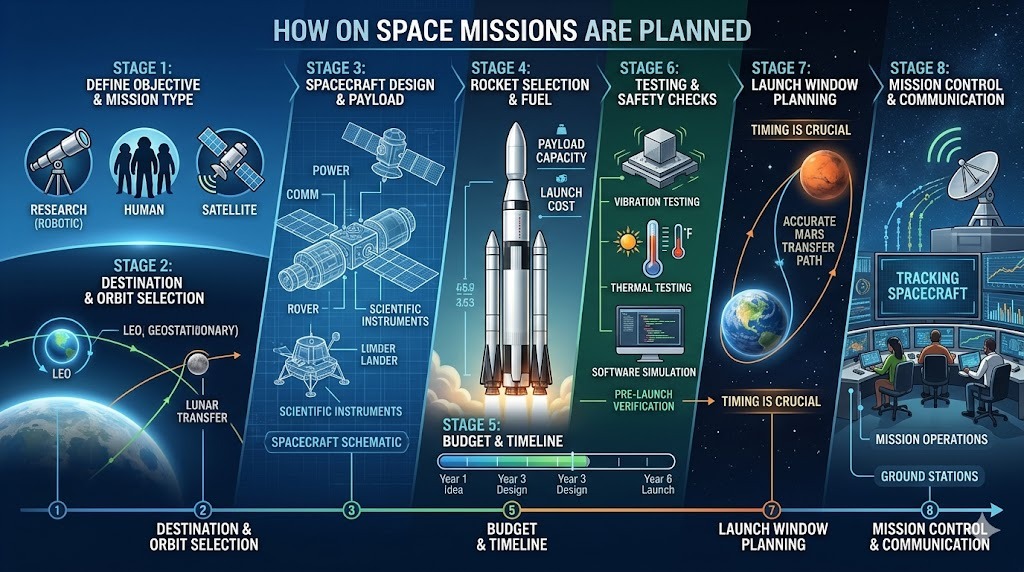
A successful space mission starts many years before launch. It begins with an idea, a goal, a team, a budget, and a detailed plan. Scientists, engineers, mission planners, safety experts, software developers, and mission control teams work together to make sure every part of the mission is ready.
For beginners, space mission planning may sound very technical. However, when we break it into simple steps, it becomes much easier to understand. This guide explains how space missions are planned from the first idea to the final launch preparation.
What Is Space Mission Planning?
Space mission planning is the process of designing and preparing a complete mission before it goes into space.
It includes deciding what the mission will do, where it will go, what spacecraft it needs, which rocket will launch it, how it will communicate with Earth, how much fuel it needs, and how success will be measured.
In simple words, space mission planning answers important questions such as:
- Why are we going to space?
- What do we want to learn or achieve?
- What type of spacecraft is needed?
- Which rocket can carry the spacecraft?
- Where will the spacecraft go?
- How will it stay powered?
- How will it send data back to Earth?
- What can go wrong?
- What backup plans are needed?
Without proper planning, even a powerful rocket and advanced spacecraft can fail.
Why Space Missions Need Careful Planning
Space is not an easy place to work. It has extreme temperatures, radiation, vacuum, microgravity, communication delays, and many unknown risks. Once a spacecraft leaves Earth, it is very difficult or sometimes impossible to repair it.
That is why planning is extremely important.
A space mission needs careful planning because:
- Space missions are expensive
- Rocket launches are risky
- Spacecraft must work in harsh conditions
- Fuel is limited
- Communication may be delayed
- Human safety may be involved
- Mission timing must be accurate
- Small mistakes can cause mission failure
Planning helps reduce risk and improves the chance of mission success. It also helps teams control cost, manage time, test technology, and prepare for emergencies.
Step 1: Defining the Mission Objective
Every space mission begins with a clear objective.
The mission objective explains the main purpose of the mission. Without a clear goal, the team cannot design the spacecraft, select the rocket, or plan the mission route.
For example, a mission objective may be:
- Launch a communication satellite
- Study Earth’s weather
- Explore the Moon
- Send a rover to Mars
- Carry astronauts to a space station
- Test a new rocket system
- Observe distant stars or planets
- Study climate change from space
A clear objective helps the team decide what equipment, budget, timeline, and technology are needed.
For example, a weather satellite needs cameras and sensors to observe clouds, storms, and temperature patterns. A Mars rover needs wheels, cameras, robotic arms, power systems, and scientific instruments to study the Martian surface.
Step 2: Choosing the Mission Type
After the objective is clear, planners decide the type of mission.
Different mission types need different planning methods. A satellite mission is different from a human spaceflight mission. A Moon mission is different from a Mars rover mission.
Common types of space missions include:
Satellite Missions
These missions place satellites in orbit around Earth. They are used for communication, weather forecasting, navigation, internet services, defense, and Earth observation.
Human Spaceflight Missions
These missions send astronauts into space. Human missions require extra safety planning because human life is involved.
Robotic Missions
Robotic missions use machines such as rovers, landers, orbiters, and probes. These missions are useful for exploring dangerous or distant places.
Moon Missions
Moon missions study the lunar surface, test landing systems, collect data, and prepare for future human exploration.
Mars Missions
Mars missions may use orbiters, landers, or rovers to study the planet’s surface, atmosphere, soil, and signs of past water.
Deep Space Missions
Deep space missions travel far from Earth to study planets, asteroids, comets, or distant parts of the solar system.
Technology Demonstration Missions
These missions test new space technologies before they are used in bigger missions.
Choosing the mission type helps define the entire planning process.
Step 3: Selecting the Destination or Orbit
The next step is deciding where the spacecraft will go.
Some missions stay close to Earth. Others travel to the Moon, Mars, or deep space. The destination affects the rocket, fuel, spacecraft design, communication method, and mission timeline.
Low Earth Orbit
Low Earth orbit is close to Earth. Many satellites and space stations operate here. It is commonly used for Earth observation, research, and human spaceflight.
Geostationary Orbit
A satellite in geostationary orbit appears to stay over the same area of Earth. This is useful for communication, television broadcasting, and weather monitoring.
Lunar Orbit
Lunar orbit is the path around the Moon. Moon missions may enter lunar orbit before landing or studying the Moon from above.
Mars Transfer Path
A Mars mission must follow a planned path from Earth to Mars. The timing is important because Earth and Mars are always moving around the Sun.
Deep Space Route
Deep space missions need complex paths. Sometimes they use the gravity of planets to gain speed and save fuel.
The destination is one of the most important decisions in mission planning.
Step 4: Designing the Spacecraft
Once the goal and destination are clear, engineers begin designing the spacecraft.
The spacecraft must be built for the mission’s purpose. A communication satellite, a Mars rover, and an astronaut capsule are very different from each other.
A spacecraft may include:
- Power system
- Solar panels
- Batteries
- Communication antennas
- Onboard computers
- Navigation system
- Cameras
- Sensors
- Scientific instruments
- Fuel tanks
- Thermal protection
- Data storage system
- Structural body
The spacecraft must survive the force of launch, the vacuum of space, temperature changes, radiation, and long mission operations.
Engineers also make sure the spacecraft is not too heavy. Weight is very important because heavier spacecraft need more powerful rockets and more fuel.
Step 5: Choosing the Rocket
The rocket is selected based on the mission requirements.
Mission planners study the spacecraft’s weight, destination, orbit, budget, and launch timing before choosing the rocket.
A small satellite may need a smaller launch vehicle. A large spacecraft or deep space mission may need a more powerful rocket.
Important factors in rocket selection include:
- Payload weight
- Target orbit
- Mission destination
- Rocket reliability
- Launch cost
- Launch site availability
- Mission schedule
- Safety requirements
The rocket does not usually complete the whole mission. Its main job is to carry the spacecraft into space and place it on the correct path.
After that, the spacecraft continues its mission using its own systems.
Step 6: Planning the Payload
The payload is the main object or equipment carried by the spacecraft or rocket.
In simple words, the payload is the “main useful part” of the mission.
A payload can be:
- Satellite
- Telescope
- Rover
- Lander
- Astronaut capsule
- Camera
- Sensor
- Scientific instrument
- Communication device
- Research equipment
Payload planning is important because the payload must match the mission goal.
For example, if the mission is studying Mars rocks, the payload may include cameras, soil testing tools, and scientific sensors. If the mission is for communication, the payload may include antennas and signal equipment.
Step 7: Budget and Timeline Planning
Space missions require careful budget and timeline planning.
Mission teams must estimate the cost of spacecraft design, rocket launch, testing, team salaries, ground systems, mission operations, communication networks, and risk management.
They also create a timeline for each stage of the mission.
A mission timeline may include:
- Research stage
- Design stage
- Manufacturing stage
- Software development
- Testing
- Launch preparation
- Launch date
- Mission operation period
- Data analysis
- Mission completion
Delays can happen due to technical problems, budget issues, weather, launch vehicle availability, or safety concerns.
Good planning helps reduce delays and keeps the mission organized.
Step 8: Testing and Safety Checks
Testing is one of the most important parts of space mission planning.
Before launch, the spacecraft must prove that it can survive launch and operate in space.
Common tests include:
Vibration Testing
The spacecraft is tested to make sure it can survive the shaking and vibration during rocket launch.
Thermal Testing
The spacecraft is tested in hot and cold conditions to check whether it can survive extreme temperatures.
Vacuum Testing
Space has no air pressure like Earth. Vacuum testing checks whether the spacecraft can work in space-like conditions.
Software Testing
Spacecraft software controls many important functions. It must be tested carefully to avoid errors.
Communication Testing
Engineers test whether the spacecraft can send and receive signals correctly.
Power Testing
Solar panels, batteries, and power systems are checked to make sure the spacecraft can stay active.
Launch Simulation
Teams practice launch operations before the real launch. This helps them prepare for normal and emergency situations.
Testing helps find problems before launch. It is much better to fix a problem on Earth than after the spacecraft is already in space.
Step 9: Launch Window Planning
A launch window is the specific time period when a rocket must launch for the mission to succeed.
Not every day or every hour is suitable for launch.
Launch timing depends on:
- Weather
- Target orbit
- Earth’s rotation
- Fuel efficiency
- Spacecraft destination
- Position of planets
- Safety conditions
- Launch site rules
For example, a mission to Mars must launch when Earth and Mars are in a favorable position. If the mission misses that period, the team may need to wait for another suitable opportunity.
For Earth orbit missions, launch timing depends on the desired orbit and the movement of Earth.
Launch window planning is a major part of mission success.
Step 10: Mission Control Preparation
Mission control is the team on Earth that monitors and manages the mission.
Before launch, mission control teams prepare their systems, communication channels, tracking tools, emergency plans, and mission timelines.
Mission control is responsible for:
- Tracking the spacecraft
- Monitoring spacecraft health
- Checking fuel, power, and temperature
- Sending commands
- Receiving data
- Solving problems
- Communicating with astronauts
- Managing mission activities
For human spaceflight, mission control also supports astronaut safety, health, and operations.
Mission control teams practice many possible situations before launch. They prepare for both expected and unexpected problems.
Step 11: Communication Planning
A spacecraft must communicate with Earth during the mission.
Communication planning decides how the spacecraft will send data, receive commands, and report its health.
Spacecraft use antennas and radio signals to communicate. Ground stations on Earth receive these signals and send instructions back.
Communication planning includes:
- Signal frequency
- Antenna design
- Ground station support
- Data transfer speed
- Communication schedule
- Backup communication methods
- Delay management
For nearby satellites, communication can happen quickly. For deep space missions, signals take longer to travel. This delay means spacecraft must sometimes operate more independently.
Communication is very important because mission teams need data to understand what the spacecraft is doing.
Step 12: Risk Management
Every space mission has risks. Mission planners must identify possible problems and create backup plans.
Common risks include:
- Rocket failure
- Software errors
- Power system failure
- Communication loss
- Fuel shortage
- Extreme temperatures
- Radiation damage
- Navigation errors
- Landing failure
- Human safety risks
Risk management does not mean removing every risk. That is impossible. It means understanding the risks, reducing them, and preparing solutions.
For example, spacecraft may have backup computers, extra communication systems, emergency power modes, or alternate mission plans.
Good risk planning can save a mission when something unexpected happens.
Step 13: Final Launch Readiness Review
Before launch, mission teams conduct a final launch readiness review.
This review checks whether all major systems are ready.
The team reviews:
- Rocket condition
- Spacecraft condition
- Payload status
- Weather forecast
- Ground systems
- Mission control readiness
- Communication networks
- Safety systems
- Launch pad status
- Emergency plans
If everything is ready, the mission moves forward toward launch. If a serious issue is found, the launch may be delayed.
A delay may seem disappointing, but safety is more important than speed. In space missions, launching only when ready is the smarter decision.
Human Mission Planning vs Robotic Mission Planning
Human and robotic missions both need careful planning, but human missions require extra safety because astronauts are involved.
| Planning Area | Human Mission | Robotic Mission |
|---|---|---|
| Crew Safety | Highest priority because astronauts are onboard | No human life risk onboard |
| Life Support | Needs oxygen, food, water, and temperature control | Not required |
| Mission Cost | Usually higher | Usually lower |
| Training | Astronauts need long preparation | Operators train for remote control |
| Risk Level | Higher due to human safety needs | Lower compared to human missions |
| Mission Duration | Limited by human needs | Can last for months or years |
| Repairs | Astronauts may repair some systems | Repairs are usually not possible |
| Communication | Direct crew communication is needed | Commands are sent to machines |
Robotic missions are often used for dangerous or distant locations. Human missions are important for research, exploration, and understanding how people can live and work in space.
Role of Scientists, Engineers, and Mission Teams
A space mission is not planned by one person. It requires a large team of experts.
Scientists
Scientists define the research goals and decide what data the mission should collect.
Aerospace Engineers
Aerospace engineers design spacecraft, rockets, flight systems, and mission structures.
Software Engineers
Software engineers build the programs that control spacecraft systems, navigation, communication, and data handling.
Rocket Engineers
Rocket engineers work on propulsion, engines, fuel systems, and launch performance.
Mission Planners
Mission planners design the mission timeline, route, operations, and success criteria.
Flight Directors
Flight directors make important decisions during mission operations.
Safety Teams
Safety teams identify risks and create emergency plans.
Astronaut Trainers
For human missions, trainers prepare astronauts for space conditions, equipment use, and emergency actions.
Data Analysts
Data analysts study the information collected by the spacecraft and turn it into useful knowledge.
Each team plays an important role in making the mission successful.
Common Challenges in Space Mission Planning
Space mission planning is difficult because many things must work perfectly together.
High Cost
Space missions require advanced technology, testing, launch systems, and skilled teams.
Long Timelines
Some missions take years from idea to launch. Deep space missions can take even longer.
Technical Complexity
Thousands of parts, systems, and software components must work correctly.
Limited Fuel
Spacecraft cannot carry unlimited fuel. Every movement must be planned carefully.
Weather Issues
Bad weather can delay launch and affect safety.
Communication Delay
For distant missions, signals take time to travel. This makes real-time control difficult.
Unknown Space Conditions
Space can be unpredictable. Radiation, dust, temperature, and technical failures can create problems.
Safety Concerns
Human missions require strong safety planning because astronaut lives are involved.
These challenges make mission planning one of the most important parts of space exploration.
Real-World Examples of Mission Planning
Satellite Mission Planning
For a satellite mission, planners decide the satellite’s purpose, orbit, launch vehicle, communication system, and expected mission life. They also plan how the satellite will send data to Earth.
Moon Mission Planning
A Moon mission requires planning the launch path, lunar orbit, landing site, surface operations, communication, and return journey if humans or samples are involved.
Mars Rover Mission Planning
A Mars rover mission needs careful planning for launch timing, travel path, landing system, rover movement, power, communication delay, and scientific activities.
Space Station Mission Planning
A space station mission includes astronaut training, spacecraft docking, supplies, experiments, safety procedures, and return planning.
These examples show that every mission has a different planning approach based on its goal.
Skills Needed to Plan Space Missions
People who want to work in space mission planning need strong technical and teamwork skills.
Important skills include:
- Physics
- Mathematics
- Aerospace engineering
- Mechanical engineering
- Electrical engineering
- Computer science
- Robotics
- Artificial intelligence
- Data analysis
- Communication
- Problem-solving
- Project management
- Teamwork
Beginners do not need to learn everything at once. They can start with basic science, mathematics, rockets, satellites, and space exploration concepts.
Beginner Tips to Understand Space Mission Planning
If you are new to space missions, start with simple learning steps.
- Learn basic space science
- Understand how rockets work
- Study the meaning of orbit
- Learn about satellites and spacecraft
- Watch launch explanations
- Read beginner-friendly space articles
- Learn about mission control
- Follow space education platforms
- Try small science or robotics projects
- Stay curious and ask questions
Space mission planning becomes easier when you understand one concept at a time.
Future of Space Mission Planning
Space mission planning is changing quickly.
Reusable rockets are helping reduce launch costs. Artificial intelligence is helping spacecraft make smarter decisions. Advanced robotics are improving Moon and Mars exploration. Private space companies are bringing new ideas and faster development.
Future missions may include:
- More Moon exploration
- Human missions to Mars
- Space tourism
- Advanced space stations
- AI-powered spacecraft
- Robotic construction in space
- Better Earth observation satellites
- Deep space exploration missions
As technology improves, planning will become more advanced, but the basic idea will remain the same: every successful mission starts with a clear goal and careful preparation.
FAQs About Space Mission Planning
1. What is space mission planning?
Space mission planning is the process of preparing a mission before launch. It includes deciding the goal, spacecraft design, rocket selection, budget, testing, launch timing, communication, and mission operations.
2. Why do space missions need planning?
Space missions need planning because they are expensive, risky, and technically complex. Careful planning helps reduce failure, improve safety, and achieve mission goals.
3. Who plans a space mission?
Space missions are planned by scientists, engineers, mission planners, software experts, safety teams, flight directors, and mission control specialists.
4. How long does it take to plan a space mission?
The planning time depends on the mission type. Some missions may take a few years, while complex Moon, Mars, or deep space missions can take much longer.
5. What is a launch window?
A launch window is the specific time period when a rocket should launch to reach the correct orbit or destination safely and efficiently.
6. How is a rocket selected for a mission?
A rocket is selected based on the spacecraft’s weight, destination, target orbit, cost, reliability, launch schedule, and mission requirements.
7. What is payload planning?
Payload planning means deciding what main equipment or object the mission will carry, such as a satellite, rover, lander, telescope, sensor, or astronaut capsule.
8. What does mission control do before launch?
Mission control prepares systems, checks communication, practices emergency situations, reviews mission timelines, and gets ready to monitor the spacecraft after launch.
9. What are the biggest risks in mission planning?
Major risks include rocket failure, software errors, fuel shortage, communication loss, power problems, radiation, extreme temperatures, and human safety concerns.
10. Can beginners learn space mission planning?
Yes, beginners can learn space mission planning by studying basic physics, rockets, satellites, orbit, spacecraft systems, and mission control step by step.
Conclusion
A space mission is not planned in a single day. It takes years of thinking, designing, testing, teamwork, and problem-solving.
Before a rocket launches, mission teams define the objective, choose the mission type, select the destination, design the spacecraft, choose the rocket, plan the payload, prepare the budget, test systems, manage risks, and train mission control teams.
The launch may be the most exciting part for the public, but planning is the foundation of success.
For beginners, the best way to understand space mission planning is to see it as a step-by-step journey. A mission starts with one idea and becomes real through science, engineering, teamwork, and careful decision-making.
Space missions are complex, but they are also inspiring. They show what humans can achieve when curiosity, technology, and planning come together.