Introduction
Flying hours are one of the most important parts of pilot training in India. For a student pilot, every hour in the aircraft is not just a number. It is proof of practical flying experience, training progress, skill development, and license eligibility.
Many beginner students focus mainly on flying lessons, aircraft handling, theory exams, and medical requirements. These are important, but flying hour tracking is equally important. If your records are incomplete, unclear, or wrongly calculated, you may face confusion later during license documentation, flying school verification, or CPL application preparation.
A pilot’s logbook is like a career record. It shows where you flew, when you flew, what aircraft you flew, how long you flew, whether the flight was dual or solo, and what type of training was completed. Good flying hour tracking builds discipline from the beginning of your aviation journey.
This guide explains how to track flying hours during Indian pilot training in a simple and practical way.
What Are Flying Hours in Pilot Training?
Flying hours refer to the time a student pilot spends in flight training. These hours are recorded in a pilot logbook and are used to show practical experience.
In simple words, flying hours tell how much real flying experience you have gained.
During Indian pilot training, students may need to track different kinds of flying time, such as:
- Actual aircraft flying time
- Dual flying time with an instructor
- Solo flying time
- Pilot-in-command time
- Cross-country flying time
- Instrument flying time
- Night flying time
- Simulator training time
- Skill test or check flight time
Each category has a different meaning. That is why students should not write all hours together without proper classification.
For example, one hour flown with an instructor is not the same as one hour flown solo. Similarly, simulator training is useful, but it should be recorded separately from actual aircraft flying.
Why Flying Hours Matter for Indian Pilot Students
Flying hours matter because they connect your training progress with your licensing journey. They are used to prove that you have completed the practical training required for your pilot license.
1. DGCA License Documentation
In India, pilot training and licensing are regulated by DGCA. When students apply for licenses or ratings, their flying experience must be properly recorded and verified.
If your flying records are not clear, it can delay your documentation process.
2. CPL Eligibility
Commercial Pilot Licence students must complete required flying experience as per applicable DGCA rules. Many CPL students generally work toward around 200 flying hours, including different categories of training. However, students must always confirm the latest requirements with their flying school and official DGCA/eGCA sources.
3. Flying School Progress Tracking
Your flying school uses your hour record to understand how much training you have completed and what training is still pending.
For example, you may need more solo flying, cross-country flying, instrument flying, or night flying depending on your training stage.
4. Skill Development
Flying hours also help you understand your own growth. A student who reviews weekly flying records can see progress in handling, navigation, radio communication, landing practice, and decision-making.
5. Future Airline Training
When you move toward airline preparation, type rating, or advanced training, your logbook becomes part of your professional aviation record. A clean logbook creates a good impression.
6. Safety and Confidence
Tracking flying hours helps students know their recency. If a student has not flown for many days, they may need revision or instructor supervision before continuing advanced exercises.
Types of Flying Hours Students Should Track
A beginner student should understand the different categories of flying hours. This avoids confusion later.
Dual Flying Hours
Dual flying hours are hours flown with a flight instructor. In these flights, the instructor teaches, demonstrates, observes, and corrects the student.
Examples of dual training include:
- Basic aircraft handling
- Climb and descent practice
- Turns
- Stall recovery
- Circuit and landing practice
- Emergency procedures
- Navigation training
- Instrument flying practice
Dual hours are very important in the early stage of training because students learn the foundation of safe flying.
Solo Flying Hours
Solo flying hours are recorded when a student flies the aircraft alone after being cleared by the instructor.
Solo flying is a major milestone in pilot training. It shows that the student has reached a level of confidence and control where the instructor trusts them to fly independently.
Solo hours should always be recorded separately because they prove independent flying experience.
Pilot-in-Command Hours
Pilot-in-command, or PIC time, means the pilot is responsible for the operation and safety of the aircraft during that flight.
For student pilots, some solo flights may be counted as PIC time depending on the applicable rules and school documentation practices. Students should confirm with their instructor how PIC time should be recorded in their logbook.
Cross-Country Flying Hours
Cross-country flying means flying from one aerodrome or location to another, usually involving navigation planning, route following, weather awareness, fuel planning, and radio communication.
Cross-country training teaches students how to operate beyond the local training area. It is important for building real-world flying confidence.
Students should record:
- Departure airport
- Destination airport
- Route
- Distance if required
- Flight duration
- Instructor or solo status
- Navigation remarks
Instrument Flying Hours
Instrument flying hours are hours where the student learns to fly using aircraft instruments instead of outside visual references.
This training improves a student’s ability to maintain attitude, altitude, direction, and speed using cockpit instruments.
Instrument flying should be recorded carefully because it is usually counted separately from normal visual flying.
Night Flying Hours
Night flying hours are recorded when training is done during approved night flying conditions.
Night flying is different from day flying because visibility, depth perception, runway lighting, and navigation references change. Students should record night flying time clearly and separately.
Simulator Hours
Simulator hours are training hours completed in an approved flight simulator or training device.
Simulator training may help students practice procedures, instrument flying, emergencies, and cockpit discipline. However, simulator time should not be mixed with actual aircraft flying time. It should have its own column or separate section.
Check Ride and Test Flight Hours
Check rides and test flights are conducted to assess a student’s flying skills. These flights may involve an instructor, examiner, or authorized person depending on the training stage.
These flights should be recorded accurately with proper remarks, because they may be important for training completion and license documentation.
How to Maintain a Pilot Logbook in India
A pilot logbook is the official record of your flying experience. Every student pilot should treat it as a serious aviation document.
A logbook should be updated after every flight. Waiting for many days can lead to mistakes, missing entries, or wrong totals.
A good logbook entry usually includes:
- Date of flight
- Aircraft type
- Aircraft registration
- Departure airport
- Arrival airport
- Flight duration
- Dual or solo status
- PIC time if applicable
- Simulator time if applicable
- Instructor name
- Instructor signature
- Training exercise
- Remarks
- Total accumulated hours
Students should ask their flying school about the exact format they follow. Some schools may use a physical logbook, some may use digital records, and some may use both.
Step-by-Step Method to Track Flying Hours
Tracking flying hours is not difficult if you follow a simple routine. The key is consistency.
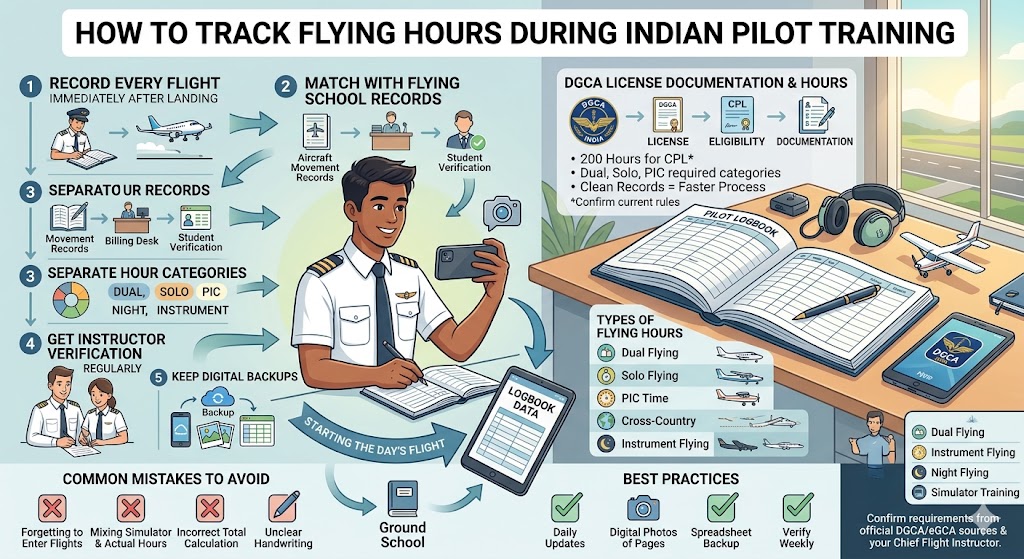
Step 1: Record Every Flight Immediately After Landing
Do not delay logbook entries. After landing, debrief with your instructor and write the flight details while everything is fresh in your mind.
Record the date, aircraft registration, route, duration, and exercise completed.
Step 2: Match Logbook Entries With Flying School Records
Your flying school may maintain aircraft movement records, instructor records, billing records, and training files. Your personal logbook should match these records.
If there is any mismatch, correct it immediately with proper approval.
Step 3: Separate Dual, Solo, Simulator, and PIC Hours
Do not combine all hours into one total without categories. Maintain separate totals for:
- Dual flying
- Solo flying
- PIC flying
- Cross-country flying
- Night flying
- Instrument flying
- Simulator training
This makes license preparation easier later.
Step 4: Get Instructor Verification Regularly
Instructor signature is important. A flight entry without proper verification can create problems later.
Instead of waiting until the end of training, get your instructor’s signature regularly.
Step 5: Keep a Digital Backup
Even if you maintain a physical logbook, keep a digital backup. You can use:
- Excel sheet
- Google Sheet
- Scanned copies
- Photos of logbook pages
- Digital logbook app
- PDF backup
This helps if the physical logbook is damaged, misplaced, or difficult to read later.
Step 6: Review Total Hours Every Week
At the end of each week, check your total hours. Compare your own record with the flying school record.
This helps you know:
- How many total hours are completed
- How many hours are pending
- Which category needs more training
- Whether any entry is missing
Step 7: Avoid Overwriting or Unclear Entries
Never overwrite logbook entries casually. If a correction is needed, follow your flying school’s process. Entries should be neat, readable, and properly verified.
Step 8: Confirm Records Before License Application
Before applying for any license or rating, review all logbook entries with your instructor or training office.
Check:
- Total hours
- Category-wise hours
- Instructor signatures
- Aircraft registration details
- Route details
- Simulator entries
- Test flight records
- Medical and training documents
Manual Logbook vs Digital Tracking
Both manual and digital tracking are useful. Many students use both for safety.
| Tracking Method | Benefits | Limitations |
|---|---|---|
| Manual Logbook | Accepted as a traditional aviation record, easy for instructor signatures, useful during training review | Can be lost, damaged, hard to calculate, or difficult to read if handwriting is poor |
| Digital Tracking | Easy calculations, quick backups, category-wise totals, simple to search and update | Must match official records, may need regular verification, should not replace required school/DGCA process unless accepted |
The best method is to maintain your official logbook properly and keep a digital backup for personal tracking.
Common Mistakes Students Make While Tracking Flying Hours
Many student pilots make small mistakes that later become big problems. Here are the most common ones.
1. Forgetting to Enter Flights
Some students complete several flights and then update the logbook after many days. This increases the chance of wrong entries.
2. Mixing Simulator and Actual Flying Hours
Simulator training is valuable, but it should be recorded separately. Do not mix simulator hours with actual aircraft flying hours.
3. Incorrect Total Calculation
Manual addition errors are common. One wrong total can affect all future totals. Use a calculator or spreadsheet to cross-check.
4. Missing Instructor Signature
A flight entry without instructor verification may not be accepted during internal review. Get signatures regularly.
5. Not Tracking Solo Hours Separately
Solo hours are important for student progress. Always separate dual and solo time.
6. Poor Handwriting
A logbook should be readable. If numbers, dates, aircraft registration, or route details are unclear, it can create confusion.
7. Not Keeping Backups
A physical logbook is important, but keeping no backup is risky. Take photos or scans regularly.
8. Not Checking School Records
Your personal record should match the flying school record. If both records show different totals, you must resolve the issue early.
DGCA and Flying Hour Documentation
Students should understand that flying hour documentation is not only a personal habit. It is also part of regulatory and licensing discipline.
In India, DGCA rules, eGCA processes, and flying school documentation practices must be followed carefully. Since aviation rules and processes may be updated, students should always confirm the latest requirements from:
- Their DGCA-approved flying training organization
- Their chief flight instructor
- Official DGCA sources
- eGCA portal guidance
- Approved training documentation staff
Do not depend only on informal advice from other students. Aviation documentation should always be verified from official or authorized sources.
Best Practices for Accurate Flying Hour Tracking
Here are practical tips every student pilot in India should follow.
Update Your Logbook Daily
The best habit is to update your logbook immediately after flying. Daily updates reduce mistakes.
Keep Photos or Scans of Important Pages
Take regular photos or scans of completed logbook pages. Store them safely in cloud storage or an external drive.
Use a Spreadsheet for Backup
A spreadsheet can help you calculate totals automatically. You can create separate columns for dual, solo, PIC, night, instrument, and simulator hours.
Verify Entries With Your Instructor
Ask your instructor to review entries regularly. This avoids last-minute corrections.
Maintain Separate Totals
Do not track only total flying hours. Track category-wise totals because licensing and training requirements may depend on specific types of flying.
Check Records Before Leaving a Flying School
If you change flying schools or complete training, verify all records before leaving. Getting corrections later can be difficult.
Keep All Training Documents Safe
Along with your logbook, keep copies of:
- Medical certificate
- Student pilot license if applicable
- Computer number documents
- Exam records
- Training progress reports
- Flying school certificates
- Fee and aircraft billing records
- Flight test documents
Sample Flying Hour Tracking Format
Students can use a format like this for personal backup.
| Date | Aircraft | Route | Dual Hours | Solo Hours | PIC Hours | Simulator Hours | Instructor Sign | Remarks |
|---|---|---|---|---|---|---|---|---|
| 05 Jan | Cessna 172 | Local Circuit | 1.0 | 0 | 0 | 0 | Yes | Circuit practice |
| 07 Jan | Cessna 172 | Local Area | 0.8 | 0 | 0 | 0 | Yes | Basic handling |
| 10 Jan | Cessna 172 | Local Circuit | 0 | 0.5 | 0.5 | 0 | Yes | First solo circuit |
| 12 Jan | Simulator | IFR Practice | 0 | 0 | 0 | 1.0 | Yes | Instrument scan |
This table is only a sample. Students should follow the format accepted by their flying school and DGCA-related documentation process.
How Flying Hour Tracking Helps During CPL Training
CPL training requires discipline, planning, and proper documentation. Flying hour tracking helps students avoid confusion near the end of training.
A student who tracks hours properly can easily answer questions like:
- How many total hours have I completed?
- How many solo hours do I have?
- How many cross-country hours are pending?
- Have I completed night flying requirements?
- How many instrument hours are recorded?
- Are all instructor signatures complete?
- Does my logbook match school records?
- Are my simulator hours separate from aircraft hours?
Without proper tracking, students may reach the final stage and discover missing signatures, wrong totals, or incomplete category records.
Proper tracking also helps with cost planning. If you know how many hours are pending, you can estimate remaining training expenses more clearly.
Real-Life Example
Imagine a student pilot named Arjun training at a flying school in India. In the beginning, he only checks total flying hours casually. After a few weeks, his instructor advises him to maintain category-wise records.
Arjun starts using both a physical logbook and a spreadsheet. Every evening after flying, he records aircraft registration, route, dual time, solo time, and instructor remarks. Every Saturday, he compares his spreadsheet with the school record.
Later, when he prepares his CPL documentation, he does not panic. His totals are clear, signatures are complete, and category-wise hours are easy to verify. Because he maintained records from the beginning, he avoids last-minute stress.
This is why disciplined tracking is valuable for every student pilot.
Final Checklist for Student Pilots After Every Flight
Use this checklist after each flight:
- Did I write the flight date correctly?
- Did I enter aircraft type and registration?
- Did I record departure and arrival points?
- Did I enter correct flight duration?
- Did I mark the flight as dual or solo?
- Did I record PIC time if applicable?
- Did I mention the training exercise?
- Did I get instructor signature?
- Did I update my total hours?
- Did I update my digital backup?
- Did I compare with school records regularly?
A small checklist can save you from big documentation problems later.
FAQs
1. What are flying hours in pilot training?
Flying hours are the recorded time a student spends flying an aircraft or completing approved training activities. They show practical flying experience.
2. How many flying hours are needed for CPL in India?
CPL students in India commonly work toward around 200 flying hours, including required categories of training. However, students should confirm the latest DGCA requirements from official sources and their flying school.
3. What is the difference between dual and solo flying hours?
Dual flying hours are flown with an instructor. Solo flying hours are flown by the student alone after receiving approval from the instructor.
4. Can simulator hours be counted as flying hours?
Simulator hours are useful training hours, but they should be recorded separately from actual aircraft flying hours. Their acceptance depends on applicable rules and approved training structure.
5. Who signs a student pilot logbook?
Usually, the flight instructor or authorized training personnel verifies and signs student pilot logbook entries. Students should follow their flying school’s process.
6. What happens if flying hours are not recorded properly?
Incorrect or incomplete records can cause confusion during training review, flying school verification, or license documentation. It may also delay the process.
7. Should I keep a digital copy of my logbook?
Yes. A digital backup is highly recommended. Students can keep scanned copies, photos, or spreadsheet records along with the official logbook.
8. How often should I verify my flying hour records?
Students should review records weekly and match them with flying school records. Regular verification prevents last-minute corrections.
9. Are night flying hours important for pilot training?
Yes. Night flying is an important part of advanced pilot training and should be recorded separately when completed.
10. Can incorrect logbook entries affect license processing?
Yes. Incorrect, unclear, or unverifiable entries may create problems during documentation review. Students should keep entries neat, accurate, and verified.
Conclusion
Tracking flying hours during Indian pilot training is not just an administrative task. It is a professional habit that every future pilot should build from the first day of training.
Your logbook is proof of your flying journey. It shows your learning, discipline, progress, and readiness for the next stage of your aviation career.
Whether you are training for SPL, PPL, CPL, or advanced flying, maintain your records carefully. Update your logbook after every flight, separate different types of hours, get instructor verification, keep digital backups, and always confirm DGCA-related requirements from official sources.
A good pilot is not only skilled in the cockpit but also disciplined in documentation. Start treating your flying hour record as an important career document from day one.