Introduction
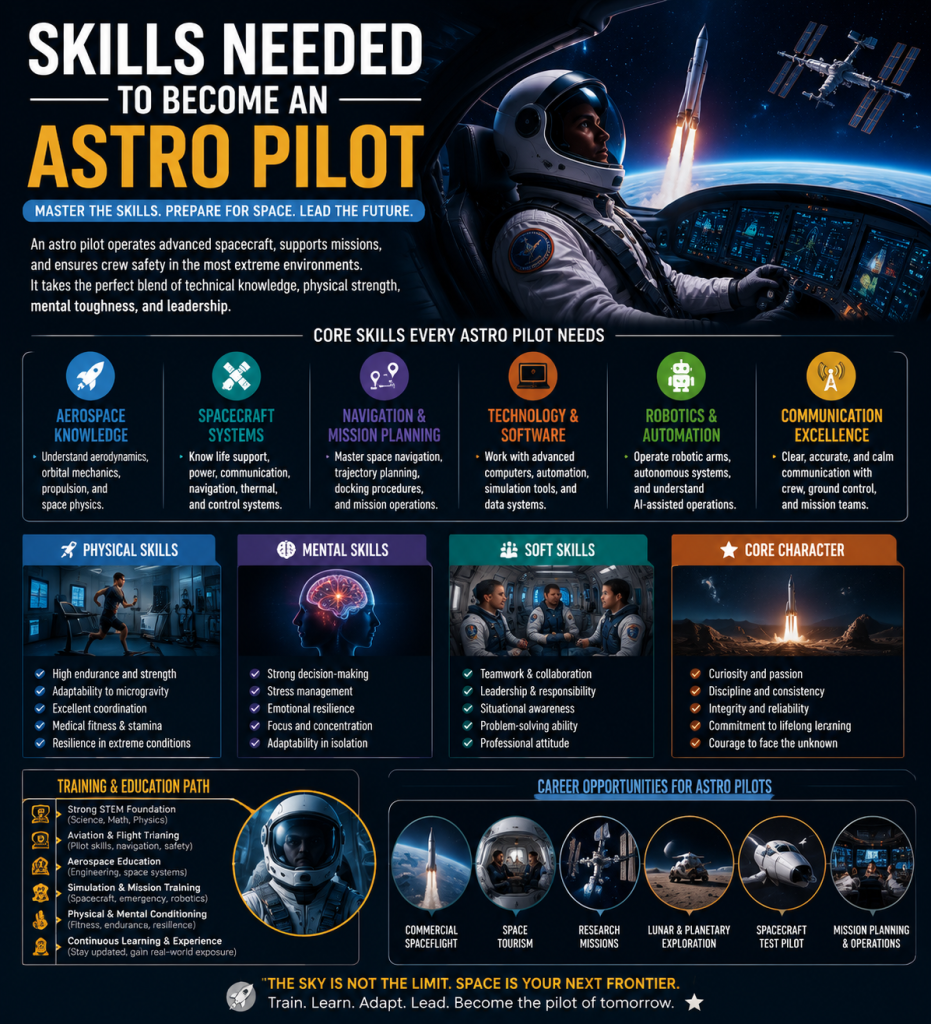
An astro pilot is a highly trained professional who understands aviation, spacecraft systems, space navigation, mission operations, and human performance in extreme environments. As space travel moves beyond traditional government missions and expands into commercial spaceflight, research missions, space tourism, orbital stations, lunar operations, and deep-space exploration, the need for skilled astro pilots is becoming more important. Unlike traditional pilots who operate aircraft within Earth’s atmosphere, astro pilots must understand how vehicles behave in space, how missions are controlled, and how crews survive and work in microgravity. This guide explains the key skills needed to become an astro pilot, including technical knowledge, physical readiness, mental strength, communication, leadership, and long-term learning habits.
What Is an Astro Pilot?
An astro pilot is a future-focused spaceflight professional trained to operate or support spacecraft during space missions. The role may include spacecraft navigation, mission planning, docking support, system monitoring, emergency response, crew coordination, and communication with ground control.
An astro pilot is different from a regular airline pilot because spaceflight involves orbital mechanics, spacecraft systems, microgravity, life support, radiation awareness, and mission operations beyond normal atmospheric flight. The role combines aviation discipline, aerospace science, engineering knowledge, and astronaut-level decision-making.
Why Astro Pilot Skills Matter
Astro pilots need advanced skills because space missions are complex and high-risk. A small mistake in navigation, system monitoring, communication, or emergency response can affect the safety of the crew and mission.
These skills matter because astro pilots may work in environments where help is limited, decisions must be fast, and technology must be trusted. They must be calm, accurate, disciplined, and prepared for unexpected situations.
Core Technical Skills Needed to Become an Astro Pilot
Aerospace Fundamentals
A strong understanding of aerospace fundamentals is one of the most important skills for any astro pilot. This includes knowledge of aerodynamics, propulsion, flight dynamics, spacecraft motion, and space physics.
Astro pilots must understand how vehicles behave during launch, orbit, re-entry, and landing. They should also understand how gravity, thrust, drag, velocity, and orbital paths affect spacecraft movement.
Orbital Mechanics
Orbital mechanics is the science of how spacecraft move around planets, moons, and other objects in space. Astro pilots need this knowledge to understand orbits, transfers, docking approaches, and mission trajectories.
This skill helps astro pilots work with mission planners, flight computers, and navigation systems. Even when spacecraft are highly automated, pilots must understand what the system is doing and why.
Space Navigation Skills
Space navigation is different from aircraft navigation. In aviation, pilots use routes, airways, runways, and air traffic control. In space, navigation depends on orbital paths, spacecraft position, velocity, timing, and mission objectives.
Astro pilots should understand trajectory planning, docking alignment, orbital adjustments, and navigation data. They must also know how to respond if automated navigation systems need human monitoring or manual support.
Spacecraft Systems Knowledge
An astro pilot must understand the major systems inside a spacecraft. These include propulsion, power, life support, communication, thermal control, navigation, guidance, and environmental control systems.
Knowing these systems helps astro pilots identify problems early, communicate clearly with engineers, and respond correctly during abnormal situations. Spacecraft systems knowledge is essential for mission safety.
Propulsion System Understanding
Propulsion systems help spacecraft launch, maneuver, change orbit, dock, and return safely. Astro pilots do not need to design engines, but they must understand how propulsion affects movement and mission planning.
They should know basic engine operations, fuel management, thrust control, reaction control systems, and emergency procedures related to propulsion.
Life Support System Awareness
Life support systems keep crew members alive in space. These systems manage oxygen, carbon dioxide removal, temperature, pressure, humidity, water, and waste control.
Astro pilots must understand how life support systems work because crew safety depends on them. They should know warning signs, emergency actions, and how to coordinate with ground control when system issues occur.
Communication System Skills
Clear communication is vital during space missions. Astro pilots must communicate with crew members, mission control, engineers, and support teams using accurate and professional language.
They should be skilled in radio communication, technical reporting, checklist communication, emergency communication, and mission updates. Miscommunication can create serious risks in space operations.
Computer and Software Skills
Modern spacecraft rely heavily on digital systems, automation, sensors, and mission software. Astro pilots must be comfortable working with computers, displays, flight control interfaces, data systems, and simulation tools.
Basic coding knowledge, data interpretation, cybersecurity awareness, and software troubleshooting can also be useful. As spacecraft become more automated, astro pilots must understand both manual control and automated decision support.
Robotics and Automation Skills
Space missions often use robotic arms, autonomous vehicles, docking systems, satellites, and remote-controlled equipment. Astro pilots may need to operate or supervise robotic systems during missions.
Robotics skills help with cargo handling, maintenance, scientific operations, lunar surface support, and space station tasks. Automation knowledge helps astro pilots understand how machines make decisions and how humans should supervise them.
Critical Soft Skills for Astro Pilots
Decision-Making Under Pressure
Astro pilots must make smart decisions during stressful and time-sensitive situations. Space missions can involve system warnings, navigation adjustments, communication delays, or emergency procedures.
Good decision-making requires training, calm thinking, checklist discipline, and the ability to separate emotion from action. Astro pilots must choose the safest and most mission-appropriate response.
Situational Awareness
Situational awareness means understanding what is happening around you, inside the spacecraft, and across the mission. Astro pilots must track system status, crew condition, mission timeline, navigation data, and possible risks.
Strong situational awareness helps prevent mistakes and allows pilots to notice early warning signs before they become serious problems.
Problem-Solving Ability
Space missions can create unexpected technical and operational problems. Astro pilots must be able to analyze the issue, understand available options, and work with the crew and ground control to solve it.
Problem-solving in space requires patience, logic, technical understanding, and creativity. It also requires the ability to stay calm when the solution is not immediately clear.
Communication Skills
Communication is one of the most important astro pilot skills. Every instruction, warning, status report, and emergency message must be clear and accurate.
Astro pilots must avoid confusion, speak with discipline, listen carefully, and confirm instructions. Good communication builds trust between the crew and mission control.
Teamwork and Crew Coordination
Astro pilots rarely work alone. They are part of a crew that may include astronauts, engineers, scientists, medical officers, mission specialists, and ground teams.
Teamwork means respecting roles, sharing information, supporting others, and staying focused on mission goals. A good astro pilot must be dependable and cooperative.
Leadership Skills
Astro pilots may need to lead during normal operations or emergencies. Leadership in space is not about giving orders only; it is about keeping the team calm, organized, and focused.
Strong leaders make clear decisions, listen to experts, follow procedures, and protect crew safety. They also help maintain morale during long and difficult missions.
Physical Skills Required to Become an Astro Pilot
Physical Fitness
Astro pilots must maintain excellent physical fitness. Spaceflight can place stress on the body during launch, re-entry, microgravity exposure, and mission tasks.
Fitness supports endurance, strength, coordination, cardiovascular health, and recovery. A physically fit astro pilot is better prepared for demanding mission environments.
Coordination and Motor Skills
Operating spacecraft systems, controls, tools, and robotic equipment requires strong coordination. In microgravity, even simple movements can become difficult.
Astro pilots must train their bodies to work in unusual conditions. Good hand-eye coordination and body control are very important.
Adaptability to Microgravity
Microgravity affects movement, balance, muscles, bones, and spatial orientation. Astro pilots must learn how to move, work, sleep, exercise, and perform tasks in this environment.
Adapting to microgravity requires training, patience, and body awareness. It is one of the major differences between aviation and spaceflight.
Medical Fitness
Medical fitness is essential for astro pilots. Space missions require strong vision, hearing, cardiovascular health, mental stability, and general physical readiness.
Medical standards may vary depending on mission type, organization, and role. However, excellent health is always important for spaceflight careers.
Psychological Skills Needed
Emotional Resilience
Space missions can be stressful, isolated, and physically demanding. Astro pilots must manage fear, pressure, frustration, and uncertainty.
Emotional resilience helps them stay steady during difficult situations. It also supports healthy teamwork during long missions.
Stress Management
Astro pilots must perform well under pressure. Stress can come from emergencies, mission deadlines, confined spaces, technical failures, and long periods away from Earth.
Strong stress management skills help pilots think clearly, follow procedures, and protect mission safety.
Mental Discipline
Mental discipline means staying focused, organized, and professional even when tasks become repetitive or difficult. Space missions require strict attention to checklists, systems, timelines, and procedures.
Astro pilots must avoid careless mistakes and stay mentally sharp throughout the mission.
Adaptability in Isolated Environments
Space crews may live and work in confined environments for long periods. Astro pilots must adapt to limited space, limited privacy, routine schedules, and close teamwork.
Adaptability helps maintain performance and crew harmony during long-duration missions.
Educational Path to Becoming an Astro Pilot
A strong education is important for anyone who wants to become an astro pilot. Students should focus on science, technology, engineering, and mathematics.
Useful fields include aerospace engineering, mechanical engineering, electrical engineering, physics, computer science, aviation, robotics, and space systems. Aviation training can also be valuable because it teaches discipline, navigation, safety procedures, and cockpit decision-making.
Training Needed for Astro Pilot Careers
Astro pilot training may include flight training, spacecraft simulation, mission operations, survival training, emergency response, physical conditioning, robotics training, and technical systems training.
Simulation is especially important because it allows candidates to practice launch, docking, system failures, communication, and emergency scenarios in a safe environment.
Emerging Technologies Astro Pilots Must Learn
Artificial Intelligence
Artificial intelligence is becoming more important in spacecraft operations, mission planning, navigation, data analysis, and automation. Astro pilots should understand how AI supports decision-making and system monitoring.
They do not need to be AI researchers, but they should know how to work with intelligent systems responsibly.
Autonomous Spacecraft
Future spacecraft may handle many tasks automatically. Astro pilots must understand autonomous systems so they can monitor performance, detect errors, and take control when needed.
Automation makes missions more efficient, but human judgment remains important in complex and unexpected situations.
Advanced Simulation Systems
Simulation helps astro pilots train for real mission scenarios. Advanced simulators can recreate launch stress, docking tasks, system failures, navigation problems, and emergency procedures.
Astro pilots should be comfortable learning through simulators and improving their performance through repeated practice.
Digital Mission Planning
Mission planning uses digital tools to calculate routes, timelines, resources, risks, and crew activities. Astro pilots must understand these tools and know how mission plans are created and adjusted.
Digital planning skills help pilots stay aligned with mission control and respond to changing conditions.
Common Challenges Aspiring Astro Pilots Face
Becoming an astro pilot is challenging because the field requires high technical knowledge, physical fitness, psychological strength, and continuous learning. Candidates may face strong competition, demanding training, medical requirements, and limited entry-level opportunities.
Another challenge is that the space industry changes quickly. Astro pilots must stay updated with new spacecraft designs, mission systems, safety standards, and commercial spaceflight developments.
Career Opportunities for Astro Pilots
Commercial Spaceflight Pilot
Commercial spaceflight pilots may support private space missions, orbital flights, and future passenger space travel. This role requires strong spacecraft systems knowledge and flight discipline.
Space Tourism Pilot
As space tourism grows, trained professionals may be needed to support passenger safety, vehicle operations, and mission coordination. This role combines aviation professionalism with spaceflight expertise.
Research Mission Pilot
Research missions may involve scientific experiments, orbital platforms, microgravity labs, and space-based observation. Astro pilots may support mission operations and crew safety.
Lunar Mission Operator
Future lunar missions may require professionals who can support landing, surface mobility, habitat operations, and return missions. Astro pilot skills can be valuable in these environments.
Spacecraft Test Pilot
Spacecraft test pilots help evaluate new vehicles, systems, and procedures. This role requires high technical knowledge, courage, precision, and strong engineering understanding.
Mission Planning Specialist
Some astro pilots may work in mission planning, simulation, operations control, or training. Their flight knowledge helps improve mission safety and efficiency.
How Students Can Start Preparing Today
Students who want to become astro pilots should build strong foundations early. They should study mathematics, physics, computer science, engineering basics, and communication skills.
They can also join aviation clubs, robotics teams, coding programs, science competitions, space camps, flight training programs, and STEM communities. Early exposure helps build confidence and direction.
Frequently Asked Questions
1- What is an astro pilot?
An astro pilot is a spaceflight professional trained to operate, monitor, or support spacecraft during space missions. The role combines aviation, aerospace engineering, spacecraft systems, mission planning, and crew coordination.
2- How is an astro pilot different from an astronaut?
An astronaut may perform many roles, including science, engineering, research, or mission operations. An astro pilot focuses more specifically on spacecraft operation, navigation, flight control, docking, and mission safety.
3- What degree is best for becoming an astro pilot?
Useful degrees include aerospace engineering, mechanical engineering, electrical engineering, physics, computer science, aviation, and robotics. A strong STEM background is very helpful for spaceflight careers.
4- Do astro pilots need aviation experience?
Aviation experience can be very useful because it builds discipline, navigation skills, cockpit awareness, communication, and emergency decision-making. However, spaceflight also requires additional aerospace and mission operations knowledge.
5- What technical skills are most important?
Important technical skills include spacecraft systems, orbital mechanics, propulsion basics, navigation, communication systems, robotics, automation, and mission planning. Strong computer skills are also valuable.
6- Is coding important for astro pilots?
Coding is not always mandatory, but it can be very helpful. Understanding software, data, automation, and digital systems allows astro pilots to work better with modern spacecraft technology.
7- What physical fitness is required?
Astro pilots need strong overall fitness, endurance, coordination, and medical readiness. They must be prepared for launch forces, microgravity, confined environments, and demanding mission schedules.
8- How competitive is the astro pilot profession?
The profession is highly competitive because it requires rare combinations of technical knowledge, physical fitness, mental strength, and leadership. Strong preparation and continuous learning are essential.
9- Can commercial pilots become astro pilots?
Yes, commercial pilots may have useful skills such as flight discipline, communication, navigation, and decision-making. However, they must also learn spacecraft systems, orbital mechanics, and space mission operations.
10- What industries hire astro pilot professionals?
Possible industries include commercial spaceflight, aerospace companies, research organizations, space tourism providers, government space agencies, simulation training centers, and mission operations teams.
11- What is the future demand for astro pilots?
Future demand may grow as commercial spaceflight, orbital stations, lunar missions, and private space programs expand. Professionals with both aviation and space systems knowledge may have strong opportunities.
12- How can beginners start preparing?
Beginners should focus on STEM education, physical fitness, aviation knowledge, coding basics, robotics, communication skills, and problem-solving. They should also follow space industry developments and explore training programs.
Conclusion
Becoming an astro pilot requires a powerful combination of technical knowledge, physical readiness, mental discipline, leadership, and lifelong learning. The role is not only about flying a spacecraft; it is about understanding mission systems, protecting crew safety, solving problems, communicating clearly, and performing under pressure. Aspiring astro pilots should begin by building strong foundations in science, engineering, aviation, computer systems, and personal discipline. As commercial spaceflight and human space exploration continue to grow, future astro pilots may play an important role in space tourism, research missions, lunar operations, and deep-space exploration. The best way to start is to study consistently, stay physically fit, build technical skills, and remain curious about the future of space travel.