
Introduction
Modern IT operations are becoming more complex every day. Businesses now run applications across cloud platforms, containers, microservices, hybrid infrastructure, databases, monitoring tools, security systems, and automation pipelines. Because of this complexity, IT teams often deal with thousands of alerts, logs, metrics, incidents, and performance issues.
Traditional monitoring methods are no longer enough for many modern environments. Teams need faster ways to detect problems, understand root causes, reduce alert noise, predict failures, and automate responses. This is where AIOps becomes important.
AIOps helps IT teams use artificial intelligence, machine learning, automation, observability, and monitoring data to improve IT operations. It supports faster decision-making, better reliability, and smarter incident management. For DevOps engineers, SREs, cloud engineers, monitoring teams, platform engineers, and IT managers, AIOps is becoming a future-ready skill.
At the same time, MLOps is also becoming important because organizations need to build, deploy, monitor, and manage machine learning models in real production environments. When professionals understand both AIOps and MLOps, they gain a strong advantage in modern IT, automation, and AI-driven operations.
This blog explains AIOps in simple English, compares AIOps with MLOps, shares important skills, use cases, project ideas, learning roadmap, career opportunities, and common mistakes beginners should avoid.
What is AIOps?
AIOps stands for Artificial Intelligence for IT Operations. In simple words, AIOps uses artificial intelligence and machine learning to improve how IT systems are monitored, managed, and automated.
AIOps combines:
- Monitoring data
- Logs
- Metrics
- Traces
- Events
- Alerts
- Machine learning
- Automation
- Incident management
- IT operations workflows
Instead of depending only on manual monitoring, AIOps helps teams understand patterns in large amounts of IT data. It can detect unusual behavior, connect related alerts, find possible root causes, predict issues, and trigger automation.
For example, in a traditional IT setup, a monitoring tool may send hundreds of alerts when a service slows down. Engineers must manually check logs, metrics, infrastructure, and application behavior. With AIOps, the system can group related alerts, identify the affected service, suggest the likely root cause, and even start an auto-remediation workflow.
AIOps does not replace IT teams. It supports them by reducing repetitive work, improving visibility, and helping engineers respond faster.
Why AIOps Matters for Modern IT Teams
Modern IT teams work in fast-moving environments. Applications are deployed frequently, infrastructure changes quickly, and customer expectations are high. Even a small outage can affect business performance, user trust, and revenue.
AIOps matters because it helps teams manage this complexity more intelligently.
Alert Noise Reduction
One of the biggest problems in IT operations is alert fatigue. Monitoring tools may generate too many alerts, many of which are duplicate, low priority, or connected to the same issue.
AIOps can reduce alert noise by grouping related alerts, removing duplicates, and highlighting the most important incidents. This helps engineers focus on real problems instead of wasting time on unnecessary notifications.
Faster Incident Detection
AIOps can analyze metrics, logs, and events in real time. It can detect abnormal behavior before users report the problem. This helps teams identify incidents faster and reduce downtime.
Root Cause Analysis
Finding the root cause of an incident can take time, especially in distributed systems. AIOps can connect data from different sources and show possible causes. For example, it may identify that a database slowdown caused API latency, which then created multiple service alerts.
Predictive Monitoring
AIOps can study historical patterns and predict possible future issues. For example, it may detect that server memory usage is increasing every day and may reach a risky level soon.
Auto-Remediation
Auto-remediation means automatically fixing known issues using predefined workflows. For example, if a service stops, an automation script can restart it. If disk usage becomes high, temporary files can be cleaned automatically.
Better Reliability
AIOps improves reliability by helping teams detect, understand, and resolve issues faster. This is especially useful for SRE teams, DevOps teams, cloud operations teams, and platform engineering teams.
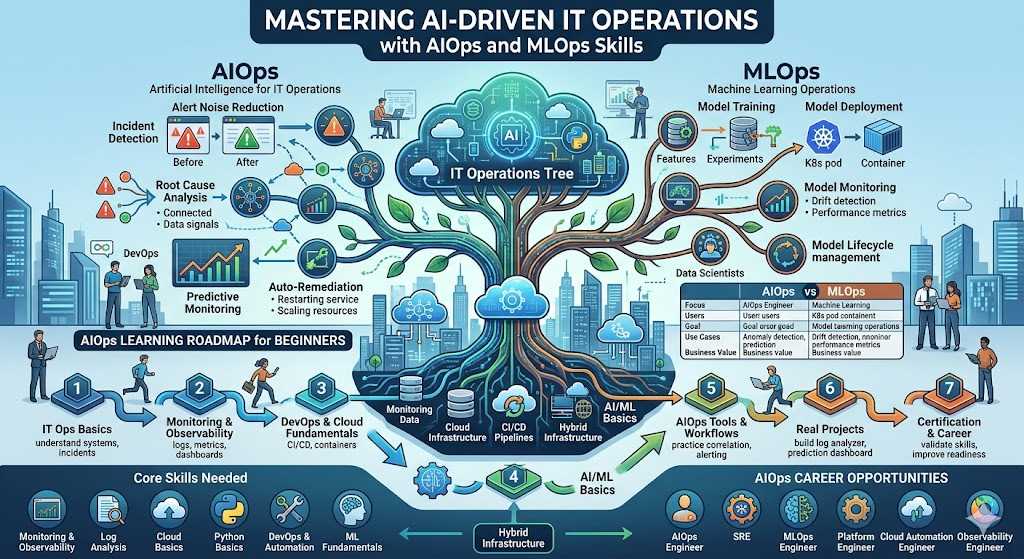
AIOps vs MLOps
AIOps and MLOps are related to AI and machine learning, but they solve different problems.
AIOps focuses on improving IT operations using AI and automation. MLOps focuses on managing the machine learning model lifecycle, from development to deployment and monitoring.
| Point | AIOps | MLOps |
|---|---|---|
| Main Focus | IT operations, monitoring, incidents, automation | Machine learning model development, deployment, and management |
| Primary Users | DevOps engineers, SREs, IT operations teams, cloud engineers | Data scientists, ML engineers, data engineers, platform teams |
| Key Goal | Improve system reliability and incident response | Build and manage ML models in production |
| Common Data | Logs, metrics, traces, alerts, events | Training data, models, features, experiments, predictions |
| Use Cases | Anomaly detection, alert correlation, root cause analysis, auto-remediation | Model training, model deployment, model monitoring, drift detection |
| Output | Better IT visibility and faster operations | Reliable ML models in production |
Both skills are valuable. AIOps helps teams run IT systems better, while MLOps helps teams run machine learning systems better. Professionals who understand both can work effectively in AI-driven IT environments.
Core Skills Needed to Learn AIOps
Learning AIOps does not mean you need to become a data scientist from day one. However, you should understand the basic areas that support AI-driven IT operations.
Monitoring and Observability
Monitoring helps teams check whether systems are working properly. Observability helps teams understand why something is happening inside a system.
To learn AIOps, you should understand:
- Application monitoring
- Infrastructure monitoring
- Service health checks
- Dashboards
- Alerts
- Logs
- Metrics
- Traces
Observability is one of the strongest foundations for AIOps.
Log Analysis
Logs contain important details about system behavior, errors, requests, warnings, and failures. AIOps systems often use logs to detect anomalies and investigate incidents.
You should learn how to read logs, search logs, identify patterns, and understand error messages.
Metrics and Traces
Metrics show numerical data such as CPU usage, memory usage, request count, latency, and error rate.
Traces help track how a request moves across multiple services. This is very useful in microservices environments.
Incident Management
AIOps is closely connected to incident management. You should understand:
- Incident detection
- Incident priority
- Escalation
- On-call process
- Root cause analysis
- Post-incident review
- Service level objectives
Cloud Basics
Many modern systems run on cloud platforms. AIOps professionals should understand basic cloud concepts such as compute, storage, networking, databases, containers, and managed services.
Python Basics
Python is useful for automation, log parsing, data analysis, scripting, and machine learning basics. You do not need to become an expert immediately, but basic Python knowledge is helpful.
Machine Learning Fundamentals
AIOps uses machine learning for anomaly detection, prediction, classification, and pattern recognition. Beginners should understand basic ML concepts such as:
- Training data
- Models
- Features
- Classification
- Clustering
- Prediction
- Anomaly detection
DevOps and Automation
AIOps works best when combined with DevOps automation. You should understand CI/CD, infrastructure automation, configuration management, scripting, and workflow automation.
Popular AIOps Use Cases
AIOps can be used in many real-world IT operations scenarios.
Anomaly Detection
Anomaly detection helps identify unusual behavior in systems. For example, if normal CPU usage is around 40% but suddenly increases to 95%, AIOps can detect it as an anomaly.
Event Correlation
Modern IT systems generate many events from different tools. AIOps can connect related events and show them as one meaningful incident.
Intelligent Alerting
AIOps can improve alert quality by reducing duplicates, ranking alerts by severity, and identifying alerts that need immediate attention.
Capacity Prediction
AIOps can help predict future capacity needs. For example, it can forecast when storage, memory, or compute resources may become insufficient.
Self-Healing Infrastructure
Self-healing infrastructure uses automation to fix known issues without manual effort. For example, a failed container can be restarted automatically.
Incident Automation
AIOps can trigger workflows when certain incidents occur. These workflows may include restarting services, scaling resources, creating tickets, or notifying teams.
Cloud Cost Visibility
AIOps can help teams detect unusual cloud usage patterns, idle resources, and cost spikes. This helps improve cloud cost management.
Service Reliability Improvement
By combining monitoring, automation, and prediction, AIOps helps improve service uptime, performance, and reliability.
AIOps Learning Roadmap for Beginners
A clear roadmap helps beginners learn AIOps step by step without confusion.
| Step | What to Learn | Practical Outcome |
|---|---|---|
| Step 1 | IT operations basics | Understand servers, networks, applications, and incidents |
| Step 2 | Monitoring and observability | Learn logs, metrics, traces, dashboards, and alerts |
| Step 3 | DevOps and cloud fundamentals | Understand CI/CD, cloud services, containers, and automation |
| Step 4 | AI and ML basics | Learn anomaly detection, prediction, and classification concepts |
| Step 5 | AIOps tools and workflows | Practice alert correlation, intelligent alerting, and dashboards |
| Step 6 | Real projects | Build hands-on projects using logs, metrics, and automation |
| Step 7 | AIOps certification | Validate your knowledge and improve career readiness |
Step 1: Learn IT Operations Basics
Start with the basics of IT operations. Understand how applications run, how servers work, how networks connect systems, and how incidents are handled.
Step 2: Understand Monitoring and Observability
Learn how monitoring tools collect data and how observability helps teams understand system behavior. Focus on logs, metrics, traces, alerts, and dashboards.
Step 3: Learn DevOps and Cloud Fundamentals
AIOps is closely connected to DevOps and cloud operations. Learn CI/CD pipelines, cloud platforms, containers, infrastructure automation, and basic scripting.
Step 4: Learn AI and ML Basics
You do not need advanced mathematics in the beginning. Start with basic concepts like anomaly detection, classification, clustering, and prediction.
Step 5: Practice AIOps Tools and Workflows
Practice how AIOps tools collect data, reduce alert noise, correlate events, and support incident response.
Step 6: Work on Real Projects
Hands-on practice is very important. Build small projects using sample logs, monitoring data, alert rules, and automation scripts.
Step 7: Prepare for AIOps Certification
An AIOps certification can help you organize your learning and show your skills to employers. It is useful for professionals who want structured AIOps training and career growth.
Real-World AIOps Project Ideas
Practical projects help you understand AIOps better than theory alone.
Alert Classification System
Create a system that classifies alerts into categories such as critical, warning, informational, duplicate, or false positive. This project helps you understand intelligent alerting.
Log Anomaly Detector
Build a simple log analysis system that detects unusual patterns in application logs. You can use sample log files and basic Python scripts.
Incident Prediction Dashboard
Create a dashboard that uses historical metrics to predict possible incidents. For example, predict when CPU, memory, or disk usage may cross a risky limit.
Auto-Remediation Workflow
Build an automation workflow that restarts a service when it fails. This project teaches how AIOps can support self-healing infrastructure.
Cloud Monitoring Pipeline
Create a basic cloud monitoring pipeline that collects metrics, shows dashboards, and triggers alerts based on defined conditions.
Who Should Learn AIOps?
AIOps is useful for many roles in modern IT.
DevOps Engineers
DevOps engineers can use AIOps to improve deployment monitoring, automate incident response, and reduce operational workload.
SREs
Site Reliability Engineers can use AIOps for service reliability, SLO monitoring, incident analysis, and reliability automation.
Cloud Engineers
Cloud engineers can use AIOps for cloud monitoring, capacity planning, cost visibility, and automated scaling.
IT Operations Teams
IT operations teams can use AIOps to improve alert handling, incident response, and infrastructure visibility.
Monitoring Engineers
Monitoring engineers can use AIOps to design smarter alerts, better dashboards, and event correlation workflows.
Managers
IT managers can use AIOps knowledge to plan better operations strategies, reduce downtime, and improve team productivity.
Freshers
Freshers who want a modern IT career can learn AIOps to build strong skills in monitoring, automation, DevOps, cloud, and AI-driven IT operations.
Common Mistakes Beginners Make
Beginners often make some common mistakes while learning AIOps. Avoiding these mistakes can make your learning journey smoother.
Learning Tools Without Concepts
Many beginners start directly with tools but do not understand monitoring, observability, logs, metrics, or incident management. Tools are important, but concepts are more important.
Ignoring Observability Basics
AIOps depends on quality data. If you do not understand observability, you may struggle to understand how AIOps works.
Depending Only on AI Without Human Review
AIOps supports engineers, but human review is still important. AI suggestions should be checked, especially during critical incidents.
Not Practicing Real Incidents
Reading about AIOps is not enough. You should practice with real or sample incidents, logs, alerts, and dashboards.
Skipping Automation Fundamentals
Automation is a major part of AIOps. If you skip scripting, DevOps automation, and workflow automation, you may not fully understand AIOps use cases.
AIOps Career Opportunities
AIOps skills can support many modern IT career paths.
AIOps Engineer
An AIOps Engineer works on AI-driven monitoring, alert correlation, incident automation, anomaly detection, and operational intelligence.
MLOps Engineer
An MLOps Engineer focuses on machine learning model deployment, monitoring, automation, and production reliability.
Site Reliability Engineer
An SRE uses AIOps to improve reliability, reduce incidents, automate operations, and manage service performance.
Platform Engineer
A Platform Engineer can use AIOps to build internal platforms with better monitoring, automation, and self-service capabilities.
Cloud Automation Engineer
A Cloud Automation Engineer can use AIOps for cloud monitoring, auto-scaling, cost visibility, and automated remediation.
Observability Engineer
An Observability Engineer designs monitoring systems, dashboards, logging pipelines, tracing systems, and intelligent alerting workflows.
AIOps career opportunities are growing because organizations need professionals who can combine IT operations, automation, monitoring, cloud, and AI skills.
How AIOps Training Helps Professionals
Structured AIOps training helps learners understand concepts in the correct order. It also helps working professionals connect theory with real-world use cases.
Good AIOps training should cover:
- IT operations basics
- Monitoring and observability
- Logs, metrics, and traces
- Incident management
- AIOps tools
- Machine learning basics
- Automation workflows
- Real-world projects
- AIOps certification preparation
Training is especially useful for professionals who want to move from traditional operations to modern AI-driven IT operations.
Why AIOps Certification Can Be Useful
An AIOps certification can help learners validate their knowledge and show that they understand important AIOps concepts. It can also help professionals organize their preparation.
Certification is useful when it focuses on practical skills, not only theory. A strong certification path should help learners understand monitoring, automation, observability, anomaly detection, intelligent alerting, root cause analysis, and auto-remediation.
For freshers, certification can help build confidence. For experienced professionals, it can support career growth into roles such as AIOps Engineer, SRE, Platform Engineer, Cloud Automation Engineer, or Observability Engineer.
FAQs
1. What is AIOps in simple words?
AIOps means using artificial intelligence and machine learning to improve IT operations. It helps teams monitor systems, detect issues, reduce alerts, find root causes, and automate responses.
2. Is AIOps only for large companies?
No. AIOps is useful for any organization that manages complex IT systems, cloud platforms, applications, alerts, and incidents. Small teams can also use AIOps concepts to improve monitoring and automation.
3. Do I need machine learning knowledge to learn AIOps?
Basic machine learning knowledge is helpful, but beginners do not need advanced expertise at the start. You can begin with monitoring, observability, DevOps, and automation basics.
4. What is the difference between AIOps and DevOps?
DevOps focuses on collaboration, automation, CI/CD, and faster software delivery. AIOps focuses on using AI and machine learning to improve IT operations, monitoring, incident response, and reliability.
5. What is the difference between AIOps and MLOps?
AIOps improves IT operations using AI. MLOps manages the machine learning model lifecycle, including training, deployment, monitoring, and maintenance of ML models.
6. Which skills are required for AIOps?
Important AIOps skills include monitoring, observability, log analysis, metrics, traces, incident management, cloud basics, Python, machine learning fundamentals, DevOps, and automation.
7. Can freshers learn AIOps?
Yes. Freshers can learn AIOps by starting with IT operations basics, monitoring, cloud fundamentals, DevOps concepts, Python basics, and simple AIOps projects.
8. What are common AIOps use cases?
Common use cases include anomaly detection, event correlation, intelligent alerting, root cause analysis, capacity prediction, auto-remediation, cloud monitoring, and incident automation.
9. Is AIOps a good career skill?
Yes. AIOps is a valuable career skill because modern IT teams need professionals who understand AI-driven operations, monitoring, automation, cloud, and reliability engineering.
10. How can I start learning AIOps?
Start with IT operations, monitoring, observability, DevOps, cloud basics, Python, and machine learning fundamentals. Then practice AIOps tools, real projects, and prepare for AIOps certification.
Conclusion
AIOps is becoming an important skill for modern IT professionals because IT systems are now more complex, dynamic, and data-driven. Traditional monitoring alone cannot always handle the speed and scale of today’s cloud platforms, microservices, automation pipelines, and distributed applications.
By learning AIOps, professionals can understand how to reduce alert noise, detect incidents faster, perform root cause analysis, predict problems, and automate operational tasks. When combined with MLOps knowledge, AIOps skills become even more powerful because they connect IT operations with machine learning practices.
For DevOps engineers, SREs, cloud engineers, monitoring teams, platform engineers, managers, and freshers, AIOps offers a practical path toward future-ready IT careers. The best way to begin is to build strong fundamentals, practice real projects, understand tools and workflows, and prepare through structured AIOps training and certification.
AIOps is not just about using AI tools. It is about building smarter, more reliable, and more automated IT operations for the future.