Introduction
Space exploration is one of the most advanced achievements of human civilization, and at the heart of every mission lies one essential discipline: Physics. Whether it is launching a rocket beyond Earth’s atmosphere, placing satellites into precise orbits, or ensuring astronauts survive extreme space conditions, physics provides the foundation for everything.
For students dreaming of space flight careers, understanding physics is not optional—it is the core skill that determines success. From motion and gravity to heat transfer and electromagnetic communication, physics explains how spacecraft behave and how humans can safely operate beyond Earth.
Careers in space science require more than curiosity; they demand strong analytical thinking, mathematical modeling, and problem-solving skills rooted in physics principles. This blog explores the essential physics skills needed to build a successful future in space flight careers.
Real-World Use Cases of Physics in Space Missions
Physics is not just theoretical—it is actively used in every stage of space exploration. Here’s how it applies in real missions:
Rocket Launch Systems
Physics governs how rockets lift off the ground. Newton’s Third Law of Motion explains how thrust is generated when fuel is expelled downward, pushing the rocket upward with equal force.
Orbital Mechanics and Satellite Placement
Satellites remain in orbit due to a balance between gravitational pull and forward velocity. Without physics-based orbital calculations, GPS systems, weather forecasting, and communication networks would not function accurately.
Spacecraft Navigation
Spacecraft traveling to the Moon, Mars, or deep space rely on precise trajectory calculations using gravitational fields, velocity adjustments, and momentum conservation.
Re-entry into Earth’s Atmosphere
When spacecraft return, they face extreme heat due to atmospheric friction. Physics-based thermal protection systems ensure safe landing by managing heat transfer and energy dissipation.
Space Station Operations
On the International Space Station, microgravity conditions affect motion, fluids, and human physiology. Physics helps design life-support systems and ensures operational stability.
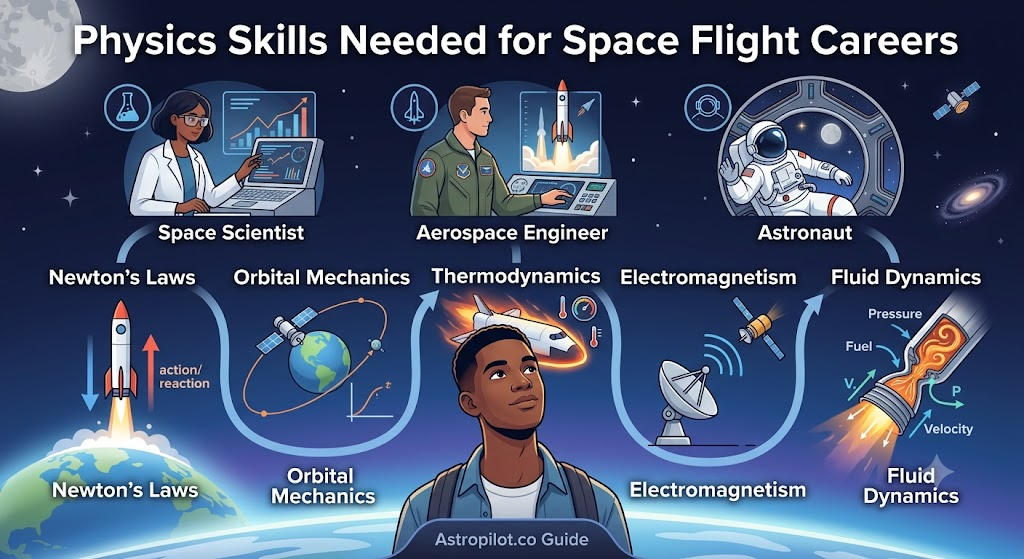
Core Physics Skills Needed for Space Flight Careers
To succeed in space-related careers, students must master several key areas of physics.
1. Newton’s Laws of Motion
Understanding motion is fundamental for space travel. Newton’s laws explain how objects move under forces, which is critical for rocket launches, satellite motion, and spacecraft control.
2. Gravity and Orbital Mechanics
Gravity determines how planets, moons, and spacecraft interact. Orbital mechanics helps calculate trajectories, escape velocities, and stable orbits.
p=mv
m1
kg
m2
kg
v
m/sm1m2
Momentum conservation is crucial in space where external resistance is minimal, allowing engineers to predict motion changes accurately.
3. Thermodynamics in Space Environments
Space has extreme temperature variations. Thermodynamics helps engineers design insulation systems, heat shields, and cooling systems for spacecraft and astronauts.
4. Electromagnetism and Communication Systems
Spacecraft communication depends on electromagnetic waves. Signals sent between Earth and spacecraft travel through radio waves, requiring strong knowledge of electromagnetism principles.
5. Fluid Dynamics in Rocket Propulsion
Even though space is vacuum, fluid dynamics is essential inside rocket engines. It helps design fuel combustion systems and optimize thrust efficiency.
6. Energy and Work Principles
Energy transformation is central to launching spacecraft. Chemical energy from fuel converts into kinetic energy, allowing rockets to overcome Earth’s gravity.
Evaluation Criteria for Aspiring Space Science Students
Students preparing for space careers should evaluate their readiness based on the following criteria:
Conceptual Understanding
Strong foundational clarity is more important than memorization. Students must understand why physical laws work, not just formulas.
Mathematical Skills
Space physics involves advanced mathematics, including algebra, calculus, and vector analysis. Strong math skills are essential.
Problem-Solving Ability
Real-world space missions require analytical thinking to solve unpredictable challenges like trajectory corrections or system failures.
Application-Based Learning
Students should be able to apply physics concepts to real-world scenarios such as satellite motion or rocket design.
Simulation Readiness
Modern aerospace training uses simulation software. Students must be comfortable with physics-based digital modeling tools.
Best For / Not Ideal For
Best For
This field is ideal for:
- Students interested in space exploration and astronomy
- Aspiring aerospace engineers and astronauts
- Learners passionate about mathematics and scientific problem-solving
- Individuals who enjoy analytical and technical thinking
Not Ideal For
This path may not be suitable for:
- Students who prefer non-mathematical or non-technical subjects
- Learners avoiding physics-heavy coursework
- Individuals not interested in abstract problem-solving or scientific modeling
Key Physics Skills Breakdown
Mechanics and Motion
Mechanics explains how objects move under force. It is essential for rocket launches, satellite movement, and spacecraft docking.
Astrodynamics
Astrodynamics focuses on how spacecraft move in space. It involves calculating orbits, transfers, and gravitational influences from celestial bodies.
Energy Systems in Rockets
Rocket propulsion depends on converting fuel energy into motion energy. Understanding energy efficiency is critical for mission planning.
Heat Transfer in Space
Spacecraft must survive extreme heat during launch and re-entry. Heat transfer principles help design thermal shields and cooling systems.
Communication Physics
Space communication relies on electromagnetic wave transmission. Signal strength, frequency, and interference must be carefully managed.
Career Connection: Where Physics Leads in Space Industry
A strong foundation in physics opens doors to multiple space-related careers:
Astronauts
Astronauts must understand motion, gravity, and pressure systems to operate safely in space environments.
Aerospace Engineers
They design rockets, spacecraft, satellites, and propulsion systems using physics principles.
Mission Planners
They calculate trajectories, fuel requirements, and orbital paths for successful missions.
Space Research Scientists
They study cosmic phenomena, planetary motion, and space environments using physics models.
Satellite Engineers
They ensure satellites remain in correct orbit and function properly for communication and data collection.
FAQs
1. Why is physics important for space careers?
Physics explains how objects move, interact, and behave in space. Without it, rocket launches, orbits, and space missions would not be possible.
2. Do I need advanced mathematics for space physics?
Yes, mathematics is essential. Topics like algebra, calculus, and vector analysis are widely used in space-related calculations.
3. Can I become an astronaut without strong physics knowledge?
No, astronauts must understand physics concepts like motion, gravity, and pressure systems to operate safely in space.
4. What is the hardest topic in space physics?
Many students find orbital mechanics and thermodynamics challenging because they involve complex real-world applications.
5. Is coding required for space science careers?
Yes, many space missions use simulations and programming for modeling spacecraft behavior and analyzing data.
6. How is physics used in rocket launches?
Physics explains thrust generation, fuel combustion, and motion dynamics that allow rockets to escape Earth’s gravity.
7. What is the role of gravity in space missions?
Gravity determines orbital paths, planetary motion, and spacecraft trajectories across space missions.
8. Can high school students start learning space physics?
Yes, students can begin early by learning basic mechanics, motion, and energy principles.
Conclusion
Physics is the backbone of all space flight careers. From launching rockets into orbit to ensuring astronauts survive in extreme conditions, every aspect of space exploration depends on a deep understanding of physical laws.
For students aspiring to enter this field, building strong foundations in mechanics, thermodynamics, electromagnetism, and orbital science is essential. These skills not only open doors to aerospace engineering and astronaut roles but also shape the future of human exploration beyond Earth.
At astropilot.co, the journey toward space begins with understanding the science that makes it possible. With dedication, curiosity, and strong physics skills, the dream of reaching space is no longer distant—it becomes achievable.