Introduction
Astro pilot careers combine aviation, spacecraft operations, engineering awareness, navigation, and advanced decision-making. Whether a future professional works as a spacecraft pilot, astronaut pilot, mission operator, flight controller, or commercial spaceflight specialist, mathematics forms an essential part of the job. Astro pilots may need to understand speed, distance, time, fuel consumption, orbital movement, spacecraft orientation, payload limits, and system performance. Modern spacecraft use powerful computers and automated controls, but trained professionals must still understand the calculations behind the information shown on their displays. Strong maths skills help them verify data, recognise errors, plan manoeuvres, and respond calmly during unexpected situations. Students do not need to become mathematical geniuses overnight, but they must gradually build accuracy, logical thinking, confidence, and the ability to apply mathematical ideas in practical spaceflight situations.
What Is an Astro Pilot?
An astro pilot is a general term used to describe a professional who may pilot, supervise, or support the operation of spacecraft. The exact job title can differ between space agencies, military organisations, research institutions, and commercial spaceflight companies.
An astro pilot may be responsible for:
- Operating or supervising spacecraft flight systems
- Monitoring automated navigation and control systems
- Supporting launch and atmospheric re-entry procedures
- Managing spacecraft orientation
- Assisting with orbital manoeuvres
- Performing rendezvous and docking procedures
- Responding to technical warnings
- Communicating with mission control
- Checking flight calculations
- Making decisions during emergency situations
Unlike ordinary aircraft, spacecraft operate in changing gravitational conditions, travel at extremely high speeds, and move through three-dimensional space. This makes mathematics especially important.
Many spacecraft are highly automated. However, automation does not remove the need for skilled human operators. Astro pilots must understand whether the computer-generated data is reasonable and know what action to take when systems behave unexpectedly.
Why Mathematics Matters in Space Aviation
Mathematics gives astro pilots a reliable way to measure, predict, compare, and control spacecraft behaviour. Space missions involve many variables that change continuously, including velocity, direction, altitude, fuel level, temperature, pressure, and distance from other objects.
Mathematics is used for:
- Navigation: Determining where the spacecraft is located
- Trajectory planning: Predicting the path the spacecraft will follow
- Fuel management: Estimating fuel use and remaining reserves
- Time calculations: Scheduling manoeuvres and mission activities
- Spacecraft control: Adjusting direction, speed, and orientation
- Payload planning: Checking mass and balance limitations
- Risk assessment: Evaluating the likelihood of system problems
- Data interpretation: Understanding sensor readings and graphs
- Docking operations: Measuring relative speed and distance
- Emergency response: Estimating safe alternatives when plans change
A small error in a basic calculation can become a major problem during a space mission. For this reason, astro pilots must work carefully, check their calculations, and understand the units being used.
Essential Mathematical Skills for Astro Pilots
| Mathematical Area | Spaceflight Application | Suggested Learning Level |
|---|---|---|
| Arithmetic | Fuel, time, distance, percentages, system readings | School foundation |
| Algebra | Solving formulas and calculating unknown values | Intermediate |
| Geometry | Angles, shapes, orientation, and docking alignment | Intermediate |
| Trigonometry | Navigation, direction, and trajectory calculations | Intermediate to advanced |
| Calculus | Velocity, acceleration, changing motion, and optimisation | Advanced |
| Vectors | Direction, speed, position, and force | Intermediate to advanced |
| Statistics | Risk, sensor analysis, trends, and uncertainty | Intermediate |
| Unit conversion | Mass, distance, time, temperature, and pressure | Essential at every level |
| Orbital mechanics | Orbits, gravity, launch windows, and re-entry | Advanced |
| Mathematical modelling | Simulations, predictions, and system testing | Advanced |
Arithmetic and Mental Mathematics
Arithmetic is the starting point for every advanced mathematical subject. Astro pilots must be comfortable with basic operations because they are used throughout mission planning and spacecraft operations.
Important arithmetic skills include:
- Addition
- Subtraction
- Multiplication
- Division
- Fractions
- Decimals
- Percentages
- Ratios
- Proportions
- Estimation
- Rounding
Practical Applications of Arithmetic
An astro pilot may use arithmetic to:
- Calculate remaining fuel
- Estimate battery duration
- Compare actual and expected system readings
- Determine how much mission time remains
- Calculate the percentage of oxygen or power available
- Divide supplies between mission stages
- Estimate the effect of a delay
For example, suppose a spacecraft has 800 kilograms of usable fuel and consumes 50 kilograms during a manoeuvre. The remaining fuel is:
800 − 50 = 750 kilograms
If the mission requires a minimum reserve of 200 kilograms, the pilot can quickly see that 550 kilograms remain available for planned operations.
Mental maths is especially useful when a pilot needs to make a fast estimate before completing a detailed calculation. Estimation can reveal whether a computer-generated answer appears realistic.
Fractions, Ratios, and Percentages
Fractions, ratios, and percentages are used to compare quantities. They are important in fuel management, payload planning, power distribution, and system monitoring.
Examples include:
- Fuel tank is 75% full
- Battery capacity has fallen by 20%
- Oxygen is shared in a particular ratio
- Payload mass represents one-third of the total available capacity
- A sensor reading is 5% higher than expected
Astro pilots must understand the difference between a percentage increase and a percentage decrease. They must also know how to convert fractions into decimals and percentages.
For example, if three out of four backup batteries are operational, the working proportion is:
3 ÷ 4 = 0.75 = 75%
This simple calculation helps operators understand how much backup capacity remains available.
Algebra
Algebra helps astro pilots calculate unknown values. It is used whenever one quantity depends on another.
Common algebraic skills include:
- Working with variables
- Solving equations
- Rearranging formulas
- Understanding powers and roots
- Using scientific notation
- Interpreting graphs
- Working with linear and nonlinear relationships
A basic relationship used in aviation and spaceflight is:
Distance = Speed × Time
If distance and speed are known, the formula can be rearranged to find time:
Time = Distance ÷ Speed
Suppose a spacecraft must travel 900 kilometres at an average relative speed of 300 kilometres per hour. The estimated travel time is:
900 ÷ 300 = 3 hours
Real spacecraft calculations are more complex because speed and direction may change. However, basic algebra provides the foundation for advanced trajectory equations.
Scientific Notation
Space-related values can be extremely large or extremely small. Scientific notation provides a compact way to write these numbers.
For example:
- 300,000,000 metres per second may be written as 3 × 10⁸ metres per second
- 0.000004 metres may be written as 4 × 10⁻⁶ metres
Scientific notation helps students:
- Read large astronomical distances
- Work with small measurement values
- Compare quantities
- Perform calculations efficiently
- Avoid writing long strings of zeros
Astro pilots and engineers must be careful with exponents. A mistake in the power of ten can create a result that is thousands or millions of times too large or too small.
Geometry
Geometry is the study of shapes, angles, dimensions, and spatial relationships. It is important because spacecraft operate in three-dimensional environments.
Astro pilots may use geometry to understand:
- Spacecraft shape and dimensions
- Angles of approach
- Direction of movement
- Docking alignment
- Antenna positioning
- Field of view
- Landing zones
- Distance between objects
- Spacecraft orientation
During docking, two spacecraft must be aligned correctly. The pilot must understand the angle between them, their distance apart, and whether their docking ports are facing the correct direction.
Geometry also helps astro pilots visualise movement around three axes:
- Pitch: Up-and-down rotation
- Yaw: Left-and-right rotation
- Roll: Rotation around the spacecraft’s forward axis
Strong spatial awareness is necessary because there is no permanent “up” or “down” in space.
Trigonometry
Trigonometry studies the relationships between angles and sides of triangles. It is widely used in aviation, navigation, engineering, and orbital calculations.
Important trigonometric concepts include:
- Sine
- Cosine
- Tangent
- Angles
- Radians
- Right-angled triangles
- Circular motion
- Periodic functions
Astro pilots may use trigonometry for:
- Calculating direction
- Estimating distance
- Determining altitude
- Planning approach paths
- Understanding orbital angles
- Aligning spacecraft
- Calculating components of velocity
- Adjusting communication antennas
Suppose a spacecraft is approaching another vehicle at an angle. The total velocity may need to be separated into forward and sideways components. Trigonometric functions help calculate each component accurately.
Students should first understand triangles and angles before moving to more advanced trigonometric applications.
Calculus
Calculus helps describe quantities that change continuously. Spacecraft speed, acceleration, fuel consumption, and gravitational forces may all change during flight.
The two major areas of calculus are:
- Differential calculus: Studies rates of change
- Integral calculus: Studies accumulated quantities
Calculus can be used to understand:
- How velocity changes over time
- How acceleration affects spacecraft motion
- How fuel is consumed throughout a manoeuvre
- How distance changes along a curved path
- How gravity affects a spacecraft
- How flight paths can be optimised
- How heat builds during atmospheric re-entry
A student does not need advanced calculus at the beginning of an astro pilot career path. However, a strong understanding of algebra, functions, graphs, and trigonometry makes calculus easier to learn later.
Graphs and Functions
Graphs provide a visual way to understand how one quantity changes in relation to another.
Astro pilots may examine graphs showing:
- Altitude over time
- Speed over time
- Fuel consumption
- Cabin pressure
- Temperature
- Battery charge
- Engine performance
- Distance from a target
- Communication signal strength
A rising line may indicate increasing temperature, while a rapidly falling line may show a loss of pressure or fuel. Pilots must recognise trends, not just individual readings.
Functions help explain mathematical relationships. For example, fuel consumption may depend on engine thrust, manoeuvre duration, and spacecraft mass.
Students should practise:
- Reading axes
- Identifying trends
- Understanding slope
- Comparing multiple graphs
- Recognising unusual patterns
- Estimating future values
Vectors
A vector has both magnitude and direction. This makes vectors extremely important in spaceflight.
Examples of vector quantities include:
- Velocity
- Acceleration
- Force
- Thrust
- Position change
- Momentum
A spacecraft may be travelling quickly, but speed alone does not describe its motion. The direction of travel must also be known.
For example, two spacecraft may each travel at the same speed but move in opposite directions. Their velocities are different because their directions are different.
Vectors help astro pilots understand:
- Current spacecraft movement
- Required course corrections
- Relative motion between spacecraft
- Direction of engine thrust
- Gravitational forces
- Docking speed
- Orientation changes
Vector addition is used when several forces or movements act on a spacecraft at the same time.
Coordinate Systems and Reference Frames
Coordinate systems allow astro pilots to describe the position of a spacecraft. Common systems use three axes, often represented as:
- X-axis
- Y-axis
- Z-axis
A spacecraft’s location may be described using three coordinates. Its movement may also be measured relative to Earth, another spacecraft, a space station, or a selected orbital reference point.
A reference frame is the viewpoint from which motion is measured. A spacecraft may appear stationary relative to a nearby vehicle while both spacecraft travel rapidly around Earth.
Understanding reference frames is essential for:
- Orbital navigation
- Rendezvous
- Docking
- Formation flying
- Re-entry planning
- Communication with mission control
Students should learn how coordinates change when the reference point changes.
Statistics and Probability
Statistics helps astro pilots analyse data, identify trends, and understand uncertainty. Probability helps estimate the likelihood of possible events.
These skills can support:
- Risk assessment
- Sensor analysis
- Weather interpretation
- Reliability evaluation
- System monitoring
- Performance comparison
- Mission planning
- Decision-making
A spacecraft may contain several sensors measuring the same temperature. If one sensor shows a very different value, the pilot must determine whether the reading indicates a real problem or a faulty sensor.
Statistics can help identify:
- Average values
- Unusual readings
- Variability
- Measurement error
- Patterns over time
- Differences between expected and actual performance
Probability is also used to evaluate risks. Mission planners may estimate the likelihood of equipment failure, poor weather, debris exposure, or communication interruption.
Orbital Mechanics Mathematics
Orbital mechanics explains how spacecraft move under the influence of gravity. It combines mathematics with physics.
Important orbital mechanics concepts include:
- Gravity
- Orbital speed
- Orbital altitude
- Escape velocity
- Orbital period
- Transfer orbits
- Launch windows
- Rendezvous
- Docking
- Re-entry trajectories
A spacecraft in orbit is continuously falling toward Earth, but it moves forward quickly enough to keep missing the surface. The balance between forward motion and gravity creates the orbit.
Astro pilots do not calculate every orbit manually during a mission. Computers and mission-control teams perform advanced calculations. However, pilots must understand the basic principles so they can interpret data and recognise unsafe conditions.
Why Orbital Movement Is Different from Aircraft Flight
Aircraft use wings to create lift while moving through the atmosphere. Spacecraft in orbit do not fly in the same way. They move according to gravity, momentum, and orbital velocity.
An unusual feature of orbital mechanics is that increasing speed can move a spacecraft into a higher orbit, while reducing speed can move it into a lower orbit. This may feel different from ordinary travel on Earth, which is why strong conceptual understanding is important.
Navigation and Trajectory Calculations
Navigation mathematics helps mission teams determine the spacecraft’s location, direction, speed, and future path.
Astro pilots may need to understand calculations involving:
- Current position
- Direction of travel
- Distance to a target
- Relative velocity
- Manoeuvre timing
- Course correction
- Arrival time
- Safe approach paths
- Re-entry location
- Landing trajectory
Trajectory calculations predict how the spacecraft will move after an engine burn or control input.
A small course correction performed early may prevent a much larger correction later. Accurate timing is therefore essential.
Although navigation computers perform continuous calculations, pilots must check whether the planned path is safe and consistent with mission requirements.
Fuel, Mass, and Payload Calculations
Spacecraft performance depends heavily on mass. A heavier spacecraft may require more fuel to accelerate, change direction, or reach orbit.
Astro pilots and mission teams must consider:
- Empty spacecraft mass
- Crew mass
- Payload mass
- Fuel mass
- Total launch mass
- Centre of mass
- Weight distribution
- Thrust
- Fuel reserves
Fuel Planning
Fuel calculations may include:
- Fuel required for launch
- Fuel needed for orbital manoeuvres
- Docking reserves
- Emergency reserves
- Re-entry requirements
- Landing or recovery requirements
Fuel is not simply used for moving forward. It may also be used to rotate the spacecraft, change orbit, slow down, or avoid an object.
Centre of Mass
The centre of mass affects stability and control. If equipment or payload is distributed incorrectly, the spacecraft may respond differently during manoeuvres.
Accurate mass and balance calculations help ensure predictable spacecraft behaviour.
Time, Speed, and Distance Calculations
Time, speed, and distance are fundamental mathematical relationships.
The basic formulas are:
- Distance = Speed × Time
- Speed = Distance ÷ Time
- Time = Distance ÷ Speed
Suppose a spacecraft travels 1,200 kilometres in two hours. Its average speed is:
1,200 ÷ 2 = 600 kilometres per hour
In real spaceflight, velocity may change continuously. However, these basic formulas remain important for understanding more advanced calculations.
Astro pilots may use time calculations for:
- Mission elapsed time
- Countdown procedures
- Manoeuvre timing
- Communication schedules
- Docking windows
- Crew activities
- Re-entry sequences
- Emergency planning
Communication Delays
Radio signals travel extremely fast, but communication delays become important over long distances.
Astro pilots must understand that:
- Instructions may not arrive instantly
- Mission control may receive data after a delay
- Emergency decisions may need to be made independently
- Message timing must be planned carefully
- Commands may reach a spacecraft later than expected
Calculating communication delay requires knowledge of distance, signal speed, and travel time.
This is particularly important for missions beyond Earth orbit, where real-time conversation may not be possible.
Unit Conversion and Scientific Measurement
Spaceflight involves many measurement units. Astro pilots must convert units accurately and ensure that all systems use consistent values.
Important conversions may involve:
- Metres and kilometres
- Kilograms and tonnes
- Seconds, minutes, and hours
- Degrees and radians
- Celsius and Kelvin
- Pressure units
- Speed units
- Volume units
- Energy units
For example:
2.5 kilometres = 2,500 metres
A simple conversion error can produce a major navigation or engineering problem. Therefore, operators should always write units beside values and check that the units match before completing a calculation.
Mathematical Modelling and Computer Simulation
A mathematical model is a simplified representation of a real system. Space organisations use models to predict spacecraft behaviour before a mission begins.
Mathematical models may simulate:
- Launch performance
- Orbital motion
- Fuel consumption
- Engine behaviour
- Docking
- Re-entry heating
- Communication coverage
- Equipment failure
- Emergency procedures
Astro pilots train in simulators that recreate realistic spacecraft conditions. These simulations allow them to practise normal operations and emergencies without risking an actual spacecraft.
However, pilots should not simply memorise simulator steps. They must understand why the spacecraft responds in a certain way. Mathematical knowledge makes simulation training more meaningful.
Programming and Computational Mathematics
Modern spaceflight depends on software, automation, data processing, and computer modelling. Basic programming knowledge can therefore be valuable for aspiring astro pilots.
Programming can help students:
- Automate calculations
- Analyse mission data
- Create graphs
- Build simple simulations
- Understand spacecraft software
- Test mathematical models
- Solve repeated problems efficiently
Useful beginner topics include:
- Variables
- Conditions
- Loops
- Functions
- Data tables
- Graph creation
- Basic numerical calculations
Astro pilots may not work as full-time software developers, but understanding how computers process instructions can help them interact more effectively with automated systems.
Maths Skills Needed for Emergency Decision-Making
Emergency situations may require fast and accurate reasoning. An astro pilot may not have time to complete every calculation in full detail.
Mathematical thinking can help when:
- Fuel consumption is higher than expected
- A sensor shows conflicting information
- A manoeuvre does not produce the planned result
- The spacecraft moves away from its expected path
- Communication with mission control is delayed
- A docking approach becomes unstable
- Power reserves begin falling
- A backup system must be activated
During an emergency, pilots may need to:
- Estimate the seriousness of the problem.
- Compare current data with normal values.
- Calculate available time or resources.
- Identify possible alternatives.
- Select the safest realistic option.
- Check whether the chosen action is producing the expected result.
The ability to estimate quickly is useful, but emergency decisions should still be verified whenever possible.
Recommended School Subjects
Students interested in astro pilot careers should build a strong STEM foundation.
Mathematics
Mathematics develops calculation, reasoning, accuracy, and problem-solving ability. Students should focus on arithmetic, algebra, geometry, trigonometry, graphs, vectors, statistics, and calculus.
Physics
Physics explains motion, forces, energy, gravity, electricity, pressure, and heat. It helps students understand how mathematical equations describe spacecraft behaviour.
Computer Science
Computer science develops programming, data analysis, automation, and logical thinking. These skills are increasingly important in modern aerospace systems.
Chemistry
Chemistry can help students understand fuels, materials, gases, life-support systems, combustion, and environmental control.
Engineering and Technical Subjects
Engineering subjects introduce design, mechanics, electronics, systems thinking, and practical problem-solving.
Statistics
Statistics helps students analyse experimental results, evaluate uncertainty, and make evidence-based decisions.
How Students Can Improve Their Maths Skills
Mathematical confidence grows through regular practice rather than memorisation alone.
Students can improve by:
- Strengthening basic arithmetic
- Practising mental calculations
- Reviewing fractions, decimals, and percentages
- Solving algebra problems regularly
- Learning how to rearrange formulas
- Studying geometry and three-dimensional shapes
- Practising trigonometry
- Learning to read graphs
- Understanding vectors
- Working with scientific notation
- Practising unit conversions
- Learning basic programming
- Using flight and space simulations
- Joining mathematics, astronomy, or robotics clubs
- Completing small engineering projects
- Reviewing mistakes carefully
- Explaining solutions to other students
Students should connect mathematical ideas to practical situations. A formula becomes easier to understand when learners know how it may be used in navigation, fuel planning, or spacecraft control.
Common Maths Challenges for Aspiring Astro Pilots
Fear of Complex Formulas
Long formulas may look difficult, but most are built from simpler ideas. Students should identify each variable, understand its meaning, and work through one step at a time.
Weak Basic Arithmetic
Advanced mathematics becomes difficult when basic arithmetic is weak. Regular practice with fractions, decimals, percentages, and negative numbers can improve the foundation.
Difficulty Visualising Three-Dimensional Movement
Students can use models, diagrams, simulation software, and physical objects to understand pitch, yaw, roll, vectors, and orbital paths.
Confusing Measurement Units
Learners should write the unit beside every number. They should also create a conversion chart for common units and practise converting values regularly.
Relying Too Heavily on Calculators
Calculators are useful, but students should estimate the answer before entering numbers. This makes it easier to detect typing errors or unrealistic results.
Memorising Without Understanding
Memorising a formula is not enough. Students should understand what each part represents, when the formula applies, and why the result makes sense.
Difficulty with Word Problems
Word problems become easier when students:
- Identify what is known.
- Identify what must be calculated.
- Select the correct formula.
- Check the units.
- Estimate the expected result.
- Complete the calculation.
- Review whether the answer is reasonable.
Do Astro Pilots Need to Be Maths Geniuses?
Astro pilots do not necessarily need to be maths geniuses. They need to be disciplined, accurate, logical, and willing to practise.
Important qualities include:
- Attention to detail
- Strong basic knowledge
- Consistent practice
- Logical reasoning
- Calm problem-solving
- Ability to verify results
- Willingness to learn from mistakes
- Confidence using formulas
- Ability to interpret data
- Good teamwork and communication
Mathematical ability can improve significantly through structured study. Many students struggle because they try to move too quickly into advanced topics without mastering the basics.
A student who practises regularly and understands the concepts may be better prepared than someone who memorises formulas without knowing how to apply them.
Step-by-Step Maths Learning Roadmap
1. Build Strong Arithmetic Skills
Begin with addition, subtraction, multiplication, division, fractions, decimals, percentages, ratios, and estimation.
2. Learn Unit Conversions
Practise converting distance, mass, time, temperature, speed, and pressure units.
3. Study Algebra
Learn variables, equations, formula rearrangement, powers, roots, and scientific notation.
4. Understand Geometry
Study angles, triangles, circles, coordinates, dimensions, and three-dimensional shapes.
5. Learn Trigonometry
Understand sine, cosine, tangent, degrees, radians, and triangle calculations.
6. Study Graphs and Functions
Learn how to read, create, and interpret graphs showing changing quantities.
7. Learn Vectors and Coordinates
Practise calculating direction, magnitude, position, velocity, and force.
8. Begin Calculus
Study limits, rates of change, derivatives, and basic integration after building a strong algebra foundation.
9. Learn Statistics and Probability
Understand averages, variation, uncertainty, trends, and risk.
10. Apply Maths to Physics
Use mathematics to solve problems involving motion, forces, gravity, energy, pressure, and electricity.
11. Explore Orbital Mechanics
Study the basic principles of orbits, velocity changes, launch windows, rendezvous, docking, and re-entry.
12. Use Programming and Simulation
Apply mathematical skills through coding, data analysis, flight simulation, robotics, and space-related projects.
Practical Study Routine for Future Astro Pilots
A simple weekly routine can help students improve steadily.
- Day 1: Arithmetic and mental maths
- Day 2: Algebra and formula rearrangement
- Day 3: Geometry and trigonometry
- Day 4: Physics-based maths problems
- Day 5: Graphs, vectors, or statistics
- Day 6: Programming or simulation practice
- Day 7: Review mistakes and revise difficult concepts
Students do not need to study every topic for several hours. Consistent practice of 30 to 60 minutes can be more effective than irregular long sessions.
Frequently Asked Questions
1- How much maths is required to become an astro pilot?
Astro pilots need a strong foundation in arithmetic, algebra, geometry, trigonometry, vectors, statistics, and applied physics. Advanced education may also require calculus, differential equations, and orbital mechanics. The exact level depends on the career path, training organisation, and spacecraft role. Students should focus first on understanding basic concepts before moving into advanced aerospace mathematics.
2- Is calculus compulsory for space aviation careers?
Calculus is commonly used in aerospace engineering, physics, orbital mechanics, and advanced flight training. Some operational roles may not require pilots to perform complex calculus manually, but understanding rates of change, acceleration, and continuous motion is highly valuable. Students planning to study engineering, physics, or aerospace subjects should expect to learn calculus.
3- Can a student with weak maths become an astro pilot?
A student with weak maths can improve through structured practice, tutoring, revision, and practical application. Weakness in one stage of education does not automatically prevent a future space career. However, the student must be willing to rebuild basic skills and practise consistently. Progress depends more on discipline and understanding than on natural speed.
4- Which branch of mathematics is most important for spacecraft pilots?
No single branch is enough on its own. Algebra supports formulas, trigonometry supports direction and angles, vectors describe movement, calculus explains changing motion, and statistics supports data interpretation. Arithmetic and unit conversion remain essential throughout all advanced topics. A balanced mathematical foundation is therefore the best preparation.
5- How is trigonometry used in spaceflight?
Trigonometry helps calculate angles, directions, distances, velocity components, and spacecraft orientation. It is used in navigation, antenna positioning, trajectory analysis, docking, and re-entry planning. Astro pilots may not solve every trigonometric problem manually, but they must understand what the displayed angles and directional values mean.
6- Why are vectors important in spacecraft navigation?
Vectors describe both the size and direction of movement or force. In spaceflight, speed alone is not enough because direction is equally important. Vectors help represent velocity, acceleration, thrust, gravity, and relative motion. They are especially useful during course corrections, rendezvous, and docking procedures.
7- Do spacecraft computers perform all the calculations?
Spacecraft computers perform a large number of calculations rapidly, but human operators must verify the results and understand their meaning. Computers can receive incorrect data, experience software problems, or produce outputs based on faulty assumptions. Astro pilots need enough mathematical knowledge to recognise unreasonable readings and make safe decisions.
8- Should aspiring astro pilots learn programming?
Basic programming is highly useful because modern spacecraft rely on software, automation, simulation, and data analysis. Programming helps students understand logical processes and create simple mathematical models. It can also improve problem-solving ability. Aspiring astro pilots do not always need to become expert developers, but computational skills provide a strong advantage.
9- What school subjects should students choose?
Students should prioritise mathematics, physics, computer science, chemistry, and engineering-related subjects where available. Statistics and technical drawing can also be useful. The best subject combination depends on the education system and future university programme. Students should confirm the entry requirements of the courses they plan to pursue.
10- How can students practise space-related mathematics?
Students can solve physics problems, use spaceflight simulations, study orbital diagrams, analyse mission data, create graphs, build robotics projects, and learn basic programming. They can also practise calculating speed, distance, time, fuel, angles, and unit conversions. Practical projects make mathematical concepts easier to understand and remember.
11- Is physics more important than mathematics?
Physics and mathematics work together. Physics explains how objects move and interact, while mathematics provides the language used to calculate and predict that behaviour. Astro pilots need both subjects. Strong mathematical skills make advanced physics easier to understand, while physics gives mathematical formulas practical meaning.
12- Are mental calculations important in automated spacecraft?
Mental calculations remain useful because they allow pilots to make quick estimates and detect unrealistic computer outputs. Astro pilots may not perform long calculations mentally, but they should be able to estimate fuel, time, percentages, and differences between readings. Estimation is an important safety skill in automated environments.
13- How long does it take to develop strong maths skills?
The time required depends on the learner’s starting level, study routine, and educational background. Strong foundations are normally built gradually over several school and college stages. Consistent weekly practice is more effective than last-minute study. Students should focus on steady improvement rather than comparing their speed with others.
14- Can calculators be used during astro pilot training?
Calculators, computers, and specialised software are commonly used for advanced calculations. However, students must still understand the mathematical process and estimate whether the answer is reasonable. Technology should support understanding rather than replace it. Training programmes may also require some calculations to be completed without electronic assistance.
Conclusion
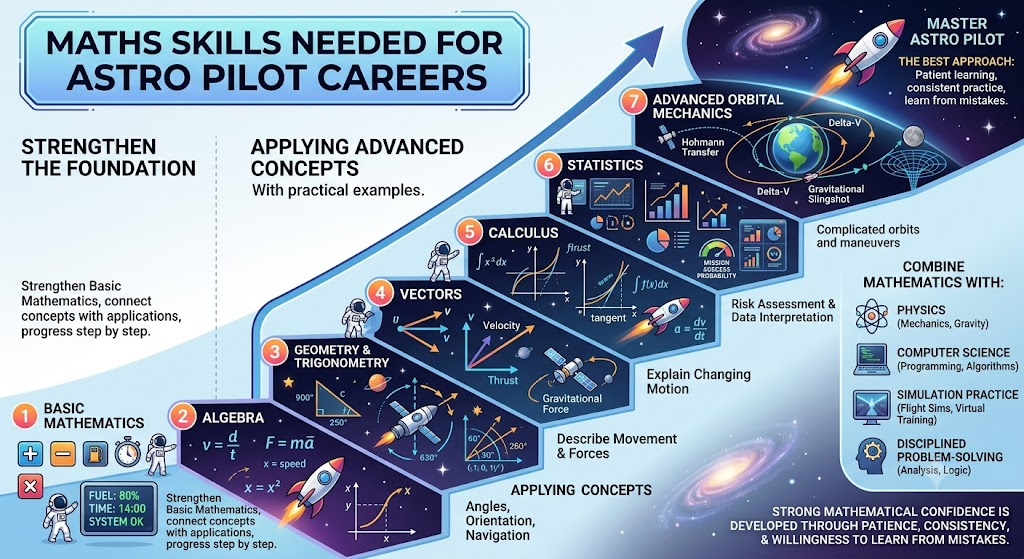
The maths skills needed for astro pilot careers extend from basic arithmetic to advanced orbital mechanics. Arithmetic helps with fuel, time, and system readings, while algebra supports formulas and unknown values. Geometry and trigonometry help astro pilots understand angles, orientation, and navigation. Vectors describe movement and forces, calculus explains changing motion, and statistics supports risk assessment and data interpretation. Students do not need to master every advanced topic immediately. The best approach is to strengthen basic mathematics, connect each concept with practical spaceflight applications, and progress step by step. Aspiring astro pilots should combine mathematics with physics, computer science, simulation practice, and disciplined problem-solving. Strong mathematical confidence is developed through patience, consistency, and a willingness to learn from mistakes.