Introduction
Space aviation is one of the most exciting career paths for students who dream about aircraft, spacecraft, rockets, satellites, space tourism, and future missions beyond Earth. Unlike traditional aviation, space aviation combines flying skills, engineering knowledge, physics, computer science, robotics, and advanced technology. Students who want to build a career in this field must choose the right subjects early and develop a strong academic foundation.
A space aviation career may lead to roles in aerospace engineering, astronaut training, spacecraft operations, mission control, commercial spaceflight, satellite systems, space tourism, planetary exploration, or advanced aircraft design. The right subjects can help students understand how vehicles fly, how spacecraft move in orbit, how pilots make decisions, and how technology supports safe space missions.
Why Subject Selection Matters in Space Aviation
Choosing the right subjects is important because space aviation is highly technical. Students need to understand science, mathematics, engineering, computers, and human performance. Every spacecraft mission depends on accurate calculations, reliable systems, strong communication, and quick decision-making.
The subjects studied in school and college create the foundation for future degrees, flight training, research work, and aerospace careers. A student who builds strong knowledge early will find it easier to understand advanced topics such as orbital mechanics, rocket propulsion, spacecraft design, and autonomous navigation.
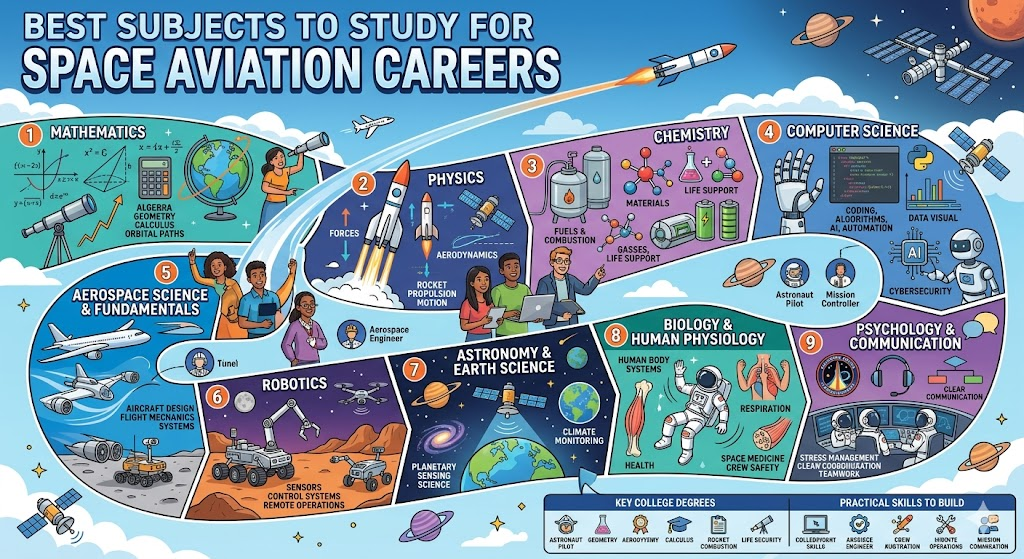
Best Subjects to Study for Space Aviation Careers
1- Mathematics
Mathematics is one of the most important subjects for space aviation. It is used in flight planning, navigation, engineering design, fuel calculations, orbital paths, speed, distance, and spacecraft control.
Students should focus on:
- Algebra
- Geometry
- Trigonometry
- Calculus
- Statistics
- Differential equations
- Coordinate systems
Mathematics helps students understand how aircraft and spacecraft move. It also supports engineering, physics, programming, and data analysis. Anyone interested in becoming an aerospace engineer, astronaut pilot, flight dynamics specialist, or mission planner must build strong math skills.
2- Physics
Physics explains how things move, fly, accelerate, rotate, and respond to forces. It is the core science behind aviation and space travel. Students who understand physics can better understand aircraft lift, rocket thrust, gravity, pressure, heat, motion, and energy.
Important physics topics include:
- Motion and forces
- Gravity
- Energy
- Momentum
- Aerodynamics
- Thermodynamics
- Electricity and magnetism
- Waves and communication
- Fluid mechanics
Physics is essential for understanding both aircraft and spacecraft. It helps students learn why rockets launch vertically, how satellites stay in orbit, and how spacecraft return safely to Earth.
3- Chemistry
Chemistry may not seem as obvious as math or physics, but it is very important in aerospace and space aviation. Rocket fuels, materials, batteries, life support systems, oxygen systems, and environmental control all involve chemistry.
Students should learn about:
- Fuels and combustion
- Materials and alloys
- Gases and pressure
- Chemical reactions
- Batteries and energy storage
- Environmental systems
- Oxygen and life support
Chemistry is useful for students interested in rocket propulsion, spacecraft materials, fuel systems, space habitats, and astronaut safety.
4- Computer Science
Modern aviation and spaceflight depend heavily on computers. Spacecraft use software for navigation, communication, automation, monitoring, and control. Future space aviation professionals must understand how digital systems work.
Important computer science topics include:
- Programming
- Algorithms
- Data structures
- Artificial intelligence
- Machine learning
- Simulation
- Cybersecurity
- Automation
- Robotics software
Students can start with programming languages like Python, C++, or MATLAB. Computer science is especially useful for careers in spacecraft software, mission simulation, autonomous systems, AI navigation, and space robotics.
5- Engineering Fundamentals
Engineering teaches students how to design, build, test, and improve machines and systems. Space aviation requires strong engineering knowledge because spacecraft, aircraft, engines, control systems, and life support systems must work safely and reliably.
Useful engineering areas include:
- Aerospace engineering
- Mechanical engineering
- Electrical engineering
- Computer engineering
- Systems engineering
- Control engineering
- Materials engineering
Students who enjoy problem-solving, designing models, building systems, and testing ideas should focus strongly on engineering subjects.
6- Aerospace Science
Aerospace science directly connects aviation and space technology. It introduces students to aircraft, rockets, satellites, spacecraft, propulsion, aerodynamics, and mission design.
Key aerospace topics include:
- Aircraft design
- Rocket systems
- Spacecraft structures
- Aerodynamics
- Propulsion
- Flight mechanics
- Orbital mechanics
- Space mission planning
This subject is ideal for students who want to become aerospace engineers, astronaut pilots, spacecraft operators, or space mission specialists.
7- Astronomy and Space Science
Astronomy helps students understand planets, stars, galaxies, the Moon, Mars, and the wider universe. While astronomy is not the same as aviation, it gives students a strong understanding of the space environment.
Important topics include:
- Solar system
- Planets and moons
- Stars and galaxies
- Space environment
- Telescopes
- Space observation
- Planetary science
- Astrobiology basics
Astronomy is useful for students interested in space exploration, planetary missions, space research, and mission planning.
8- Robotics
Robotics is becoming increasingly important in space aviation. Space missions use robotic arms, rovers, drones, autonomous spacecraft, and remote-controlled systems. Future space pilots and engineers may work closely with robotic systems.
Students should learn about:
- Sensors
- Motors
- Control systems
- Automation
- Robot programming
- Machine vision
- Remote operation
- Autonomous movement
Robotics builds practical engineering and programming skills. It is especially useful for careers in space robotics, lunar rovers, Mars missions, satellite servicing, and autonomous spacecraft.
9- Biology and Human Physiology
Space aviation is not only about machines. Human beings must survive, work, and stay healthy in extreme environments. Biology and human physiology help students understand how the body reacts to high altitude, acceleration, microgravity, isolation, radiation, and pressure changes.
Important topics include:
- Human body systems
- Respiration
- Circulation
- Muscle and bone health
- Stress response
- Space medicine basics
- Nutrition
- Human performance
This subject is useful for astronaut training, aviation medicine, crew safety, human factors engineering, and long-duration space missions.
10- Geography and Earth Science
Earth science is useful because many space missions observe Earth, climate, oceans, weather, and natural resources. Geography also helps with navigation, mapping, satellite imaging, and environmental monitoring.
Important topics include:
- Weather systems
- Climate
- Earth observation
- Mapping
- Remote sensing
- Atmosphere
- Natural resources
- Environmental science
Students interested in satellite missions, climate monitoring, remote sensing, and planetary science can benefit from Earth science.
11- Communication Skills
Space aviation professionals must communicate clearly. Pilots, engineers, astronauts, mission controllers, and safety teams must exchange information quickly and accurately. A small misunderstanding can cause serious problems in aviation and spaceflight.
Students should develop:
- English communication
- Technical writing
- Presentation skills
- Team communication
- Report writing
- Listening skills
- Briefing and debriefing skills
Strong communication helps students succeed in interviews, group projects, flight training, research, and mission operations.
12- Psychology and Human Factors
Space aviation involves pressure, risk, teamwork, isolation, and fast decision-making. Psychology and human factors help students understand how people behave in high-stress environments.
Important areas include:
- Stress management
- Decision-making
- Crew coordination
- Fatigue management
- Situational awareness
- Mental resilience
- Leadership
- Team behavior
This subject is useful for future pilots, astronauts, mission commanders, safety specialists, and human factors engineers.
Best Subject Combination for School Students
Students interested in space aviation should choose a strong STEM combination. A good subject combination includes:
- Mathematics
- Physics
- Chemistry
- Computer Science
- English
- Optional astronomy, robotics, or engineering activities
This combination prepares students for aerospace engineering, aviation science, physics, computer engineering, and space technology degrees.
Best College Degrees for Space Aviation Careers
After school, students can choose a degree based on their career goal.
Good degree options include:
- Aerospace Engineering
- Aeronautical Engineering
- Astronautical Engineering
- Mechanical Engineering
- Electrical Engineering
- Computer Engineering
- Physics
- Aviation Science
- Robotics Engineering
- Space Systems Engineering
Aerospace Engineering is ideal for students who want to design aircraft, rockets, and spacecraft. Aviation Science is useful for flight operations and pilot-related careers. Computer Engineering is excellent for spacecraft software, AI systems, and autonomous navigation.
Skills Students Should Build Alongside Subjects
Subjects are important, but students should also build practical skills.
Useful skills include:
- Coding
- Flight simulation
- Drone flying
- Model rocket building
- Robotics projects
- Public speaking
- Teamwork
- Research writing
- Data analysis
- Problem-solving
- Physical fitness
These activities make learning more practical and prepare students for real aerospace challenges.
Career Options in Space Aviation
Students who study the right subjects can explore many career paths, such as:
- Aerospace Engineer
- Astronaut Pilot
- Spacecraft Systems Engineer
- Mission Control Specialist
- Flight Dynamics Engineer
- Space Robotics Engineer
- Satellite Systems Engineer
- Commercial Spaceflight Crew Trainer
- Space Mission Planner
- Aviation Safety Specialist
- Rocket Propulsion Engineer
- Space Tourism Operations Specialist
Space aviation is not limited to becoming an astronaut. Many careers support space missions from the ground, in labs, in control centers, and through engineering teams.
Common Mistakes Students Should Avoid
Students should avoid choosing subjects only because they sound easy. Space aviation requires strong technical preparation. Avoid ignoring mathematics, physics, and computer science because these subjects form the base of most aerospace careers.
Common mistakes include:
- Ignoring math fundamentals
- Not learning coding
- Avoiding practical projects
- Focusing only on theory
- Not improving communication skills
- Waiting too long to explore career options
- Not participating in STEM activities
- Ignoring physical fitness and discipline
A balanced approach is best: strong academics, practical learning, communication, and curiosity.
Tips for Students Starting Today
Students can begin preparing even before college.
Helpful steps include:
- Study math and physics seriously
- Learn basic programming
- Read about space missions
- Watch educational aerospace content
- Join science and robotics clubs
- Use flight simulator tools
- Build small engineering projects
- Follow space agencies and aerospace companies
- Practice English communication
- Stay physically active
- Ask teachers and mentors for guidance
Small steps taken early can create a strong foundation for future space aviation careers.
Frequently Asked Questions
1- Which subject is most important for space aviation?
Mathematics and physics are the most important subjects because they explain motion, forces, navigation, speed, gravity, and flight. These subjects are used in aerospace engineering, spacecraft design, mission planning, and flight operations.
2- Is computer science useful for space aviation careers?
Yes, computer science is very useful. Modern aircraft and spacecraft depend on software, automation, artificial intelligence, simulations, and control systems. Students who know programming can explore careers in spacecraft software, robotics, and autonomous navigation.
3- Do I need chemistry for space aviation?
Chemistry is helpful, especially for rocket propulsion, fuel systems, batteries, materials, oxygen systems, and life support. It may not be the main subject for every role, but it supports many important space technology areas.
4- Is biology important for becoming an Astro Pilot?
Biology is useful for understanding human health, space medicine, physical performance, and the effects of microgravity. Future Astro Pilots and crew members must understand how the body responds to unusual flight and space environments.
5- What should I study in school to become an aerospace engineer?
Students should focus on mathematics, physics, chemistry, and computer science. These subjects prepare students for engineering entrance exams, aerospace degrees, and technical careers in aircraft and spacecraft design.
6- Can I enter space aviation without becoming a pilot?
Yes, many space aviation careers do not require becoming a traditional pilot. Students can work as engineers, mission planners, software developers, robotics experts, satellite specialists, researchers, or mission control professionals.
7- Is astronomy required for space aviation?
Astronomy is not always required, but it is helpful. It builds understanding of planets, stars, space environments, and exploration missions. It is especially useful for students interested in planetary science and space research.
8- Which degree is best after school?
Aerospace Engineering is one of the best choices for space aviation. Other strong options include Mechanical Engineering, Computer Engineering, Physics, Aviation Science, Robotics Engineering, and Space Systems Engineering.
9- Should students learn coding for space careers?
Yes, coding is highly recommended. Programming helps students work with simulations, data analysis, robotics, spacecraft systems, AI tools, and automation. Python, C++, and MATLAB are useful starting points.
10- How can beginners start preparing for space aviation?
Beginners should focus on STEM subjects, learn coding, join robotics or science clubs, use flight simulators, read about aerospace topics, and build small projects. Consistent learning is more important than trying to master everything at once.
Conclusion
The best subjects for space aviation careers are mathematics, physics, computer science, engineering, chemistry, aerospace science, robotics, astronomy, biology, and communication. Together, these subjects create the foundation for future roles in aircraft systems, spacecraft operations, commercial spaceflight, mission control, satellite technology, and human space exploration. Students who want to become future Astro Pilots or space aviation professionals should start early, choose strong STEM subjects, build practical skills, and stay curious about the future of flight. Space aviation is a challenging field, but with the right education path and consistent effort, students can prepare for exciting opportunities beyond traditional aviation.