Introduction
Space aviation is no longer just a concept from science fiction. It is rapidly becoming a real and expanding industry driven by private space companies, government space agencies, and new technologies like reusable rockets and space tourism. Today, humans are preparing for missions to the Moon, Mars, and beyond, while satellites and orbital systems are already part of everyday life.
For students and young learners, this creates exciting career opportunities in space science, aerospace engineering, robotics, AI systems, and even astronaut training. Preparing early for a space aviation career helps build the right foundation in science, technology, and problem-solving skills.
This guide explains how to prepare for a future in space aviation in a simple and structured way.
What Is Space Aviation?
Space aviation refers to the field of designing, building, operating, and managing systems that travel beyond Earth’s atmosphere. It includes spacecraft, rockets, satellites, space stations, and human space missions.
Unlike traditional aviation, which focuses on aircraft flying within Earth’s atmosphere, space aviation deals with:
- Orbital flight
- Rocket propulsion systems
- Space exploration missions
- Satellite deployment
- Interplanetary travel research
It is a combination of aerospace engineering, physics, robotics, computer science, and advanced mathematics.
Why Space Aviation Is the Future
Space aviation is becoming one of the fastest-growing industries in the world. Several major developments are driving this growth:
- Expansion of private space companies
- Growth of space tourism services
- Satellite communication and internet systems
- Moon and Mars exploration missions
- Reusable rocket technology advancements
- Increasing demand for space-based research
As technology evolves, space is becoming more accessible, opening new career paths for students and professionals.
Career Opportunities in Space Aviation
Space aviation offers a wide range of exciting career options. These roles combine science, engineering, technology, and exploration.
Astronaut Careers
Astronauts are trained professionals who travel to space for missions, research, and exploration. This is one of the most competitive and prestigious roles in space aviation.
Aerospace Engineer
Aerospace engineers design spacecraft, rockets, satellites, and propulsion systems.
Spacecraft Designer
They work on designing the structure, systems, and performance of space vehicles.
Mission Control Specialist
These professionals monitor and control space missions from Earth.
Space Data Scientist
They analyze data from satellites, space missions, and telescopes.
Rocket Propulsion Engineer
They develop engines that power rockets into space.
Space Tourism Operator
They manage commercial space travel experiences for civilians.
Satellite Systems Engineer
They design and maintain communication and navigation satellites.
Space Robotics Engineer
They build robotic systems used in space exploration.
Space Mission Analyst
They plan and evaluate space mission performance and outcomes.
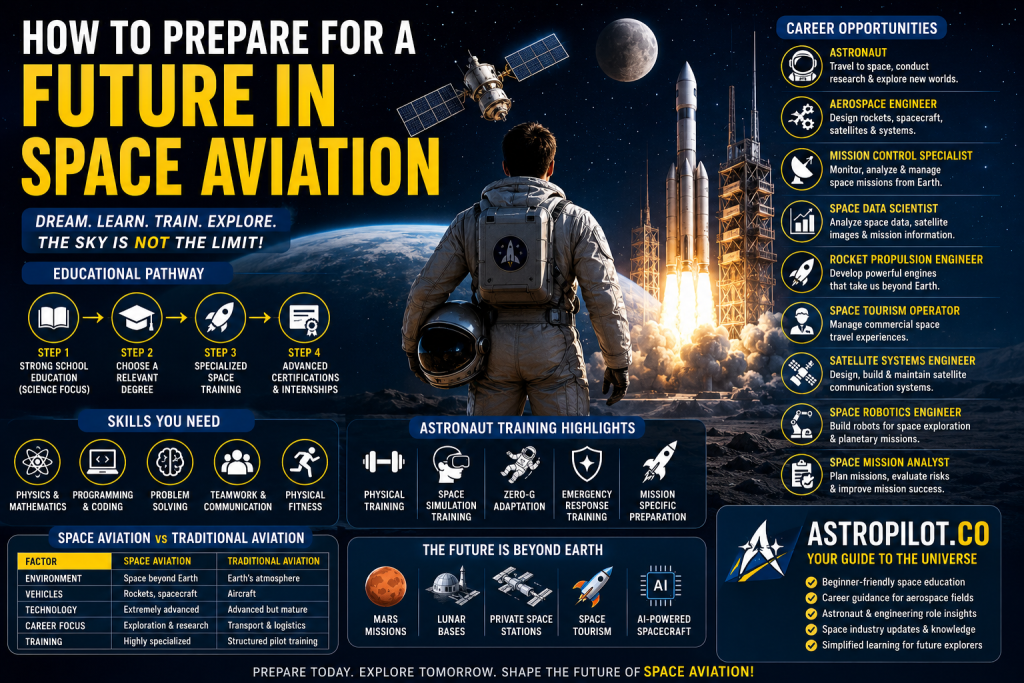
Educational Pathway for Space Aviation Careers
A structured education path is essential for entering the space industry.
Step 1: Strong School Education (Science Focus)
Students should focus on core science subjects:
- Physics
- Mathematics
- Computer Science
These subjects form the foundation of space-related careers.
Step 2: Choose a Relevant Degree
After school, students can pursue degrees such as:
- Aerospace Engineering
- Mechanical Engineering
- Computer Science
- Physics or Astrophysics
Step 3: Specialized Space Training
At this stage, learners begin focusing on space-specific topics like:
- Orbital mechanics
- Rocket systems
- Space environment studies
- Simulation-based learning
Step 4: Advanced Certifications
Additional certifications can improve career opportunities:
- Space technology programs
- AI and robotics training
- Data science and simulation tools
- Aerospace internships
Skills Required for Space Aviation
To succeed in space aviation, students must develop a mix of technical and personal skills.
- Strong mathematics and physics knowledge
- Problem-solving ability
- Programming and coding skills
- Analytical thinking
- Teamwork and communication
- Physical fitness (for astronaut candidates)
- Adaptability under pressure
These skills are essential for both engineering and astronaut roles.
How Astronaut Training Works
Becoming an astronaut requires rigorous and highly specialized training.
Physical Training
Astronauts must maintain excellent physical fitness to handle space conditions.
Space Simulation Training
Simulated environments replicate zero-gravity and spacecraft conditions.
Zero-Gravity Adaptation
Training helps astronauts adapt to weightlessness in space.
Emergency Response Training
Astronauts learn how to respond to critical mission failures.
Mission-Specific Preparation
Each mission requires detailed preparation based on objectives and spacecraft systems.
Space Aviation vs Traditional Aviation
| Factor | Space Aviation | Traditional Aviation |
|---|---|---|
| Environment | Space beyond Earth | Earth’s atmosphere |
| Vehicles | Rockets, spacecraft | Aircraft |
| Technology | Extremely advanced | Advanced but mature |
| Career Focus | Exploration & research | Transport & logistics |
| Training | Highly specialized | Structured pilot training |
Space aviation is significantly more complex and research-driven than traditional aviation.
Challenges in Space Aviation Careers
Space aviation careers are highly rewarding but come with challenges:
- Extremely high competition
- Long educational and training period
- Advanced technical requirements
- Physical and mental stress
- Limited entry-level opportunities
- Continuous learning requirement
Students must be prepared for long-term dedication.
Future of Space Aviation
The future of space aviation is extremely promising.
Key developments include:
- Space tourism for civilians
- Permanent lunar bases
- Mars exploration missions
- Private space stations
- AI-powered spacecraft systems
- Reusable rocket advancements
- Interplanetary travel research
These advancements will create thousands of new career opportunities.
Why Students Should Start Preparing Early
Early preparation gives students a strong advantage in space careers.
Benefits include:
- Strong foundation in STEM subjects
- Better understanding of advanced concepts
- More time to build technical skills
- Early exposure to space technologies
- Competitive advantage in admissions and careers
Starting early helps students stay ahead in this highly competitive field.
How Astropilot.co Helps Students
Astropilot.co is designed to guide learners interested in space aviation by providing:
- Beginner-friendly space science education
- Career pathway guidance for aerospace fields
- Information on astronaut and engineering roles
- Updates on space industry developments
- Simplified explanations of complex space topics
It helps students turn curiosity about space into real career direction.
Frequently Asked Questions
1- What is space aviation?
Space aviation is the field of designing and operating spacecraft, rockets, and systems used for space exploration.
2- How can I become an astronaut?
You need strong education in science or engineering, physical fitness, and specialized astronaut training.
3- What subjects are needed for space careers?
Physics, mathematics, computer science, and engineering subjects are most important.
4- Is space aviation a good career?
Yes, it is a high-growth field with opportunities in engineering, research, and exploration.
5- What is the difference between aviation and space travel?
Aviation deals with flight inside Earth’s atmosphere, while space travel involves missions beyond it.
6- Do astronauts need engineering degrees?
Most astronauts have backgrounds in engineering, physics, medicine, or science.
7- What is space tourism?
It is commercial travel where civilians can experience short trips to space.
8- What skills are required for space jobs?
Technical knowledge, problem-solving, coding, teamwork, and strong analytical skills.
9- How is astronaut training done?
Through physical training, simulations, emergency drills, and mission preparation.
10- What is the future of space aviation?
It includes Mars missions, space tourism, AI spacecraft, and advanced exploration systems.
Conclusion
Space aviation represents the next major leap in human exploration and technology. From spacecraft engineering to astronaut training, this field offers exciting opportunities for students who are passionate about science and innovation. Preparing early with strong STEM education, technical skills, and curiosity can open the door to a future in this extraordinary industry. As space exploration expands, the demand for skilled professionals will continue to grow, making this one of the most promising career paths of the future.