Introduction
Aerospace and space flight are among the most exciting fields in science and technology. They connect aviation, engineering, physics, exploration, communication, defense, research, and future human travel beyond Earth. For beginners, aerospace may seem complex, but the basic ideas are easy to understand when explained step by step. Aerospace is about designing and operating vehicles that fly in the air and in space, while space flight focuses on sending spacecraft, satellites, astronauts, and scientific missions beyond Earth’s atmosphere. This guide is written for students, aviation enthusiasts, aspiring astronauts, and anyone who wants to understand the foundation of aerospace and space flight.
What Is Aerospace?
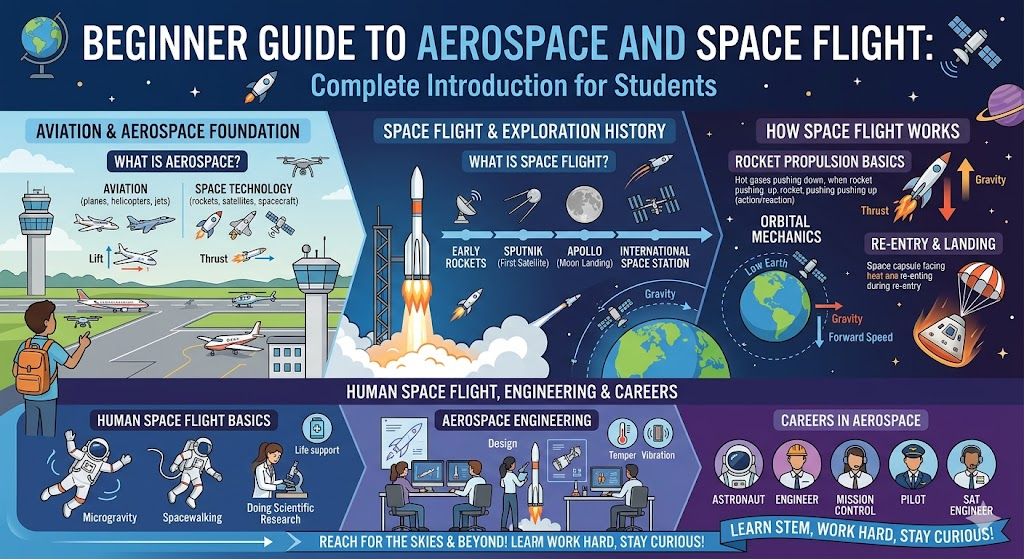
Aerospace is the field that deals with aircraft and spacecraft. It includes both aviation and space technology.
Aviation focuses on vehicles that fly within Earth’s atmosphere, such as airplanes, helicopters, drones, and jets. Space technology focuses on rockets, satellites, spacecraft, space stations, probes, and space exploration systems.
Aerospace is important because it supports:
- Air travel
- Satellite communication
- Weather forecasting
- Space exploration
- National defense
- Scientific research
- GPS and navigation
- Earth observation
- Commercial spaceflight
In simple words, aerospace helps humans fly higher, travel farther, explore space, and understand the universe better.
What Is Space Flight?
Space flight means traveling beyond Earth’s atmosphere using rockets and spacecraft. It can involve humans, satellites, scientific instruments, or robotic missions.
There are different types of space flight:
- Human spaceflight where astronauts travel to space
- Robotic missions where machines explore planets, moons, or asteroids
- Satellite missions for communication, navigation, and weather
- Scientific missions to study space and Earth
- Commercial spaceflight for private missions and space tourism
Space flight requires powerful rockets, accurate planning, advanced engineering, strong safety systems, and trained mission teams.
Brief History of Space Exploration
Space exploration began with early rocket experiments and scientific curiosity. Over time, rockets became powerful enough to leave Earth’s atmosphere and carry satellites into orbit.
The launch of the first artificial satellites proved that humans could send machines into space. Later, human space missions showed that astronauts could survive and work beyond Earth. Moon missions became a major milestone in space history and inspired generations of scientists, engineers, and explorers.
International cooperation later became important through space stations and joint missions. Today, government space agencies and private companies are working together on reusable rockets, commercial missions, lunar exploration, Mars research, satellite networks, and space tourism.
How Space Flight Works
Rocket Propulsion Basics
Rockets move by pushing hot gases downward at very high speed. This creates an opposite force that pushes the rocket upward. This principle is based on action and reaction.
Unlike airplanes, rockets do not need air to create thrust. They carry both fuel and oxidizer, which allows them to operate in space where there is no breathable air.
Launch Procedures
A space launch begins with mission planning, rocket assembly, fuel loading, system checks, weather monitoring, and final countdown. During launch, the rocket engines ignite and generate enough thrust to lift the vehicle from the launch pad.
Launch is one of the most intense phases of space flight because the rocket must overcome Earth’s gravity and pass through the atmosphere safely.
Escaping Earth’s Gravity
Earth’s gravity pulls everything toward the planet. To reach space, a rocket must travel fast enough and high enough to overcome this pull.
Most rockets do not simply go straight up forever. They gradually turn and build horizontal speed to enter orbit. Reaching orbit is more about speed than height.
Orbital Mechanics Fundamentals
Orbital mechanics is the science of how objects move in space. An object in orbit is constantly falling toward Earth, but it is moving forward so fast that it keeps missing the ground.
This balance between gravity and forward motion allows satellites, space stations, and spacecraft to stay in orbit.
Spacecraft Navigation
Spacecraft navigation means knowing where the spacecraft is, where it is going, and how to adjust its path. Mission teams use tracking systems, computers, sensors, and communication networks to guide spacecraft.
Accurate navigation is important for reaching orbit, docking with space stations, landing on planets, or traveling to the Moon and beyond.
Re-entry Procedures
Re-entry happens when a spacecraft returns to Earth’s atmosphere. During re-entry, the spacecraft faces extreme heat because it moves very fast through the air.
Thermal protection systems help protect the spacecraft and crew from high temperatures. The spacecraft must enter at the correct angle to return safely.
Landing Operations
Landing depends on the type of spacecraft. Some capsules use parachutes and land in the ocean or on land. Some spacecraft use controlled descent systems. Future spacecraft may use advanced landing technologies for the Moon, Mars, and other destinations.
Types of Spacecraft
Satellites
Satellites orbit Earth or other planets. They are used for communication, navigation, weather forecasting, defense, television broadcasting, internet services, and Earth observation.
Space Capsules
Space capsules carry astronauts or cargo into space and back to Earth. They are designed for safety, re-entry, and crew protection.
Space Stations
Space stations are large spacecraft where astronauts live and work for long periods. They support scientific research, technology testing, and international cooperation.
Space Shuttles
Space shuttles were reusable spacecraft designed to carry astronauts and cargo into orbit. They helped build space stations and support orbital missions.
Deep Space Probes
Deep space probes travel far beyond Earth to study planets, moons, asteroids, comets, and deep space environments. They usually operate without humans onboard.
Lunar and Planetary Landers
Landers are spacecraft designed to land on the Moon, Mars, or other planetary bodies. They carry scientific instruments, cameras, and sometimes rovers.
Major Components of a Spacecraft
Propulsion Systems
Propulsion systems move the spacecraft. They may be used for launch, orbit changes, course corrections, or landing.
Guidance Systems
Guidance systems help the spacecraft follow the correct path. They support navigation, stability, and mission accuracy.
Navigation Systems
Navigation systems help determine the spacecraft’s position and movement. They are essential for orbit insertion, docking, landing, and deep space travel.
Communication Systems
Communication systems allow spacecraft to send and receive signals from Earth. They transmit data, images, commands, and crew communication.
Power Systems
Spacecraft need power to operate instruments, computers, communication systems, life support, and sensors. Many spacecraft use solar panels, while some deep space missions use other power sources.
Thermal Protection Systems
Spacecraft face extreme heat and cold. Thermal systems protect equipment and crew from temperature changes, especially during re-entry.
Life Support Systems
Life support systems are needed for human spaceflight. They provide oxygen, remove carbon dioxide, manage temperature, control humidity, and support crew survival.
Understanding Orbits for Beginners
Low Earth Orbit
Low Earth Orbit is close to Earth compared to other orbits. Many satellites and space stations operate here. It is commonly used for research, observation, and crewed missions.
Medium Earth Orbit
Medium Earth Orbit is higher than Low Earth Orbit. It is often used for navigation satellites and special communication systems.
Geostationary Orbit
A satellite in geostationary orbit appears to stay over the same point on Earth. This is useful for communication, television broadcasting, and weather monitoring.
Polar Orbit
A polar orbit passes over Earth’s poles. Satellites in this orbit can observe the entire planet over time, making it useful for mapping, weather, and Earth observation.
Deep Space Trajectories
Deep space trajectories are paths used to travel beyond Earth’s orbit. These paths are used for missions to the Moon, Mars, asteroids, and other planets.
Human Space Flight Basics
Astronaut Training
Astronauts train for spacecraft systems, emergency procedures, physical fitness, spacewalks, robotics, teamwork, survival, and mission operations. Training helps them stay prepared for complex and high-pressure situations.
Life in Space
Life in space is very different from life on Earth. Astronauts float in microgravity, follow strict schedules, exercise daily, eat specially prepared food, and perform scientific experiments.
Microgravity
Microgravity makes objects and people appear weightless. It affects movement, muscles, bones, fluids, and daily tasks. Astronauts must learn how to work safely in this environment.
Spacewalks
A spacewalk happens when astronauts leave the spacecraft wearing a spacesuit. Spacewalks are used for repairs, construction, testing, and scientific tasks.
Health Challenges
Space can affect the human body. Astronauts may face muscle loss, bone density reduction, radiation exposure, sleep changes, and stress. That is why medical monitoring and exercise are important.
Crew Operations
Crew operations include teamwork, communication, experiments, maintenance, emergency practice, and mission tasks. Good coordination is essential for mission success.
How Aerospace Engineering Supports Space Flight
Aerospace engineering is the foundation of space flight. Engineers design, test, and improve rockets, spacecraft, satellites, aircraft, and mission systems.
Aircraft Engineering
Aircraft engineering helps develop knowledge of aerodynamics, materials, control systems, and safety. Many aerospace ideas begin with aviation principles.
Rocket Engineering
Rocket engineering focuses on propulsion, structure, fuel systems, launch performance, and stability. Rockets must survive extreme forces during launch.
Spacecraft Design
Spacecraft design includes structure, power, thermal control, communication, guidance, navigation, and mission equipment.
Systems Integration
Spacecraft are made of many systems that must work together. Systems integration ensures that every part works properly as one complete vehicle.
Testing and Safety
Before any mission, aerospace systems go through strict testing. Engineers test performance, vibration, temperature, pressure, software, electronics, and safety procedures.
Commercial Space Flight and Space Tourism
Commercial spaceflight means private companies are involved in launching rockets, carrying cargo, sending astronauts, and developing space tourism.
Space tourism allows private individuals to experience space or near-space travel. While it is still expensive and limited, it is becoming an exciting area of future growth.
Reusable rockets are also changing the space industry by reducing launch costs and making missions more frequent. Commercial spaceflight may create new careers in spaceport operations, spacecraft maintenance, mission planning, customer training, safety management, and space travel services.
Careers in Aerospace and Space Flight
Astronaut
Astronauts travel to space, conduct experiments, operate spacecraft systems, perform spacewalks, and support missions.
Aerospace Engineer
Aerospace engineers design and test aircraft, rockets, satellites, and spacecraft systems.
Mission Control Specialist
Mission control specialists monitor spacecraft, communicate with crews, analyze data, and support mission decisions from Earth.
Flight Director
Flight directors lead mission control teams and make important operational decisions during space missions.
Space Operations Specialist
Space operations specialists support planning, scheduling, monitoring, and execution of space missions.
Satellite Engineer
Satellite engineers design, test, launch, and monitor satellites used for communication, navigation, and research.
Propulsion Engineer
Propulsion engineers work on engines and systems that move rockets and spacecraft.
Aerospace Research Scientist
Aerospace research scientists study new technologies, materials, propulsion methods, flight systems, and space environments.
Skills Students Should Develop
Students interested in aerospace and space flight should begin building strong foundations early.
Important skills include:
- Mathematics for calculations and engineering concepts
- Physics for motion, forces, energy, gravity, and orbits
- Engineering fundamentals for design and problem-solving
- Programming for simulation, data analysis, and automation
- Communication skills for teamwork and reports
- Problem-solving for technical challenges
- Teamwork for mission and project success
- Curiosity for continuous learning
Future of Aerospace and Space Flight
The future of aerospace is filled with exciting possibilities. Space agencies and private companies are planning more advanced missions, better spacecraft, and wider access to space.
Future developments may include:
- More lunar missions
- Mars exploration
- New space stations
- Growth of space tourism
- Advanced propulsion technologies
- Artificial intelligence in mission operations
- More satellite networks
- Space-based research labs
- Robotic exploration of distant worlds
- Stronger international cooperation
Students who start learning today can become part of this future.
Beginner Learning Roadmap
Step 1: Learn the Basics
Start with simple topics such as aircraft, rockets, gravity, orbits, satellites, and space missions.
Step 2: Build STEM Knowledge
Focus on mathematics, physics, computer science, and engineering basics.
Step 3: Explore Aerospace Projects
Try model rockets, drone projects, robotics, flight simulators, or satellite design activities.
Step 4: Learn Programming
Start with beginner-friendly programming and data analysis. Programming is useful for simulation, automation, and aerospace research.
Step 5: Join Communities
Join aviation clubs, space clubs, science groups, competitions, or online learning communities.
Step 6: Build Practical Experience
Work on projects, internships, workshops, and competitions related to aerospace and space science.
Step 7: Choose a Career Direction
Decide whether you are more interested in engineering, piloting, mission control, research, operations, or space science.
Tips for Aspiring Aerospace Professionals
- Stay curious and keep learning
- Build strong math and science skills
- Read about space missions and aircraft
- Practice problem-solving regularly
- Learn basic programming
- Work on small projects
- Improve communication skills
- Follow aerospace industry trends
- Ask questions from teachers and professionals
- Be patient because aerospace learning takes time
Frequently Asked Questions
1- What is aerospace engineering?
Aerospace engineering is the field that focuses on designing, testing, and improving aircraft, rockets, satellites, spacecraft, and related systems. It combines physics, mathematics, engineering, materials, computers, and safety design.
2- How does a rocket reach space?
A rocket reaches space by producing powerful thrust. It burns fuel and pushes hot gases downward, which pushes the rocket upward. The rocket must gain enough speed and altitude to move beyond Earth’s atmosphere and enter space.
3- What is an orbit?
An orbit is the path an object follows around a planet, moon, or star. A satellite stays in orbit because it moves forward fast enough while gravity pulls it toward Earth.
4- How do astronauts live in space?
Astronauts live inside spacecraft or space stations with life support systems. These systems provide oxygen, temperature control, food, water, communication, and safety. Astronauts also exercise daily to protect their health.
5- What skills are needed for aerospace careers?
Important skills include mathematics, physics, engineering, programming, teamwork, communication, creativity, problem-solving, and safety awareness. Different careers may require different levels of technical knowledge.
6- Is space tourism becoming common?
Space tourism is growing, but it is still limited and expensive. As technology improves and commercial spaceflight develops, space tourism may become more accessible in the future.
7- How long does astronaut training take?
Astronaut training can take several years depending on the space agency, mission type, and role. Training includes spacecraft systems, physical fitness, emergency procedures, robotics, survival skills, and mission operations.
8- What is the difference between aviation and aerospace?
Aviation focuses on aircraft that fly within Earth’s atmosphere. Aerospace includes both aviation and space technology, covering aircraft, rockets, spacecraft, satellites, and space missions.
9- Can students start learning aerospace early?
Yes, students can start early by learning science, mathematics, physics, robotics, programming, astronomy, model rockets, and aviation basics. Early curiosity can help build a strong foundation for future careers.
10- What are the future opportunities in space exploration?
Future opportunities include lunar missions, Mars exploration, commercial spaceflight, satellite services, space tourism, space station research, robotic missions, aerospace engineering, and mission operations.
Conclusion
Aerospace and space flight open the door to some of the most inspiring careers in science and technology. For beginners, the journey starts with understanding simple concepts like rockets, spacecraft, orbits, satellites, astronaut training, and aerospace engineering. As the space industry grows, students and future professionals will find more opportunities in engineering, research, mission control, satellite operations, commercial spaceflight, and exploration. The best way to begin is to stay curious, build strong science and math skills, work on practical projects, and keep learning step by step. Aerospace is not only about reaching space; it is about solving difficult problems, exploring new frontiers, and helping humanity move forward.