Introduction
Aviation and space careers are closely connected because both fields require discipline, technical knowledge, safety awareness, teamwork, and the ability to make smart decisions under pressure. A person trained in aviation learns how machines fly, how crews communicate, how missions are planned, and how emergencies are handled. These same skills are highly useful in space-related careers such as astronaut training, mission control, aerospace engineering, spacecraft operations, and commercial spaceflight. For students, pilots, engineers, and aviation lovers, learning aviation skills can become a strong foundation for entering the growing space industry.
Why Aviation and Space Industries Are Closely Connected
Aviation focuses on flight inside Earth’s atmosphere, while space careers deal with operations beyond it. Even though the environments are different, the thinking process is very similar. Both industries depend on advanced technology, accurate planning, strong safety systems, and trained professionals who can work calmly in complex situations.
Aircraft and spacecraft both require navigation, communication, system monitoring, weather awareness, mission planning, and emergency procedures. Pilots, astronauts, flight controllers, and aerospace engineers all need to understand how systems behave during normal and abnormal conditions.
Aviation also teaches operational discipline. In both flying and space missions, even small mistakes can create serious risks. That is why checklists, procedures, teamwork, and continuous training are important in both industries.
Key Aviation Skills That Transfer to Space Careers
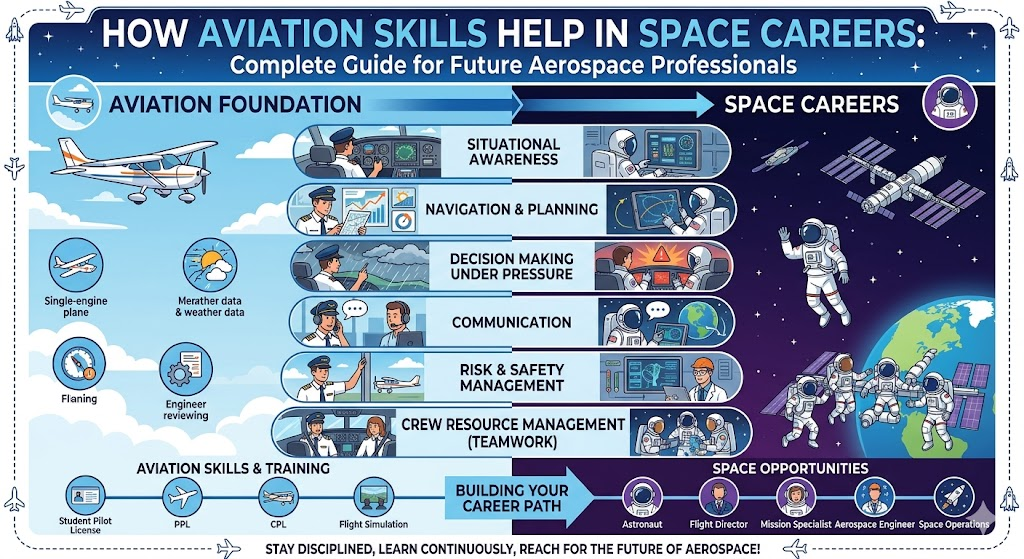
Situational Awareness
Situational awareness means understanding what is happening around you, what could happen next, and what action should be taken. Pilots use this skill during takeoff, landing, weather changes, traffic monitoring, and emergency handling.
In space careers, situational awareness is equally important. Astronauts, mission controllers, and spacecraft operators must constantly monitor systems, mission status, crew health, and environmental conditions.
Navigation and Flight Planning
Aviation teaches route planning, fuel calculation, weather analysis, timing, and navigation. These skills help professionals understand mission planning and movement through air or space.
In space operations, navigation becomes more advanced, but the basic thinking is similar. Space missions require accurate path planning, timing, orbital awareness, and coordination between ground teams and onboard crews.
Decision Making Under Pressure
Pilots are trained to make quick but safe decisions. Bad weather, technical issues, low visibility, or communication problems can happen at any time.
Space careers also demand calm decision-making. Astronauts and mission control teams must respond quickly to system warnings, equipment problems, or mission changes. Aviation experience helps build confidence in pressure situations.
Communication Skills
Clear communication is one of the most important aviation skills. Pilots speak with air traffic control, crew members, engineers, and ground teams using precise language.
In space missions, communication is critical. Mission control, astronauts, engineers, and support teams must share accurate information without confusion. Aviation training helps professionals communicate clearly and professionally.
Risk Assessment and Safety Management
Aviation professionals are trained to identify risks before they become problems. They study weather, aircraft performance, system health, runway conditions, and operational limits.
Space careers also depend on risk management. Space missions involve high-cost equipment, complex systems, and human safety. Aviation safety thinking helps professionals prepare better and reduce mission risks.
Crew Resource Management
Crew Resource Management teaches teamwork, leadership, communication, and decision-making inside a crew environment. It helps pilots and crew members work together instead of depending on one person.
Space missions also require strong teamwork. Astronauts live and work in small teams, while mission control supports them from Earth. Good crew coordination can improve safety and mission success.
Technical Systems Knowledge
Aviation gives learners a strong understanding of engines, avionics, navigation systems, flight controls, sensors, and safety equipment. This technical foundation is useful in aerospace and spacecraft careers.
Spacecraft systems are more complex, but aviation knowledge helps beginners understand how technical systems are designed, monitored, and maintained.
Emergency Response Training
Pilots train for engine failure, communication failure, instrument failure, fire, cabin pressure problems, and emergency landings.
Space professionals also train for emergency situations. These may include equipment failure, oxygen system issues, communication problems, or mission delays. Aviation-style emergency training builds calmness and confidence.
Problem Solving Skills
Aviation professionals must solve problems quickly and logically. They learn to follow procedures, use available information, and avoid panic.
Space careers require the same mindset. Whether working in mission control, spacecraft design, or astronaut operations, problem-solving is a daily requirement.
Operational Discipline
Aviation teaches punctuality, checklist usage, documentation, regulation compliance, and professional behavior. These habits are highly valuable in space careers.
Space missions are planned in great detail, and every action must follow strict procedures. Aviation training prepares people for this disciplined environment.
Space Careers That Benefit from Aviation Skills
Astronaut
Astronauts need physical fitness, technical knowledge, teamwork, communication, and emergency handling skills. Aviation experience can be helpful because pilots already understand flight operations and high-pressure decision-making.
Mission Specialist
Mission specialists work on scientific, technical, or operational tasks during space missions. Aviation skills help them understand procedures, crew coordination, and system monitoring.
Flight Director
Flight directors manage mission operations and guide teams during space missions. Aviation experience supports leadership, planning, communication, and decision-making.
Aerospace Engineer
Aerospace engineers design aircraft, spacecraft, satellites, and related systems. Aviation knowledge helps them understand real flight behavior, safety needs, and operational challenges.
Space Operations Specialist
Space operations specialists support mission planning, spacecraft monitoring, communication, and technical coordination. Aviation skills make it easier to understand mission discipline and system workflows.
Mission Control Operator
Mission control operators monitor mission data, communicate with crew, and support real-time operations. Aviation communication and checklist habits are very useful in this role.
Commercial Space Pilot
As commercial space travel grows, pilots with advanced aviation experience may find opportunities in space tourism and suborbital flight operations.
Aerospace Safety Specialist
Safety specialists study risks, procedures, failures, and prevention methods. Aviation safety training provides a strong foundation for this career.
How Pilot Training Helps Future Astronauts
Pilot training is one of the best ways to develop practical aerospace skills. It teaches students how to read instruments, manage workload, follow checklists, respond to emergencies, and work with a team.
Flight simulation is also useful for astronaut preparation. Simulators help trainees practice complex scenarios without real-world danger. This builds confidence and improves reaction time.
Pilot training also develops human factors knowledge. Students learn how stress, fatigue, weather, workload, and communication affect performance. These lessons are important in space missions where pressure and isolation can be high.
Aviation Certifications That Can Strengthen a Space Career
Student Pilot License
A Student Pilot License introduces beginners to basic flying skills, cockpit discipline, and aviation rules. It is a good starting point for anyone interested in aviation and aerospace.
Private Pilot License
A Private Pilot License helps learners build stronger flight planning, navigation, weather understanding, and aircraft handling skills.
Commercial Pilot License
A Commercial Pilot License develops professional-level flying knowledge, decision-making, safety awareness, and operational discipline.
Flight Instructor Ratings
Flight instructor training improves communication, teaching ability, leadership, and technical explanation skills. These are useful in aerospace training and mission education roles.
Aviation Safety Certifications
Safety certifications can help professionals understand risk management, accident prevention, compliance, and operational safety.
Skills Students Should Start Building Today
Students who want aviation or space careers should begin with strong basics. Science, technology, engineering, and mathematics are important subjects. Physics, mathematics, computer science, robotics, and engineering projects can build a strong foundation.
Students can also use flight simulators to understand cockpit procedures, navigation, and decision-making. Joining aviation clubs, space clubs, science fairs, and robotics teams can improve practical learning.
Communication and leadership skills are equally important. Space careers are not only about technical knowledge. They also require teamwork, clear speaking, discipline, and responsibility.
Challenges of Moving from Aviation to Space Careers
Moving from aviation to space careers can be challenging. Space roles often require advanced education, strong technical skills, physical fitness, and specialized training.
Competition can also be high because many students and professionals want to enter the space industry. However, aviation experience can give candidates a strong advantage by showing discipline, operational maturity, and real-world flight understanding.
Another challenge is continuous learning. Space technology changes quickly, so professionals must keep improving their knowledge in spacecraft systems, artificial intelligence, robotics, orbital mechanics, and advanced engineering.
Future Opportunities in Commercial Spaceflight
The future of space careers is expanding. Commercial spaceflight, space tourism, private missions, reusable spacecraft, satellite services, lunar exploration, and Mars mission planning are creating new career paths.
Aviation professionals may find opportunities in spacecraft operations, spaceport management, flight safety, crew training, commercial space travel, and aerospace project management.
As the space industry becomes more commercial, aviation-style operations will become even more important. This means pilots, engineers, safety experts, and aviation-trained professionals may have more chances to contribute.
Tips for Building an Aviation-to-Space Career Path
Start by learning the basics of aviation and aerospace. Build strong knowledge in physics, mathematics, engineering, and computer science. Practice communication, leadership, and problem-solving.
Use flight simulation tools to understand aircraft systems and navigation. Join aviation or space-related communities. Work on technical projects such as drones, model rockets, robotics, or aircraft design.
If possible, pursue pilot training or aviation certifications. These can help build confidence, discipline, and real-world operational understanding.
Most importantly, stay curious. Space careers need people who are willing to learn continuously and solve difficult problems.
Frequently Asked Questions
1- Can pilots become astronauts?
Yes, pilots can become astronauts if they meet the required education, physical, technical, and training standards. Aviation experience can be helpful because pilots already understand flight operations, navigation, teamwork, and decision-making under pressure.
2- Do astronauts need aviation experience?
Not always. Many astronauts come from engineering, science, medicine, or military backgrounds. However, aviation experience is highly useful because it builds operational discipline, technical understanding, and emergency response skills.
3- What aviation skills are most valuable in space careers?
The most valuable aviation skills include situational awareness, communication, navigation, safety management, teamwork, technical system knowledge, and decision-making under pressure. These skills are useful in astronaut training, mission control, and aerospace operations.
4- Is engineering more important than flying experience?
Both can be important depending on the career path. Engineering is essential for spacecraft design and technical roles, while flying experience helps in operations, crew coordination, and mission decision-making. A combination of both can be very powerful.
5- How does flight simulation help future astronauts?
Flight simulation helps trainees practice procedures, emergencies, navigation, and system monitoring in a safe environment. It builds confidence, improves reaction time, and teaches how to stay calm during complex situations.
6- Can commercial pilots work in the space industry?
Yes, commercial pilots may work in areas such as spaceflight operations, safety management, crew training, space tourism, aerospace consulting, and mission support. Additional technical training may be required for specialized roles.
7- What education is required for space careers?
Most space careers require strong education in science, engineering, mathematics, aviation, computer science, or related fields. Some roles may need advanced degrees, while others focus more on operations, safety, or technical training.
8- Are aviation safety skills useful in space missions?
Yes, aviation safety skills are very useful. Space missions require strong risk assessment, checklist discipline, emergency planning, and system monitoring. Aviation safety training helps professionals think carefully and prevent mistakes.
9- What is the future of commercial spaceflight careers?
Commercial spaceflight careers are expected to grow with space tourism, private missions, reusable spacecraft, and spaceport operations. This may create opportunities for pilots, engineers, safety experts, trainers, and mission planners.
10- How can students prepare for both aviation and space careers?
Students should focus on STEM subjects, communication skills, leadership, flight simulation, aviation basics, robotics, and aerospace projects. They should also explore pilot training, internships, science competitions, and space-related learning programs.
Conclusion
Aviation skills provide a strong foundation for space careers because both fields require discipline, technical knowledge, safety awareness, communication, and calm decision-making. Whether someone wants to become an astronaut, aerospace engineer, mission controller, space operations specialist, or commercial spaceflight professional, aviation training can help build the right mindset. The journey from aviation to space may require extra education and advanced skills, but the foundation remains powerful. For students and professionals dreaming of space careers, learning aviation is one of the best ways to begin. Start with curiosity, build practical skills, stay disciplined, and keep moving toward the future of aerospace.