Introduction
Space careers are becoming more exciting for students, aviation learners, and science enthusiasts. Many people dream of flying beyond Earth, working with advanced spacecraft, and becoming part of future space missions. A space pilot career is one of the most inspiring paths in this field because it combines aviation skills, engineering knowledge, physical fitness, teamwork, and mission discipline. For new learners, the journey may look difficult at first, but it becomes easier to understand when broken into clear steps. A space pilot may work with spacecraft systems, support mission operations, communicate with mission control, and help ensure crew safety during spaceflight. This guide explains what a space pilot does, what skills are needed, what education can help, and how beginners can start preparing for a future in space aviation.
What Is a Space Pilot?
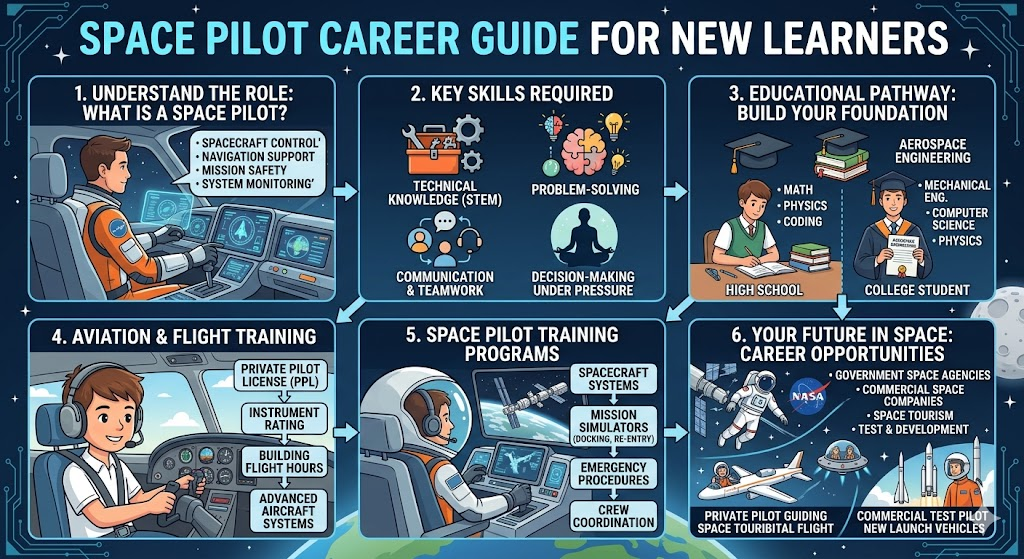
A space pilot is a trained professional who helps operate spacecraft during missions beyond Earth’s atmosphere. The role may include spacecraft control, navigation support, system monitoring, crew coordination, and mission safety.
A space pilot is not exactly the same as a commercial airline pilot. Airline pilots fly aircraft through Earth’s atmosphere, while space pilots may work with spacecraft designed for orbital, suborbital, or future deep-space missions.
A space pilot may also be an astronaut, depending on the mission and organization. In many space programs, pilots are selected from highly trained professionals with aviation, engineering, military, science, or technical backgrounds.
Difference Between a Space Pilot, Astronaut, and Airline Pilot
| Feature | Space Pilot | Astronaut | Airline Pilot |
|---|---|---|---|
| Primary Role | Helps operate spacecraft systems and flight operations | Works on space missions, research, operations, and exploration | Flies passenger or cargo aircraft |
| Work Environment | Spacecraft, simulators, mission training centers | Spacecraft, space stations, training centers | Aircraft cockpit and airports |
| Vehicle Operated | Spacecraft or spaceflight systems | Spacecraft, rovers, station systems, scientific equipment | Airplanes |
| Training Focus | Spaceflight systems, navigation, emergency procedures | Mission tasks, science, survival, spacecraft systems | Aircraft handling, navigation, safety, airline procedures |
| Technical Requirements | Very high technical and operational knowledge | High science, technical, and physical readiness | Aviation knowledge and professional flying skills |
| Mission Type | Spaceflight operations and crew safety | Research, exploration, operations, experiments | Commercial, cargo, private, or military aviation |
Why Students Are Interested in Space Pilot Careers
Space Exploration Growth
Students are increasingly interested in space because missions to the Moon, Mars, space stations, and commercial space destinations are becoming more visible. Space exploration feels like a future-focused career with purpose and adventure.
Commercial Space Companies
Private space companies are creating new possibilities in launch systems, reusable rockets, space tourism, satellite operations, and spacecraft development. This has increased interest in spaceflight-related careers.
Advanced Technology Careers
Space pilot careers involve advanced technology, robotics, artificial intelligence, spacecraft systems, navigation, and aerospace engineering. Students who enjoy science and technology often find this path exciting.
Future Space Tourism
Space tourism may create new types of jobs in spacecraft operations, safety, training, passenger support, and mission planning. While the field is still developing, it can offer future opportunities for skilled professionals.
Scientific Discovery
Space careers allow people to contribute to research, exploration, and human understanding of the universe. For many students, this is a powerful motivation.
What Does a Space Pilot Do?
A space pilot’s responsibilities may vary depending on the mission, spacecraft, and organization. However, the role usually requires strong technical understanding and teamwork.
A space pilot may:
- Monitor spacecraft systems
- Support launch and landing operations
- Communicate with mission control
- Help manage navigation and flight path
- Follow emergency procedures
- Support crew safety
- Work with automated flight systems
- Train in simulators
- Assist with mission planning
- Respond to system alerts or unexpected conditions
Modern spacecraft use a lot of automation, but trained humans are still important for decision-making, mission safety, and handling unusual situations.
Skills Required to Become a Space Pilot
Technical Knowledge
Space pilots need strong technical knowledge in areas such as physics, engineering, spacecraft systems, navigation, computers, and flight operations. Understanding how machines behave in extreme environments is important.
Problem-Solving Skills
Space missions can involve unexpected challenges. A space pilot must be able to analyze problems quickly, stay calm, and help find safe solutions.
Communication Skills
Clear communication is essential in spaceflight. Space pilots must communicate with crew members, mission control, engineers, and support teams using precise language.
Leadership and Teamwork
Space missions depend on teamwork. A space pilot must be able to follow instructions, support others, lead when needed, and work well under pressure.
Physical and Mental Fitness
Spaceflight can place stress on the body and mind. Fitness, focus, emotional control, and mental resilience are important for mission readiness.
Decision-Making Under Pressure
A space pilot must make careful decisions during high-pressure situations. Training helps build calm judgment and confidence.
Educational Pathway for Future Space Pilots
High School Preparation
Students should build a strong foundation in science, technology, engineering, and mathematics. Helpful subjects include:
- Mathematics
- Physics
- Computer science
- Chemistry
- Engineering basics
- Robotics
- Astronomy
- English communication
Strong academic habits at this stage can help students prepare for advanced education later.
College Degrees
Many space professionals study technical subjects in college. Useful degree areas include:
- Aerospace engineering
- Mechanical engineering
- Electrical engineering
- Computer science
- Physics
- Aviation
- Mathematics
- Robotics
- Systems engineering
A technical degree can help students understand spacecraft design, flight systems, propulsion, control systems, and mission planning.
Advanced Education and Training
Some space careers may require advanced degrees, research experience, military aviation background, test pilot training, or specialized aerospace training. Requirements vary by organization and role.
Students should stay flexible and build both technical and practical skills.
Aviation Experience and Flight Training
Aviation experience can be valuable for future space pilots because it teaches flight discipline, cockpit procedures, navigation, communication, and safety thinking.
Useful aviation steps may include:
- Learning basic flight principles
- Taking an introductory flying lesson
- Earning a private pilot license
- Building flight hours
- Learning instrument flying
- Studying advanced aircraft systems
- Developing crew resource management skills
Not every space career requires traditional pilot training, but flight experience can strengthen understanding of real-world operations.
Space Pilot Training Programs
Space pilot training is highly specialized and may include many types of preparation.
Spacecraft Systems Training
Trainees learn how spacecraft systems work, including power, life support, propulsion, navigation, communication, and control systems.
Mission Simulators
Simulators help trainees practice launch, docking, orbit operations, landing, emergency situations, and system failures in a safe environment.
Survival Training
Some programs include survival training for emergency landing situations on land or water.
Emergency Procedures
Space pilots must learn how to respond to equipment failures, communication problems, pressure issues, fire risks, and medical emergencies.
Crew Coordination Exercises
Crew members practice teamwork, communication, role management, and decision-making under pressure.
Physical and Medical Requirements
Space pilot candidates usually need excellent health and fitness. Spaceflight can involve acceleration forces, microgravity, confined spaces, unusual sleep schedules, and mental pressure.
Medical checks may include:
- Vision testing
- Hearing testing
- Heart health evaluation
- Physical fitness assessment
- Mental health screening
- Balance and coordination checks
- General medical history review
Students should focus on long-term health, exercise, sleep, nutrition, and mental resilience.
Technology Used by Space Pilots
Spacecraft Navigation Systems
Navigation systems help spacecraft follow planned routes, adjust position, and reach mission targets.
Flight Computers
Modern spacecraft depend on computers to manage flight data, guidance, controls, and system monitoring.
Communication Systems
Communication systems connect the spacecraft with mission control and other crew members.
Robotics and Automation
Robotic systems may support docking, repairs, experiments, and exploration tasks. Automation helps manage complex flight operations.
Artificial Intelligence Support
Artificial intelligence may support monitoring, data analysis, decision assistance, and future autonomous spacecraft operations.
Career Opportunities for Space Pilots
Government Space Agencies
Government space agencies select astronauts and mission specialists for scientific and exploration missions. These roles are highly competitive and require strong qualifications.
Commercial Space Companies
Commercial space companies may create opportunities in spacecraft operations, training, testing, mission support, and space tourism.
Space Tourism Operations
As space tourism develops, there may be more roles related to passenger safety, spacecraft operation, training, and mission management.
Research Missions
Space pilots and mission specialists may support scientific experiments, technology testing, and exploration missions.
Aerospace Testing and Development
Some professionals work in test programs, spacecraft design, flight simulation, mission planning, or safety evaluation.
Challenges of Becoming a Space Pilot
Competitive Selection
Space pilot roles are rare and highly competitive. Candidates usually need excellent education, strong experience, and outstanding personal discipline.
Long Training Periods
Training can take many years. Students must be ready for continuous learning and skill development.
Technical Complexity
Spaceflight involves advanced systems, strict safety rules, and complex mission planning. Strong technical understanding is required.
Physical Demands
Spaceflight can affect the body, so candidates must maintain strong physical and medical readiness.
Continuous Learning
Space technology changes quickly. Future space professionals must keep learning throughout their careers.
How to Start Preparing Today
New learners can begin preparing early by building the right habits and knowledge.
Useful steps include:
- Study mathematics and physics seriously
- Learn basic aviation concepts
- Read about spacecraft and rockets
- Join STEM clubs or science projects
- Learn coding and robotics
- Improve communication skills
- Stay physically active
- Follow space missions and industry updates
- Practice teamwork and leadership
- Explore flight training if possible
Beginners do not need to know everything immediately. The key is to stay curious and consistent.
Future of Space Pilot Careers
The future of space pilot careers may include new types of missions and technologies. Space travel is moving toward reusable spacecraft, private missions, lunar exploration, orbital stations, and possibly future deep-space journeys.
Future opportunities may develop in:
- Commercial spacecraft operations
- Space tourism
- Lunar missions
- Orbital stations
- Satellite servicing
- Space research
- Planetary exploration
- Autonomous spacecraft supervision
As spacecraft become more advanced, the role of human pilots may change. Instead of manually controlling every movement, space pilots may manage systems, supervise automation, make safety decisions, and support mission operations.
Interesting Facts About Space Pilots
- Space pilots train for both normal and emergency situations.
- Many spacecraft use advanced automation, but human judgment remains important.
- Space pilots must understand both flight operations and technical systems.
- Mission simulators are a major part of training.
- Communication with mission control is critical during spaceflight.
- Spaceflight can affect balance, sleep, and muscle strength.
- Teamwork is as important as technical skill.
- Space pilots may train for years before a mission.
- Future spacecraft may use more artificial intelligence.
- Space tourism may create new spaceflight support careers.
FAQs
1- What is a space pilot?
A space pilot is a trained professional who supports or controls spacecraft flight operations. The role may include navigation, system monitoring, mission communication, crew safety, and emergency response. Space pilots need strong technical knowledge and excellent decision-making skills.
2- Is a space pilot the same as an astronaut?
A space pilot may be an astronaut, but the terms are not always the same. An astronaut can perform many roles, including science, engineering, medical work, mission operations, or piloting. A space pilot focuses more specifically on spacecraft flight operations.
3- What subjects should students study to become a space pilot?
Students should focus on mathematics, physics, computer science, engineering, robotics, and communication. These subjects help build the technical foundation needed for aviation and spaceflight careers.
4- Do space pilots need flight experience?
Flight experience can be very helpful because it teaches cockpit discipline, navigation, communication, and safety procedures. Some space pilot paths may prefer candidates with aviation or test pilot experience, while other space roles may focus more on engineering or science backgrounds.
5- Is becoming a space pilot difficult?
Yes, becoming a space pilot is difficult because the field is highly competitive and requires strong education, technical skills, health, discipline, and training. However, beginners can start step by step by building STEM knowledge, fitness, and aviation awareness.
6- What companies or organizations hire space pilots?
Space pilots and spaceflight professionals may work with government space agencies, commercial space companies, aerospace manufacturers, research organizations, and future space tourism operators. Exact roles depend on the mission type and organization.
7- Can commercial pilots become space pilots?
Commercial pilots may be able to move toward space-related careers if they also build strong technical knowledge, advanced training, and meet selection requirements. Aviation experience can be useful, but space roles often require additional science, engineering, or mission training.
8- What physical fitness is required for space pilot careers?
Space pilot candidates usually need strong overall health, good vision and hearing, physical endurance, mental stability, and the ability to handle stressful environments. Medical standards vary by organization and mission type.
9- Will space tourism create new careers?
Space tourism may create new careers in spacecraft operations, passenger training, safety management, mission support, spaceflight instruction, and maintenance. The field is still developing, but it may open new opportunities for skilled aviation and aerospace professionals.
10- How can beginners start preparing for a space pilot career?
Beginners can start by studying STEM subjects, learning about aviation, following space missions, joining science or robotics projects, improving fitness, and developing communication skills. Over time, they can explore aviation training, engineering education, and aerospace career pathways.
Conclusion
A space pilot career is one of the most inspiring and challenging paths for new learners interested in aviation, science, and space exploration. It requires strong education, technical knowledge, physical fitness, teamwork, communication, and years of dedicated training. While the path is competitive, students can begin early by building a strong foundation in mathematics, physics, engineering, computer science, aviation awareness, and problem-solving. The future of spaceflight may create new opportunities through commercial missions, space tourism, lunar exploration, and advanced spacecraft systems. For beginners, the most important step is to stay curious, learn consistently, and prepare with patience. Space aviation belongs to those who are ready to dream big, work hard, and keep learning beyond the limits of Earth.