Introduction
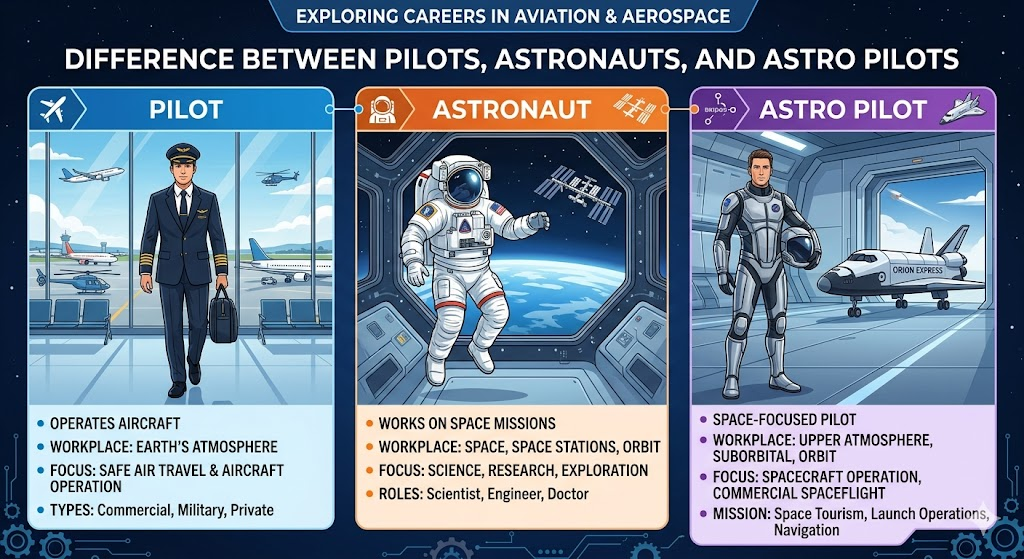
Many students and aviation lovers often confuse pilots, astronauts, and astro pilots because all three are connected with flying, aerospace, and advanced technology. A pilot flies aircraft, an astronaut works on space missions, and an astro pilot is a future-focused space aviation concept connected with spacecraft operations, astronaut pilot duties, commercial spaceflight, and advanced aerospace vehicles.
Although these roles may look similar from the outside, they are different in terms of training, workplace, responsibilities, education, risk level, and career path. Understanding these differences can help beginners choose the right direction in aviation, aerospace, or space careers.
This guide explains the difference between pilots, astronauts, and astro pilots in simple language.
What Is a Pilot
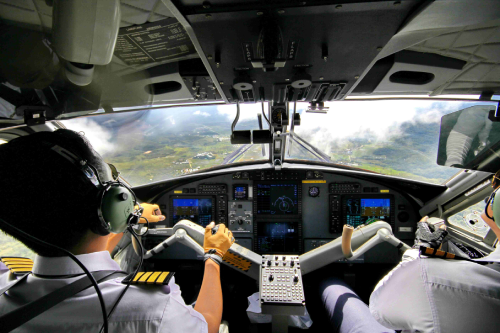
A pilot is a trained professional who operates aircraft. Pilots may fly airplanes, helicopters, private jets, cargo aircraft, military aircraft, or training aircraft. Their main job is to safely control the aircraft from takeoff to landing.
Pilots work mostly within Earth’s atmosphere and follow aviation rules, weather conditions, air traffic instructions, flight plans, and safety procedures.
Types of Pilots
- Commercial pilots
- Airline pilots
- Private pilots
- Cargo pilots
- Military pilots
- Helicopter pilots
- Corporate jet pilots
- Flight instructors
- Test pilots
Main Responsibilities of a Pilot
- Operate aircraft safely
- Check weather and flight plans
- Communicate with air traffic control
- Monitor aircraft systems
- Navigate during flight
- Handle emergencies
- Ensure passenger and crew safety
- Follow aviation regulations
A pilot career is ideal for people who love aircraft, flying, navigation, discipline, and operational responsibility.
What Is an Astronaut
An astronaut is a trained space crew member who travels to space or prepares for space missions. Astronauts may work on spacecraft, space stations, scientific research, experiments, robotics, mission operations, and exploration programs.
Not all astronauts are pilots. Some astronauts are scientists, engineers, doctors, researchers, mission specialists, or payload specialists.
What Astronauts Do
Astronauts may:
- Travel to space
- Conduct scientific experiments
- Operate spacecraft systems
- Maintain space station equipment
- Support spacewalks
- Work with robotic systems
- Communicate with mission control
- Study human health in space
- Support exploration missions
Astronauts need strong education, technical knowledge, teamwork, physical fitness, and mental discipline. Their work environment is more extreme than a normal aviation environment because space has microgravity, radiation exposure, isolation, pressure changes, and mission risks.
What Is an Astro Pilot
An astro pilot is a space-focused pilot or aerospace professional connected with spacecraft operation, astronaut pilot duties, commercial spaceflight, advanced aerospace vehicles, or future space tourism systems.
The term astro pilot may not always be used as an official job title everywhere. However, it is a useful concept for explaining future careers that combine aviation and space operations.
An astro pilot may be connected with:
- Spacecraft piloting
- Astronaut pilot roles
- Commercial spaceflight operations
- Advanced aerospace vehicle testing
- Space tourism support
- Mission control operations
- Spacecraft navigation
- Reusable launch vehicle operations
- Future spaceplane operations
In simple words, an astro pilot represents the bridge between traditional pilots and astronauts. They may understand aircraft-style operations as well as spacecraft systems, mission control, safety procedures, and spaceflight environments.
Pilot vs Astronaut: Key Differences
| Factor | Pilot | Astronaut |
|---|---|---|
| Main Workplace | Aircraft cockpit, airports, air routes | Spacecraft, space stations, mission training centers |
| Operating Environment | Earth’s atmosphere | Space, orbit, space stations, mission environments |
| Vehicle Type | Airplanes, helicopters, jets | Spacecraft, capsules, space stations, exploration vehicles |
| Main Goal | Safe air travel and aircraft operation | Space mission success, research, exploration, operations |
| Education | Aviation training and licenses | Strong STEM education and advanced mission training |
| Training | Flight school, simulator training, flight hours | Space systems, survival, robotics, physical training, mission simulation |
| Physical Requirements | Aviation medical fitness | Very strict physical and mental fitness for space missions |
| Risk Level | High but routine and regulated | Very high due to space environment |
| Career Path | Flight training to airline, cargo, military, private, or corporate roles | STEM background, professional experience, selection, astronaut training |
| Work Schedule | Regular flights, routes, shifts | Mission-based training and spaceflight schedules |
Pilot vs Astro Pilot
| Factor | Pilot | Astro Pilot |
|---|---|---|
| Vehicle Focus | Aircraft | Spacecraft, spaceplanes, advanced aerospace vehicles |
| Operating Area | Atmosphere | Upper atmosphere, suborbital space, orbit, or future space routes |
| Main Skill | Aircraft control and aviation navigation | Spacecraft systems, mission operations, advanced navigation |
| Training | Flight training and aviation licensing | Aviation, aerospace, spacecraft systems, simulation, mission training |
| Mission Type | Passenger, cargo, military, private, training | Spaceflight, commercial space travel, research, testing, tourism |
| Safety Focus | Aircraft safety and air traffic procedures | Spaceflight safety, launch, re-entry, emergency systems |
| Career Status | Well-established career | Emerging and future-focused career concept |
| Future Opportunity | Commercial aviation, cargo, defense, training | Commercial spaceflight, space tourism, spacecraft operations |
Astronaut vs Astro Pilot
| Factor | Astronaut | Astro Pilot |
|---|---|---|
| Definition | A trained space crew member | A space-focused pilot or aerospace operator |
| Role Scope | Broad space mission role | More focused on piloting, vehicle systems, and operations |
| Main Duties | Research, experiments, mission tasks, spacecraft work | Spacecraft control, navigation, monitoring, flight operations |
| Scientific Work | Often involved in research and experiments | May be involved, but usually more operations-focused |
| Vehicle Operation | Some astronauts operate spacecraft systems | More directly connected with spacecraft or aerospace vehicle operation |
| Career Type | Formal space agency or commercial mission role | Future-focused space aviation role |
| Space Tourism Link | May support private missions | Strong connection with future commercial spaceflight and tourism |
| Skill Focus | Science, engineering, teamwork, mission training | Aviation, aerospace systems, navigation, mission safety |
Pilot vs Astronaut vs Astro Pilot
| Category | Pilot | Astronaut | Astro Pilot |
|---|---|---|---|
| Simple Definition | Person trained to fly aircraft | Person trained for space missions | Space-focused pilot or aerospace operator |
| Primary Workplace | Aircraft cockpit | Spacecraft, space station, mission training center | Spacecraft, mission control, commercial spaceflight systems |
| Vehicle Operated | Aircraft, helicopter, jet | Spacecraft systems and mission equipment | Spacecraft, spaceplane, advanced aerospace vehicle |
| Main Mission | Safe air transport or aircraft operation | Space research, exploration, and mission tasks | Spaceflight operation and future space aviation support |
| Education | Aviation training and licenses | STEM education and mission training | Aviation, aerospace, engineering, space systems |
| Technical Skills | Navigation, aircraft systems, weather, communication | Science, engineering, robotics, mission systems | Aviation, spacecraft systems, simulation, navigation |
| Physical Fitness | Aviation medical fitness | High physical and mental fitness | High fitness may be required depending on role |
| Training Duration | Varies by license and career level | Long and highly competitive | Varies by pilot, engineering, or operations path |
| Career Opportunities | Airlines, cargo, military, corporate aviation | Space agencies, research missions, commercial missions | Commercial spaceflight, space tourism, aerospace operations |
| Future Demand | Strong in aviation and transport | Specialized and competitive | Growing concept with future space aviation |
| Typical Responsibilities | Fly aircraft safely | Complete space mission tasks | Support spacecraft operation and spaceflight safety |
Education Requirements
Pilot Education Path
A pilot usually needs aviation training, flight experience, and proper licensing. The path may vary by country and aircraft type.
Common steps include:
- Complete required education
- Join flight training
- Pass medical fitness requirements
- Learn aircraft systems and aviation rules
- Complete flight hours
- Pass written and practical exams
- Earn pilot licenses
- Build experience for advanced roles
Pilots need strong discipline, decision-making, communication, and situational awareness.
Astronaut Education Path
Astronauts usually need a strong academic background in science, technology, engineering, mathematics, medicine, aviation, or related fields. Many astronauts have advanced degrees, research experience, military aviation experience, engineering experience, or specialized professional backgrounds.
Useful fields include:
- Engineering
- Physics
- Mathematics
- Computer science
- Biology
- Medicine
- Aerospace science
- Robotics
- Aviation
- Space science
Astronaut selection is highly competitive and requires strong physical fitness, teamwork, technical excellence, and mission readiness.
Astro Pilot Education Path
An astro pilot career path may include aviation, aerospace engineering, spacecraft systems, mission operations, or commercial spaceflight training.
Useful education areas include:
- Aerospace engineering
- Aeronautical engineering
- Aviation science
- Mechanical engineering
- Electrical engineering
- Computer science
- Robotics
- Physics
- Space science
- Systems engineering
- Pilot training where applicable
The best path depends on whether the person wants a pilot-focused career, engineering career, mission control career, or commercial spaceflight operations career.
Skills Needed for Each Career
Skills for Pilots
Pilots need:
- Aircraft control skills
- Navigation skills
- Communication skills
- Weather understanding
- Decision-making ability
- Situational awareness
- Emergency response skills
- Discipline and checklist management
- Team coordination
- Safety-first mindset
Skills for Astronauts
Astronauts need:
- Strong science and engineering knowledge
- Research skills
- Physical endurance
- Mental strength
- Teamwork
- Communication
- Problem-solving
- Adaptability
- Robotics awareness
- Mission discipline
Skills for Astro Pilots
Astro pilots may need:
- Aviation knowledge
- Space systems awareness
- Engineering understanding
- Spacecraft operation basics
- Advanced navigation thinking
- Technical problem-solving
- Simulation training
- Mission control communication
- Physical and mental fitness
- Safety-first mindset
Which Career Is Right for You
Choose Pilot If
You may choose a pilot career if you:
- Love aircraft and flying
- Want a practical aviation career
- Enjoy navigation and cockpit operations
- Can follow strict safety procedures
- Want to work in airlines, cargo, private aviation, or defense
- Are ready for flight training and licensing
- Like responsibility and decision-making
Choose Astronaut If
You may choose an astronaut path if you:
- Love space exploration
- Enjoy science, engineering, or research
- Are ready for highly competitive selection
- Want to work on space missions
- Have strong physical and mental discipline
- Like teamwork in extreme environments
- Are interested in experiments, robotics, and mission operations
Choose Astro Pilot If
You may choose an astro pilot direction if you:
- Love both aviation and space
- Are interested in spacecraft operations
- Want to explore future space aviation careers
- Like advanced aerospace vehicles
- Are interested in commercial spaceflight or space tourism
- Want a career connected with both flying and space systems
- Are ready to build technical, aviation, and space knowledge
Career Opportunities
Career Opportunities for Pilots
Pilots can work in:
- Commercial airlines
- Cargo airlines
- Charter aviation
- Corporate aviation
- Private aviation
- Military aviation
- Flight training schools
- Medical air services
- Agricultural aviation
- Test flying
Career Opportunities for Astronauts
Astronauts may work in:
- Space agencies
- Space stations
- Research missions
- Scientific programs
- Space exploration programs
- Commercial crew missions
- Lunar and deep-space missions
- Spacewalk operations
- Robotics and mission support
Career Opportunities for Astro Pilots
Astro pilot-related opportunities may include:
- Commercial spaceflight
- Space tourism
- Spacecraft operations
- Advanced aerospace vehicles
- Mission control
- Flight operations engineering
- Space systems operations
- Simulation training
- Space safety roles
- Space mission planning
Future of Pilots, Astronauts, and Astro Pilots
The future of aviation and space is changing quickly. Pilots will continue to play an important role in commercial aviation, cargo transport, private aviation, and advanced aircraft systems. Astronauts will remain important for scientific research, space exploration, space station operations, and future lunar or deep-space missions.
Astro pilots may become more important as commercial spaceflight, reusable rockets, space tourism, private space stations, and advanced aerospace vehicles grow. This role represents the future connection between aviation and spaceflight.
Future opportunities may grow in:
- Commercial spaceflight
- Space tourism
- Reusable launch systems
- Lunar missions
- Space station operations
- Advanced spaceplanes
- Satellite operations
- Aerospace vehicle testing
- Human space exploration
Common Myths
Myth 1: Pilots Can Automatically Become Astronauts
Pilots may have useful skills, but becoming an astronaut requires much more than flying experience. Astronaut candidates often need strong education, technical expertise, physical fitness, teamwork, and mission training.
Myth 2: Astronauts Only Fly Spacecraft
Astronauts do much more than fly spacecraft. They conduct research, maintain equipment, operate robotics, support experiments, communicate with mission control, and complete mission tasks.
Myth 3: Astro Pilots Are Completely Fictional
The exact term may not always be formal, but the concept is connected with real and emerging roles such as spacecraft pilot, astronaut pilot, commercial spaceflight crew, mission operator, and aerospace vehicle operator.
Myth 4: Pilots and Astronauts Do the Same Job
Pilots mainly operate aircraft within Earth’s atmosphere. Astronauts work on space missions, research, spacecraft systems, and exploration tasks. Their environments and responsibilities are very different.
Myth 5: Space Tourism Requires Astronauts Only
Space tourism may need many professionals, including safety trainers, commercial spaceflight crew, spacecraft operators, mission support teams, engineers, and passenger preparation specialists.
FAQs
1- What is the difference between a pilot and an astronaut?
A pilot operates aircraft within Earth’s atmosphere, while an astronaut is trained for space missions. Pilots focus on aviation operations, and astronauts focus on space exploration, research, spacecraft systems, and mission tasks.
2- What is an astro pilot?
An astro pilot is a space-focused pilot or aerospace professional connected with spacecraft operations, astronaut pilot duties, commercial spaceflight, advanced aerospace vehicles, or future space tourism systems.
3- Can a pilot become an astronaut?
Yes, a pilot can become an astronaut if they meet the required education, experience, medical, and selection standards. However, being a pilot alone does not automatically qualify someone to become an astronaut.
4- Is astro pilot a real career?
Astro pilot may not always be used as an official job title, but the concept is connected with real roles such as spacecraft pilot, astronaut pilot, commercial spaceflight crew member, test pilot, and mission operations specialist.
5- Do astronauts fly spacecraft?
Some astronauts are trained to operate spacecraft systems, but not all astronauts are pilots. Many astronauts work as scientists, engineers, doctors, researchers, or mission specialists.
6- Are astro pilots the same as astronauts?
Not exactly. Astronaut is a broader space mission role, while astro pilot is more focused on spacecraft operation, space aviation, and future commercial spaceflight roles.
7- Which career is harder?
Each career is difficult in its own way. Pilot careers require flight training and operational discipline. Astronaut careers are extremely competitive and require advanced training. Astro pilot careers may require both aviation and space systems knowledge.
8- Which career requires more education?
Astronaut and astro pilot-related careers often require strong STEM education and specialized training. Pilot careers require aviation training, licenses, and flight experience.
9- Can astro pilots work in commercial spaceflight?
Yes, astro pilot-related roles may grow in commercial spaceflight, space tourism, spacecraft operations, vehicle safety, mission support, and advanced aerospace vehicle programs.
10- What subjects should students study?
Students should focus on physics, mathematics, computer science, engineering basics, aviation science, robotics, and space science depending on their career goal.
11- Is aerospace engineering useful?
Yes, aerospace engineering is very useful for astronaut, astro pilot, spacecraft, aviation, and space systems careers. It helps students understand aircraft, spacecraft, rockets, propulsion, structures, and flight systems.
12- What is the future of astro pilot careers?
The future looks promising because of commercial spaceflight, reusable rockets, space tourism, private space stations, lunar missions, satellite growth, and advanced aerospace vehicles.
Conclusion
Pilots, astronauts, and astro pilots all belong to the exciting world of aviation and space, but their roles are different. Pilots focus on operating aircraft safely within Earth’s atmosphere. Astronauts focus on space missions, research, spacecraft systems, and exploration. Astro pilots represent the emerging connection between aviation and future spaceflight, especially in spacecraft operations, commercial spaceflight, space tourism, and advanced aerospace vehicles.
For students and beginners, the right path depends on personal interest. If you love aircraft and flying, a pilot career may be suitable. If you love science, research, and space missions, the astronaut path may inspire you. If you are excited by both aviation and space technology, the astro pilot direction may be a powerful future-focused choice. Start with strong science, mathematics, communication, and technical skills, then choose a path that matches your passion and long-term goals.