Introduction
Many students and beginners dream about careers that connect flying, space, science, and advanced technology. The idea of becoming an astro pilot sounds exciting because it brings together aviation and space exploration. It is a career direction linked with spacecraft operations, astronaut pilot roles, aerospace engineering, commercial spaceflight, mission control, space tourism, and future space aviation jobs.
Today, the aviation and space industries are becoming more connected. Reusable rockets, satellite missions, space tourism, private space companies, lunar exploration, and advanced aerospace vehicles are creating new interest among students who want to work beyond traditional aviation careers. However, many beginners are confused about where to start, which subjects to study, whether pilot training is required, and what skills are important.
This blog gives you a clear and beginner-friendly astro pilot career roadmap. It explains what an astro pilot means, whether it is a real career path, what education options are useful, what skills you need, and how to prepare step by step for future opportunities in space aviation.
What Is an Astro Pilot
An astro pilot can be understood as a space-focused pilot or aerospace professional connected with spacecraft, space aviation, advanced aerospace vehicles, or commercial spaceflight operations. The term may not always be used as a formal job title everywhere, but the concept is related to several real career roles in aviation and space.
An astro pilot may be connected with:
- Spacecraft operation
- Astronaut pilot duties
- Commercial spaceflight missions
- Advanced aerospace vehicle testing
- Space tourism support
- Mission control operations
- Aerospace engineering
- Flight operations
- Space mission planning
- Spacecraft safety and systems monitoring
In simple words, an astro pilot is someone who may help operate, monitor, guide, or support vehicles and systems used for space-related flying. This may include spacecraft, spaceplanes, reusable launch systems, orbital vehicles, or future passenger space travel systems.
An astro pilot career is not only about flying a rocket. It can also involve engineering, mission support, training, simulation, safety, navigation, robotics, and spacecraft systems.
Is Astro Pilot a Real Career
The term astro pilot may sound futuristic, and it may not always appear as an official job title in every organization. However, the career idea behind it is real.
Astro pilot-related careers are connected with roles such as:
- Astronaut pilot
- Spacecraft pilot
- Test pilot
- Commercial spaceflight crew member
- Aerospace engineer
- Mission operations specialist
- Flight operations engineer
- Satellite operations specialist
- Space systems analyst
- Simulation and training instructor
So, while every company or space agency may not use the exact title “astro pilot,” the skills and career direction are very real. Students interested in this field can prepare for careers in aviation, aerospace engineering, spacecraft operations, mission control, space tourism, robotics, software, and commercial spaceflight.
The important thing is to understand that an astro pilot career roadmap is not one single fixed path. It can include pilot-focused paths and non-pilot technical paths.
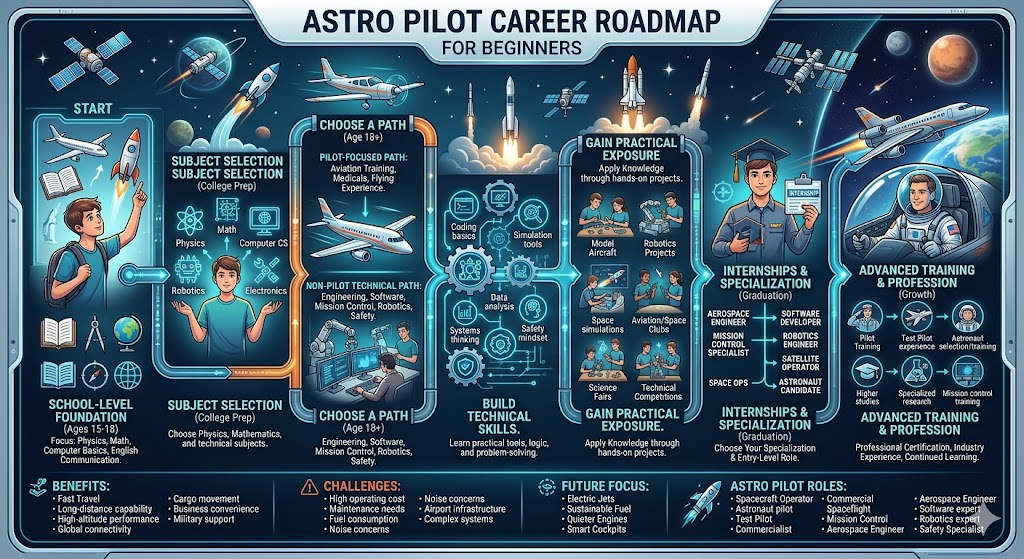
Astro Pilot Career Roadmap Overview
| Roadmap Stage | Focus Area | What Beginners Should Do |
|---|---|---|
| School-Level Foundation | Science, mathematics, communication | Build strong basics in physics, math, computer basics, and English |
| Subject Selection | Science and technical subjects | Choose physics, mathematics, computer science, chemistry, or robotics where possible |
| Aviation and Space Basics | Aircraft, rockets, satellites, spacecraft | Learn how flying and space systems work |
| Education Path | Degree or training selection | Choose aerospace, aeronautical, mechanical, electrical, computer science, physics, or aviation science |
| Technical Skills | Coding, simulation, robotics, systems | Learn practical tools and problem-solving skills |
| Practical Exposure | Projects, clubs, competitions | Build model aircraft, robotics projects, space simulations, or science projects |
| Internship Stage | Real-world learning | Apply for aerospace, aviation, research, or technical internships |
| Specialization | Career direction | Choose pilot path, engineering path, mission control, robotics, software, or operations |
| Entry-Level Career | First professional role | Apply for aerospace, aviation, satellite, research, or space operations roles |
| Advanced Growth | Higher training and specialization | Continue with pilot training, higher studies, astronaut training, or specialized technical roles |
Step 1: Build a Strong School-Level Foundation
The first step in the astro pilot career roadmap begins at the school level. Students should focus on subjects and habits that create a strong base for aviation and space careers.
Physics, mathematics, computer basics, English communication, and general science are especially important. Space aviation is a technical field, so students must become comfortable with numbers, logic, machines, systems, and scientific thinking.
At the beginner level, students should focus on:
- Understanding basic science concepts
- Practicing mathematics regularly
- Learning basic computer skills
- Improving reading and writing skills
- Building curiosity about aircraft and space
- Developing discipline and study consistency
- Staying physically active and healthy
Students should not worry if they do not understand everything at once. The goal is to build strong basics slowly and consistently.
Step 2: Choose the Right Subjects
Choosing the right subjects is important for students who want to enter space aviation or astro pilot-related careers. While exact requirements can vary by country, college, and career path, science and technical subjects are usually very helpful.
Useful subjects include:
- Physics: Helps you understand motion, gravity, force, energy, pressure, speed, and flight.
- Mathematics: Helps with calculations, navigation, engineering, programming, and problem-solving.
- Computer Science: Helps with software, coding, automation, simulation, and spacecraft systems.
- Chemistry: Useful for understanding materials, fuels, reactions, and basic engineering science.
- Engineering Basics: Helpful for students who want to enter aerospace or technical fields.
- Robotics or Electronics: Useful for spacecraft systems, satellites, automation, and mission technology.
- Aviation-Related Subjects: Useful where available, especially for students interested in pilot or flight operations paths.
Students should choose subjects based on their long-term interests. If you want to become a pilot, aviation and physics are useful. If you want to become an engineer, mathematics and science are essential. If you want to work in spacecraft software or robotics, computer science is very helpful.
Step 3: Understand Aviation and Space Basics
Before choosing a specific career path, beginners should understand the basics of aviation and space technology. This helps them decide which direction suits them best.
Students should learn about:
- How aircraft fly
- How rockets launch
- How satellites work
- What spacecraft do
- How astronauts train
- How mission control supports missions
- What happens during launch and re-entry
- How space tourism works
- How reusable rockets are changing space travel
- How aviation safety systems work
This basic understanding helps beginners see that space aviation is not only about flying. It includes engineering, operations, software, robotics, communication, safety, and mission support.
A student who enjoys machines and design may choose aerospace engineering. A student who enjoys coding may choose spacecraft software or simulation. A student who enjoys flying may explore aviation training. A student who enjoys teamwork and operations may explore mission control.
Step 4: Select the Right Education Path
There is no single education path for becoming an astro pilot or entering a related career. The right path depends on your goal.
Common academic paths include:
- Aerospace engineering
- Aeronautical engineering
- Mechanical engineering
- Electrical engineering
- Computer science
- Physics
- Mathematics
- Space science
- Robotics
- Aviation science
- Systems engineering
- Software engineering
- Data science
Aerospace Engineering
Aerospace engineering is one of the most popular paths for students interested in aircraft, spacecraft, rockets, satellites, and flight systems. It is useful for careers in design, testing, mission support, and aerospace technology.
Aeronautical Engineering
Aeronautical engineering focuses mainly on aircraft and flying within Earth’s atmosphere. It can be useful for students interested in aviation, aircraft design, and advanced aerospace vehicles.
Computer Science
Computer science is useful for spacecraft software, simulation tools, automation, mission systems, data analysis, artificial intelligence, robotics, and cybersecurity in aerospace systems.
Mechanical Engineering
Mechanical engineering is useful for structures, engines, materials, thermal systems, manufacturing, and mechanical design in aerospace projects.
Physics and Mathematics
Physics and mathematics are useful for research, orbital mechanics, space science, mission planning, and advanced technical roles.
Robotics and Automation
Robotics is important for space exploration, robotic arms, rovers, autonomous spacecraft systems, and future mission support.
The best education path depends on whether you want to become a pilot, engineer, mission controller, software specialist, robotics expert, or space operations professional.
Step 5: Decide Whether You Want a Pilot Path or Non-Pilot Path
Many beginners think an astro pilot career means they must become a pilot. This is not always true. Space aviation includes both pilot-focused and non-pilot roles.
Pilot-Focused Roles
Pilot-focused roles may require aviation training, flying experience, physical fitness, and advanced operational training.
Examples include:
- Aircraft pilot
- Test pilot
- Astronaut pilot
- Spacecraft pilot
- Commercial spaceflight pilot
- Advanced aerospace vehicle operator
These roles are suitable for people who want to operate aircraft or spacecraft directly and are ready for strict training, medical fitness standards, and high responsibility.
Non-Pilot Space Aviation Roles
Non-pilot roles are equally important in space aviation. These roles may focus on engineering, software, mission control, satellite operations, safety, robotics, or simulation.
Examples include:
- Aerospace engineer
- Mission control specialist
- Satellite operations specialist
- Robotics engineer
- Software engineer
- Space systems analyst
- Flight operations engineer
- Simulation instructor
- Safety specialist
- Space mission planner
These roles are suitable for people who love space and aviation but may not want to become professional pilots.
Simple Comparison Table
| Career Direction | Best For | Typical Focus |
|---|---|---|
| Pilot Path | Students interested in flying and vehicle operation | Pilot training, flight control, safety, navigation, advanced aviation |
| Engineering Path | Students interested in design and systems | Aircraft, spacecraft, rockets, structures, propulsion, testing |
| Software Path | Students interested in coding and digital systems | Simulation, spacecraft software, data, automation, mission tools |
| Mission Control Path | Students interested in operations and teamwork | Monitoring spacecraft, communication, mission support, problem-solving |
| Robotics Path | Students interested in machines and automation | Rovers, robotic arms, autonomous systems, exploration technology |
| Safety and Training Path | Students interested in procedures and people | Crew training, passenger safety, emergency planning, simulations |
Step 6: Build Technical Skills
Technical skills are very important for astro pilot-related careers. Even if you choose a pilot-focused path, you still need to understand systems, safety, navigation, and technology.
Important technical skills include:
- Basic coding
- Data analysis
- Simulation tools
- Robotics basics
- Electronics basics
- Aircraft systems basics
- Spacecraft systems basics
- Navigation basics
- Safety procedures
- Problem-solving
- Technical writing
- Systems thinking
- Computer-aided design basics
- Mission planning awareness
Coding
Coding is useful for simulation, automation, spacecraft software, robotics, data analysis, and engineering tools. Beginners can start with simple programming concepts and gradually move to advanced applications.
Simulation Tools
Simulators help students understand flight controls, mission operations, spacecraft behavior, and emergency situations. Flight simulators and space mission simulators can be very useful learning tools.
Robotics
Robotics is important in space missions because robots can explore dangerous places, assist astronauts, repair equipment, and support scientific missions.
Data Analysis
Space missions produce large amounts of data. Knowing how to read, analyze, and interpret data can be useful in many aerospace roles.
Step 7: Gain Practical Exposure
Practical exposure helps beginners move beyond textbook knowledge. It shows how science and technology work in real life.
Students can gain exposure through:
- Science projects
- Robotics projects
- Model aircraft projects
- Space mission simulations
- Flight simulators
- Aviation clubs
- Space clubs
- Science fairs
- Technical competitions
- Internships
- Research projects
- College labs
- Online technical workshops
- Team-based innovation projects
Practical projects do not need to be very advanced at the beginning. A simple model aircraft project, basic coding project, small robot, or satellite presentation can help students build confidence.
As students grow, they can work on more advanced projects such as drone systems, simulation models, small electronics projects, propulsion concepts, data dashboards, or mission planning exercises.
Step 8: Learn Communication and Teamwork
Space aviation is not only about technical knowledge. Communication and teamwork are equally important.
In aviation and space missions, people work in teams. Pilots, engineers, mission controllers, safety officers, software teams, trainers, and researchers must coordinate carefully. A small communication mistake can create serious problems.
Important soft skills include:
- Clear communication
- Active listening
- Teamwork
- Leadership
- Discipline
- Calm decision-making
- Time management
- Responsibility
- Patience
- Respect for safety procedures
Students should practice explaining technical ideas in simple language. They should also participate in group projects, presentations, clubs, and competitions to improve confidence.
Step 9: Explore Internships and Entry-Level Roles
Internships help students understand real work environments. They also help build experience, confidence, and professional direction.
Possible beginner exposure areas include:
- Aerospace engineering intern
- Flight operations intern
- Satellite operations trainee
- Mission support assistant
- Robotics intern
- Simulation trainee
- Research assistant
- Aviation operations assistant
- Space systems trainee
- Software development intern
- Data analysis intern
- Technical documentation assistant
Entry-level roles may not always include the word “space” or “astro” in the job title. Many students start in aviation, engineering, research, software, manufacturing, or operations and later move toward space aviation roles.
Step 10: Choose a Specialization
After building basics, students should choose a specialization based on their interests and strengths.
Possible specialization areas include:
- Spacecraft operations
- Aerospace engineering
- Commercial spaceflight
- Mission control
- Satellite operations
- Space robotics
- Flight testing
- Simulation training
- Space tourism safety
- Propulsion systems
- Avionics
- Space mission planning
- Flight operations
- Space systems engineering
- Aerospace software
- Human factors in aviation and space
Choosing a specialization helps students focus their learning, projects, internships, and career applications.
For example, a student interested in software can specialize in spacecraft software or simulation systems. A student interested in operations can focus on mission control. A student interested in machines can choose aerospace engineering or propulsion. A student interested in people and safety can explore crew training or space tourism support.
Step 11: Prepare for Advanced Training
Advanced training depends on the career path. Pilot-focused roles may require flight training, advanced licenses, medical fitness, and test pilot experience. Engineering roles may require higher studies, research, internships, and specialized technical projects.
Advanced training options may include:
- Pilot training
- Test pilot training
- Astronaut training
- Spacecraft systems training
- Mission control training
- Aerospace research
- Higher studies
- Specialized technical certifications
- Simulator-based training
- Safety and emergency procedure training
- Robotics and automation training
- Satellite operations training
Students should remember that advanced space roles are competitive. Preparation takes time, but every step builds stronger career readiness.
Step 12: Build a Long-Term Career Plan
An astro pilot career roadmap is a long-term journey. It requires patience, discipline, and continuous learning.
A good long-term plan can include:
Short-Term Goals
- Improve physics and mathematics
- Learn basic coding
- Read about aviation and space
- Join clubs or competitions
- Build beginner projects
- Improve communication skills
Medium-Term Goals
- Choose a relevant degree
- Build technical projects
- Apply for internships
- Learn simulation tools
- Explore aviation or space-related training
- Build a professional portfolio
Long-Term Goals
- Choose a specialization
- Apply for aerospace or space-related roles
- Continue higher studies or advanced training
- Gain industry experience
- Prepare for pilot, astronaut, mission control, or engineering roles
- Keep learning new technologies
The key is consistency. Space aviation careers are built step by step, not overnight.
Skills Needed for an Astro Pilot Career
A strong astro pilot career roadmap requires a mix of technical, physical, mental, and communication skills.
Physics and Mathematics Knowledge
Physics and mathematics help you understand motion, force, speed, gravity, energy, pressure, flight, navigation, and orbital concepts.
Aviation Awareness
Understanding aircraft, flight rules, navigation, safety procedures, and cockpit thinking can be helpful, especially for pilot-focused paths.
Space Science Basics
Space science helps you understand rockets, satellites, spacecraft, space stations, planets, orbits, and mission environments.
Engineering Understanding
Engineering knowledge helps you understand how machines, vehicles, engines, structures, and systems work.
Computer and Software Skills
Modern aviation and space systems use software, automation, data, simulation, and digital monitoring. Computer skills are useful in almost every path.
Problem-Solving Ability
Space aviation professionals must solve technical problems under pressure. Logical thinking and calm analysis are very important.
Communication Skills
Clear communication helps teams work safely and correctly. This is important in pilot roles, mission control, engineering, training, and operations.
Teamwork
Aerospace work is team-based. No mission succeeds alone.
Physical Fitness
Pilot and astronaut-related roles may require strong fitness. Even non-pilot roles benefit from healthy habits and mental stamina.
Mental Strength
Space aviation can involve pressure, long preparation, competition, and complex challenges. Mental strength helps you stay focused.
Safety-First Mindset
Safety is the foundation of aviation and space. Professionals must follow procedures, respect checklists, and avoid shortcuts.
Curiosity and Continuous Learning
The aerospace industry keeps changing. A good learner stays updated and open to new technologies.
Education Roadmap for Beginners
| Stage | Focus Area | What to Do |
|---|---|---|
| School | Science and mathematics | Build strong basics in physics, math, computer science, and communication |
| Early College | Degree selection | Choose aerospace, aviation, engineering, physics, computer science, or robotics |
| Skill Building | Technical skills | Learn coding, simulation, robotics, systems basics, and data analysis |
| Practical Exposure | Projects and internships | Build real-world experience through clubs, competitions, and training |
| Specialization | Space aviation focus | Choose pilot, engineering, mission control, software, robotics, or operations path |
| Career Entry | First role | Apply for aerospace, aviation, space, research, or technical roles |
| Growth | Advanced training | Continue with higher studies, pilot training, mission training, or technical specialization |
Common Mistakes Beginners Should Avoid
1- Thinking Astro Pilot Only Means Astronaut
Astro pilot careers are connected with astronaut roles, but the field is much broader. It includes pilots, engineers, mission controllers, software experts, robotics specialists, satellite operators, and training professionals.
2- Ignoring Mathematics and Physics
Math and physics are the foundation of aviation and space. Ignoring them can make technical career paths difficult later.
3- Believing Only Pilots Can Work in Space Aviation
Pilots are important, but many space aviation professionals never fly aircraft or spacecraft. Ground-based roles are equally valuable.
4- Choosing a Course Without Understanding Career Goals
Students should understand their interests before choosing a degree. The right course depends on whether they want to enter piloting, engineering, software, robotics, mission control, or operations.
5- Not Building Technical Skills Early
Technical skills are important in modern aerospace careers. Coding, simulation, robotics, and data analysis can help students become more job-ready.
6- Avoiding Communication and Teamwork Skills
Technical knowledge alone is not enough. Space aviation requires clear communication, teamwork, and discipline.
7- Not Doing Projects or Internships
Projects and internships help students apply knowledge. They also make career direction clearer.
8- Expecting Quick Results
Astro pilot-related careers take time. Students should prepare for a long-term journey.
9- Not Exploring Multiple Career Paths
The field has many options. Beginners should explore different roles before deciding.
10- Ignoring Physical and Mental Fitness
Fitness, discipline, and mental strength are important, especially for pilot or astronaut-related paths.
Career Opportunities Related to Astro Pilot Roadmap
Astro pilot-related careers can lead to many opportunities in aviation, aerospace, space operations, and future commercial spaceflight.
Astronaut Pilot
Astronaut pilots are trained space crew members who may support spacecraft operation, navigation, docking, and mission execution.
Spacecraft Pilot
A spacecraft pilot may operate or support the control of spacecraft during launch, orbit, docking, re-entry, and landing.
Test Pilot
Test pilots fly advanced or experimental aircraft and may support future aerospace vehicle programs.
Aerospace Engineer
Aerospace engineers design, test, and support aircraft, spacecraft, rockets, satellites, and advanced systems.
Mission Control Specialist
Mission control specialists monitor spacecraft, communicate with crews, analyze systems, and support mission decisions from the ground.
Satellite Operations Specialist
Satellite operators monitor satellites, manage communication, track performance, and solve system issues.
Flight Operations Engineer
Flight operations engineers support mission planning, launch preparation, vehicle performance, and operational safety.
Commercial Spaceflight Crew Member
Commercial spaceflight crew members may support private missions, passenger safety, spacecraft systems, and mission communication.
Space Tourism Safety Specialist
Space tourism safety specialists may help prepare passengers, explain safety procedures, support training, and manage emergency planning.
Simulation Instructor
Simulation instructors train pilots, crew members, operators, and mission teams using advanced simulators.
Robotics Engineer
Robotics engineers work on rovers, robotic arms, autonomous systems, and exploration technologies.
Space Systems Analyst
Space systems analysts study how spacecraft, satellites, software, communication systems, and mission processes work together.
Space Mission Planner
Space mission planners help design mission goals, schedules, operations, safety plans, and technical coordination.
Future of Astro Pilot Careers
The future of astro pilot careers looks promising because space aviation is expanding in many directions. Commercial spaceflight, reusable launch vehicles, space tourism, private space stations, satellite expansion, lunar missions, robotics, and automation may create new career opportunities.
Commercial Spaceflight
Private companies are making space missions more frequent and more diverse. This may increase demand for skilled professionals in operations, engineering, safety, and training.
Reusable Launch Vehicles
Reusable rockets and spacecraft can make missions more efficient. More frequent missions may create more opportunities for aerospace professionals.
Space Tourism
Space tourism may create demand for passenger safety experts, crew trainers, mission support teams, and vehicle operators.
Satellite Expansion
Satellites are used for internet, communication, navigation, weather, defense, agriculture, and Earth observation. This creates many technical and operations roles.
Lunar Missions
Future Moon missions may require experts in mission planning, spacecraft systems, robotics, landing systems, and crew safety.
Robotics and Automation
Robots will play a major role in space exploration. Careers in robotics, automation, and artificial intelligence may become more important.
Human Space Exploration
As humans explore farther from Earth, the need for trained space aviation professionals will continue to grow.
Beginner Action Plan
1- Learn What an Astro Pilot Career Means
Understand that the career is not limited to astronauts. It includes pilot, engineering, mission control, software, robotics, and operations paths.
2- Build Strong Science and Mathematics Basics
Focus on physics, mathematics, and general science. These subjects support almost every space aviation career.
3- Study Aviation and Space Fundamentals
Learn how aircraft fly, how rockets work, how satellites operate, and how spacecraft missions are managed.
4- Choose the Right Academic Path
Select a degree or training path based on your interests, such as aerospace engineering, aviation, computer science, physics, robotics, or mechanical engineering.
5- Learn Coding and Technical Tools
Build digital skills through coding, simulation, data analysis, and technical software.
6- Build Small Projects
Start with simple science, robotics, model aircraft, coding, or simulation projects. Practical learning builds confidence.
7- Join Clubs, Competitions, or Simulations
Participate in aviation clubs, space clubs, science fairs, robotics competitions, and simulator-based learning.
8- Gain Internships or Practical Exposure
Look for internships, research projects, technical workshops, or entry-level exposure in aviation, aerospace, or technology.
9- Choose a Specialization
Decide whether you want to focus on piloting, engineering, mission control, satellite operations, software, robotics, safety, or training.
10- Keep Learning and Growing Consistently
Space aviation is a long-term journey. Stay curious, disciplined, and consistent.
FAQs
1- What is an astro pilot career?
An astro pilot career is a space-focused aviation or aerospace career connected with spacecraft operations, astronaut pilot roles, commercial spaceflight, mission control, advanced aviation, or future space travel systems. It can include both pilot and non-pilot career paths.
2- How can a beginner become an astro pilot?
A beginner should start by studying physics, mathematics, computer science, and space basics. After that, they can choose a relevant education path such as aerospace engineering, aviation science, computer science, robotics, or pilot training depending on their career goal.
3- Is astro pilot a real job title?
Astro pilot may not always be used as a formal job title in every organization. However, the concept is connected with real careers such as astronaut pilot, spacecraft pilot, test pilot, aerospace engineer, mission operations specialist, and commercial spaceflight crew member.
4- Do I need to become a pilot to become an astro pilot?
Not always. If you want a flying-focused career, pilot training may be important. But space aviation also includes engineering, mission control, satellite operations, software, robotics, safety, and simulation roles that may not require pilot training.
5- Which subjects are important for an astro pilot career?
Important subjects include physics, mathematics, computer science, chemistry, robotics, electronics, and engineering basics. These subjects help students understand flight, spacecraft systems, coding, navigation, and technical problem-solving.
6- Which degree is best for an astro pilot career?
Aerospace engineering is one of the most useful degrees, but it is not the only option. Aeronautical engineering, mechanical engineering, electrical engineering, computer science, physics, robotics, and aviation science can also support astro pilot-related careers.
7- Can computer science students enter space aviation?
Yes, computer science students can work in spacecraft software, mission systems, simulation tools, automation, robotics, data analysis, artificial intelligence, cybersecurity, and satellite operations.
8- Is aerospace engineering required to become an astro pilot?
Aerospace engineering is helpful, especially for spacecraft and aircraft-related roles, but it is not required for every career. Students from computer science, physics, mechanical engineering, robotics, and aviation backgrounds can also enter the field.
9- What skills are needed for astro pilot careers?
Important skills include science knowledge, mathematics, aviation awareness, space science basics, engineering understanding, coding, problem-solving, communication, teamwork, physical fitness, mental strength, and a safety-first mindset.
10- Are there jobs in commercial spaceflight and space tourism?
Yes, commercial spaceflight and space tourism may create jobs in operations, passenger safety, training, vehicle monitoring, mission support, engineering, and emergency planning. These fields are still developing but may grow in the future.
11- How long does it take to build an astro pilot career?
The timeline depends on the chosen path. Engineering, software, mission control, pilot training, and astronaut-related routes all take different amounts of time. In general, students should expect a long-term journey involving education, skills, projects, internships, and experience.
12- What is the future of astro pilot careers?
The future looks promising because of commercial spaceflight, reusable rockets, private space stations, satellite growth, space tourism, lunar missions, robotics, automation, and human space exploration. The field may offer many future career options for skilled professionals.
Conclusion
An astro pilot career roadmap is not a single fixed path. It can include pilot training, aerospace engineering, spacecraft operations, mission control, satellite operations, robotics, software, commercial spaceflight, space tourism, and advanced aviation technologies. Beginners should start by building strong foundations in physics, mathematics, computer science, communication, and general science. After that, they can choose the right education path, build technical skills, gain practical exposure, and specialize in the area that matches their interests. This career direction requires patience, discipline, curiosity, and continuous learning, but for students who love aviation, space, and technology, it can be an inspiring path toward the future of space aviation.