Introduction
Astro pilot careers represent a futuristic blend of aviation and space exploration. As technology advances, the line between traditional flying and space travel is slowly becoming more connected. What once sounded like science fiction is now turning into real career possibilities through commercial space programs, advanced aircraft development, and aerospace innovation.
For beginners, the idea of becoming an “astro pilot” may feel complex, but the foundation is simple: it starts with aviation knowledge and gradually moves toward advanced aerospace and space-related flight systems.
This guide explains everything in a structured and beginner-friendly way—from what an astro pilot is, to the skills, education, and career pathways needed to enter this exciting field.
What is an Astro Pilot?
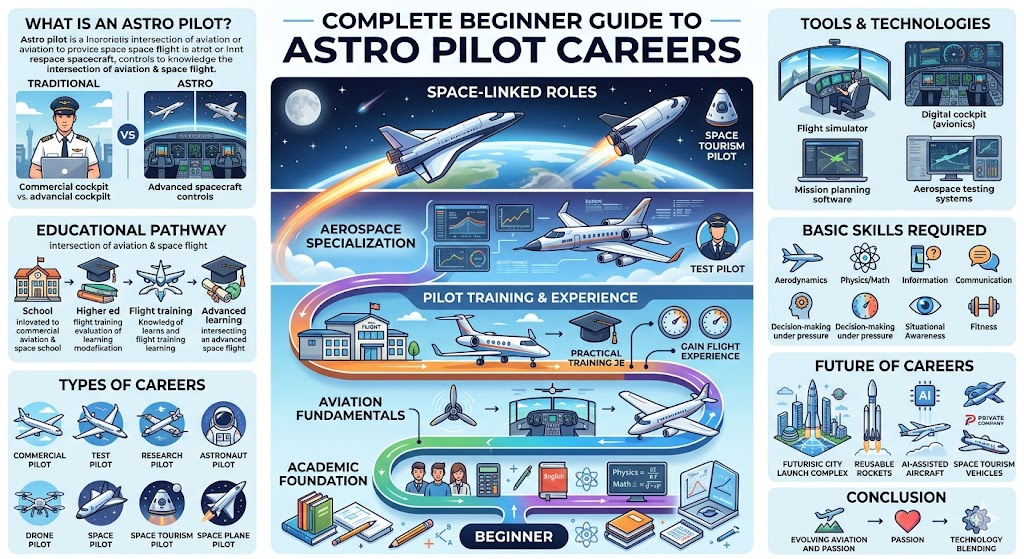
An astro pilot is a concept used to describe a pilot who operates at the intersection of aviation and space-related flight systems.
Simple Definition:
An astro pilot is a highly trained pilot who works with advanced aircraft, aerospace systems, and potentially space-capable vehicles in future aviation and space industries.
Key Difference:
| Role | Focus Area | Example |
|---|---|---|
| Traditional Pilot | Aircraft flying within Earth’s atmosphere | Commercial airline pilot |
| Astro Pilot Concept | Aviation + aerospace + space-linked systems | Test pilots, space mission pilots (emerging roles) |
Core Idea:
Astro pilot careers combine aviation skills with aerospace knowledge and future space travel technologies.
Types of Astro Pilot Careers
There are several career directions that fall under the broader concept of astro pilot pathways.
| Career Type | Description | Future Scope |
|---|---|---|
| Commercial Airline Pilot | Operates passenger aircraft | High demand globally |
| Test Pilot | Tests new aircraft and systems | Advanced aerospace development |
| Aerospace Research Pilot | Works on experimental flight technologies | Innovation and R&D |
| Astronaut Pilot (Conceptual) | Space mission pilot roles | Space agencies and missions |
| Space Tourism Pilot | Flies commercial space travel vehicles | Emerging private space industry |
Key Insight:
Most astro pilot careers begin with traditional aviation training before moving into advanced aerospace or experimental flight domains.
Basic Skills Required
To build a career in this field, students must develop strong foundational skills:
- Understanding of aerodynamics
- Basic physics and mathematics knowledge
- Strong communication abilities
- Decision-making under pressure
- Situational awareness
- Physical and mental fitness
These skills form the backbone of both aviation and aerospace careers.
Educational Pathway
A structured education path is essential for aspiring astro pilots.
School Level
- Focus on Physics and Mathematics
- Develop analytical thinking
- Improve English communication
Higher Education
- Aviation or aerospace engineering degree (optional but helpful)
- Pilot training programs after 10+2 or equivalent
Flight Training
- Ground school for aviation theory
- Practical flight training in aircraft
- Simulation-based training for advanced scenarios
Advanced Learning
- Aerospace systems knowledge
- Space mission training concepts
- High-performance aircraft handling
How to Become an Astro Pilot (Step-by-Step)
Step 1: Build Academic Foundation
Start with strong basics in science, especially physics and mathematics.
Step 2: Learn Aviation Fundamentals
Understand aircraft systems, flight principles, and aviation terminology.
Step 3: Begin Pilot Training
Enroll in certified flight training programs to learn real flying skills.
Step 4: Gain Flight Experience
Accumulate flying hours and practice navigation, communication, and safety procedures.
Step 5: Move Toward Aerospace Specialization
Explore advanced aviation systems, test flying, or experimental aircraft training.
Step 6: Explore Space-Linked Roles
Future opportunities may include space agencies, private space companies, or experimental flight programs.
Tools and Technologies Used
Astro pilot careers rely heavily on modern technology and simulation systems.
- Advanced flight simulators
- Navigation and autopilot systems
- Digital cockpit instruments (avionics)
- Mission planning software
- Aerospace testing systems
These tools help pilots understand both aviation and space-related flight environments.
Career Opportunities in Astro Pilot Field
Astro pilot careers are not limited to space alone—they include multiple aviation and aerospace roles.
- Commercial Airline Pilot
- Private Jet Pilot
- Aerospace Test Pilot
- Flight Instructor
- Aviation Research Specialist
- Space Industry Pilot Roles (emerging)
Key Insight:
Many professionals begin in traditional aviation before transitioning into advanced aerospace roles.
Challenges in Astro Pilot Careers
This career path is highly rewarding but also demanding:
- Long and expensive training process
- Strict medical and fitness requirements
- High competition in aviation industry
- Advanced technical learning requirements
- Limited current space-related pilot roles
Despite challenges, the field is expanding rapidly with new opportunities.
Future of Astro Pilot Careers
Astro pilot careers are expected to grow significantly in the coming years.
- Expansion of space tourism industry
- Development of reusable spacecraft
- AI-assisted aviation systems
- Hybrid aviation-space transportation systems
- Increased private space company involvement
Key Insight:
The future pilot may not only fly airplanes but also operate advanced aerospace vehicles and space-capable aircraft.
Frequently Asked Questions (FAQs)
1. What is an astro pilot?
An astro pilot is a concept that combines aviation and aerospace roles, including advanced flight and potential space-related piloting careers.
2. Is astro pilot a real job today?
Some roles exist in aviation and aerospace, while space-related pilot roles are still emerging.
3. How do I start an astro pilot career?
Start with basic education, then move into aviation training and flight experience.
4. Do I need engineering for this career?
Not mandatory, but aerospace or aviation engineering can be helpful.
5. What skills are important?
Physics, mathematics, communication, and decision-making skills are essential.
6. Can a commercial pilot become an astro pilot?
Yes, many future aerospace roles will build on commercial pilot experience.
7. Is space travel part of this career?
In future roles, yes—especially with growing space tourism.
8. What is the first step?
Focus on education and basic aviation knowledge.
9. Are astro pilot jobs available now?
Limited, but expanding in private space and aerospace industries.
10. Is this a high-paying career?
It can be, depending on specialization and experience level.
11. What is the future scope?
Strong growth expected with space exploration and advanced aviation technologies.
12. Is it hard to become an astro pilot?
It requires dedication, training, and long-term commitment.
Conclusion
Astro pilot careers represent the future evolution of aviation, combining traditional flying skills with advanced aerospace and space exploration opportunities. While the path begins with basic aviation training, it gradually expands into high-tech, experimental, and space-related domains.
For beginners, the journey may seem long, but it is built step by step through education, training, and experience. As the aviation and space industries continue to grow, new opportunities will emerge for those who are prepared and passionate about flying beyond traditional boundaries.
If you are fascinated by aircraft, space, and future technology, the astro pilot path offers one of the most exciting career journeys in the modern world.