Introduction
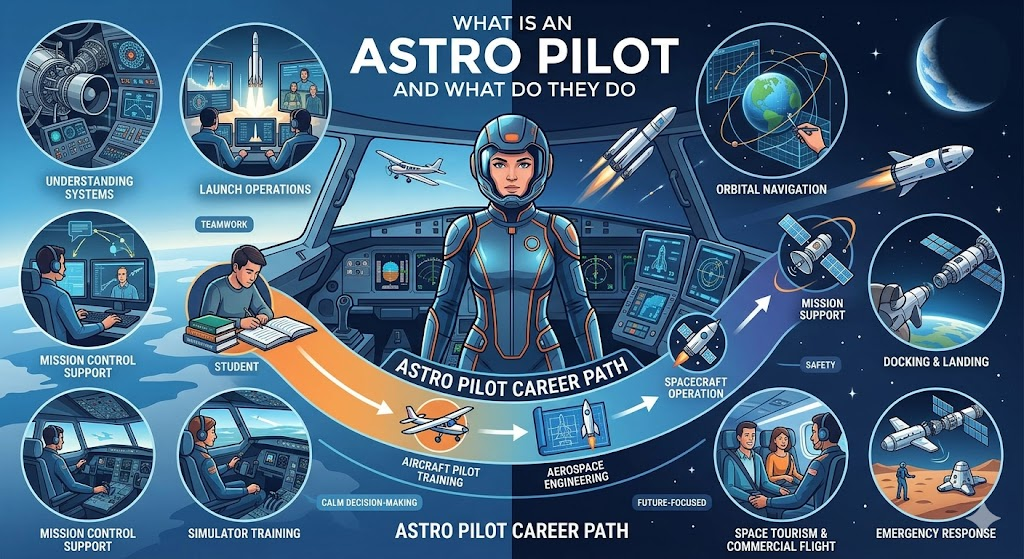
The idea of an astro pilot sounds exciting because it combines two powerful worlds: aviation and space exploration. For many people, a pilot is someone who flies an aircraft in the sky, while an astronaut is someone who travels beyond Earth. An astro pilot sits somewhere between these ideas. The term is often used to describe a person who may operate, guide, support, or train for advanced aerospace vehicles, spacecraft, orbital vehicles, or future space travel systems.
As space tourism, reusable rockets, private space companies, lunar missions, and advanced aerospace technologies continue to grow, more people are becoming interested in careers that go beyond traditional flying. Students, aviation learners, engineering aspirants, and space enthusiasts often ask: What is an astro pilot, and what do they actually do?
This blog explains the meaning of an astro pilot in simple words, how the role is different from an aircraft pilot and an astronaut, what skills are needed, and what the future of this career may look like.
What Is an Astro Pilot
An astro pilot can be understood as a pilot or aerospace professional connected with space-related flying, spacecraft operations, or future space travel missions. The term is not always used as a formal job title in every country or organization, but it is closely related to roles such as:
- Astronaut pilot
- Spacecraft pilot
- Space mission pilot
- Aerospace vehicle operator
- Commercial spaceflight pilot
- Test pilot for advanced aerospace systems
- Space tourism vehicle operator
- Mission operations specialist
In simple words, an astro pilot is someone who may help control, guide, monitor, or operate vehicles designed to travel beyond normal airspace. These vehicles may include spacecraft, spaceplanes, orbital vehicles, lunar landers, reusable launch systems, or future vehicles designed for commercial space travel.
Traditional pilots operate aircraft within Earth’s atmosphere. Astro pilots, on the other hand, are linked with vehicles and missions that may move beyond the atmosphere, enter orbit, dock with space stations, return safely to Earth, or support future exploration missions.
Astro Pilot Meaning in Simple Words
The word astro relates to stars, space, and celestial objects. The word pilot refers to a person trained to operate or guide a vehicle. So, the phrase astro pilot can be understood as a space-focused pilot or a pilot connected with aerospace and space missions.
A simple definition would be:
An astro pilot is a trained aerospace professional who may operate, assist, or support the control of spacecraft, advanced flying vehicles, or space-related mission systems.
An astro pilot is not always the same as a normal aircraft pilot. A normal pilot usually flies airplanes or helicopters within Earth’s atmosphere. An astro pilot may need knowledge of aircraft systems, spacecraft systems, orbital movement, navigation, mission control, engineering, safety procedures, and emergency response.
An astro pilot is also not always the same as an astronaut. Some astronauts may be pilots, but many astronauts are scientists, engineers, doctors, mission specialists, or researchers. Astro pilots are more specifically connected with the flying, navigation, control, and operational side of space missions.
What Does an Astro Pilot Do
The work of an astro pilot depends on the mission, vehicle type, organization, and training level. Since the term is broad, the exact responsibilities can vary. However, the role is generally connected with spacecraft operation, advanced vehicle control, safety monitoring, mission support, and technical decision-making.
Understanding Spacecraft and Aerospace Systems
An astro pilot must understand how advanced vehicles work. Unlike regular aircraft, spacecraft operate in extreme conditions. They may deal with high-speed launch, microgravity, vacuum, orbital paths, re-entry heating, docking systems, life-support systems, and automated controls.
An astro pilot may need to understand:
- Flight control systems
- Propulsion basics
- Navigation systems
- Communication systems
- Life-support systems
- Emergency backup systems
- Docking and landing systems
- Re-entry and recovery procedures
Supporting Launch Operations
During launch, every second matters. An astro pilot may monitor instruments, follow checklists, communicate with mission control, and help ensure that the vehicle performs correctly. In many modern spacecraft, systems are highly automated, but trained crew members still need to understand what is happening and respond if something goes wrong.
Monitoring Navigation and Flight Path
Space navigation is very different from flying an aircraft. Aircraft pilots use air traffic routes, runways, weather reports, and atmospheric navigation. Spacecraft travel using orbital mechanics, planned trajectories, computer guidance, and mission control support.
An astro pilot may help monitor:
- Vehicle position
- Speed and direction
- Orbital path
- Docking alignment
- Re-entry path
- Landing sequence
- Fuel and system performance
Assisting Mission Control Teams
Space missions are teamwork-driven. An astro pilot does not work alone. They may coordinate with engineers, flight directors, mission specialists, ground controllers, safety officers, and other crew members. Clear communication is one of the most important parts of the job.
Even a small misunderstanding during a mission can create serious risk. That is why astro pilots need calm communication, discipline, and strong teamwork skills.
Handling Emergency Situations
Space missions involve high risk. An astro pilot may need to respond to system warnings, navigation issues, pressure problems, communication failures, landing challenges, or unexpected mission changes.
They must be trained to remain calm under pressure and follow emergency procedures carefully. Their decisions can affect crew safety, vehicle safety, and mission success.
Supporting Space Tourism and Commercial Spaceflight
As commercial space travel grows, astro pilots may become important for future passenger spaceflight. In the future, trained pilots or operators may support space tourism vehicles, suborbital flights, orbital travel, private space stations, and commercial lunar missions.
Their role could include:
- Passenger safety support
- Vehicle operation monitoring
- Emergency response
- Flight readiness checks
- Communication with ground teams
- Guidance during launch and return phases
Operating Simulators and Training Systems
Before anyone controls a real spacecraft or advanced aerospace vehicle, they spend a huge amount of time in simulators. Astro pilots may train using high-level simulation systems that recreate launch, docking, emergency events, orbital navigation, and landing conditions.
Simulator training helps them practice dangerous situations without real-world risk.
Astro Pilot vs Aircraft Pilot
An aircraft pilot and an astro pilot both need discipline, focus, technical understanding, and safety awareness. However, the operating environment and training needs are very different.
| Factor | Aircraft Pilot | Astro Pilot |
|---|---|---|
| Main Vehicle | Airplane, helicopter, or jet | Spacecraft, spaceplane, orbital vehicle, or advanced aerospace vehicle |
| Operating Area | Earth’s atmosphere | Upper atmosphere, suborbital space, orbit, or beyond |
| Main Focus | Takeoff, flight, navigation, landing | Launch, mission control, orbital navigation, docking, re-entry, landing |
| Training Type | Aviation training and flight hours | Aerospace systems, spacecraft operations, mission training, simulations |
| Navigation | Air routes, airports, weather, air traffic control | Orbital paths, mission control, automated systems, space navigation |
| Risk Level | High but well-regulated and routine | Very high due to space environment and mission complexity |
| Physical Demands | Medical fitness required | Higher physical and mental fitness may be required |
| Team Support | Air traffic control and flight crew | Mission control, engineers, crew, ground operations |
| Mission Goal | Transport passengers, cargo, defense, private flying | Space travel, research, exploration, tourism, testing |
| Career Path | Flight school and aviation licensing | Aviation, engineering, science, astronaut training, aerospace operations |
A normal pilot must understand weather, runways, air traffic rules, fuel planning, aircraft systems, and passenger safety. An astro pilot must understand many of those ideas plus spacecraft systems, mission planning, orbital movement, extreme environments, and space safety.
Astro Pilot vs Astronaut
Many people may think an astro pilot and an astronaut are exactly the same, but there is a difference.
An astronaut is a trained space crew member who may travel into space for a mission. Astronauts can have different roles. Some are pilots, while others are mission specialists, scientists, engineers, doctors, researchers, or payload specialists.
An astro pilot is more specifically focused on the flying, control, vehicle operation, navigation, and mission safety side of space travel.
Key Difference
- Astronaut: A broad term for someone trained for space missions.
- Astro pilot: A space-focused pilot or operator connected with spacecraft control and aerospace vehicle operations.
For example, on a space mission, one crew member may focus on scientific experiments, another may handle robotics, another may manage medical tasks, and another may support flight control. The person focused on piloting or vehicle operation would be closest to the idea of an astro pilot.
Skills Needed to Become an Astro Pilot
Becoming an astro pilot or entering a related aerospace career requires a strong mix of technical, mental, physical, and teamwork skills. This is not a simple career path, but students can start building the right foundation early.
Strong Knowledge of Physics and Mathematics
Physics and mathematics are extremely important because spaceflight depends on motion, speed, force, gravity, energy, pressure, and navigation. A future astro pilot should understand basic and advanced science concepts.
Important topics may include:
- Mechanics
- Gravity
- Motion
- Energy
- Aerodynamics
- Orbital basics
- Navigation
- Measurement and calculation
Aviation Understanding
Aviation knowledge is useful because space vehicles and aircraft share some operational ideas, especially in flight control, safety, communication, navigation, and emergency response.
A strong background in aviation can help future astro pilots understand:
- Flight controls
- Aircraft systems
- Crew coordination
- Safety checklists
- Navigation
- Weather awareness
- Landing procedures
Engineering Awareness
Astro pilots do not always need to design spacecraft, but they must understand how complex systems work. Engineering awareness helps them identify problems, understand vehicle behavior, and communicate with technical teams.
Useful engineering fields include:
- Aerospace engineering
- Aeronautical engineering
- Mechanical engineering
- Electrical engineering
- Computer engineering
- Robotics
- Systems engineering
Problem-Solving Ability
Space missions can change quickly. A system may behave unexpectedly, communication may become delayed, or a landing condition may become difficult. Astro pilots must be strong problem-solvers who can think clearly and act correctly under pressure.
Calm Decision-Making
A good astro pilot must remain calm even during stressful situations. Panic can lead to mistakes. Calm decision-making helps protect the crew, vehicle, and mission.
Physical and Mental Fitness
Space travel can place pressure on the human body and mind. High acceleration, confined spaces, microgravity, isolation, and mission stress can be difficult. Future astro pilots may need excellent physical fitness, medical fitness, and mental strength.
Teamwork and Communication
No space mission succeeds because of one person. Astro pilots must work with commanders, engineers, scientists, ground teams, and support staff. Clear communication and teamwork are essential.
Computer and Navigation Skills
Modern spacecraft and aerospace vehicles depend heavily on computers. Astro pilots should be comfortable with digital systems, software interfaces, navigation displays, automated controls, and simulation tools.
Safety-First Mindset
Safety is one of the most important qualities. Astro pilots must follow procedures carefully, respect checklists, monitor risks, and never ignore small warning signs.
Education Path for Future Astro Pilots
There is no single fixed path to becoming an astro pilot because the role can vary by country, space agency, company, and mission type. However, students can prepare by choosing strong academic and technical fields.
Useful Study Areas
Future astro pilots may study:
- Aerospace engineering
- Aeronautical engineering
- Aviation science
- Physics
- Space science
- Mechanical engineering
- Electrical engineering
- Computer science
- Robotics and automation
- Mathematics
- Systems engineering
- Flight operations
- Human factors in aviation
- Space mission design
Flight Training
Flight training can be helpful because it builds discipline, situational awareness, cockpit communication, navigation skills, emergency response habits, and confidence in operating complex vehicles.
Some future astro pilot candidates may come from:
- Civil aviation
- Military aviation
- Test pilot programs
- Aerospace engineering
- Space mission operations
- Commercial spaceflight training
Astronaut Training
For those aiming at formal space missions, astronaut training may be required. This can include physical training, survival training, spacecraft systems training, robotics training, spacewalk preparation, mission simulation, and emergency procedures.
Computer and Automation Training
Future space vehicles may use more automation, artificial intelligence, remote control, and advanced software systems. This means future astro pilots may also need strong digital and technical skills.
Useful areas include:
- Software basics
- Data interpretation
- Simulation tools
- Robotics
- Control systems
- Mission planning software
- Artificial intelligence awareness
- Cybersecurity basics for aerospace systems
Where Can Astro Pilots Work
Since astro pilot is a broad and future-focused concept, related professionals may work in several environments.
Space Agencies
Government space agencies may need astronauts, pilot astronauts, spacecraft operators, test pilots, engineers, and mission specialists. These roles are usually highly competitive and require excellent education, experience, and training.
Aerospace Companies
Private aerospace companies build rockets, spacecraft, satellites, spaceplanes, and launch systems. Astro pilot-related professionals may support testing, simulation, mission planning, safety, training, or vehicle operations.
Commercial Space Travel Companies
As commercial space travel grows, companies may need trained operators and pilots for suborbital flights, orbital missions, private astronaut missions, and passenger safety operations.
Space Tourism Programs
Space tourism may create new roles for flight crew, training instructors, mission guides, safety operators, and vehicle support specialists. These roles may not always be called astro pilots, but they may involve similar skills.
Defense and Research Organizations
Defense and research organizations may work on high-speed aircraft, space defense systems, advanced aerospace vehicles, and experimental flight programs. Test pilots and aerospace specialists may play a major role here.
Simulation and Training Centers
Training centers use advanced simulators to prepare crews and operators. Astro pilot-related professionals may work as instructors, simulator operators, mission trainers, or safety evaluators.
Mission Control Operations
Not every space operations expert travels into space. Some work from the ground in mission control centers. They monitor spacecraft, support decisions, guide crews, and manage mission safety.
Research Labs
Advanced aviation and space research labs study future flying systems, propulsion, robotics, life support, navigation, and human-machine interaction. Astro pilot skills can connect strongly with these areas.
Is Astro Pilot a Real Career Today
The answer is both simple and slightly complex.
Astro pilot is not always a formal job title used everywhere today. You may not find every space agency or company hiring under the exact title “astro pilot.” However, the concept is real because it connects with existing roles such as:
- Astronaut pilot
- Spacecraft pilot
- Spacecraft commander
- Commercial spaceflight pilot
- Test pilot
- Aerospace vehicle operator
- Mission operations specialist
- Flight dynamics officer
- Spacecraft systems operator
- Space tourism flight crew
So, while “astro pilot” may sound futuristic, the work behind the idea already exists in different forms. As space travel becomes more commercial and advanced, the term may become more common in education, media, training programs, and future career discussions.
Future of Astro Pilots
The future of astro pilots looks exciting because space travel is changing. For many years, spaceflight was mostly managed by government space agencies. Today, private companies, commercial missions, reusable launch vehicles, lunar programs, and space tourism are creating new possibilities.
Reusable Rockets
Reusable rockets are changing the economics of space travel. As launch systems become more reusable, space missions may become more frequent. More frequent missions may create more demand for trained professionals who understand spacecraft operations.
Space Tourism
Space tourism is one of the biggest reasons people are talking about future space pilots. If more civilians travel to space, trained crew members will be needed to guide passengers, monitor safety, handle emergencies, and support mission operations.
Private Space Stations
Future private space stations may need transportation systems, docking operations, crew transfer missions, and emergency return planning. Astro pilot-related professionals may support these missions.
Lunar Missions
Moon missions require advanced navigation, landing systems, surface operations, and return planning. Space pilots and mission operators may play a key role in these missions.
Spaceplanes and Advanced Vehicles
Some future vehicles may combine aircraft-like and spacecraft-like features. These may require pilots who understand both atmospheric flight and spaceflight concepts.
Why Astro Pilot Careers Are Important
Astro pilot careers are important because space missions require safety, precision, discipline, and technical knowledge. Whether the mission involves astronauts, researchers, tourists, cargo, or exploration, the vehicle must be operated and monitored carefully.
Astro pilots and related professionals may help with:
- Safe mission execution
- Crew protection
- Vehicle control
- Emergency response
- Navigation accuracy
- Passenger confidence
- Commercial space travel
- Space exploration
- Mission success
- Future aerospace transportation
As humans explore farther from Earth, the need for skilled aerospace professionals will continue to grow.
Beginner Tips for Students Interested in Astro Pilot Careers
Students who are interested in becoming astro pilots or entering related careers should start early and build a strong foundation.
1- Focus on Science and Mathematics
Physics and mathematics are the foundation of aviation and spaceflight. Students should take these subjects seriously and understand concepts instead of only memorizing them.
2- Learn About Aviation
Read about aircraft, pilots, airports, flight controls, and navigation. Understanding basic aviation will help you later understand advanced aerospace systems.
3- Explore Space Science
Learn about rockets, planets, satellites, astronauts, space stations, gravity, orbits, and missions. This builds curiosity and long-term interest.
4- Build Physical Fitness
Fitness matters in aviation and space careers. Start building healthy habits, discipline, stamina, and mental strength.
5- Practice Problem-Solving
Solve puzzles, study science problems, learn coding basics, and practice logical thinking. Astro pilot-related careers require quick and clear thinking.
6- Try Flight Simulators
Flight simulators can help beginners understand cockpit thinking, navigation, controls, and decision-making. They are not a replacement for real training, but they are useful for learning.
7- Learn Communication Skills
Good communication is essential in aviation and space missions. Practice speaking clearly, listening carefully, and working in teams.
8- Study Engineering Basics
Engineering knowledge helps you understand how machines, systems, and vehicles work. Even basic engineering awareness can be useful.
9- Follow Space Industry Developments
Stay updated with space missions, commercial space travel, moon programs, spacecraft launches, and aerospace technology. This helps you understand where the industry is going.
10- Think Long-Term
Astro pilot-related careers require years of preparation. Be patient, stay consistent, and build your skills step by step.
Common Myths About Astro Pilots
Myth 1- Astro Pilots Only Fly Rockets
Astro pilots may not simply “fly rockets” like aircraft pilots fly planes. Many modern spacecraft use automated systems, mission control support, and computer guidance. The pilot’s role may involve monitoring, decision-making, system control, and emergency handling.
Myth 2- Only Military Pilots Can Become Space Pilots
Military test pilots have historically played a major role in space programs, but future space careers may include engineers, scientists, commercial pilots, robotics experts, mission operators, and technical specialists.
Myth 3- Astro Pilots Do Not Need Science Knowledge
This is false. Spaceflight depends heavily on science, mathematics, engineering, and technology. A strong academic foundation is very important.
Myth 4- Space Flying Is Like Normal Flying
Space flying is very different from normal flying. Aircraft move through air, while spacecraft may operate in vacuum, orbit, microgravity, and extreme temperature conditions.
Myth 5- The Career Path Is Quick and Simple
Astro pilot-related careers require years of education, training, experience, discipline, and selection. It is a challenging path, but it can be rewarding for dedicated learners.
Astro Pilot Career Opportunities
Astro pilot careers may not always appear under one exact title, but many related career options exist in aviation and space industries.
Possible career directions include:
- Aerospace engineer
- Astronaut candidate
- Pilot astronaut
- Test pilot
- Spacecraft operator
- Mission control specialist
- Flight operations engineer
- Commercial spaceflight crew member
- Space tourism safety officer
- Simulation instructor
- Robotics operator
- Aerospace systems analyst
- Space mission planner
- Flight dynamics specialist
Students should understand that the path may differ depending on country, organization, mission type, and personal background.
How Astro Pilots Support Space Missions
Astro pilots support space missions by combining technical understanding with practical decision-making. They may help before, during, and after a mission.
Before the Mission
Before launch, they may train in simulators, study mission plans, review safety procedures, practice emergency actions, and understand vehicle systems.
During the Mission
During the mission, they may monitor spacecraft systems, assist with navigation, communicate with mission control, support docking, handle alerts, and help maintain crew safety.
After the Mission
After return, they may support landing procedures, recovery operations, mission review, technical feedback, and future training improvements.
Astro Pilot and Space Tourism
Space tourism may become one of the most visible areas where astro pilot-related roles grow. Tourists who travel to space may not have deep technical knowledge, so trained crew members will be needed to guide them.
An astro pilot in space tourism may help with:
- Safety briefings
- Passenger preparation
- Vehicle monitoring
- Communication support
- Emergency response
- Launch and re-entry support
- Comfort and confidence during the mission
As space travel becomes more available, safety and professionalism will become even more important.
Astro Pilot and Technology
Technology will shape the future of astro pilots. Future vehicles may use automation, artificial intelligence, advanced sensors, digital cockpits, robotics, and remote control systems.
This means future astro pilots may need to understand both flying and technology. They may not only control a vehicle manually but also supervise automated systems, interpret data, and make decisions when computers need human support.
Important technology areas include:
- Autonomous navigation
- Spacecraft software
- Digital flight displays
- Artificial intelligence support systems
- Robotics
- Remote operations
- Cybersecurity
- Simulation technology
- Human-machine interfaces
Challenges of Becoming an Astro Pilot
The path to becoming an astro pilot or related aerospace professional can be difficult. It requires strong education, physical fitness, technical training, patience, and discipline.
Common challenges include:
- High competition
- Long preparation time
- Strong academic requirements
- Physical and medical standards
- Expensive training in some cases
- Limited formal openings
- Need for advanced technical knowledge
- High-pressure work environment
- Continuous learning
- Strict safety expectations
However, these challenges should not discourage students. Instead, they should help learners understand the seriousness of the field and prepare step by step.
Who Should Consider an Astro Pilot Career Path
An astro pilot-related career may be suitable for people who love aviation, space, technology, science, and problem-solving.
This path may be good for you if you:
- Are curious about space and flying
- Enjoy science and mathematics
- Like solving technical problems
- Can stay calm under pressure
- Want to work in a disciplined environment
- Enjoy teamwork
- Are interested in engineering or aviation
- Want a future-focused career
- Are ready for long-term preparation
- Care deeply about safety and mission success
It may not be ideal for someone who wants a quick career path, dislikes technical subjects, avoids strict training, or does not enjoy high-responsibility work.
FAQs
1- What is an astro pilot?
An astro pilot is a space-focused pilot or aerospace professional connected with spacecraft operation, advanced aerospace vehicles, or space-related missions. The term may not always be used as a formal job title, but it is related to astronaut pilots, spacecraft pilots, commercial spaceflight pilots, and mission operators.
2- Is an astro pilot the same as an astronaut?
Not exactly. An astronaut is a trained space crew member, while an astro pilot is more focused on the flying, navigation, control, and operation side of space missions. Some astronauts may work as pilots, but not every astronaut is a pilot.
3- What does an astro pilot do?
An astro pilot may help operate spacecraft systems, monitor navigation, support launch and landing, communicate with mission control, assist in docking, manage safety procedures, and respond to emergencies. The exact duties depend on the mission and organization.
4- Is astro pilot a real job?
The exact title “astro pilot” is not always used formally everywhere. However, the concept is real and connects with existing roles such as astronaut pilot, spacecraft pilot, test pilot, mission operations specialist, and commercial spaceflight crew member.
5- What subjects should I study to become an astro pilot?
Useful subjects include physics, mathematics, computer science, aerospace engineering, aeronautical engineering, mechanical engineering, aviation science, robotics, and space science. A strong technical foundation is important for this career direction.
6- Do astro pilots need flight training?
Flight training can be very useful, especially for roles connected with piloting, test flying, or commercial spaceflight. However, some related space operations roles may focus more on engineering, mission control, or spacecraft systems rather than traditional aircraft flying.
7- Can commercial space travel create astro pilot jobs?
Yes, commercial space travel may create more demand for trained spaceflight crew, spacecraft operators, safety specialists, and mission support professionals. As space tourism grows, astro pilot-related roles may become more visible.
8- What skills are important for astro pilots?
Important skills include technical knowledge, calm decision-making, communication, teamwork, problem-solving, physical fitness, mental strength, computer awareness, navigation understanding, and a strong safety-first mindset.
9- Is aerospace engineering useful for becoming an astro pilot?
Yes, aerospace engineering is highly useful because it teaches aircraft and spacecraft systems, aerodynamics, propulsion, structures, control systems, and mission-related technology. It can be a strong academic path for students interested in space aviation.
10- What is the future of astro pilot careers?
The future looks promising because of reusable rockets, space tourism, private space stations, lunar missions, advanced aerospace vehicles, and commercial spaceflight. While the field will remain competitive, more space activity may create new career paths.
Conclusion
An astro pilot represents the exciting future connection between aviation and space exploration. While the title may not always be used formally today, the idea is closely linked with astronaut pilots, spacecraft operators, commercial spaceflight pilots, test pilots, and mission operations professionals. Astro pilots may help guide advanced vehicles, support spacecraft systems, monitor safety, assist with mission control, and prepare for future space travel. For students and beginners, the best way to start is by building strong foundations in science, mathematics, aviation, engineering, communication, and physical fitness. As space tourism, private missions, reusable rockets, and lunar exploration continue to grow, astro pilot-related careers may become more important in the future of aerospace.