Introduction
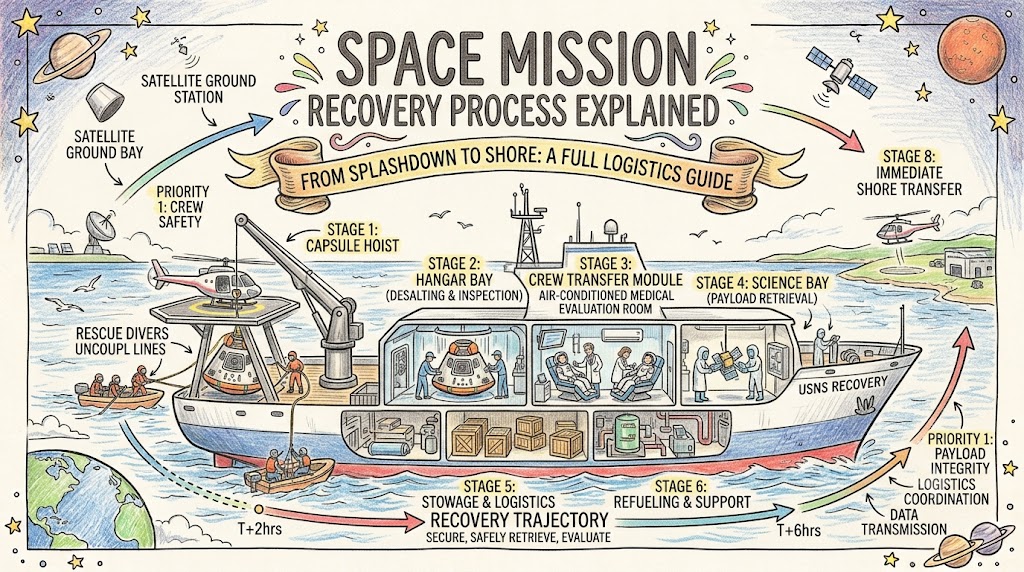
A space mission does not officially end when a spacecraft lands. After touchdown or splashdown, a carefully coordinated recovery operation begins to protect the astronauts, secure the spacecraft, collect scientific materials, and preserve important mission data.
The space mission recovery process involves specialists from many fields. Pilots, divers, doctors, engineers, communication teams, ship crews, ground vehicles, and mission controllers may all participate.
Their first priority is crew safety. They must locate the spacecraft, check for hazards, stabilise the vehicle, open the hatch, assist the astronauts, and begin medical examinations. After the crew is safe, teams recover experiments, cargo, computers, and the spacecraft itself.
For students, the recovery process is an important example of how planning, engineering, medicine, navigation, and teamwork support space exploration.
What Is Space Mission Recovery?
Space mission recovery is the complete process of locating, securing, and retrieving astronauts and spacecraft after a mission returns to Earth.
Recovery begins before the spacecraft lands. Teams are already positioned near the planned landing area, communication systems are active, medical facilities are prepared, and transport vehicles are ready.
The process may include:
- Tracking the descending spacecraft
- Confirming the landing location
- Reaching the capsule or vehicle
- Checking for fire, leaks, or structural damage
- Stabilising the spacecraft
- Helping astronauts exit
- Performing medical assessments
- Recovering scientific samples
- Transporting the spacecraft
- Studying mission data
Recovery procedures depend on whether the spacecraft lands on land, in water, or on a runway.
Why Recovery Planning Starts Before Launch
Recovery operations are planned long before the mission begins.
Engineers and mission planners study possible landing zones, weather patterns, ocean conditions, emergency locations, transport routes, and medical requirements.
The recovery plan must consider both normal and emergency situations.
Teams prepare for possibilities such as:
- Landing far from the planned location
- Rough weather
- Communication failure
- Parachute problems
- Capsule rollover
- Crew injury
- Toxic fuel leakage
- Delayed rescue
- Fire or electrical hazards
Training exercises are conducted repeatedly so that every team member understands their role.
Main Stages of Space Mission Recovery
The recovery process can be divided into several major stages:
- Tracking the spacecraft
- Confirming touchdown or splashdown
- Reaching the landing site
- Assessing hazards
- Stabilising the spacecraft
- Opening the hatch
- Recovering the astronauts
- Performing medical checks
- Recovering samples and equipment
- Transporting and inspecting the spacecraft
Each stage must be completed carefully and in the correct order.
Tracking the Returning Spacecraft
Mission controllers track the spacecraft throughout reentry and descent.
Tracking systems help teams estimate the exact landing position and monitor whether the spacecraft is following the planned route.
Common tracking methods include:
- Ground radar
- Satellites
- GPS systems
- Radio signals
- Aircraft observations
- Ship-based tracking equipment
- Emergency locator beacons
The spacecraft may continue transmitting its position after landing.
If communication is lost, recovery teams use the last known location, predicted flight path, radar data, and visual searches.
Confirming a Safe Landing
After touchdown or splashdown, mission controllers must confirm that the spacecraft has landed safely.
The crew may report:
- Landing completed
- Cabin pressure stable
- No visible fire
- No water leakage
- Crew members conscious
- Communication systems working
- Vehicle position stable
Automatic sensors may also transmit landing information.
If the crew cannot communicate, recovery teams treat the situation as a possible emergency and move quickly toward the vehicle.
Different Types of Recovery Operations
Recovery methods vary according to the spacecraft’s landing system.
Ocean Splashdown Recovery
A capsule lands in the ocean using parachutes.
Recovery requires:
- Ships
- Helicopters
- Divers
- Flotation equipment
- Medical teams
- Capsule-lifting systems
Ocean conditions can strongly affect the operation.
Land Capsule Recovery
A capsule lands on the ground using parachutes, airbags, shock absorbers, or small rockets.
Recovery may involve:
- Helicopters
- Off-road vehicles
- Medical teams
- Fire crews
- Engineers
- Security personnel
Remote landing zones can make access difficult.
Runway Recovery
A spaceplane or reusable vehicle lands on a runway.
Recovery teams reach the spacecraft using ground vehicles.
They inspect the landing gear, fuel systems, engines, thermal protection, and crew cabin before opening the hatch.
Powered Landing Recovery
Some spacecraft use engines and landing legs to touch down.
Recovery teams must check for:
- Hot engines
- Remaining fuel
- Unstable landing legs
- Electrical hazards
- Pressurised systems
Reaching the Spacecraft
Recovery teams are positioned near the predicted landing zone before the spacecraft returns.
After landing, they travel toward the vehicle using ships, helicopters, boats, aircraft, trucks, or specialised ground vehicles.
The time needed to reach the spacecraft depends on:
- Distance from the planned landing point
- Weather conditions
- Ocean waves
- Terrain
- Visibility
- Communication quality
- Crew medical condition
Emergency aircraft may arrive first to observe the landing site and report conditions.
Initial Hazard Assessment
Before anyone opens the spacecraft, recovery specialists inspect the area for danger.
Spacecraft may contain hazardous materials, including:
- Toxic propellants
- High-pressure gases
- Damaged batteries
- Hot surfaces
- Electrical systems
- Sharp structural debris
- Fire risks
- Unexploded devices or pyrotechnics
Recovery teams wear protective equipment and use detectors to identify dangerous substances.
They may also establish a safety zone around the spacecraft.
Stabilising the Spacecraft
The vehicle must be stable before astronauts can exit.
A capsule that lands on uneven ground may tilt or roll. A capsule in the ocean may move with waves or float upside down.
Stabilisation methods may include:
- Attaching ropes
- Installing supports
- Inflating flotation bags
- Using recovery collars
- Securing landing legs
- Connecting the vehicle to a ship
- Clearing parachute lines
In water recovery, divers may attach inflatable equipment around the capsule to prevent it from sinking or rolling.
Handling an Upside-Down Capsule
A water-landing capsule may sometimes float upside down.
This position can be uncomfortable for astronauts, but spacecraft are designed to handle it temporarily.
Inflatable recovery balloons can rotate the capsule into an upright position.
The crew remains secured in their seats until the spacecraft is stable.
Divers and recovery personnel are trained to assist if the automatic righting system fails.
Communicating With the Crew
Recovery teams establish communication with the astronauts as soon as possible.
They ask about:
- Injuries
- Breathing conditions
- Cabin temperature
- Smoke or fire
- Water leakage
- Equipment failure
- Crew alertness
- Medical emergencies
Astronauts may be instructed to keep helmets on, remain seated, or prepare emergency equipment.
Clear communication helps recovery teams decide whether the hatch should be opened normally or through an emergency procedure.
Opening the Spacecraft Hatch
The hatch is opened only after the area has been declared safe.
Before opening it, teams check:
- Cabin pressure
- External air quality
- Fire risk
- Toxic gases
- Water level
- Capsule stability
- Electrical condition
- Crew readiness
Opening the hatch too early could expose the crew to smoke, chemicals, seawater, or pressure changes.
In emergency situations, specially trained personnel may open an alternative hatch or use rescue equipment.
Recovering the Astronauts
Astronaut recovery is the most important stage.
Crew members may exit independently after short missions, but astronauts returning from long missions often need assistance.
Recovery personnel may use:
- Support harnesses
- Stretchers
- Lifting seats
- Medical chairs
- Helicopter baskets
- Boats
- Mobile platforms
Astronauts are moved slowly to reduce dizziness and changes in blood pressure.
Why Astronauts Need Assistance After Landing
The human body changes during spaceflight.
In microgravity, muscles do not work against body weight in the normal way. Bones experience less loading, body fluids shift upward, and the balance system adapts to weightlessness.
After returning to Earth, astronauts may experience:
- Weak legs
- Dizziness
- Low blood pressure
- Motion sickness
- Poor balance
- Fatigue
- Headaches
- Back discomfort
- Difficulty walking
These effects are often temporary, but medical supervision is necessary.
Immediate Medical Checks
Medical teams examine astronauts shortly after recovery.
Initial checks may include:
- Heart rate
- Blood pressure
- Oxygen level
- Body temperature
- Breathing
- Alertness
- Hydration
- Muscle strength
- Balance
- Signs of injury
Doctors also ask astronauts about pain, nausea, vision changes, headache, or breathing difficulty.
Crew members may then be transported to a hospital, medical centre, recovery ship, or specialised examination facility.
Post-Mission Medical Evaluation
The medical process continues after the first examination.
Astronauts may undergo:
- Blood tests
- Heart monitoring
- Bone-density tests
- Muscle evaluation
- Eye examinations
- Balance testing
- Neurological checks
- Psychological evaluation
- Radiation-exposure review
These examinations help doctors understand how spaceflight affects the human body.
The information is also used to improve astronaut health during future missions.
Rehabilitation After Spaceflight
Astronauts returning from long missions often begin a rehabilitation programme.
The goal is to help the body readjust to Earth’s gravity.
Rehabilitation may include:
- Strength training
- Balance exercises
- Walking practice
- Cardiovascular exercise
- Flexibility training
- Core strengthening
- Physical therapy
- Nutrition support
Recovery time differs from one astronaut to another.
Some crew members feel better within hours, while others may require several days or weeks.
Recovering Scientific Samples
Space missions often return valuable experiments and samples.
These materials may include:
- Biological samples
- Blood and tissue samples
- Space-grown plants
- Material-science experiments
- Microgravity research
- Computer storage devices
- Earth-observation data
- Spacecraft components
Some samples must be removed quickly because they require refrigeration or special handling.
Scientists follow strict procedures to avoid contamination or damage.
Planetary Protection Procedures
Certain missions may return material collected from another world.
These samples require additional safety measures.
Planetary protection procedures are designed to:
- Prevent Earth organisms from contaminating the sample
- Prevent unknown material from entering the environment
- Maintain scientific accuracy
- Protect recovery personnel
- Control sample transport
Samples may be placed inside sealed containers and transported to specialised laboratories.
Recovering Mission Data
Spacecraft computers record large amounts of information during flight.
After recovery, engineers download data related to:
- Reentry temperature
- Navigation performance
- Parachute deployment
- Engine operation
- Cabin pressure
- Communication quality
- Landing impact
- Crew health
- Electrical systems
- Heat-shield behaviour
This information helps experts determine whether every system worked correctly.
Recovering the Spacecraft
Once the astronauts and urgent samples are removed, the spacecraft itself is recovered.
For ocean landings, a crane may lift the capsule onto a recovery ship.
For land landings, the vehicle may be transported using a truck, trailer, aircraft, or specialised carrier.
The spacecraft must be handled carefully because it may still contain:
- Fuel
- Batteries
- Pressurised tanks
- Pyrotechnic devices
- Sensitive electronics
- Contaminated materials
Inspecting the Spacecraft
Engineers perform a detailed inspection after recovery.
They examine:
- Heat-shield damage
- Exterior panels
- Windows
- Parachutes
- Landing legs
- Flotation systems
- Electrical equipment
- Cabin structure
- Communication systems
- Engine components
Even small marks or damaged parts can provide important information.
The goal is to understand how the vehicle responded to launch, space conditions, reentry, and landing.
Heat-Shield Inspection
The heat shield receives special attention because it protects the spacecraft during atmospheric reentry.
Engineers inspect it for:
- Cracks
- Burn marks
- Missing material
- Uneven heating
- Structural damage
- Unexpected erosion
Ablative heat shields are designed to lose material as they carry heat away.
Engineers compare the actual damage with computer predictions and ground-test results.
Parachute Inspection
Parachutes may be recovered and examined after landing.
Specialists study:
- Fabric condition
- Suspension lines
- Deployment sequence
- Opening forces
- Packing method
- Damage caused by water or impact
Parachute data helps engineers improve future landing systems.
Crew Debriefing
Astronauts participate in a detailed mission debriefing.
They describe:
- Reentry sensations
- Spacecraft movement
- Noise and vibration
- Parachute deployment
- Landing impact
- Communication quality
- Equipment problems
- Recovery experience
Human observations can reveal details that sensors may not record.
Emergency Recovery Situations
Not every spacecraft lands exactly where planned.
Emergency recovery may be required if the vehicle lands:
- In a remote ocean area
- In a desert
- In a forest
- In cold weather
- Near mountains
- Far from recovery teams
- Outside the planned country or region
Astronauts carry survival equipment for such situations.
Emergency supplies may include:
- Food
- Water
- Medical kits
- Thermal clothing
- Communication devices
- Flotation gear
- Signalling equipment
- Portable shelters
Search and Rescue Operations
If the spacecraft location is unknown, a search and rescue operation begins.
Teams may use:
- Radar records
- Satellite images
- Aircraft
- Ships
- Helicopters
- Radio direction finding
- Emergency signals
- Predicted landing calculations
Search areas are prioritised based on the last known spacecraft position and expected descent path.
Weather Challenges During Recovery
Weather can make recovery difficult.
Possible challenges include:
- High ocean waves
- Strong winds
- Heavy rain
- Lightning
- Fog
- Snow
- Extreme heat
- Poor visibility
Mission planners may delay reentry if weather conditions at the landing site are unsafe.
Multiple backup landing zones are often prepared.
Importance of Team Coordination
Space mission recovery requires close coordination among many groups.
These may include:
- Mission control
- Astronaut crews
- Medical teams
- Engineers
- Military personnel
- Coast guards
- Ship crews
- Divers
- Pilots
- Scientists
- Security teams
Each group follows a detailed timeline and communication plan.
Good coordination prevents confusion and reduces recovery time.
Recovery Team Training
Recovery personnel train using realistic spacecraft models and emergency simulations.
Training may include:
- Capsule approach
- Hatch opening
- Fire control
- Hazardous fuel detection
- Medical evacuation
- Diver operations
- Helicopter rescue
- Sample handling
- Night recovery
- Rough-weather operations
These exercises help teams respond correctly under pressure.
Common Risks During Mission Recovery
Toxic Fuel Exposure
Some spacecraft propellants are dangerous to breathe or touch.
Fire
Damaged batteries, fuel systems, or electrical equipment may create fire risks.
Capsule Instability
A vehicle may roll, tilt, sink, or move unexpectedly.
Delayed Medical Support
Remote landing locations can delay treatment.
Water Entry
A damaged capsule may take in water after splashdown.
Parachute Hazards
Parachute lines can become tangled around the spacecraft or recovery personnel.
Structural Damage
Parts of the spacecraft may be weakened after reentry and landing.
Best Practices for Safe Recovery
Safe recovery depends on preparation and discipline.
Important best practices include:
- Training for normal and emergency landings
- Maintaining constant communication
- Positioning recovery teams in advance
- Monitoring weather continuously
- Using protective equipment
- Checking hazards before opening the hatch
- Giving crew health the highest priority
- Protecting scientific samples
- Recording every recovery step
- Reviewing the operation after completion
Student-Friendly Example of Mission Recovery
Imagine a school science project returning from a high-altitude balloon flight.
The balloon may land far from the expected location. Students must use GPS, travel to the area, check whether the equipment is damaged, safely collect it, and examine the recorded information.
A space mission recovery follows a similar idea, but on a much larger and more complex scale.
The teams must:
- Locate the spacecraft.
- Reach the landing site.
- Check for danger.
- Help the crew.
- Recover experiments.
- Inspect the vehicle.
- Study the collected data.
Common Misunderstandings About Space Mission Recovery
Landing Does Not Immediately End the Mission
Recovery, medical care, transportation, inspection, and research continue afterward.
Astronauts May Not Walk Out Without Help
Microgravity can temporarily reduce strength and balance.
Recovery Teams Do More Than Rescue the Crew
They also manage hazards, samples, mission data, and spacecraft transport.
Water Landings Are Not Automatically Easy
Waves, wind, distance, and capsule movement can make splashdown recovery difficult.
Every Landing Has Backup Plans
Mission planners prepare alternative landing zones and emergency procedures.
Future of Space Mission Recovery
Future recovery systems may become faster, safer, and more automated.
Possible developments include:
- Autonomous recovery ships
- Drone-based tracking
- Improved emergency beacons
- Robotic spacecraft inspection
- Faster medical monitoring
- More precise landing systems
- Reusable recovery equipment
- Artificial intelligence for search planning
- Advanced astronaut support suits
Future Moon and Mars missions will require different recovery methods because crews may land far from Earth.
Astronauts on Mars may need to inspect, stabilise, and maintain their own spacecraft without immediate recovery teams.
Key Takeaways
- Space mission recovery begins before the spacecraft lands.
- Crew safety is the highest priority.
- Tracking systems help locate the spacecraft.
- Recovery teams check for fire, fuel leaks, and structural hazards.
- Astronauts may require help because of microgravity-related changes.
- Immediate medical checks are essential.
- Scientific samples must be handled carefully.
- Engineers inspect the spacecraft and analyse mission data.
- Weather, terrain, and landing accuracy affect recovery operations.
- Training and teamwork make recovery safer and faster.
Frequently Asked Questions
What is the space mission recovery process?
It is the complete operation of locating, securing, and retrieving astronauts, scientific samples, mission data, and the spacecraft after landing.
When does recovery planning begin?
Recovery planning usually begins during the early mission-design stage, long before launch.
Who reaches the spacecraft first?
The first team depends on the landing method. Divers may arrive first after splashdown, while helicopters or ground teams may arrive first after a land landing.
Why are astronauts given medical checks immediately?
Spaceflight affects muscles, bones, circulation, balance, and other body systems. Medical checks identify any urgent health problems.
Why might astronauts need help walking?
Their bodies adapt to microgravity, so Earth’s gravity can temporarily cause weakness, dizziness, and poor balance.
How do teams locate a landed spacecraft?
They use GPS, radar, radio beacons, satellites, aircraft, ships, and visual observations.
What happens to scientific samples?
Samples are removed, documented, protected from contamination, and transported to specialised laboratories.
What happens to the spacecraft after recovery?
Engineers transport it to a facility, inspect its systems, download data, and study any damage.
What happens if the spacecraft lands far from the planned area?
Search and rescue teams use tracking data and emergency signals to locate and reach it.
Can a recovered spacecraft fly again?
Some modern spacecraft are reusable. They may fly again after detailed inspection, repair, testing, and certification.
Conclusion
The space mission recovery process is a vital final stage of spaceflight that combines navigation, engineering, medicine, rescue operations, and scientific care. From locating the spacecraft and protecting the crew to recovering experiments and inspecting the vehicle, every step must be carefully planned. Successful recovery ensures that astronauts return safely, valuable research reaches scientists, and future space missions benefit from the lessons learned.