Introduction
Returning from space is one of the most demanding stages of any space mission. After spending days, weeks, or even months in orbit, astronauts must travel back through Earth’s atmosphere at extremely high speed and land safely.
The landing process after space missions involves much more than simply falling toward Earth. Mission teams must calculate the reentry angle, control spacecraft speed, protect the crew from extreme heat, deploy landing systems, locate the spacecraft, and begin immediate medical and technical recovery procedures.
Every stage must happen at the correct time. Even a small navigation or equipment error can place the spacecraft far from its target area or expose the crew to dangerous forces.
This guide explains the complete landing process in simple language, from leaving orbit to recovering astronauts after touchdown.
Why Spacecraft Cannot Simply Fly Straight Back to Earth
A spacecraft in orbit travels around Earth at thousands of kilometres per hour. It remains in orbit because its forward speed continuously balances Earth’s gravitational pull.
To return, the spacecraft must reduce its speed. This allows gravity to pull it toward the atmosphere.
The spacecraft does not descend vertically. Instead, it follows a carefully calculated path that gradually brings it into the upper atmosphere.
Mission controllers must consider:
- Spacecraft speed
- Orbital altitude
- Reentry location
- Weather conditions
- Landing-zone safety
- Communication coverage
- Crew health
- Fuel availability
The timing of the return burn determines where the spacecraft will enter the atmosphere and where it is expected to land.
Preparing for the Return Journey
Before leaving orbit, astronauts and mission controllers complete a long preparation checklist.
The crew secures equipment, stores loose objects, checks emergency systems, wears pressure suits, and confirms that the landing seats are properly adjusted.
The spacecraft is also inspected for possible damage. Engineers review data from navigation systems, heat shields, engines, batteries, parachutes, and communication equipment.
Mission teams on Earth study the weather at the intended landing location. Strong winds, storms, high waves, or poor visibility can delay the return.
Closing and Separating Spacecraft Sections
Many spacecraft consist of several connected sections. Some sections support astronauts while they are in orbit but are not required for landing.
Before reentry, the crew closes the hatch between the return capsule and other spacecraft modules.
The capsule may then separate from:
- The space station
- An orbital module
- A service module
- A propulsion section
- A disposable cargo section
Only the part designed to survive atmospheric reentry returns with the crew.
The remaining sections may burn up in the atmosphere, remain temporarily in orbit, or follow another planned disposal path.
The Deorbit Burn
The deorbit burn is the manoeuvre that begins the return to Earth.
The spacecraft points its engines in the correct direction and fires them for a specific amount of time. This reduces orbital speed and changes the spacecraft’s path.
The burn must be extremely precise. If it is too short, the spacecraft may remain in orbit. If it is too long or poorly directed, the spacecraft may enter the atmosphere at the wrong location or angle.
Mission controllers closely monitor the burn using tracking stations, satellites, and onboard navigation systems.
After the deorbit burn is completed, the spacecraft is committed to reentry.
Positioning the Spacecraft for Reentry
The spacecraft must face the correct direction before entering the atmosphere.
Most crew capsules enter with their heat shield facing forward. The heat shield protects the spacecraft from the extreme temperatures generated during reentry.
Thrusters or attitude-control systems rotate and stabilise the capsule.
The correct orientation helps ensure that:
- The heat shield receives the highest thermal load
- The capsule remains stable
- The crew experiences manageable forces
- Navigation systems can guide the descent
- Communication equipment operates correctly
If the spacecraft enters in the wrong position, heat and aerodynamic forces can damage critical systems.
Atmospheric Reentry
Atmospheric reentry begins when the spacecraft reaches the upper layers of Earth’s atmosphere.
At this point, the vehicle is still travelling at extremely high speed. As the atmosphere becomes denser, air resistance begins slowing the spacecraft.
This resistance creates enormous heat around the vehicle.
The temperature outside the spacecraft can reach several thousand degrees Celsius. The heat shield absorbs, reflects, or carries away this energy.
Inside the cabin, thermal protection and insulation keep astronauts and equipment within survivable temperature limits.
Understanding Reentry Heating
Reentry heating is caused mainly by the rapid compression of air in front of the spacecraft.
As the spacecraft moves through the atmosphere, air molecules cannot move away quickly enough. They become compressed and heated.
A layer of extremely hot gas forms around the vehicle.
Heat shields are designed using materials that can survive this environment. Some heat shields slowly burn or wear away in a controlled manner. This process is known as ablation.
Ablative material carries heat away from the spacecraft as it breaks down.
The Importance of the Reentry Angle
The reentry angle is one of the most important parts of the landing process.
If the angle is too shallow, the spacecraft may skip off the atmosphere like a stone bouncing across water. It may also travel far beyond the intended landing zone.
If the angle is too steep, the spacecraft may slow too quickly and expose the crew to dangerous gravitational forces and intense heating.
The correct reentry corridor is narrow.
Navigation computers and mission controllers calculate the entry path using:
- Current spacecraft position
- Velocity
- Atmospheric conditions
- Landing-zone coordinates
- Vehicle design
- Crew safety limits
Modern spacecraft can make small adjustments during descent to stay within the planned corridor.
Gravitational Forces During Reentry
As the spacecraft slows rapidly, astronauts experience increased gravitational force, usually called G-force.
The crew may feel several times heavier than normal.
For example, under four Gs, a person experiences forces similar to weighing four times their normal body weight.
Astronaut seats are designed to support the body during this period. Crew members lie in positions that distribute pressure across the chest and back.
Astronauts also receive training to remain calm, breathe properly, and follow procedures during high-G conditions.
Communication Blackout
During some reentries, communication between the spacecraft and ground teams may temporarily weaken or stop.
This happens because the extremely hot gas around the spacecraft can become electrically charged. The charged gas, called plasma, may block radio signals.
This period is often known as the communication blackout.
Ground teams continue tracking the expected path while waiting for signals to return.
Modern spacecraft designs and communication systems may reduce the duration or severity of the blackout, but it remains an important consideration in mission planning.
Slowing the Spacecraft
Atmospheric drag removes most of the spacecraft’s speed, but additional systems are needed before landing.
Different spacecraft use different methods to complete the final descent.
Common systems include:
- Parachutes
- Retro-rockets
- Airbags
- Landing legs
- Wings
- Engine-powered landing
- Water splashdown systems
The spacecraft type and mission design determine which method is used.
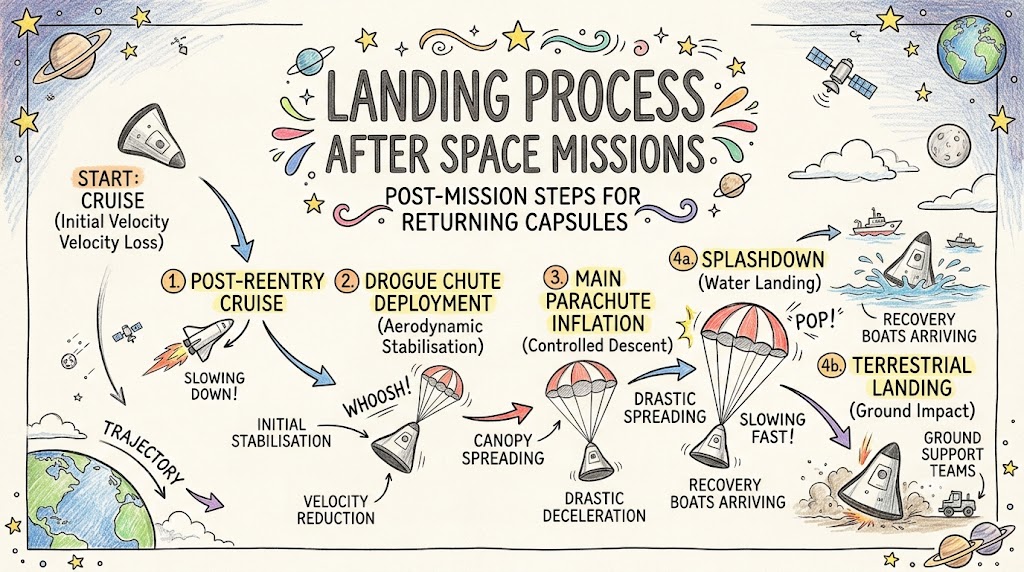
Parachute Deployment
Many crew capsules use a sequence of parachutes.
Small parachutes may deploy first to stabilise the capsule. Larger parachutes then open to reduce the descent speed.
The sequence commonly includes:
Drogue Parachutes
Drogue parachutes stabilise the spacecraft and begin slowing it.
They are smaller than the main parachutes and operate while the spacecraft is still moving quickly.
Main Parachutes
Main parachutes provide most of the final speed reduction.
They are designed to open in stages rather than all at once. Gradual opening reduces stress on the capsule and parachute lines.
Backup Systems
Crewed spacecraft often include multiple parachutes for redundancy.
The capsule may still land safely even if one parachute does not deploy correctly.
Land Landing Versus Water Landing
Spacecraft may return to land or splash down in the ocean.
Land Landing
Land landings usually take place in wide, open areas away from cities.
The spacecraft may use parachutes, small rockets, shock absorbers, or landing airbags to reduce impact.
Advantages include easier access by ground recovery teams and less exposure to seawater.
However, the capsule may land far from the expected point because of winds or navigation differences.
Water Landing
Water landings allow the ocean to absorb part of the landing force.
The spacecraft usually descends under parachutes and enters the sea at a controlled speed.
After splashdown, flotation systems help keep the capsule upright.
Recovery ships, helicopters, and medical teams move toward the spacecraft.
Water landings require careful planning because waves, weather, and capsule stability can affect recovery.
Powered Spacecraft Landings
Some spacecraft use engines to slow down before landing.
This method is known as powered descent or propulsive landing.
Landing engines fire during the final stage to reduce vertical speed. The spacecraft may touch down on landing legs.
Powered landing offers greater control over the landing location, but it requires reliable engines, fuel, sensors, and navigation systems.
A failure during the final seconds can be dangerous, so these systems usually include backup procedures and automatic controls.
Spaceplane Landing
Some spacecraft return like aircraft.
A spaceplane enters the atmosphere, slows down, glides toward a runway, and lands using wheels.
Unlike conventional aircraft, many spaceplanes have limited ability to change their landing plan once reentry begins.
The crew must carefully control speed, altitude, and glide path.
Runway landing allows the spacecraft to avoid ocean recovery, but it requires suitable landing facilities and precise navigation.
Touchdown or Splashdown
Touchdown marks the moment the spacecraft reaches land or water.
Although the major reentry phase has ended, the mission is not yet complete.
After landing, the crew must confirm:
- Cabin pressure is stable
- No fire or fuel leak is present
- Electrical systems are safe
- Communication is working
- All crew members are conscious
- Emergency supplies are available
- The spacecraft is stable
Astronauts remain seated until recovery personnel arrive or until mission control gives instructions.
Locating the Spacecraft
Tracking systems help recovery teams locate the spacecraft.
The vehicle may transmit radio signals, satellite coordinates, flashing lights, or emergency beacons.
Aircraft and ships may also visually identify the capsule.
The actual landing point can differ from the planned location because of:
- Wind
- Atmospheric variations
- Navigation errors
- Parachute behaviour
- Ocean currents
- Equipment performance
Recovery teams are positioned across a wide area to respond quickly.
Recovery Team Operations
Recovery personnel approach the spacecraft carefully.
Their first task is to secure the vehicle and protect the crew.
For water landings, divers may attach flotation equipment and safety lines.
For land landings, teams check for fire, toxic fuel, unstable equipment, or damaged batteries.
The recovery process may include:
- Stabilising the capsule
- Opening the hatch
- Checking air quality
- Providing medical support
- Helping astronauts exit
- Recovering mission samples
- Securing spacecraft data
- Transporting the vehicle
Recovery teams train repeatedly for normal and emergency situations.
Astronaut Medical Checks After Landing
Returning astronauts may feel weak, dizzy, or unbalanced.
In microgravity, the body adapts to living without normal Earth gravity. Muscles and bones receive less load, and the balance system changes.
After landing, astronauts may experience:
- Difficulty standing
- Motion sickness
- Low blood pressure
- Muscle weakness
- Reduced coordination
- Headache
- Fatigue
- Back discomfort
- Balance problems
Medical teams examine astronauts immediately after recovery.
Checks may include heart rate, blood pressure, oxygen levels, neurological response, hydration, and general physical condition.
Why Astronauts May Need Help Walking
Astronauts returning from long missions are often assisted from the spacecraft.
This does not always mean they are seriously ill.
Their bodies have adapted to microgravity, where muscles do not work against body weight in the same way.
When Earth’s gravity returns, even standing can feel difficult.
The balance organs inside the ear also need time to readjust.
Recovery time depends on:
- Mission duration
- Astronaut age
- Physical condition
- Exercise performed in space
- Individual response
- Landing forces
Some astronauts recover quickly, while others require several days or weeks of rehabilitation.
Post-Mission Rehabilitation
Astronaut rehabilitation begins soon after landing.
Specialists use exercise, medical monitoring, and physical therapy to help the body adjust to gravity again.
Rehabilitation may focus on:
- Leg strength
- Core stability
- Cardiovascular fitness
- Balance
- Coordination
- Bone health
- Mobility
- Flexibility
Astronauts are regularly evaluated before they return to normal work or flight duties.
Recovering Scientific Samples and Equipment
Crew safety is the first priority, but scientific cargo is also important.
Spacecraft may return with:
- Biological experiments
- Material samples
- Medical research
- Space-grown plants
- Computer storage devices
- Earth-observation data
- Equipment requiring inspection
Some samples must be stored at controlled temperatures.
Recovery teams follow strict handling procedures to prevent damage or contamination.
Inspecting the Spacecraft After Landing
Engineers inspect the spacecraft to understand how it performed.
They examine:
- Heat-shield damage
- Parachute condition
- Landing-system performance
- Cabin systems
- Navigation equipment
- Structural stress
- Engine data
- Communication records
This information improves future spacecraft designs and mission procedures.
Reusable spacecraft may be repaired, tested, and prepared for another mission.
Emergency Landing Procedures
Mission planners always prepare for off-course or emergency landings.
A spacecraft may land outside the planned area because of a system failure, weather change, or navigation problem.
Astronauts carry survival equipment that may include:
- Food and water
- Medical supplies
- Communication devices
- Thermal clothing
- Flotation gear
- Signalling equipment
- Emergency oxygen
Recovery teams prepare for deserts, forests, oceans, cold regions, and other possible landing environments.
Major Risks During the Landing Process
The return phase includes several serious risks.
Heat-Shield Failure
Damage to the heat shield can allow extreme heat to reach the spacecraft structure.
Incorrect Reentry Angle
A wrong angle can create excessive heat, dangerous G-forces, or a missed landing zone.
Parachute Failure
Failure of one or more parachutes can increase landing speed.
Communication Loss
Extended communication loss may prevent ground teams from understanding the spacecraft’s condition.
Navigation Error
Incorrect navigation can cause the spacecraft to land far from recovery forces.
Rough Landing
Strong winds, high waves, uneven ground, or system problems can create a hard impact.
Toxic Material Exposure
Some spacecraft use fuels or chemicals that are hazardous to astronauts and recovery teams.
How Space Agencies Improve Landing Safety
Landing safety depends on preparation, testing, and redundancy.
Space agencies improve safety through:
- Reentry simulations
- Parachute drop tests
- Heat-shield testing
- Crew emergency training
- Recovery-team exercises
- Backup navigation systems
- Multiple communication methods
- Medical planning
- Weather monitoring
- Independent system checks
Engineers study every mission to improve future operations.
Common Misunderstandings About Spacecraft Landings
Astronauts Do Not Fall Straight Down
They follow a controlled curved path through the atmosphere.
Parachutes Do Not Handle the Entire Reentry
Atmospheric drag removes most of the spacecraft’s speed before parachutes deploy.
Landing Does Not End the Mission Immediately
Recovery, medical checks, data collection, and spacecraft inspection continue after touchdown.
Water Landings Are Not Automatically Soft
Splashdown can still create strong impact forces and rough motion.
Returning Astronauts May Not Walk Immediately
Temporary weakness and balance problems are common after long periods in microgravity.
Future Developments in Spacecraft Landing
New landing systems are being developed to make space travel safer, more precise, and more reusable.
Future technologies may include:
- Fully reusable crew vehicles
- More accurate powered landings
- Improved heat-shield materials
- Smarter autonomous navigation
- Faster recovery systems
- Better crew-impact protection
- Advanced parachute materials
- Improved medical monitoring
- Moon and Mars landing technologies
Landing on the Moon or Mars is different from landing on Earth because atmospheric conditions and gravity levels are different.
Mars has a thin atmosphere, making parachute-based landing difficult. The Moon has no meaningful atmosphere, so spacecraft must rely mainly on engines.
Key Takeaways
- The landing process begins with a precisely timed deorbit burn.
- Spacecraft must enter the atmosphere at a safe angle.
- Heat shields protect the crew from extreme reentry temperatures.
- Atmospheric drag removes most of the spacecraft’s speed.
- Parachutes, engines, wings, or landing systems complete the descent.
- Recovery teams locate and secure the spacecraft after landing.
- Astronauts receive immediate medical checks.
- Long-duration crews may require rehabilitation after returning to gravity.
- Engineers inspect the spacecraft and mission data to improve future flights.
Frequently Asked Questions
What is the first step in returning from orbit?
The spacecraft performs a deorbit burn. This reduces its orbital speed and begins the descent toward Earth.
Why does a spacecraft become extremely hot during reentry?
Air is compressed rapidly in front of the spacecraft, creating intense heat around the vehicle.
What protects astronauts from reentry heat?
A specially designed heat shield protects the spacecraft and crew from extreme temperatures.
Why is the reentry angle important?
A shallow angle can cause the spacecraft to skip away from the atmosphere, while a steep angle can create excessive heating and G-forces.
How do spacecraft slow down before landing?
They use atmospheric drag, parachutes, engines, wings, airbags, or a combination of these systems.
Why do some spacecraft land in the ocean?
Water provides a large landing area and helps absorb some impact energy.
Can astronauts walk immediately after landing?
Some can walk with support, while others need assistance because their muscles, balance, and circulation have adapted to microgravity.
How do recovery teams find a spacecraft?
They use tracking data, satellite coordinates, radio beacons, aircraft, ships, and visual signals.
What happens to the spacecraft after recovery?
Engineers inspect the heat shield, structure, landing systems, electronics, and mission data.
Are spacecraft landings fully automatic?
Many parts are automated, but astronauts and mission controllers monitor the process and can respond to emergencies when possible.
Conclusion
The landing process after space missions is a carefully planned sequence involving deorbiting, atmospheric reentry, speed reduction, touchdown, recovery, and medical support. Every stage requires accurate navigation, reliable technology, trained crews, and experienced ground teams. A successful landing does more than return astronauts safely—it also completes the mission, protects scientific research, and provides valuable knowledge for future journeys into space.