Introduction
How Flight Training Helps Future Astronauts is an important topic for students who dream of careers in aviation and space exploration. While flying an aircraft and traveling into space may seem like two very different worlds, they share a strong foundation of skills, discipline, and technical knowledge.
Flight training is often considered one of the strongest stepping stones toward becoming an astronaut. Many astronauts around the world have backgrounds in aviation because piloting teaches real-world experience in high-speed, high-pressure environments—similar to what is experienced in space missions.
In this blog, we will explore how flight training builds essential astronaut skills, why it is so valuable for space careers, and how it prepares individuals for future space exploration opportunities.
What is Flight Training?
Flight training is a structured program designed to teach individuals how to operate and control aircraft safely. It combines theoretical knowledge with practical flying experience.
Key Components of Flight Training
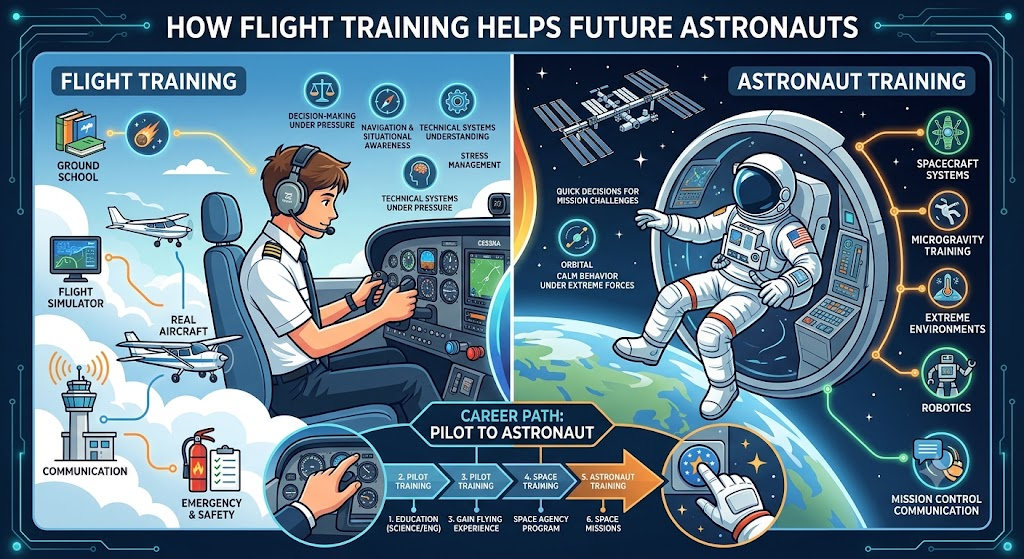
Ground school (aviation theory, meteorology, navigation)
Flight simulator training
Real aircraft flying hours
Communication with air traffic control
Emergency and safety procedures
Skills Developed in Flight Training
Flight training helps students develop:
Strong decision-making ability
Situational awareness
Technical understanding of aircraft systems
Discipline and focus
Stress management under pressure
These skills form the foundation for advanced aviation and space-related careers.
What is Astronaut Training?
Astronaut training is a highly advanced and competitive program that prepares individuals for space missions. It is conducted by space agencies and private space organizations.
Key Areas of Astronaut Training
Spacecraft systems and operations
Microgravity (zero-gravity) training
Survival training in extreme environments
Robotics and mission control operations
Physical and psychological conditioning
Astronaut training is designed to prepare individuals for the extreme conditions of space, where precision and control are critical.
How Flight Training Helps Future Astronauts
Flight training plays a major role in shaping future astronauts by building real-world operational skills.
- Decision-Making Under Pressure
Pilots are trained to make quick and accurate decisions in emergencies. This ability is essential for astronauts who must respond instantly to space mission challenges.
- Navigation and Situational Awareness
Flight training improves spatial awareness and navigation skills, which are critical in orbit where there is no traditional “up” or “down.”
- Understanding Aerodynamics and Physics
Pilots learn how forces like lift, drag, and thrust affect flight. These same principles are essential in spacecraft movement and orbital mechanics.
- Communication with Control Systems
Pilots constantly communicate with air traffic control. Similarly, astronauts must maintain constant communication with mission control on Earth.
- Emergency Handling Skills
Flight training teaches pilots how to handle engine failure, turbulence, and system errors—skills that directly translate to spacecraft emergency procedures.
Key Overlapping Skills Between Pilots and Astronauts
Both professions require a strong set of shared skills:
High-level concentration and focus
Leadership and teamwork abilities
Technical systems understanding
Calm behavior under pressure
Strong communication skills
Physical and mental endurance
These shared skills explain why many astronauts come from aviation backgrounds.
Why Many Astronauts Are Former Pilots
Many astronauts worldwide begin their careers as pilots, especially military or test pilots. This is because:
They already have experience handling high-performance machines
They are trained in complex navigation systems
They are familiar with extreme physical forces like G-forces
They have proven ability in high-risk environments
Flight training provides a real-world foundation that makes astronaut training easier to adapt to.
Comparison: Flight Training vs Astronaut Training
Aspect Flight Training Astronaut Training
Environment Earth’s atmosphere Outer space
Purpose Operate aircraft Operate spacecraft
Training Focus Flying skills & safety Space missions & survival
Physical Demand High Extremely high
Complexity Moderate to high Very high
Experience Needed Aviation schooling Advanced education + experience
Flight training builds the base, while astronaut training expands it into space operations.
Career Path: From Pilot to Astronaut
While not mandatory, many astronauts follow a path that includes aviation experience.
Typical Pathway:
Complete education in science or engineering
Undergo pilot training (civil or military aviation)
Gain professional flying experience
Apply to space agency astronaut programs
Complete astronaut selection and training
Participate in space missions
This pathway is highly competitive but proven to be effective.
Future of Aviation and Space Careers
The connection between aviation and space exploration is becoming stronger due to technological advancements.
Emerging Trends:
Commercial space tourism
Reusable rockets and spacecraft
AI-assisted flight systems
Autonomous aircraft and drones
Deep space exploration missions
Space station expansion projects
Flight training will continue to be a strong foundation for future space professionals.
Conclusion
How Flight Training Helps Future Astronauts is clearly seen through the strong overlap in skills, discipline, and technical knowledge required in both fields. Flight training builds essential abilities such as decision-making, situational awareness, communication, and emergency handling, all of which are critical for astronaut missions.
While astronaut training takes these skills to a more advanced level for space environments, the foundation built during flight training remains invaluable. This is why many astronauts come from aviation backgrounds.
For students aiming for careers in space exploration, starting with flight training is one of the most effective ways to build confidence, experience, and readiness for future opportunities beyond Earth.
FAQs
- How does flight training help in becoming an astronaut?
Flight training builds core skills like navigation, decision-making, and stress management, which are essential for astronauts.
- Do all astronauts need flight training?
Not all, but many astronauts have aviation backgrounds because it provides strong operational experience.
- Is pilot training required to become an astronaut?
It is not mandatory, but it is highly beneficial for understanding high-performance vehicles.
- What skills from flight training are useful in space?
Situational awareness, communication, emergency handling, and technical understanding are key transferable skills.
- Why are many astronauts former pilots?
Because pilots already have experience handling complex machines in high-pressure environments.
- Can civilian pilots become astronauts?
Yes, civilian pilots with strong qualifications and experience can apply for astronaut programs.
- Is astronaut training harder than flight training?
Yes, astronaut training is more advanced, competitive, and physically demanding.
- What subjects are common in both careers?
Physics, navigation, aerodynamics, and systems engineering are common in both fields.
- How long does it take to become an astronaut after flight training?
It can take several additional years of selection, training, and experience.
- Is flight training necessary for space careers?
It is not mandatory but highly valuable for developing foundational aviation skills.