Introduction
The idea of becoming an astro pilot represents one of the most advanced and exciting career paths in modern aerospace. An astro pilot is not just a spacecraft operator; they are trained professionals capable of navigating, controlling, and understanding complex space systems in extreme environments beyond Earth.
At the core of this role lies engineering knowledge. Spaceflight is not driven by imagination alone—it is built on precise engineering principles that ensure rockets launch successfully, spacecraft remain stable in orbit, and astronauts survive in harsh space conditions.
Engineering integrates physics, mathematics, design thinking, and systems analysis. For future astro pilots, understanding engineering basics is essential because every decision in space missions depends on technical accuracy, safety, and system reliability. This blog explores the core engineering foundations required to prepare for this futuristic career path.
Real-World Applications of Engineering in Spaceflight
Engineering is present in every stage of a space mission. Here’s how it is applied in real-world scenarios:
Rocket Design and Propulsion Systems
Engineers design rocket engines that generate thrust powerful enough to escape Earth’s gravity. This involves fuel chemistry, combustion systems, and structural design to withstand extreme pressure and heat.
Spacecraft Structural Engineering
Spacecraft must be lightweight yet extremely strong. Engineering ensures materials can survive launch vibrations, space radiation, and temperature extremes.
Navigation and Control Systems
Astro pilots rely on advanced control systems that help stabilize spacecraft, adjust trajectories, and ensure accurate orbital insertion.
Life Support Systems
Engineering makes human survival possible in space by controlling oxygen supply, temperature, pressure, and waste management inside spacecraft.
Satellite and Communication Systems
Engineers design satellite systems that enable GPS, weather forecasting, and global communication networks.
Core Engineering Basics for Future Astro Pilots
To become an astro pilot, students must understand the following engineering fundamentals:
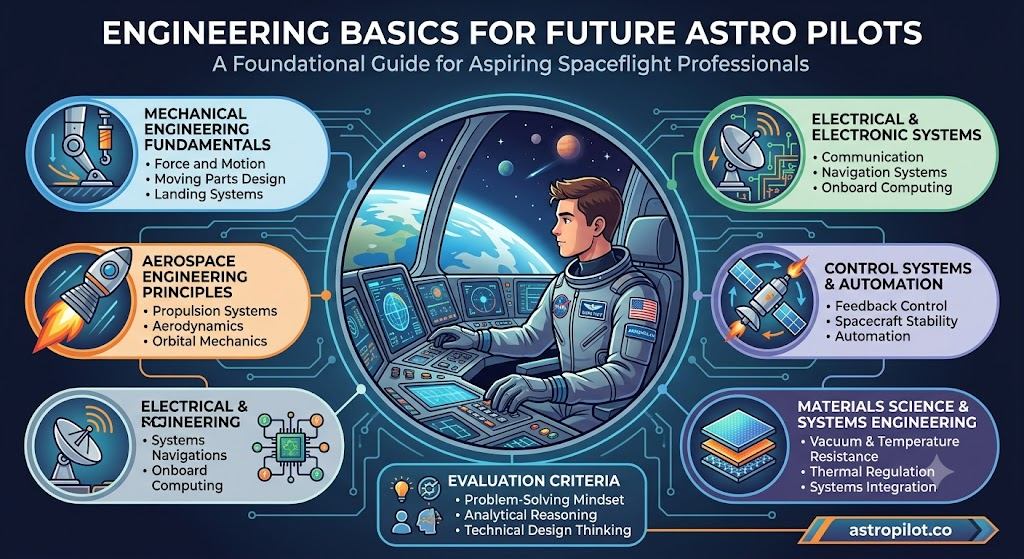
Mechanical Engineering Fundamentals
Mechanical principles explain how forces act on objects. In spaceflight, this helps design moving parts, landing systems, and propulsion mechanisms.
Aerospace Engineering Principles
Aerospace engineering focuses on flight within and beyond Earth’s atmosphere, including aerodynamics, orbital mechanics, and spacecraft design.
Electrical and Electronic Systems
Spacecraft depend heavily on electrical systems for communication, navigation, and onboard computing.
Control Systems and Automation
Control engineering ensures spacecraft remain stable and can adjust automatically to changing conditions in space.
Materials Science for Spacecraft
Special materials are required to withstand radiation, heat, and vacuum conditions in space.
Systems Engineering Approach
Space missions are complex systems. Systems engineering ensures all components—mechanical, electrical, and software—work together efficiently.
Evaluation Criteria for Aspiring Astro Pilots
Students preparing for engineering-based space careers should focus on the following:
Problem-Solving Mindset
Engineering challenges require logical thinking and the ability to break down complex problems into smaller parts.
Technical Design Thinking
Understanding how to design systems that are efficient, safe, and reliable is crucial.
Simulation and Modeling Skills
Modern aerospace engineering uses computer simulations to test spacecraft behavior before real missions.
Analytical Reasoning
Astro pilots must analyze system data, interpret performance, and make quick decisions.
Understanding Real-World Constraints
Engineering decisions must consider limitations like fuel capacity, weight, heat, and structural stress.
Best For / Not Ideal For
Best For
This field is ideal for:
- Students interested in aerospace engineering and space exploration
- Learners passionate about physics, mathematics, and design
- Aspiring astro pilots and spacecraft operators
- Individuals who enjoy technical problem-solving
Not Ideal For
This path may not suit:
- Students avoiding mathematics or engineering subjects
- Learners preferring non-technical career paths
- Those uninterested in systems-based thinking
Engineering Skills Breakdown for Astro Pilots
Force and Motion in Engineering Systems
Understanding how forces affect motion is essential for controlling spacecraft during launch and orbit.
Structural Stability of Spacecraft
Engineering ensures spacecraft can survive intense vibrations, pressure changes, and external forces.
Electrical Circuits in Aerospace Systems
Electrical engineering powers communication, navigation, and onboard systems.
Feedback Control Systems
Control systems automatically correct spacecraft movement to maintain stability and direction.
Thermal and Pressure Engineering
Space environments have extreme temperatures and vacuum pressure, requiring advanced thermal regulation systems.
Career Path Connection: Where Engineering Leads
Engineering fundamentals open doors to several high-impact space careers:
Astro Pilots
Operate and control spacecraft using engineering-based navigation and system understanding.
Aerospace Engineers
Design rockets, spacecraft, and propulsion systems for space missions.
Mission Systems Engineers
Oversee spacecraft operations and ensure all systems function correctly.
Satellite Operators
Manage satellite positioning, communication, and performance systems.
Space Research Engineers
Develop new technologies and study advanced aerospace systems.
FAQs
1. What is an astro pilot?
An astro pilot is a trained professional who operates and navigates spacecraft during space missions using advanced engineering and control systems.
2. Why is engineering important for space careers?
Engineering ensures spacecraft are designed, built, and operated safely and efficiently in extreme space environments.
3. Do astro pilots need mechanical engineering knowledge?
Yes, mechanical engineering helps understand forces, motion, and structural behavior of spacecraft.
4. Is coding important for space engineering?
Yes, coding is widely used for simulations, navigation systems, and spacecraft automation.
5. What subjects should I study for space engineering?
Physics, mathematics, computer science, and engineering fundamentals are essential.
6. Can beginners learn aerospace engineering basics?
Yes, beginners can start with basic mechanics, electronics, and system design concepts.
7. How do control systems help in spaceflight?
Control systems stabilize spacecraft and help adjust their movement automatically.
8. What makes spacecraft design challenging?
Extreme conditions like vacuum, radiation, and temperature variations make spacecraft design highly complex.
9. Are simulations used in aerospace engineering?
Yes, simulations are crucial for testing spacecraft behavior before actual missions.
10. What skills are most important for future astro pilots?
Problem-solving, analytical thinking, engineering knowledge, and system understanding are key skills.
Conclusion
Engineering is the backbone of every space mission and the foundation of all astro pilot careers. From designing rockets to controlling spacecraft systems, engineering principles ensure safety, precision, and success in space exploration.
For students aspiring to enter this futuristic field, mastering engineering basics is not just an academic requirement—it is a pathway to shaping humanity’s future beyond Earth. With strong fundamentals in mechanics, electronics, control systems, and materials science, future astro pilots can confidently step into the world of spaceflight and exploration.
At astropilot.co, the journey begins with understanding how engineering turns imagination into reality—and how tomorrow’s space travelers are built today.