Introduction
The dream of becoming a pilot is no longer limited to flying aircraft across countries or continents. As space technology advances, a new generation of aviation professionals is beginning to imagine careers beyond Earth’s atmosphere. These future professionals may operate spacecraft, support orbital missions, assist commercial spaceflight programs, or contribute to lunar and deep-space transportation systems. This is where the idea of an Astro Pilot becomes exciting.
An Astro Pilot is someone who combines aviation skills, aerospace knowledge, space systems understanding, and strong decision-making ability to support human spaceflight operations. While the career path is still developing, students can begin preparing today through the right education, technical training, flight experience, and STEM-focused learning.
What Is an Astro Pilot?
An Astro Pilot can be understood as a future space aviation professional trained to operate or support spacecraft, advanced aerospace vehicles, and space mission systems. Unlike traditional aircraft pilots who fly within Earth’s atmosphere, Astro Pilots may work with vehicles designed for suborbital flights, orbital travel, space tourism, lunar transportation, or research missions.
Their responsibilities may include spacecraft navigation, mission monitoring, emergency response, flight system coordination, crew safety support, and communication with mission control. In many cases, the role may overlap with astronaut pilot, spacecraft operator, aerospace engineer, test pilot, mission specialist, or commercial spaceflight crew member.
Why Students Are Interested in Astro Pilot Careers
Space careers are becoming more visible because of commercial spaceflight, reusable rockets, private space companies, lunar mission planning, and growing interest in space tourism. Students who love aviation, science, engineering, and exploration see Astro Pilot careers as a future-facing opportunity.
This career path is attractive because it combines multiple exciting fields: flying, engineering, robotics, physics, artificial intelligence, navigation, and human space exploration. It is also ideal for students who enjoy solving complex problems, working under pressure, and learning advanced technology.
Education Path for Future Astro Pilots
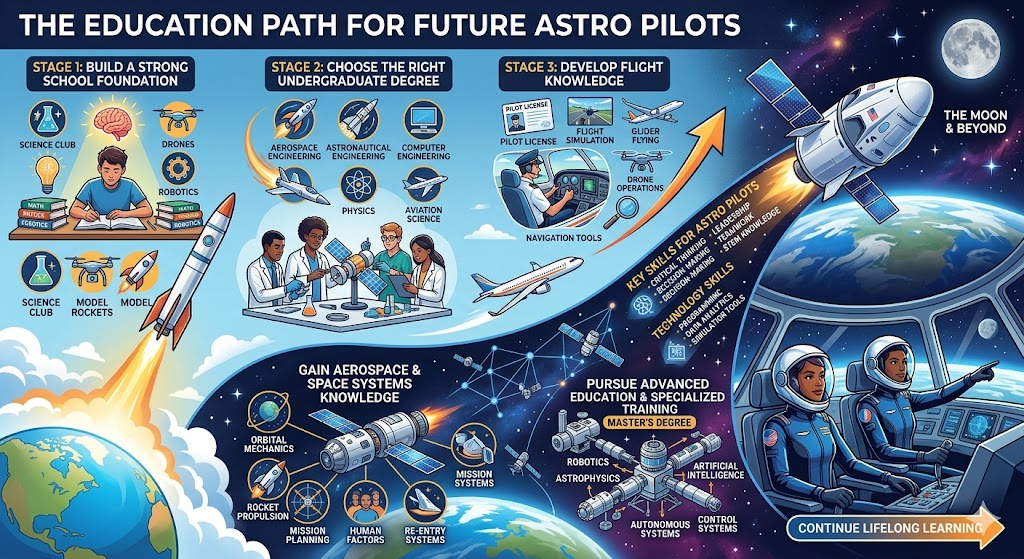
Stage 1: Build a Strong School Foundation
The journey should begin early with strong academic preparation. Students should focus on mathematics, physics, computer science, chemistry, and engineering basics. These subjects help build the foundation needed to understand aircraft systems, rocket motion, spacecraft design, navigation, and orbital mechanics.
Students should also develop communication skills, teamwork, discipline, and problem-solving ability. Astro Pilot careers are not only about technical knowledge. They also require calm thinking, leadership, and the ability to make decisions in high-pressure environments.
Useful school-level activities include:
- Joining science clubs
- Participating in robotics competitions
- Learning coding basics
- Building model rockets or drones
- Joining astronomy clubs
- Attending STEM workshops
- Practicing public speaking
- Using flight simulator software
Stage 2: Choose the Right Undergraduate Degree
A strong undergraduate degree is one of the most important steps. Future Astro Pilots should consider degrees that combine engineering, science, aviation, and technology.
Good degree options include:
- Aerospace Engineering
- Aeronautical Engineering
- Astronautical Engineering
- Mechanical Engineering
- Electrical Engineering
- Computer Engineering
- Physics
- Aviation Science
- Space Systems Engineering
Aerospace Engineering is one of the most relevant choices because it covers aircraft, rockets, spacecraft, propulsion, aerodynamics, structures, and flight systems. Mechanical Engineering is also useful because it builds strong fundamentals in machines, materials, thermodynamics, and control systems. Computer Engineering can help students understand automation, spacecraft software, artificial intelligence, and autonomous navigation.
Stage 3: Develop Flight Knowledge
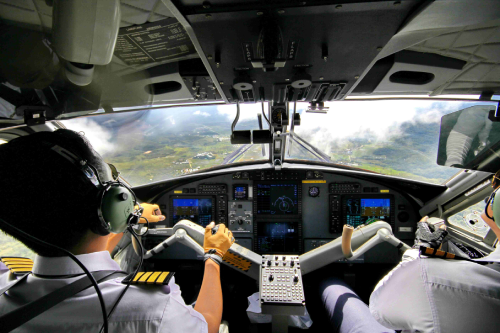
Traditional flight training can be a valuable advantage for future Astro Pilots. Even if every spaceflight role does not require a pilot license, aviation training helps students understand navigation, cockpit discipline, communication, weather, aircraft systems, emergency procedures, and flight safety.
Students may explore:
- Private Pilot License training
- Commercial Pilot License pathway
- Glider flying
- Flight simulators
- Drone operations
- Aviation safety courses
- Aircraft maintenance basics
- Navigation and radio communication training
Flight training also helps build confidence, situational awareness, and practical decision-making skills.
Stage 4: Gain Aerospace and Space Systems Knowledge
After basic academic and aviation preparation, students should study space-specific subjects. These areas help bridge the gap between ordinary aviation and spaceflight operations.
Important topics include:
- Orbital mechanics
- Rocket propulsion
- Spacecraft systems
- Space navigation
- Mission planning
- Space environment
- Human factors engineering
- Life support systems
- Space medicine basics
- Autonomous spacecraft operations
- Communication systems
- Re-entry and landing systems
This knowledge helps students understand how spacecraft behave differently from aircraft. Spaceflight requires understanding gravity, velocity, vacuum conditions, radiation, limited resources, and mission-critical systems.
Stage 5: Pursue Advanced Education
Many future Astro Pilot roles may require advanced education or specialized training. A master’s degree can improve career opportunities in aerospace, space mission operations, research, spacecraft design, or astronaut-style selection programs.
Relevant postgraduate fields include:
- Aerospace Engineering
- Astronautical Engineering
- Space Systems Engineering
- Astrophysics
- Robotics
- Artificial Intelligence
- Autonomous Systems
- Human Spaceflight Systems
- Avionics
- Control Systems
Advanced education is especially useful for students who want to work with spacecraft design, mission operations, space robotics, or high-level aerospace research.
Important Skills Future Astro Pilots Need
Astro Pilots must develop a balanced mix of technical, physical, and mental skills.
Key skills include:
- Strong STEM knowledge
- Critical thinking
- Fast decision-making
- Situational awareness
- Leadership
- Teamwork
- Technical communication
- Adaptability
- Emotional control
- Emergency response ability
- Physical fitness
- Continuous learning mindset
Space missions are complex and high-risk. A future Astro Pilot must be able to stay calm, analyze problems quickly, follow procedures, and work closely with engineers, scientists, medical teams, and mission controllers.
Technology Skills for Future Astro Pilots
Future space vehicles will depend heavily on advanced technology. Students should not limit themselves to traditional aviation knowledge. They should also learn modern digital and engineering skills.
Important technology areas include:
- Programming
- Artificial Intelligence
- Robotics
- Data Analytics
- Automation
- Cybersecurity
- Digital Twin Technology
- Simulation Tools
- Sensor Systems
- Autonomous Navigation
- Human Machine Interface Design
Programming languages such as Python, C++, and MATLAB can be useful for simulations, data analysis, robotics, and aerospace research. Understanding AI and automation will also help students adapt to the future of spacecraft operations.
Career Roadmap for Future Astro Pilots
A realistic roadmap may look like this:
1- Focus on STEM subjects in school
2- Join science, robotics, drone, or astronomy activities
3- Complete an undergraduate degree in aerospace, engineering, aviation, or physics
4- Gain basic flight training or simulator experience
5- Build technical skills in programming, robotics, and data analysis
6- Complete internships in aerospace, aviation, research, or space technology
7- Pursue advanced education or specialized space systems training
8- Gain work experience in aerospace operations, flight testing, mission control, or spacecraft systems
9- Apply for astronaut-style, test pilot, commercial spaceflight, or mission operations roles
10- Continue lifelong training in aviation, space systems, safety, and emerging technology
Challenges on the Astro Pilot Path
The path to becoming an Astro Pilot is demanding. Students must prepare for strong academic competition, advanced technical subjects, physical fitness requirements, psychological evaluation, and long-term training.
Common challenges include:
- Difficult STEM subjects
- Expensive flight training
- Highly competitive selection processes
- Need for continuous learning
- Physical and mental readiness
- Rapidly changing technology
- Limited but growing career openings
- High safety expectations
Students should not be discouraged by these challenges. The best approach is to build step by step, gain practical experience, and stay consistent.
Future Career Opportunities
Future Astro Pilots may find opportunities in several areas as the space economy grows.
Possible career paths include:
- Commercial spaceflight crew
- Space tourism operations
- Spacecraft systems operator
- Mission control specialist
- Aerospace test pilot
- Space mission planner
- Lunar transportation support
- Orbital logistics operations
- Space station operations
- Space robotics operator
- Human spaceflight safety specialist
- Aerospace research professional
Not every student will become a spacecraft commander, but many can build meaningful careers around spaceflight operations, aerospace engineering, mission systems, and human space exploration.
Tips for Students Starting Today
Students who want to become future Astro Pilots should start with small but consistent actions.
Helpful tips include:
- Focus strongly on math and physics
- Learn coding early
- Read about aviation and space missions
- Practice with flight simulators
- Join robotics or drone clubs
- Build science projects
- Improve English communication
- Stay physically active
- Follow aerospace companies and space agencies
- Look for internships and research opportunities
- Learn teamwork and leadership
- Stay curious about new technology
The journey may be long, but early preparation makes a big difference.
Frequently Asked Questions
1- What is the best degree for becoming an Astro Pilot?
Aerospace Engineering is one of the best degrees because it covers aircraft, rockets, spacecraft, propulsion, and flight systems. Other good options include Mechanical Engineering, Astronautical Engineering, Physics, Aviation Science, and Computer Engineering. The best choice depends on whether the student wants to focus more on flying, engineering, mission systems, or spacecraft technology.
2- Do Astro Pilots need a traditional pilot license?
A traditional pilot license may not be required for every space-related role, but it can be very helpful. Flight training builds navigation skills, cockpit discipline, safety awareness, and decision-making ability. Students interested in astronaut pilot or spacecraft commander roles may benefit strongly from aviation experience.
3- Can someone become an Astro Pilot without military experience?
Yes, military experience can be useful, especially for test pilot or astronaut pilot pathways, but it is not the only route. Civilian engineers, scientists, pilots, researchers, and commercial spaceflight professionals may also enter space-related careers. Strong education, technical skills, physical readiness, and mission experience matter a lot.
4- What subjects should students focus on in school?
Students should focus on mathematics, physics, computer science, chemistry, and engineering basics. These subjects help explain motion, forces, energy, navigation, programming, and technical systems. Communication, teamwork, and problem-solving skills are also important.
5- How long does it take to prepare for an Astro Pilot career?
The timeline can vary widely. A student may spend several years completing school, undergraduate education, flight training, internships, advanced studies, and professional aerospace experience. Since this is a highly specialized career path, continuous learning is expected throughout the journey.
6- Is physical fitness important for Astro Pilots?
Yes, physical fitness is important because spaceflight and high-performance aviation can place stress on the body. Future Astro Pilots may need strong cardiovascular health, balance, coordination, endurance, and mental resilience. Fitness also supports better performance during emergency and simulation training.
7- What technology skills are useful for Astro Pilots?
Programming, robotics, artificial intelligence, data analytics, automation, cybersecurity, and simulation tools are highly useful. Space vehicles are becoming more automated and software-driven, so future professionals must understand both physical systems and digital systems.
8- Can commercial space tourism create Astro Pilot jobs?
Commercial space tourism may create new opportunities in training, spacecraft operations, safety, mission support, customer preparation, and flight operations. The number of direct pilot roles may be limited, but the wider spaceflight ecosystem can create many related career paths.
9- Is Aerospace Engineering better than Aviation Science?
Aerospace Engineering is better for students who want deep technical knowledge of aircraft, rockets, and spacecraft. Aviation Science is useful for students who want stronger focus on flight operations, aviation safety, and pilot training. Some students may combine both through degrees, certifications, and practical experience.
10- What should a beginner do first?
A beginner should start by building strong STEM skills, especially in math and physics. They should also explore coding, robotics, astronomy, drones, and flight simulators. Reading about aviation and space missions can help students understand the career path better and stay motivated.
Conclusion
The education path for future Astro Pilots is challenging, exciting, and full of possibilities. It combines the discipline of aviation, the depth of aerospace engineering, the curiosity of space science, and the adaptability required for advanced technology careers. Students who begin early with STEM learning, flight knowledge, technical skills, and strong personal discipline can position themselves for future opportunities in commercial spaceflight, spacecraft operations, lunar missions, and human space exploration. The role of an Astro Pilot may continue to evolve, but the foundation remains clear: learn deeply, train consistently, stay physically and mentally prepared, and keep exploring the future of flight beyond Earth.