Introduction
A rocket launch may look like a few minutes of fire, smoke, sound, and speed. But behind every successful launch, there are months or even years of preparation. Before a rocket leaves the launch pad, hundreds of engineers, scientists, technicians, safety experts, weather teams, and mission control specialists work together to make sure everything is ready.
Pre-launch preparation is one of the most important stages of a space mission. It includes spacecraft testing, rocket inspection, payload integration, fuel planning, communication checks, weather monitoring, mission control preparation, countdown rehearsal, and final launch approval.
For beginners, this process may sound complex. But when we understand it step by step, it becomes much easier to see how a mission moves from planning to liftoff.
What Is Pre-Launch Preparation in a Space Mission?
Pre-launch preparation is the final stage before a space mission launches.
It is the process of checking and preparing the rocket, spacecraft, payload, launch pad, ground systems, mission control, safety teams, and weather conditions before liftoff.
In simple words, pre-launch preparation answers one important question:
Is everything ready for launch?
Before launch, teams must make sure:
- The rocket is safe and ready
- The spacecraft is working properly
- The payload is correctly installed
- Mission control is prepared
- Ground systems are active
- Weather conditions are safe
- Communication systems are working
- Fuel systems are ready
- Safety teams are prepared
- The final countdown can begin
A rocket launch is not only about starting the engines. It is about making sure every system works together at the right time.
Why Pre-Launch Preparation Is Important
Space missions are expensive, risky, and highly technical. Once the rocket launches, there is very little chance to fix problems physically. That is why teams must find and solve issues before liftoff.
Pre-launch preparation is important because it helps protect:
- The spacecraft
- The rocket
- The payload
- Astronauts, if it is a human mission
- Ground workers
- Launch site equipment
- Mission budget
- Scientific goals
- Public safety
Even a small issue can cause a launch delay or mission failure. For example, a faulty sensor, bad weather, software error, fuel pressure issue, or communication problem can stop a launch.
A delay may seem disappointing, but it is often the safest decision. In space missions, safety is always more important than speed.
Main Teams Involved Before Launch
A space launch needs many teams working together. Each team has a specific role during pre-launch preparation.
Rocket Engineers
Rocket engineers check the launch vehicle, engines, fuel systems, structure, guidance systems, and stage separation systems.
Spacecraft Engineers
Spacecraft engineers check the spacecraft’s power, software, communication, navigation, sensors, batteries, and thermal systems.
Payload Specialists
Payload specialists take care of the main mission equipment, such as a satellite, rover, lander, telescope, or astronaut capsule.
Mission Control Team
Mission control monitors the mission from Earth. Before launch, they prepare tracking systems, communication channels, and mission procedures.
Safety Team
Safety teams identify possible risks and prepare emergency procedures for workers, astronauts, equipment, and the launch site.
Weather Team
Weather experts study wind, rain, storms, lightning, clouds, temperature, and visibility to decide whether launch conditions are safe.
Ground Support Team
Ground support teams manage launch pad systems, fuel lines, power connections, communication cables, and support equipment.
Flight Directors
Flight directors coordinate mission decisions and help confirm whether the mission is ready to launch.
Astronaut Support Team
For human missions, astronaut support teams help crew members prepare, suit up, enter the spacecraft, and follow safety procedures.
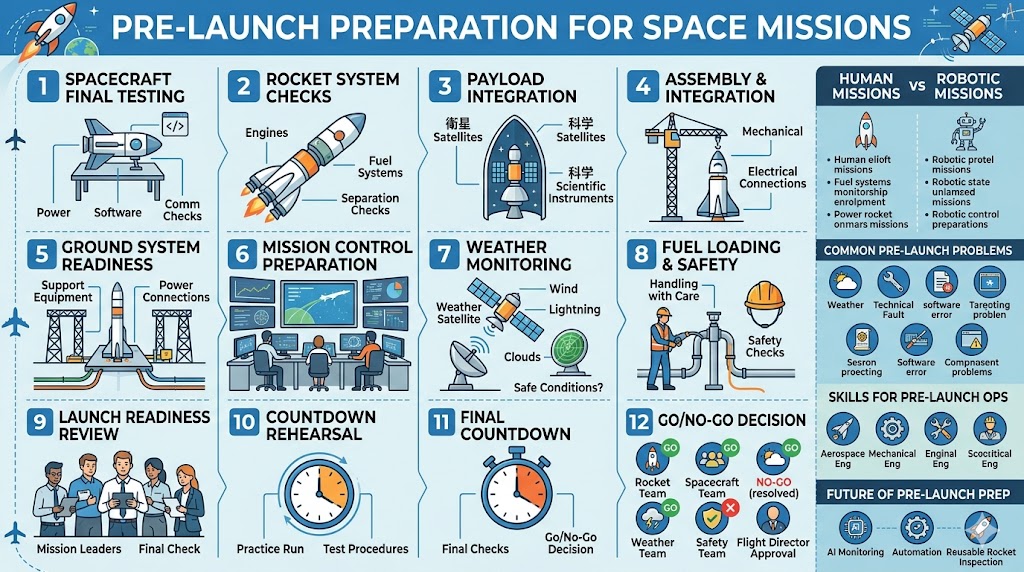
Step 1: Spacecraft Final Testing
Before launch, the spacecraft goes through final testing to confirm that all major systems are working.
The spacecraft is the part of the mission that will operate in space. It may be a satellite, astronaut capsule, rover, lander, telescope, or scientific probe.
Power System Testing
Engineers check whether the spacecraft can generate, store, and distribute power. Solar panels, batteries, and electrical systems must work correctly.
Communication Testing
The spacecraft must communicate with Earth. Engineers test antennas, radio systems, transmitters, receivers, and data links.
Software Testing
Spacecraft software controls many functions, including navigation, communication, system health, and automatic responses. Software errors can be dangerous, so testing is very important.
Navigation Checks
Navigation systems help the spacecraft know where it is and where it is going. These systems must be accurate before launch.
Battery Checks
Batteries provide power when solar panels are not receiving sunlight or during important mission stages. Battery health is checked carefully.
Sensor and Camera Checks
If the spacecraft carries cameras or sensors, teams confirm that they are working and collecting correct data.
Thermal System Checks
Spacecraft face extreme heat and cold in space. Thermal systems help control temperature and protect sensitive equipment.
Final spacecraft testing helps ensure that the mission can continue after the rocket places the spacecraft in space.
Step 2: Rocket System Checks
The rocket is responsible for lifting the spacecraft from Earth and sending it toward its destination. Because launch is one of the most powerful and risky parts of a mission, rocket checks are extremely important.
Engine Checks
Rocket engines are inspected to make sure they can produce the required thrust. Teams check engine systems, valves, pumps, sensors, and ignition systems.
Fuel System Checks
Fuel tanks, pipes, pressure systems, and loading equipment are checked for safety and performance.
Structural Inspection
The rocket structure must handle vibration, pressure, heat, and force during launch. Engineers inspect the body, joints, stages, and support systems.
Stage Separation Checks
Many rockets have multiple stages. These stages separate during flight. The separation system must work at exactly the right time.
Guidance System Checks
The guidance system helps the rocket follow the correct path. It controls direction, speed, and flight stability.
Electrical System Checks
Electrical systems support sensors, computers, communication, and control systems. These must work without interruption.
Safety System Checks
Safety systems help protect the launch site and mission if something goes wrong. These systems are tested before launch approval.
Step 3: Payload Integration
Payload integration means attaching the mission’s main equipment to the spacecraft or rocket.
The payload is the most important part of the mission. It may be:
- A satellite
- A rover
- A lander
- A telescope
- A scientific instrument
- A communication device
- An astronaut capsule
- A research experiment
Payload integration must be done carefully because the payload is often expensive and sensitive. It must be protected from dust, vibration, temperature changes, and accidental damage.
For example, if the mission is launching a weather satellite, the satellite must be carefully mounted, connected, tested, and protected inside the rocket fairing. The fairing is the protective cover that shields the payload during launch through the atmosphere.
Step 4: Launch Vehicle and Spacecraft Assembly
After the payload is ready, the spacecraft and launch vehicle are assembled.
This may include connecting the spacecraft to the rocket, installing protective covers, checking mechanical connections, connecting electrical systems, and verifying communication links.
The rocket may be assembled vertically or horizontally depending on the launch system. Once assembly is complete, the rocket is moved to the launch pad or prepared at the pad itself.
During this stage, engineers check:
- Mechanical connections
- Electrical connections
- Data lines
- Payload protection
- Rocket alignment
- Spacecraft mounting
- Final access panels
- Safety locks and covers
This step makes sure the spacecraft and rocket are ready to function as one complete launch system.
Step 5: Ground System Readiness
Ground systems are the equipment and facilities that support the launch from Earth.
A rocket cannot launch without strong ground support. These systems help fuel the rocket, provide power, support communication, track the launch, and handle emergencies.
Ground systems include:
- Launch pad equipment
- Fuel loading systems
- Power supply systems
- Communication systems
- Tracking antennas
- Cooling systems
- Fire safety systems
- Emergency response systems
- Control rooms
- Transport equipment
Before launch, ground teams confirm that all support systems are working. If the ground systems are not ready, the launch cannot proceed safely.
Step 6: Mission Control Preparation
Mission control is the team that monitors and manages the mission from Earth.
Before launch, mission control teams review the mission timeline, test communication systems, prepare emergency procedures, and confirm that all tracking systems are ready.
Mission control preparation includes:
- Setting up monitoring screens
- Checking communication channels
- Reviewing the flight plan
- Testing command systems
- Preparing emergency procedures
- Assigning team roles
- Practicing mission scenarios
- Confirming data tracking systems
Mission control must be ready before liftoff because the spacecraft needs continuous monitoring after launch.
If the mission includes astronauts, mission control also prepares to communicate with the crew and support them during launch and flight.
Step 7: Weather Monitoring
Weather plays a major role in launch safety.
A rocket launch may be delayed if weather conditions are unsafe. Even if the rocket and spacecraft are ready, bad weather can stop the mission.
Weather teams monitor:
- Strong winds
- Lightning
- Rain
- Thick clouds
- Storms
- Temperature
- Visibility
- Upper-atmosphere winds
Lightning is especially dangerous because it can affect rocket electronics. Strong winds can also create problems during launch.
Weather is checked not only at ground level but also higher in the atmosphere. A launch may look safe from the ground, but upper-level winds can still create risk.
Step 8: Fuel Loading and Safety Procedures
Fuel loading is one of the most careful stages before launch.
Rockets use powerful fuels, and many fuels must be handled at very low temperatures or high pressure. Because of this, fuel loading follows strict safety rules.
During fuel loading, teams monitor:
- Fuel temperature
- Tank pressure
- Fuel quantity
- Valve operation
- Leak detection
- Safety zones
- Emergency systems
Fuel loading may happen hours before launch or closer to liftoff depending on the rocket type.
Only trained teams handle fuel operations. Safety teams remain alert because fuel systems can be dangerous if not managed correctly.
Step 9: Launch Readiness Review
A launch readiness review is a final meeting or review process where mission leaders confirm that all major systems are ready for launch.
Teams review the condition of:
- Rocket
- Spacecraft
- Payload
- Launch pad
- Ground systems
- Mission control
- Weather forecast
- Safety systems
- Communication networks
- Emergency plans
If any serious issue is found, the launch may be delayed. This review helps prevent avoidable failures.
The launch readiness review is like a final quality check before the mission moves into the countdown stage.
Step 10: Countdown Rehearsal
Before the real launch, teams may perform a countdown rehearsal.
A countdown rehearsal is a practice run of the launch countdown. It helps teams test procedures, communication, timing, and coordination.
During rehearsal, teams may practice:
- System checks
- Communication calls
- Launch team coordination
- Emergency responses
- Fuel loading simulation
- Countdown timing
- Go/No-Go decision process
The purpose is to find problems before the actual launch day.
A rehearsal helps everyone understand their roles clearly. It also builds confidence across the mission team.
Step 11: Final Countdown Process
The final countdown is the last sequence before liftoff.
During this time, every major system is checked step by step. The countdown may include many planned holds, where teams pause to verify readiness.
A simple final countdown process may include:
- Rocket system checks
- Spacecraft system checks
- Weather confirmation
- Fuel status check
- Communication check
- Ground system check
- Mission control approval
- Launch director approval
- Engine ignition
- Liftoff
The final minutes are very important. Rocket computers, ground systems, and mission teams all work together.
If a problem appears during countdown, the launch can be paused, delayed, or stopped.
Step 12: Go/No-Go Decision
The Go/No-Go decision is one of the most important parts of launch operations.
Each team reports whether their system is ready. If a team says “Go,” it means their area is ready for launch. If a team says “No-Go,” it means there is a problem that must be solved before launch.
A launch can only continue when all required teams give a “Go.”
Teams involved in Go/No-Go decisions may include:
- Rocket team
- Spacecraft team
- Payload team
- Weather team
- Safety team
- Ground systems team
- Mission control team
- Flight director
- Launch director
If even one critical team reports “No-Go,” the launch may be delayed. This process helps protect the mission and everyone involved.
Pre-Launch Preparation for Human Missions vs Robotic Missions
Human and robotic missions both need strong preparation, but human missions require extra safety because astronauts are onboard.
| Preparation Area | Human Mission | Robotic Mission |
|---|---|---|
| Crew Safety | Very high priority because lives are involved | No crew onboard |
| Life Support | Oxygen, food, water, pressure, and temperature systems needed | Not required |
| Payload | Crew capsule, experiments, supplies | Satellite, rover, lander, or instruments |
| Training | Astronauts need detailed training | Operators train for remote control |
| Emergency Planning | More complex due to human safety | Focuses on spacecraft protection |
| Medical Support | Required before and during mission | Not required |
| Launch Approval | Extra safety checks needed | Mainly technical checks |
| Mission Risk | Higher because humans are involved | Lower compared to crewed missions |
Robotic missions can go to dangerous places without risking human life. Human missions require more preparation because the spacecraft must support and protect astronauts.
Common Problems Found Before Launch
Many problems can appear before launch. This is normal because space systems are complex.
Common pre-launch problems include:
Weather Problems
Storms, lightning, strong winds, or poor visibility can delay launch.
Technical Faults
A problem with the rocket, spacecraft, sensor, valve, battery, or engine can stop the countdown.
Communication Errors
If the spacecraft or rocket cannot communicate properly with ground systems, launch may not be approved.
Sensor Problems
Incorrect sensor readings can create confusion about system health.
Fuel System Concerns
Fuel leaks, pressure issues, or temperature problems can delay launch.
Software Issues
Software must work correctly because it controls many mission functions.
Ground System Delays
Launch pad equipment, power systems, or support tools may need extra checks.
Safety Risks
If any risk is considered too high, the launch team may stop the launch.
Finding these problems before launch is actually a good thing. It gives teams a chance to fix them before the mission begins.
Why Launch Delays Happen
Launch delays are common in space missions.
A launch delay does not always mean failure. In many cases, it shows that teams are being careful and responsible.
Launches may be delayed because of:
- Bad weather
- Fuel system concerns
- Rocket system issues
- Spacecraft problems
- Communication failures
- Range safety concerns
- Ground equipment problems
- Final review findings
A delayed launch is better than a failed mission. Space teams prefer to wait and launch safely rather than take unnecessary risks.
Role of Safety in Pre-Launch Preparation
Safety is at the center of every space launch.
Safety teams protect workers, astronauts, equipment, the launch site, and nearby areas. They study possible risks and create emergency plans.
Safety preparation includes:
- Launch pad safety zones
- Fire protection systems
- Emergency evacuation plans
- Fuel handling rules
- Crew escape planning for human missions
- Worker safety procedures
- Public safety checks
- Weather risk monitoring
In human missions, safety becomes even more important because astronauts are onboard. Their suits, seats, life support systems, communication, and emergency escape systems must be checked carefully.
Beginner-Friendly Example of a Pre-Launch Timeline
Here is a simple example of how pre-launch preparation may look before liftoff.
| Time Before Launch | Main Activity |
|---|---|
| Several weeks before launch | Final spacecraft and rocket testing |
| Several days before launch | Payload integration and launch pad preparation |
| 2–3 days before launch | Ground systems and communication checks |
| 1 day before launch | Weather review and final readiness checks |
| Launch day morning | Fuel loading preparation and team briefings |
| Few hours before launch | Fuel loading and final system checks |
| Final hour | Countdown procedures and Go/No-Go decisions |
| Final minutes | Engine checks, ignition sequence, and liftoff |
This is only a simple example. Real launch timelines vary depending on mission type, rocket system, and launch organization.
Skills Needed to Work in Pre-Launch Operations
Pre-launch operations require many skills. People from different backgrounds work together to prepare a mission.
Important skills include:
Aerospace Engineering
Useful for understanding rockets, spacecraft, flight systems, and launch vehicles.
Mechanical Engineering
Helpful for working with structures, engines, moving parts, and mechanical systems.
Electrical Engineering
Important for power systems, circuits, sensors, and communication hardware.
Computer Science
Needed for software, automation, data systems, and mission control tools.
Systems Engineering
Helps connect different parts of the mission into one working system.
Safety Management
Important for protecting people, equipment, and mission assets.
Weather Analysis
Useful for studying launch weather and atmospheric conditions.
Communication Skills
Teams must communicate clearly during countdown and emergency situations.
Teamwork
Pre-launch preparation depends on many teams working together.
Problem-Solving
Unexpected issues can happen before launch. Teams must solve them quickly and carefully.
Future of Pre-Launch Preparation
Pre-launch preparation is becoming more advanced with new technology.
Artificial intelligence may help detect problems faster. Automation can reduce manual checks. Advanced sensors can monitor rocket and spacecraft health more accurately. Digital simulations can help teams practice launch scenarios before the real event.
Reusable rockets are also changing pre-launch work. Since some rockets can be used again, teams must inspect and prepare reused parts carefully before each mission.
Future pre-launch preparation may include:
- AI-based system monitoring
- Faster safety checks
- Advanced launch simulations
- Better weather prediction
- Automated countdown systems
- Smarter ground support equipment
- Improved reusable rocket inspection
- Stronger mission control software
Even with advanced technology, human judgment will remain important. Space missions still need experienced teams to make careful decisions.
FAQs About Pre-Launch Preparation for Space Missions
1. What is pre-launch preparation in a space mission?
Pre-launch preparation is the process of checking and preparing the rocket, spacecraft, payload, mission control, ground systems, weather conditions, and safety procedures before launch.
2. Why is pre-launch preparation important?
It is important because space missions are risky and expensive. Careful preparation helps reduce failure, protect equipment, improve safety, and increase the chance of mission success.
3. What is checked before a rocket launch?
Teams check rocket engines, fuel systems, spacecraft power, communication, navigation, payload, ground systems, weather, safety systems, and mission control readiness.
4. What is payload integration?
Payload integration is the process of attaching the mission’s main equipment, such as a satellite, rover, lander, telescope, or crew capsule, to the spacecraft or rocket.
5. Who gives final approval before launch?
Final approval usually comes from mission leaders, launch directors, flight directors, and key technical teams after all systems are confirmed ready.
6. What is a launch readiness review?
A launch readiness review is a final check where teams review the rocket, spacecraft, payload, ground systems, weather, safety, and mission control before approving launch.
7. Why do rocket launches get delayed?
Rocket launches may be delayed due to bad weather, technical faults, fuel system issues, communication problems, ground system delays, or safety concerns.
8. What happens during the final countdown?
During the final countdown, teams check systems, confirm weather, monitor fuel status, verify communication, complete Go/No-Go decisions, start engines, and prepare for liftoff.
9. What does Go/No-Go mean in launch operations?
“Go” means a system or team is ready for launch. “No-Go” means there is a problem that must be fixed before launch can continue.
10. Can beginners learn about launch preparation?
Yes, beginners can learn launch preparation by studying rockets, spacecraft, mission control, weather checks, payloads, safety procedures, and launch countdown basics.
Conclusion
Pre-launch preparation is one of the most important stages of any space mission.
A successful liftoff depends on much more than powerful rocket engines. It depends on careful testing, rocket inspection, spacecraft checks, payload integration, ground system readiness, weather monitoring, safety planning, mission control preparation, and final launch approval.
Every launch is the result of teamwork. Engineers, scientists, technicians, safety experts, weather teams, and mission controllers all play an important role.
For beginners, the easiest way to understand pre-launch preparation is to see it as a final checklist before a space journey begins. Every system must be checked. Every risk must be reviewed. Every team must confirm readiness.
The launch may last only a few minutes, but the preparation behind it is what makes the mission possible.