Introduction
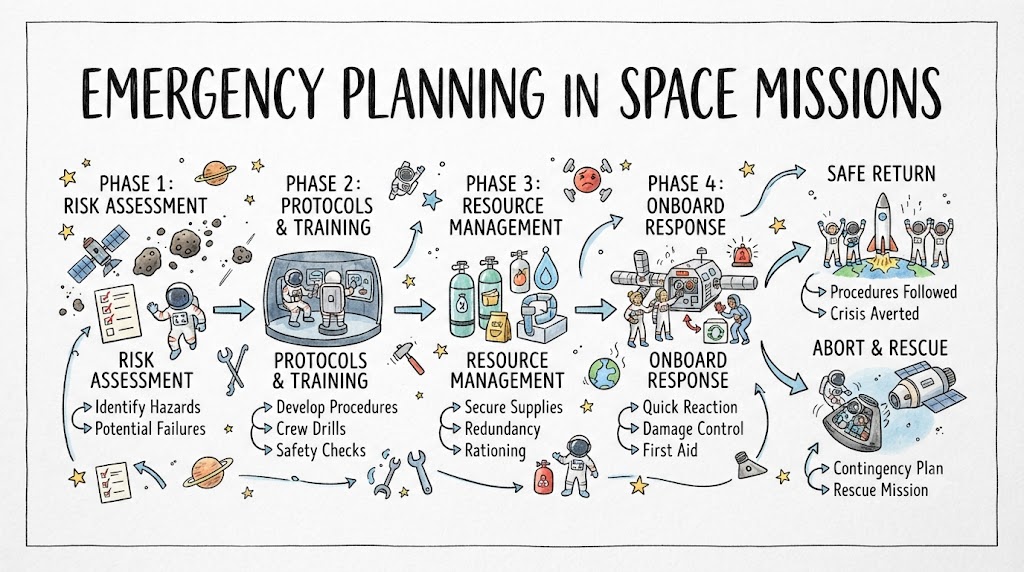
Space missions take people and machines into an environment where immediate outside assistance may be impossible. A small technical failure involving air, electrical power, navigation, temperature control, propulsion, or communication can quickly become a serious emergency. For this reason, emergency planning begins long before launch. Engineers, astronauts, doctors, flight controllers, recovery teams, and safety specialists work together to identify hazards, test spacecraft systems, develop backup plans, and practise emergency responses. NASA’s human-rating requirements and mission-training programmes treat crew protection, system reliability, human performance, and operational readiness as central parts of human spaceflight.
What Is Emergency Planning in Space Missions?
Emergency planning in space missions is the process of identifying possible dangers and preparing suitable responses before a spacecraft leaves Earth. It covers the spacecraft, crew, ground facilities, mission control, communication networks, medical support, landing locations, and recovery operations.
Several related terms are commonly used in mission planning:
Emergency planning prepares the crew and ground teams to respond to an immediate dangerous situation, such as fire, pressure loss, or a medical crisis.
Contingency planning creates alternative ways to complete or safely end a mission when the original plan can no longer be followed.
Risk management identifies hazards, estimates their probability and consequences, and decides how they should be reduced or controlled.
Backup procedures explain how another system or operating method can be used when the primary one fails.
Abort planning defines how the crew can escape from a dangerous launch or terminate a mission safely.
Recovery planning covers the return, landing, rescue, medical support, transportation, and collection of spacecraft components after an emergency.
These activities are connected. A risk assessment may identify a possible oxygen-system failure, redundancy may provide a backup supply, an emergency checklist may help the crew control the situation, and an abort plan may provide a safe return when the failure cannot be corrected.
Why Space Emergencies Require Special Preparation
An emergency on Earth may receive help from firefighters, doctors, engineers, hospitals, or rescue vehicles within minutes. Space crews cannot depend on the same level of immediate support.
The distance from Earth creates one of the greatest limitations. Crews on the International Space Station can communicate with ground teams relatively quickly, but astronauts travelling to Mars could experience communication delays lasting several minutes in each direction. Depending on the positions of Earth and Mars, a message may take roughly four to 24 minutes to travel one way. Crews must therefore be prepared to recognise problems, make decisions, and stabilise their spacecraft without waiting for real-time instructions.
Other difficulties include:
- Limited oxygen, water, food and electrical power
- Exposure to radiation
- Restricted medical equipment
- Microgravity and reduced-gravity environments
- Confined living areas
- Dependence on life-support machinery
- Difficult or impossible rescue operations
- Psychological pressure and isolation
- Limited replacement parts
- Complex return and landing opportunities
NASA identifies distance from Earth, radiation, isolation and confinement, altered gravity, and hostile closed environments as major hazards of human exploration. These conditions make prevention and preparation especially important.
Major Emergency Risks During Space Missions
The exact risks depend on the spacecraft and mission. Nevertheless, mission planners regularly consider several broad categories.
| Potential Emergency | Possible Causes | Main Danger | General Planning Response |
|---|---|---|---|
| Launch vehicle failure | Engine, guidance or structural problem | Loss of crew and vehicle | Abort system, escape route and recovery plan |
| Spacecraft fire | Electrical fault, overheated equipment or flammable material | Smoke, toxic gases and equipment damage | Detection, breathing protection, suppression and isolation |
| Cabin depressurisation | Hull damage, seal failure or valve problem | Loss of breathable atmosphere | Pressure monitoring, leak isolation, suits and safe return |
| Oxygen-system problem | Equipment failure or contamination | Inadequate breathable air | Backup oxygen, atmosphere monitoring and repair planning |
| Carbon dioxide buildup | Scrubber or ventilation failure | Crew illness and loss of performance | Backup removal systems and consumable management |
| Electrical failure | Battery, wiring or power-distribution problem | Loss of critical spacecraft systems | Independent power sources and load reduction |
| Communication loss | Antenna, radio, network or orientation problem | Loss of ground support | Backup links and autonomous procedures |
| Navigation failure | Sensor, computer or software problem | Incorrect trajectory | Independent sensors, ground tracking and manual options |
| Propulsion failure | Engine, valve, tank or control problem | Inability to manoeuvre or return | Alternative burns, backup propulsion and revised trajectory |
| Orbital-debris impact | Collision with natural or artificial material | Structural damage and pressure loss | Tracking, avoidance manoeuvres and shielding |
| Radiation event | Solar activity or cosmic radiation | Increased health risk | Monitoring, shelter and exposure management |
| Medical emergency | Illness, injury or behavioural crisis | Reduced crew capability | Medical kit, trained crew member and remote support |
| Spacesuit problem | Leak, cooling issue or equipment failure | Danger during a spacewalk | Suit monitoring and rapid return planning |
| Software failure | Defect, corrupted data or incorrect command | Loss of control or system instability | Verified software, safe modes and backup computers |
| Re-entry problem | Heat-shield, guidance or parachute failure | Unsafe atmospheric entry or landing | Continuous monitoring and alternative recovery preparation |
NASA documentation for the International Space Station groups its major in-flight emergency planning around rapid depressurisation, fire, toxic release and medical emergencies. The equipment and detailed procedures may evolve, but protecting the crew, stabilising the vehicle and preserving essential systems remain central priorities.
Emergency Planning During Each Mission Phase
Spaceflight risk changes throughout a mission. A response that is possible before launch may not be possible after the spacecraft has entered orbit.
| Mission Phase | Important Risks | Main Planning Considerations |
|---|---|---|
| Pre-launch | Fire, fuel leak, weather or equipment fault | Evacuation routes, emergency crews and launch cancellation |
| Launch | Rocket, engine or structural failure | Launch-abort system and rapid recovery |
| Ascent | Guidance, propulsion or staging problem | Abort boundaries and safe trajectory options |
| Orbital operations | Fire, pressure loss, collision or system failure | Safe haven, repair, return vehicle and backup systems |
| Docking | Collision, failed capture or pressure-seal problem | Hold points, retreat manoeuvres and manual control |
| Spacewalk | Suit leak, cooling failure or lost connection | Buddy support, suit monitoring and rapid airlock return |
| Deep-space travel | Communication delay, radiation or life-support failure | Greater autonomy, spare parts and resource conservation |
| Surface operations | Dust, suit damage, terrain or habitat failure | Shelter access, navigation and return to ascent vehicle |
| Re-entry | Heat-shield, guidance or control failure | Entry monitoring and preselected landing regions |
| Landing and recovery | Parachute, weather or location problem | Alternative recovery zones and medical support |
Mission planners define acceptable conditions and decision points before each important activity. A launch, docking, spacewalk or landing may be delayed when conditions exceed established safety limits.
Risk Assessment Before Launch
Emergency planning begins with systematic hazard identification. Teams examine the vehicle, software, mission profile, crew activities, ground systems, environment and recovery plan.
A typical assessment considers:
- What can fail?
- Why could it fail?
- How likely is the failure?
- What would happen if it occurred?
- Can the problem be detected early?
- Is another system available?
- Can the crew respond safely?
- Would the mission need to be terminated?
- What tests are required before launch?
Engineers may use failure-mode analysis, simulations, component testing, software verification, safety reviews and mission rehearsals. The crew’s health, weather conditions, landing zones, communication networks and ground-team readiness are also reviewed before a launch decision is made.
NASA’s human-rating framework connects spacecraft design with health protection, vehicle performance, crew capability and ground operations. Requirements may be adapted to the mission, but crew survival and safe operation must remain part of the complete system design.
Spacecraft Redundancy and Fail-Safe Design
Redundancy means providing more than one way to perform an essential function. A spacecraft may have a primary computer and a backup computer, several communication antennas, multiple batteries, independent navigation sensors, or more than one way to control the vehicle.
Redundancy is especially important for systems that protect:
- Cabin pressure
- Breathable air
- Electrical power
- Thermal control
- Navigation
- Communication
- Fire detection
- Propulsion
- Guidance and attitude
- Crew return
A redundant system should not simply copy the same weakness. Two components may appear independent but remain vulnerable if they share the same power supply, software defect, cooling loop or physical location.
A fail-safe design attempts to place a system in the safest achievable condition after a malfunction. A spacecraft may enter a safe operating mode, reduce electrical use, stop non-essential activities, point its solar panels toward the Sun, or wait for authorised commands.
Redundancy adds mass, complexity and cost, so engineers must decide which functions require backups and what level of independence is necessary.
Mission Abort Planning
A mission abort is a planned early termination used when continuing the flight presents an unacceptable danger. It is not automatically a failure of emergency planning. A successful abort may show that the safety system performed its intended purpose.
A crewed launch vehicle may have different options depending on altitude, speed, vehicle condition, weather and distance from suitable landing areas.
Possible options include:
- Escaping from the launch pad
- Separating from a failing rocket during ascent
- Following a safe suborbital path
- Entering a temporary orbit
- Returning earlier than planned
- Using an alternative landing area
- Ending surface operations
- Moving to a docked return spacecraft
- Conducting emergency re-entry
NASA has tested launch-abort systems designed to move a crew capsule away from a dangerous rocket during pad or ascent emergencies. Orion’s launch-abort system, for example, is designed to separate and carry the crew module away from the launch vehicle when necessary.
Abort decisions are highly vehicle-specific. Astronauts and controllers use approved procedures, live spacecraft data and previously established decision rules rather than general instructions.
The Role of Mission Control During Emergencies
Mission control acts as the ground-based centre for spacecraft operations. Flight controllers monitor telemetry, analyse system performance, communicate with the crew and coordinate specialist teams.
Important roles may include:
Flight director: Leads the flight-control team and holds responsibility for major operational decisions.
Spacecraft communicator: Communicates directly with the crew so that instructions remain controlled and clear.
Engineering controllers: Analyse propulsion, power, computers, life support, thermal control, communication and other spacecraft systems.
Medical specialists: Monitor crew health and provide medical guidance.
Navigation specialists: Calculate trajectories, manoeuvres, entry paths and landing opportunities.
Recovery teams: Prepare aircraft, ships, vehicles, doctors and other resources for landing or rescue.
Mission simulations train controllers and astronauts together. This helps teams understand their responsibilities, communicate under pressure and test whether procedures can be completed using the available time, information and equipment. NASA states that mission training prepares both astronauts and flight controllers to perform mission objectives safely and effectively.
Astronaut Emergency Training
Astronauts train for emergencies that they may never experience in flight. Repetition helps turn a complicated response into a familiar sequence of priorities.
Training may include:
- Spacecraft fire scenarios
- Cabin-depressurisation drills
- Toxic-release exercises
- Launch and landing emergencies
- Medical response
- Communication failure
- Spacesuit malfunctions
- Water and wilderness survival
- Spacecraft evacuation
- Team decision-making
- Equipment repair
- Psychological stress management
Training is conducted through classroom study, simulators, mock spacecraft, virtual systems, survival locations and integrated exercises with mission-control teams. ESA training programmes also prepare astronauts for fire, depressurisation, toxic-release and medical scenarios before space-station missions.
Simulations often introduce several problems at once. For example, a technical failure may be combined with incomplete information, a communication problem or an injured crew member. This tests not only technical knowledge but also leadership, teamwork and workload management.
Emergency Checklists and Procedures
During a serious event, memory may be affected by stress, noise, time pressure and incomplete information. Checklists provide a verified sequence that helps the crew and controllers avoid missing critical actions.
A well-designed emergency checklist should:
- Identify the condition clearly
- Separate warnings from possible causes
- Address immediate threats first
- Protect the crew before mission objectives
- Stabilise essential systems
- Provide communication points
- Identify conditions for an abort
- Include suitable backup methods
- Use clear and consistent wording
- Be tested in realistic simulations
Checklists must also account for secondary effects. Turning off faulty equipment may reduce a fire risk but could remove cooling, communication or navigation functions. Teams therefore study system connections before approving a procedure.
Emergency documents are mission-specific. Public educational information should never replace the certified procedures used by trained astronauts and controllers.
Medical Emergency Planning in Space
Medical planning begins with astronaut selection and preflight health screening. Crews receive medical training, and spacecraft carry medical equipment and medications chosen for the mission’s duration, crew size and distance from Earth.
Medical support may involve:
- Health monitoring
- First aid and stabilisation
- Remote consultation with flight surgeons
- Medical checklists
- Medication management
- Diagnostic equipment
- Behavioural health support
- Exercise and physical countermeasures
- Isolation procedures
- Emergency-return evaluation
NASA considers medical planning before, during and after spaceflight essential for protecting health and mission performance. Telemedicine has been integrated into human-spaceflight operations, although its usefulness decreases when communication delays prevent real-time consultation.
A deep-space crew may need greater medical independence than a crew in low Earth orbit. Astronauts may have to assess symptoms, use onboard decision-support systems and stabilise a patient while communication with Earth is delayed.
Fire and Cabin Depressurisation Planning
Fire is particularly dangerous inside a spacecraft because the crew lives in an enclosed atmosphere surrounded by electrical equipment and limited escape options. Smoke and toxic combustion products may spread through ventilation systems, while microgravity changes how flames and hot gases behave.
Fire planning generally involves:
- Restricting flammable materials
- Monitoring smoke and combustion products
- Providing fire-suppression equipment
- Supplying breathing protection
- Removing electrical power from affected equipment
- Isolating parts of a vehicle where possible
- Evaluating atmosphere quality
- Preparing for evacuation or return
Cabin depressurisation may be caused by structural damage, a faulty seal, valve failure or impact. Pressure sensors and atmosphere-monitoring systems help identify abnormal conditions. Planning may include locating the leak, isolating a compartment, using pressure suits, moving to a safe area or returning to Earth.
NASA’s spaceflight standards and ISS emergency studies recognise fire and rapid depressurisation as major hazards requiring specialised equipment, procedures and continuing crew training.
Communication Failure Procedures
Spacecraft do not depend on only one communication path. Mission designs may include different antennas, radio frequencies, relay satellites, ground stations and stored command sequences.
During a communication loss, a crew or autonomous spacecraft may follow pre-approved procedures involving:
- Checking onboard communication equipment
- Reorienting the spacecraft or antenna
- Attempting contact at scheduled times
- Switching to another radio or antenna
- Preserving critical data
- Continuing only authorised activities
- Entering a safe operating mode
- Waiting for the next ground-station opportunity
Uncrewed spacecraft are commonly designed to protect themselves when contact is lost. A safe mode may reduce activity and maintain power, temperature and orientation until communication is restored.
For Mars missions, communication disruption and delay are unavoidable operational concerns. NASA therefore expects crew autonomy and onboard decision-making to become increasingly important as missions travel farther from Earth.
Emergency Planning for Deep-Space Missions
A low-Earth-orbit crew may have a return spacecraft available and can receive fast support from mission control. A crew travelling to Mars may be unable to return quickly, receive replacement supplies or obtain real-time medical advice.
Deep-space emergency planning must therefore consider:
- Long-duration life-support reliability
- Repairable spacecraft systems
- Spare tools and components
- Greater medical capability
- Radiation shelters
- Autonomous navigation
- Delayed communication
- Independent decision-making
- Long-term food and water control
- Psychological resilience
- Alternative mission objectives
- Safe-haven areas within a vehicle or habitat
NASA notes that Mars crews will need to solve many problems as a team without immediate assistance from Earth. Greater distance shifts part of the operational responsibility traditionally held by mission control to the astronauts and onboard systems.
Human Factors and Emergency Decision-Making
An emergency is not only an engineering problem. Human performance can determine whether a technically manageable failure becomes worse.
Stress may narrow attention and cause a person to focus on one warning while missing another. Fatigue can slow reactions, reduce memory and weaken communication. Confusing authority or unclear responsibilities may delay decisions.
Strong emergency management therefore requires:
- Clearly assigned responsibilities
- Open reporting of safety concerns
- Short and precise communication
- Confirmation of critical commands
- Cross-checking by another crew member
- Control of unnecessary workload
- Awareness of fatigue
- A willingness to stop unsafe activities
- Respect for technical disagreement
- Continuous learning after tests and missions
NASA describes a strong safety culture as one in which people can communicate concerns, learn from mistakes, balance risk responsibly and trust that safety remains a priority.
Lessons From Historical Spaceflight Emergencies
Apollo 1
A cabin fire occurred during a launch-pad test in January 1967. The accident led to extensive spacecraft and management reviews. Important changes included a faster-opening hatch and stricter control of combustible materials inside the Apollo spacecraft. The event demonstrated that ground tests must be treated with the same seriousness as flight operations when they reproduce hazardous conditions.
Apollo 13
An oxygen-tank explosion forced Apollo 13 to abandon its lunar landing. The command module was powered down, and the lunar module was used as a temporary lifeboat. Astronauts, flight controllers and engineers worked together to manage power, water, carbon dioxide and the return trajectory. The crew’s safe return showed the value of trained teams, adaptable procedures, subsystem knowledge and usable backup capabilities.
Soyuz 11
The Soyuz 11 crew died after the spacecraft lost cabin pressure during return. The accident was followed by a temporary halt in Soviet crewed missions and a redesign of the spacecraft. Pressure suits became standard for Soyuz crews during launch and landing. The lesson was clear: protection must remain available during mission phases in which rapid pressure loss is possible.
Space Shuttle Challenger
The Challenger accident highlighted the danger of technical concerns being weakened by schedule pressure, ineffective communication and poor risk interpretation. Later safety work placed greater emphasis on reporting concerns, independent review and organisational responsibility.
Space Shuttle Columbia
The Columbia investigation identified both a physical failure and serious organisational weaknesses. NASA’s lessons include the risks of organisational silence and accepting abnormal events as routine simply because they have not previously produced a disaster.
Mir Space Station Fire
A fire involving an oxygen-generating system occurred aboard Mir in February 1997. Smoke spread through the station, and the fire temporarily obstructed access to an escape spacecraft. The event reinforced the importance of breathing equipment, access to escape vehicles, atmosphere monitoring and realistic fire training.
International Space Station Drills
ISS crews regularly practise responses to emergencies such as fire, pressure loss and toxic release. These exercises allow internationally trained crews and control centres to review responsibilities, communication and hardware use before a real emergency occurs.
Typical Space Mission Emergency Response Process
Although every spacecraft uses its own approved procedures, a general planning model includes the following stages:
- Detect the abnormal condition: Sensors, alarms, telemetry or crew observations indicate a problem.
- Confirm the emergency: The crew and controllers compare warnings and system data.
- Protect human life: Immediate threats to breathing, pressure, fire safety or crew health receive priority.
- Stabilise the spacecraft: Essential power, atmosphere, attitude and thermal functions are protected.
- Communicate the situation: The crew and mission control exchange confirmed information.
- Isolate the failure: Faulty equipment or an affected compartment may be separated where possible.
- Activate backup capability: Independent equipment or an alternative operating method is used.
- Evaluate mission options: Teams decide whether to continue, modify or terminate the mission.
- Prepare for return or recovery: Landing locations, medical support and rescue assets are coordinated.
- Investigate and learn: Data is preserved, causes are examined and future procedures are improved.
Space Mission Emergency Planning Checklist
A mission safety review should confirm that:
- Major hazards have been identified.
- Critical systems have suitable backup capability.
- Crew responsibilities are clearly assigned.
- Communication alternatives have been tested.
- Medical equipment matches the mission.
- Fire detection and suppression are available.
- Pressure-loss scenarios have been evaluated.
- Abort options are defined for applicable mission phases.
- Emergency oxygen and survival supplies are available.
- Landing and recovery locations have been assessed.
- Ground and recovery teams can coordinate effectively.
- Crew and controllers have completed simulations.
- Emergency documents are current.
- Lessons from previous tests and missions have been reviewed.
Common Emergency Planning Mistakes
A strong plan should avoid several common weaknesses.
Depending on one critical system: A single failure should not automatically remove every safe option.
Providing backups without independence: Backup equipment may fail with the primary system when both share power, software or cooling.
Using outdated procedures: Spacecraft configuration and mission conditions can change after a checklist is written.
Creating unrealistic simulations: Easy drills may build confidence without preparing teams for uncertainty or multiple failures.
Ignoring human fatigue: A technically correct plan may fail when it requires an exhausted crew to perform too many complex tasks.
Assigning unclear authority: Teams need to understand who makes decisions and who communicates with the crew.
Discouraging technical concerns: Engineers and operators must be able to report risk without pressure to remain silent.
Underestimating recovery operations: A safe landing still requires location tracking, transport, medical care and environmental preparation.
Best Practices for Space Mission Safety
Effective emergency planning combines engineering, operations and human performance.
The most important practices are to:
- Design safety into the spacecraft from the beginning
- Analyse complete systems rather than isolated components
- Protect essential functions with independent backups
- Train crews and controllers together
- Conduct realistic simulations
- Define clear abort and recovery criteria
- Use simple, tested emergency procedures
- Preserve crew health and decision-making ability
- Encourage open reporting of safety concerns
- Review plans whenever the vehicle or mission changes
- Investigate problems without hiding uncomfortable findings
- Apply lessons to future designs and operations
Safety does not mean removing every risk. Spaceflight cannot be made completely risk-free. The goal is to understand the risk, reduce it where reasonably possible and prepare effective responses for the failures that remain.
The Future of Emergency Planning in Space
Future spacecraft may use more autonomous tools because distant crews cannot depend on immediate ground support.
Technologies under development or continued study include:
Artificial intelligence for anomaly detection: Onboard software may identify unusual patterns before a failure becomes critical.
Predictive maintenance: Data from equipment may help estimate when a component is likely to fail.
Digital twins: A computer model of a spacecraft or subsystem may help teams study faults, evaluate system behaviour and support mission decisions.
Autonomous medical assistance: Decision-support systems may guide diagnosis and treatment when flight surgeons cannot communicate in real time.
Robotic inspection and repair: Robots may inspect external surfaces or reach hazardous locations.
In-space manufacturing: Future crews may produce selected tools or replacement parts instead of carrying every possible spare.
Improved radiation shelters: Habitats may use better shielding, monitoring and protected areas during high-radiation events.
NASA projects are exploring anomaly response, prognostics, onboard autonomy, digital-twin applications and in-space manufacturing. However, many advanced concepts remain in development and must undergo extensive verification before they can be trusted with safety-critical decisions.
Frequently Asked Questions
1. What is emergency planning in a space mission?
It is the process of identifying possible dangers and preparing the spacecraft, crew, mission-control team and recovery services to respond safely.
2. Who makes emergency decisions during spaceflight?
Responsibility depends on the mission and situation. The flight director, spacecraft commander, crew members and specialised controllers may all have defined decision-making roles.
3. Can astronauts return immediately during an emergency?
Not always. Return depends on the spacecraft, orbit, fuel, landing conditions, vehicle condition and mission distance. A Mars crew could not return to Earth immediately.
4. What happens when communication with Earth is lost?
The crew follows approved loss-of-communication procedures, attempts backup systems and may continue limited operations or place the spacecraft in a safe configuration.
5. How do astronauts prepare for spacecraft fires?
They complete simulations involving alarms, breathing protection, fire-response equipment, communication, atmosphere monitoring and possible evacuation.
6. Why are backup systems important in spacecraft?
Spacecraft cannot receive quick repairs or replacement equipment from Earth. Backup systems provide another way to maintain essential functions after a failure.
7. How are medical emergencies handled in space?
Crew members use onboard medical equipment and training while receiving guidance from ground-based medical specialists when communication permits.
8. What is a mission abort?
A mission abort is a planned early termination intended to protect the crew when continuing the original mission becomes unacceptably dangerous.
9. How is deep-space emergency planning different?
Deep-space crews face longer communication delays, limited rescue opportunities, fewer supplies and a greater need for autonomous repair, medical care and decision-making.
10. Can artificial intelligence improve spacecraft safety?
AI may support anomaly detection, diagnosis and decision-making, but safety-critical systems require careful testing, human oversight and reliable backup methods.
Key Takeaways
Emergency planning in space missions starts before launch and continues through landing and recovery. It requires hazard analysis, reliable spacecraft design, independent backup systems, trained crews, prepared controllers, medical support, abort options and realistic simulations.
Historical missions show that technical design alone is not enough. Clear communication, responsible leadership, open reporting and a strong safety culture are equally important.
As missions travel farther from Earth, astronauts and onboard systems will need greater independence. Emergency plans for the Moon and Mars must prepare crews to make important decisions without immediate help from mission control.
Conclusion
Emergency planning in space missions brings together engineering, crew training, medical readiness, mission-control support, communication, risk management, abort capability and recovery preparation. No plan can remove every danger from spaceflight, but careful design, independent backup systems, realistic simulations and honest learning from previous missions can reduce risk and improve the chance of a safe outcome. As human exploration moves toward longer lunar missions and eventual journeys to Mars, emergency planning will become even more important because crews must operate with delayed communication and limited rescue possibilities. Astropilot.co can help students, space enthusiasts and future aerospace professionals understand these essential spaceflight-safety concepts through clear and responsible educational resources.