
Introduction
India’s heritage is visible in its temples, palaces, forts, monasteries, caves, stepwells, historic cities, sculptures, paintings, and traditional neighbourhoods. These places do more than preserve old structures. They help visitors understand how communities worshipped, governed cities, created art, developed engineering systems, and expressed their beliefs through architecture.
The country’s heritage represents many periods and traditions. Buddhist cave complexes, Rajput forts, Mughal gardens, Pallava temples, Chola shrines, Chandela sculptures, and Vijayanagara ruins reveal how different regions developed their own artistic languages.
India’s World Heritage properties include cultural, natural, and mixed sites, while the Archaeological Survey of India is responsible for protecting and conserving many nationally important monuments and archaeological places.
This HolidayLandmark India Travel Guide introduces famous heritage destinations that bring together history, art, architecture, religion, craftsmanship, and local culture. It also provides itinerary ideas, seasonal guidance, transportation advice, accommodation suggestions, travel budgets, and responsible tourism tips.
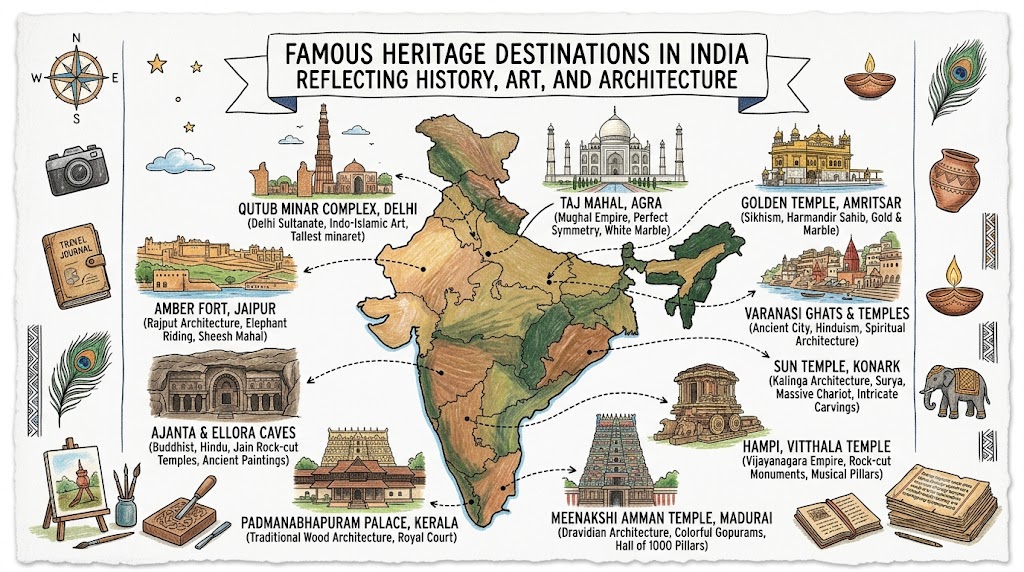
Heritage Destinations at a Glance
| Destination | State | Main Heritage Experience | Suggested Duration |
|---|---|---|---|
| Agra Heritage Circuit | Uttar Pradesh | Mughal monuments, marble art and royal architecture | 2–3 days |
| Jaipur | Rajasthan | Planned city, palaces, observatory, forts and bazaars | 3 days |
| Hampi | Karnataka | Vijayanagara temples, royal ruins and historic landscapes | 3 days |
| Khajuraho | Madhya Pradesh | Chandela temples, sculpture and Nagara architecture | 2–3 days |
| Ajanta and Ellora | Maharashtra | Buddhist paintings and multi-faith rock-cut monuments | 3 days |
| Mahabalipuram | Tamil Nadu | Pallava rock-cut temples, reliefs and coastal monuments | 2 days |
| Konark | Odisha | Monumental Sun Temple and stone sculpture | 1–2 days |
| Sanchi | Madhya Pradesh | Buddhist stupas, gateways, pillars and monasteries | 1–2 days |
| Great Living Chola Temples | Tamil Nadu | Monumental temples, inscriptions and Chola craftsmanship | 3–4 days |
Why Heritage Travel in India Is Important
It connects monuments with real history
Heritage travel helps visitors understand how kingdoms rose, cities were planned, religious centres developed, and artistic traditions moved across regions.
It reveals India’s artistic diversity
Indian monuments feature stone carving, mural painting, calligraphy, inlay work, metal art, temple sculpture, geometric design, symbolic imagery, and traditional building techniques.
It supports conservation awareness
Responsible visitors help protect monuments by respecting barriers, avoiding damage, following photography rules, and supporting authorised heritage services.
It strengthens local livelihoods
Local guides, craft sellers, transport providers, restaurants, homestays, and small businesses often depend on cultural tourism.
It creates educational journeys
Heritage destinations are useful for students, architects, photographers, artists, researchers, families, pilgrims, and anyone interested in India’s cultural development.
Agra: Mughal Architecture and Timeless Marble Art
Agra is home to three major UNESCO World Heritage properties: the Taj Mahal, Agra Fort, and Fatehpur Sikri. Together, they reflect Mughal architectural planning, imperial power, garden design, red-sandstone construction, marble decoration, and cultural exchange.
Taj Mahal
The Taj Mahal is one of India’s best-known architectural landmarks. Its white-marble mausoleum, formal garden, gateways, minarets, water channels, calligraphy, and carefully balanced design create a unified architectural composition.
Visitors should observe details such as floral stone inlay, geometric patterns, changing light on the marble, and the relationship between the monument and the Yamuna River.
Agra Fort
Agra Fort represents several phases of Mughal architecture. Its walls, gateways, courtyards, audience halls, palaces, and river views provide insight into imperial administration and royal life.
Fatehpur Sikri
Fatehpur Sikri was developed as an imperial city under Emperor Akbar. The complex contains palaces, public halls, courtyards, religious buildings, gateways, and residential structures displaying a mixture of regional and imperial architectural ideas.
Recommended experiences
- Visit the Taj Mahal early in the day
- Explore Agra Fort with an authorised guide
- Observe marble-inlay craftsmanship
- Walk through older neighbourhoods respectfully
- Set aside a separate half-day for Fatehpur Sikri
- Try regional Mughlai and North Indian food
HolidayLandmark planning tip
Use HolidayLandmark to organise Agra’s major attractions into separate morning and afternoon sessions. Trying to cover the Taj Mahal, Agra Fort, and Fatehpur Sikri in one rushed day reduces the quality of the experience.
Jaipur: Royal Planning, Palaces, Forts, and Traditional Markets
Jaipur was developed as a planned city with organised streets, public squares, markets, residential areas, temples, and royal buildings. UNESCO highlights its urban planning as well as landmarks such as City Palace, Govind Dev Temple, Jantar Mantar, and Hawa Mahal.
City Palace
The City Palace complex contains courtyards, gateways, museums, ceremonial spaces, and buildings connected with Jaipur’s royal history.
Hawa Mahal
Hawa Mahal is recognised for its distinctive façade, small openings, balconies, and visual relationship with the old city’s streets.
Jantar Mantar
Jantar Mantar is an early eighteenth-century astronomical observation site with approximately twenty large fixed instruments. These structures reflect the relationship between science, architecture, mathematics, and court scholarship.
Amer Fort
Amer Fort combines defensive architecture, palace spaces, courtyards, decorated halls, water systems, and views across the surrounding hills.
Jaipur’s wider heritage is also connected with Rajasthan’s hill-fort tradition. UNESCO’s Hill Forts of Rajasthan property includes six major forts representing Rajput political power and defensive architecture over several centuries.
Recommended experiences
- Explore Amer Fort early in the morning
- Visit City Palace and Jantar Mantar together
- Walk through the old bazaars
- Observe block printing, jewellery, pottery, and textile work
- Try a guided architecture or food walk
- Keep one evening for local cultural performances
HolidayLandmark planning tip
HolidayLandmark can help visitors balance Jaipur’s monuments with traditional markets, local food, and craft experiences instead of treating the city as only a fort-and-palace destination.
Hampi: Vijayanagara History Within a Dramatic Landscape
Hampi preserves the remains of the Vijayanagara capital within a landscape of granite hills, riverbanks, agricultural areas, temples, royal enclosures, markets, tanks, and defensive structures.
UNESCO identifies important complexes including the Krishna Temple, Hemakuta temples, Achyutaraya Temple, Vitthala Temple, Lotus Mahal, Pattabhirama Temple, bazaars, residential areas, tanks, and hydraulic systems.
Virupaksha Temple
Virupaksha Temple remains an important active religious site and forms one of the central landmarks of Hampi’s sacred area.
Vitthala Temple Complex
The Vitthala complex is known for its temple architecture, pillared halls, sculptural details, and the famous stone chariot.
Royal Enclosure
The royal zone contains platforms, water systems, palace foundations, audience spaces, underground chambers, and structures associated with administration and ceremony.
Lotus Mahal and Elephant Stables
These buildings demonstrate the variety of architectural forms found in Hampi’s secular structures.
Recommended experiences
- Divide Hampi into sacred and royal zones
- Visit riverside monuments early in the morning
- Explore Hemakuta Hill at a comfortable pace
- Use a bicycle or local vehicle for distant areas
- Hire a knowledgeable guide for architectural context
- Visit nearby Anegundi for village and cultural experiences
HolidayLandmark planning tip
HolidayLandmark travellers should allow at least two full sightseeing days. Hampi is geographically extensive, and its heritage cannot be understood properly through a quick photo-based visit.
Khajuraho: Temple Sculpture and Chandela Architectural Excellence
Khajuraho represents an important achievement of northern Indian temple architecture under the Chandela dynasty. UNESCO describes the temples as a high point of Chandela art and architecture during the tenth and eleventh centuries.
The surviving temples are organised into Western, Eastern, and Southern groups and belong mainly to Hindu and Jain traditions. UNESCO notes that approximately twenty temples remain from a much larger historical complex.
Western Group
The Western Group contains some of the most prominent temples, including Kandariya Mahadeva, Lakshmana, Vishvanatha, and Devi Jagadambi.
Eastern Group
The Eastern Group includes important Jain monuments and provides insight into Khajuraho’s religious diversity.
Temple sculpture
The sculptures represent deities, musicians, dancers, warriors, animals, daily activities, symbolic figures, and human relationships. The monuments should be viewed as complete architectural and philosophical compositions rather than reduced to a small category of carvings.
Recommended experiences
- Begin with the Western Group
- Use an official guide or audio interpretation
- Visit the archaeological museum when available
- Explore quieter Eastern and Southern groups
- Attend an authorised cultural presentation
- Combine the trip with nearby natural attractions when time allows
HolidayLandmark planning tip
HolidayLandmark can help travellers build a balanced Khajuraho itinerary that includes temple architecture, sculpture, museums, local villages, and regional culture.
Ajanta and Ellora: Rock-Cut Art, Paintings, and Religious Architecture
Ajanta and Ellora are separate heritage sites near Chhatrapati Sambhaji Nagar in Maharashtra. They should be visited on different days because each complex requires considerable walking and attention.
Ajanta Caves
Ajanta represents one of the great achievements of Buddhist rock-cut architecture, sculpture, and painting. UNESCO identifies the caves as an important record of religious, artistic, social, and political history.
The earliest Buddhist cave monuments at Ajanta date from the second and first centuries BCE, with richly decorated additions created during later periods. Its paintings and sculptures had a significant influence on Buddhist religious art.
Visitors should pay attention to:
- Narrative paintings
- Buddha images
- Monastic spaces
- Prayer halls
- Decorative ceilings
- Sculptural programmes
- Natural placement within the Waghora Valley
Ellora Caves
Ellora contains thirty-four monasteries and temples extending for more than two kilometres along a basalt cliff. The monuments date broadly from the sixth to tenth centuries and represent Buddhist, Hindu, and Jain traditions.
The Kailasa Temple is particularly important for understanding large-scale rock-cut engineering and sculptural planning.
Recommended experiences
- Keep separate days for Ajanta and Ellora
- Carry water and comfortable footwear
- Follow restrictions on flash photography
- Study the layout before entering each cave
- Use a trained heritage guide
- Include nearby Daulatabad or other regional heritage only with enough time
HolidayLandmark planning tip
HolidayLandmark travellers should avoid adding both cave complexes to the same day. A slower visit allows proper appreciation of paintings, sculptures, religious spaces, and construction techniques.
Mahabalipuram: Pallava Monuments Beside the Coromandel Coast
Mahabalipuram, also called Mamallapuram, contains a group of Pallava-period sanctuaries created along the Coromandel Coast during the seventh and eighth centuries.
UNESCO highlights its rock-cut rathas, cave sanctuaries, giant open-air reliefs, sculptural traditions, and coastal temple architecture.
Shore Temple
The Shore Temple is the destination’s most recognisable coastal monument and demonstrates the transition from rock-cut to structural temple architecture.
Pancha Rathas
The Pancha Rathas are monolithic structures carved in different architectural forms. They are useful for understanding experimentation in early South Indian temple design.
Descent of the Ganges
This monumental open-air relief contains numerous human, animal, divine, and symbolic figures arranged across a large rock surface.
Cave temples
Mahabalipuram’s cave sanctuaries contain pillars, reliefs, mythological scenes, and early examples of Pallava artistic development.
Recommended experiences
- Begin sightseeing before midday heat
- Visit the Shore Temple early or late in the day
- Study the Pancha Rathas individually
- Explore cave temples with a local guide
- Visit craft workshops
- Combine heritage exploration with a quiet coastal evening
HolidayLandmark planning tip
HolidayLandmark can help travellers combine Mahabalipuram with Chennai, Kanchipuram, or Puducherry without making the trip too crowded.
Konark: Monumental Stone Architecture Dedicated to the Sun
The Konark Sun Temple in Odisha is one of India’s most significant examples of temple architecture and sculptural storytelling.
UNESCO describes it as an outstanding achievement in conception, scale, proportion, and sculptural decoration, connected with the thirteenth-century kingdom of Odisha and the worship of Surya, the Sun God.
Architectural concept
The temple was designed with the visual symbolism of a monumental chariot. Its carved wheels, horses, walls, panels, and sculptural details create a powerful architectural narrative.
Artistic details
Visitors can observe:
- Carved stone wheels
- Musicians and dancers
- Animals and mythical figures
- Floral patterns
- Religious imagery
- Scenes of social and courtly life
- Structural and decorative stonework
Recommended experiences
- Visit during cooler morning hours
- Walk around the monument slowly
- Use interpretation to understand sculptural panels
- Explore the site museum when accessible
- Combine Konark with Puri or Bhubaneswar
- Respect all protected areas and barriers
HolidayLandmark planning tip
HolidayLandmark can support a wider Odisha heritage itinerary covering Konark, Bhubaneswar’s temples, regional crafts, coastal landscapes, and pilgrimage experiences.
Sanchi: Buddhist Heritage, Stupas, and Symbolic Gateways
Sanchi is one of India’s most important Buddhist heritage centres. It contains stupas, monasteries, temples, pillars, and other structures created over different historical periods.
UNESCO describes Sanchi as the oldest surviving Buddhist sanctuary and notes that many of its major monuments date from the second and first centuries BCE. The site continued as an important Buddhist centre until around the twelfth century.
Great Stupa
The Great Stupa is recognised for its hemispherical form, surrounding railings, circumambulatory path, and carved gateways.
Toranas
The gateways contain narrative carvings, symbolic images, animals, vegetation, architectural scenes, and representations connected with Buddhist teachings.
Monastic remains
The site includes foundations and remains of monasteries and temples, helping visitors understand Sanchi as a complete religious and educational centre rather than a single monument.
Recommended experiences
- Begin at the museum or interpretation centre
- Walk around the Great Stupa respectfully
- Study each gateway separately
- Observe symbols used to represent Buddhist teachings
- Visit nearby Udayagiri only with enough time
- Maintain silence around spiritual areas
HolidayLandmark planning tip
HolidayLandmark travellers can combine Sanchi with Bhopal, Bhimbetka, Udayagiri, or other Madhya Pradesh heritage locations in a carefully planned circuit.
Great Living Chola Temples: Monumental South Indian Temple Heritage
The Great Living Chola Temples include Brihadisvara Temple at Thanjavur, Brihadisvara Temple at Gangaikondacholisvaram, and Airavatesvara Temple at Darasuram.
These temples were built under the Chola Empire during the eleventh and twelfth centuries and remain important religious and architectural sites.
Thanjavur Brihadisvara Temple
The Thanjavur temple is known for its monumental scale, tower, courtyards, inscriptions, sculptures, and relationship with Chola royal authority.
Gangaikondacholisvaram
This temple reflects a refined development of Chola architecture and was completed under Rajendra I.
Airavatesvara Temple
The Darasuram temple is admired for its smaller scale, detailed stone carving, sculptural panels, and carefully designed architectural elements.
Recommended experiences
- Visit all three temples over several days
- Observe inscriptions and sculptural details
- Respect active worship practices
- Hire a guide familiar with Chola history
- Explore Thanjavur’s art and music traditions
- Visit local bronze and craft workshops responsibly
HolidayLandmark planning tip
HolidayLandmark can help travellers connect these temples with Thanjavur Palace, local art, classical music traditions, regional cuisine, and responsible pilgrimage planning.
Best Heritage Experiences Beyond Monument Sightseeing
Join an architectural walk
A guided architecture walk can explain construction materials, structural forms, urban planning, symbolism, and changes made during different historical periods.
Visit museums
Site museums provide sculptures, inscriptions, excavated objects, models, photographs, and historical explanations that improve understanding of the monuments.
Meet traditional craftspeople
Heritage cities often support stone carvers, textile workers, painters, metalworkers, jewellery makers, woodworkers, and pottery communities.
Attend cultural performances
Classical music, folk dance, theatre, storytelling, and traditional festivals can connect architectural heritage with living cultural traditions.
Explore local neighbourhoods
Historic bazaars, temple streets, river ghats, old residential areas, and craft districts reveal the social life surrounding major monuments.
Suggested Heritage Travel Itineraries
North India Heritage Circuit
| Day | Destination and Experience |
|---|---|
| Arrival | Reach Delhi or Agra and rest |
| Full day | Taj Mahal and Agra Fort |
| Full day | Fatehpur Sikri and local craft experience |
| Transfer | Travel to Jaipur |
| Full day | Amer Fort and old-city markets |
| Full day | City Palace, Jantar Mantar and Hawa Mahal area |
| Departure | Local breakfast and onward journey |
Central India Art and Buddhist Heritage Circuit
| Day | Destination and Experience |
|---|---|
| Arrival | Reach Bhopal |
| Full day | Sanchi monuments and museum |
| Transfer | Continue towards Khajuraho |
| Full day | Western Group of temples |
| Full day | Eastern and Southern temple groups |
| Extension | Add a regional museum, village, or nature visit |
| Departure | Continue to the nearest practical transport point |
South India Temple and Architecture Circuit
| Day | Destination and Experience |
|---|---|
| Arrival | Reach Chennai |
| Full day | Mahabalipuram monuments |
| Transfer | Travel towards Thanjavur |
| Full day | Brihadisvara Temple and Thanjavur heritage |
| Full day | Gangaikondacholisvaram |
| Full day | Darasuram and surrounding cultural sites |
| Departure | Continue from a suitable regional hub |
Deccan Heritage Circuit
| Day | Destination and Experience |
|---|---|
| Arrival | Reach Chhatrapati Sambhaji Nagar |
| Full day | Ajanta Caves |
| Full day | Ellora Caves |
| Rest or extension | Regional fort, museum, or local craft experience |
| Transfer | Continue towards Karnataka |
| Full day | Hampi sacred zone |
| Full day | Hampi royal zone and village experience |
Best Time to Visit Heritage Destinations
| Destination | Generally Comfortable Period | Main Consideration |
|---|---|---|
| Agra | October–March | Winter mornings may be foggy |
| Jaipur | October–March | Festivals and holidays increase crowds |
| Hampi | October–February | Summer afternoons can be extremely hot |
| Khajuraho | October–March | Outdoor temple exploration is easier in cooler weather |
| Ajanta and Ellora | October–March | Long walking periods require comfortable conditions |
| Mahabalipuram | November–February | Coastal humidity remains possible |
| Konark | October–February | Midday heat can be strong |
| Sanchi | October–March | Limited shade in some open areas |
| Chola Temple Circuit | November–February | Temple floors and courtyards may become hot later in the day |
Weather patterns and monument arrangements can change. Travellers should verify current opening days, ticket procedures, local festivals, transport conditions, and official visitor rules before departure.
How to Reach India’s Major Heritage Destinations
By air
Major airports or practical air gateways serve Delhi, Agra’s wider region, Jaipur, Bhopal, Khajuraho, Chennai, Bhubaneswar, Maharashtra’s cave circuit, and South Indian temple routes.
By train
Rail services are useful for Agra, Jaipur, Hampi’s gateway towns, Khajuraho, Bhopal, Thanjavur, Bhubaneswar, and Chhatrapati Sambhaji Nagar.
By road
Road travel is often needed for Fatehpur Sikri, Hampi’s wider monument zone, Ajanta, Ellora, Sanchi, Konark, Mahabalipuram, and the three Chola temples.
HolidayLandmark transport advice
Choose accommodation close to the main heritage zone where practical. This reduces commuting time and allows early-morning visits before larger tour groups arrive.
Local Transportation
Common local options include:
- Government and private buses
- Prepaid taxis
- App-based cabs in larger cities
- Auto-rickshaws
- Rental vehicles with drivers
- Bicycles in selected heritage areas
- Electric vehicles where provided
- Walking tours
- Authorised monument transport
Before hiring a vehicle, confirm the total price, waiting time, parking charges, route, and return arrangements.
Accommodation and Heritage Stays
Heritage destinations offer many types of accommodation:
- Budget guesthouses
- Hostels
- Mid-range hotels
- Family-run homestays
- Restored heritage properties
- Boutique hotels
- Pilgrimage accommodation
- Rural stays near monument areas
Choosing accommodation
Select a property based on:
- Distance from monuments
- Early-morning transport
- Safe neighbourhood access
- Recent guest reviews
- Meal availability
- Parking or pickup facilities
- Cancellation terms
- Noise levels
- Suitability for children or senior travellers
The Best Homestays in India often provide local food and personal cultural guidance, but travellers should check cleanliness, registration, road access, and host communication before booking.
Local Tour Guides and Historical Interpretation
Local Tour Guides in India can help visitors understand architecture, sculpture, inscriptions, historical events, restoration work, religious customs, and symbolic details.
A trained guide is especially useful at:
- Hampi
- Khajuraho
- Ajanta and Ellora
- Fatehpur Sikri
- Jaipur’s forts
- Sanchi
- Konark
- Chola temples
Before booking, confirm:
- Authorisation or professional experience
- Language
- Tour duration
- Monument coverage
- Total price
- Entry-ticket responsibility
- Photography advice
- Transport inclusions
HolidayLandmark can help travellers identify the type of guide required, whether the interest is architecture, religion, photography, history, crafts, or family education.
Village Tourism and Traditional Craft Experiences
Heritage travel becomes more meaningful when visitors explore the communities surrounding monuments.
Possible Village Tourism in India experiences include:
- Anegundi near Hampi
- Craft settlements around Jaipur
- Stone-carving communities near Mahabalipuram
- Textile and bronze workshops near Thanjavur
- Village areas around Khajuraho
- Artisan communities in Odisha
- Rural experiences around Sanchi and Bhopal
Responsible visitors should ask before taking photographs, avoid entering workshops without permission, and purchase genuine products directly from artisans where possible.
Pilgrimage and Spiritual Experiences
Many heritage monuments remain active places of worship.
Important spiritual destinations in this itinerary include:
- Virupaksha Temple in Hampi
- Chola temples in Tamil Nadu
- Hindu and Jain temples in Khajuraho
- Buddhist monuments at Sanchi
- Religious spaces at Fatehpur Sikri
- Konark’s historic association with Surya worship
Visitors should dress respectfully, remove footwear where required, follow entry rules, keep voices low, and avoid interrupting worship for photographs.
Pilgrimage Tours in India should balance spiritual importance with heritage conservation and local customs.
Heritage-Friendly Activities
| Activity | Suitable Destination | Main Requirement |
|---|---|---|
| Architectural photography | Jaipur, Hampi and Mahabalipuram | Follow camera and tripod rules |
| Museum visits | Agra, Khajuraho, Sanchi and Ajanta | Check current opening days |
| Heritage cycling | Hampi and selected historic cities | Use safe recognised routes |
| Craft workshops | Jaipur, Thanjavur and Odisha | Book through responsible providers |
| Riverside walks | Agra, Hampi and Sanchi region | Respect protected and religious areas |
| Monument sketching | Khajuraho, Hampi and Mahabalipuram | Avoid blocking visitor routes |
| Cultural performances | Jaipur, Khajuraho and Thanjavur | Choose authorised events |
| Guided village visits | Hampi, Khajuraho and craft regions | Ask community permission |
Local Food and Heritage Shopping
Agra
Try regional Mughlai dishes, North Indian meals, sweets, and locally produced marble-inlay decorative work from reliable sellers.
Jaipur
Explore Rajasthani meals, sweets, savoury snacks, block-printed textiles, jewellery, pottery, leatherwork, and miniature-style art.
Hampi
Look for Karnataka meals, regional snacks, bananas, local crafts, textiles, and products from nearby village enterprises.
Khajuraho and Sanchi
Try Madhya Pradesh regional food, vegetarian thalis, local snacks, stone craft, textiles, and community-made products.
Maharashtra cave circuit
Regional meals, traditional sweets, textiles, metal crafts, and locally produced food items can be explored around the gateway city.
Tamil Nadu heritage circuit
Taste regional rice dishes, temple-town food, filter coffee, sweets, brass products, bronze art, textiles, and stone sculpture.
Odisha
Explore Odia cuisine, sweets, appliqué work, stone carving, handloom textiles, paintings, and responsible artisan products.
Avoid purchasing objects claimed to be ancient, excavated, or taken from protected monuments.
Estimated Heritage Travel Budget
The following figures are broad planning estimates per person for a three-night domestic trip. Long-distance flights and premium shopping are excluded.
| Travel Style | Estimated Total |
|---|---|
| Budget | ₹7,000–₹14,000 |
| Mid-range | ₹15,000–₹30,000 |
| Comfortable | ₹32,000–₹65,000+ |
| Expense | General Planning Range |
|---|---|
| Accommodation | ₹1,000–₹10,000+ per night |
| Meals | ₹700–₹2,500 per day |
| Local transportation | ₹800–₹5,000 per day |
| Guide services | ₹800–₹4,000 per tour |
| Monument entries | Destination-dependent |
| Museum or cultural experiences | ₹200–₹2,500+ |
| Emergency reserve | Around 10–15% of the budget |
Actual costs change according to season, booking date, traveller nationality, transport choice, accommodation standard, guide type, and monument-ticket rules.
Safety, Conservation, and Responsible Heritage Tourism
Do not touch carvings and paintings
Oils and moisture from hands can damage delicate surfaces over time.
Never write on monuments
Graffiti permanently harms cultural property and may lead to legal penalties.
Follow barriers and marked routes
Restricted areas may contain unstable structures, fragile art, archaeological remains, or active conservation work.
Avoid unsafe photography
Do not climb walls, stand on exposed edges, cross barriers, or damage structures for photographs.
Respect active religious sites
Heritage importance does not remove the spiritual meaning of temples, mosques, monasteries, churches, or shrines.
Carry water responsibly
Use reusable bottles where permitted, but do not leave waste inside monument grounds.
Hire authorised services
Use recognised guides, transport operators, and ticket platforms to reduce misinformation and fraud.
Verify current information
Opening hours, weekly closures, ticket categories, festival restrictions, and photography policies may change. Confirm them through official monument or tourism channels before travelling.
Frequently Asked Questions
- Which heritage destination in India is best for first-time visitors?
Agra and Jaipur are practical choices because they offer famous monuments, varied accommodation, established transport, authorised guides, and strong cultural experiences. - How many days are required to explore Hampi properly?
At least two full sightseeing days are recommended. A third day allows time for Anegundi, village experiences, museums, or slower exploration. - Can Ajanta and Ellora be visited on the same day?
It is not advisable. The complexes are separate, require extensive walking, and contain enough art and architecture to justify one day each. - Why is Khajuraho important in Indian art history?
Khajuraho represents a major achievement in Chandela-period temple architecture and sculpture. Its carvings cover religious, symbolic, social, musical, and everyday themes. - Which heritage destination is suitable for families with children?
Jaipur, Agra, Mahabalipuram, and Sanchi can suit families when sightseeing is limited to a few major places each day and rest breaks are included. - Are local guides necessary at Indian heritage monuments?
Guides are not always compulsory, but they can explain architecture, inscriptions, symbolism, historical context, and conservation details that visitors may otherwise miss. - What should visitors wear at heritage and religious sites?
Comfortable, modest clothing and easy-to-remove footwear are practical. Some active religious places may have additional dress or entry requirements. - Which destinations combine heritage with local crafts?
Jaipur, Mahabalipuram, Thanjavur, Konark, Hampi, and Agra offer access to textiles, stone carving, metalwork, painting, jewellery, or traditional decorative arts. - What is the best season for a multi-city heritage journey?
October to March is generally comfortable for many destinations, although regional weather, festivals, and peak-season crowds should be checked before booking. - How can HolidayLandmark help plan an Indian heritage tour?
HolidayLandmark can help travellers discover historic destinations, compare attractions, create India Travel Itinerary plans, identify suitable seasons, and explore local guides, homestays, pilgrimage routes, food, crafts, and cultural experiences.
Conclusion
India’s heritage destinations reveal a long and varied story told through stone, paint, sculpture, engineering, urban planning, religion, and craftsmanship. Each place represents a different historical period and regional identity.
Agra reflects the balance and refinement of Mughal architecture, while Jaipur demonstrates royal planning, scientific knowledge, fort construction, and living craft traditions. Hampi preserves the scale and ambition of the Vijayanagara Empire within an unforgettable natural landscape.
Khajuraho shows how sculpture and architecture can work together as one artistic composition. Ajanta and Ellora reveal centuries of rock-cut engineering, Buddhist painting, religious diversity, and human creativity. Mahabalipuram presents Pallava experimentation in monolithic and structural architecture, while Konark expresses religious symbolism through monumental stone design.
Sanchi connects visitors with the early development of Buddhist sacred architecture, and the Great Living Chola Temples continue to unite active worship with artistic and architectural heritage.
These monuments should not be treated only as backgrounds for photographs. They are protected cultural spaces requiring patience, responsible behaviour, and respect. Visitors can contribute by following official rules, hiring knowledgeable local guides, supporting traditional craftspeople, avoiding litter, and learning the meaning behind what they see.
HolidayLandmark can make heritage planning simpler by helping travellers discover the Best Places to Visit in India, understand the Best Time to Visit India, create realistic routes, and connect heritage sightseeing with local food, homestays, guides, village tourism, pilgrimage experiences, and cultural activities. A thoughtful heritage journey does more than show the past—it helps travellers understand how India’s history continues to shape its living culture.