
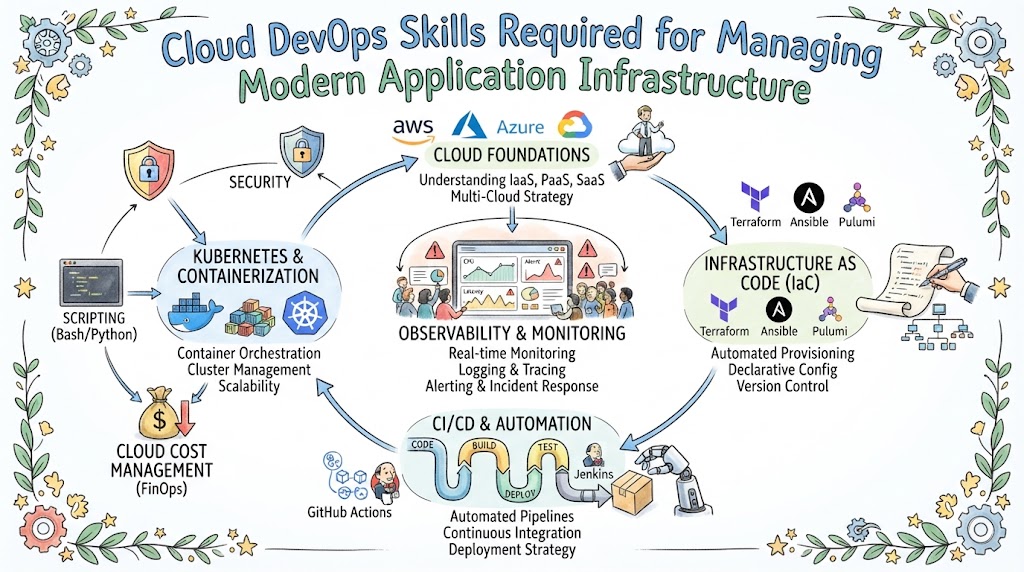
Introduction
Modern applications rarely run on a single server. They may use cloud services, containers, Kubernetes clusters, databases, APIs, messaging systems, monitoring tools, and automated delivery pipelines.
Managing this environment requires more than knowing how to operate one cloud platform. Professionals need a combination of Cloud DevOps Skills covering infrastructure, software delivery, automation, reliability, security, and collaboration.
A common problem for beginners is trying to learn too many tools without understanding how they work together. Working professionals may face a different challenge: they know individual technologies but struggle to design a reliable end-to-end delivery and operating model.
This article explains the technical foundations, tools, projects, career paths, DORA metrics, practical exercises, and engineering practices required to manage modern application infrastructure effectively.
Why Cloud DevOps Skills Matter
Cloud DevOps knowledge is useful for different professionals for different reasons.
Beginners need a structured learning path instead of randomly studying tools.
DevOps engineers use these skills to automate builds, deployments, infrastructure, monitoring, and recovery processes.
SRE teams need them to maintain service reliability, manage incidents, define service-level objectives, and reduce operational risk.
Platform engineers use them to build reusable infrastructure and self-service development platforms.
Engineering managers need enough technical understanding to evaluate delivery risks, reliability problems, team capacity, and improvement opportunities.
For modern organizations, strong Cloud DevOps capabilities can reduce manual work, improve delivery consistency, strengthen security, and make application performance easier to understand.
Industry Overview
Cloud infrastructure has changed how applications are developed and operated. Teams can create servers, databases, storage, networks, and managed services through APIs instead of waiting for physical hardware.
DevOps connects development and operations through automation, shared responsibility, continuous feedback, and measurable improvement. Cloud computing gives teams flexible infrastructure, while DevOps provides the practices needed to manage that infrastructure responsibly.
Cloud-native teams increasingly use containers, Kubernetes, Infrastructure as Code, GitOps, observability, DevSecOps, SRE, and platform engineering. These approaches are connected rather than independent.
For example, an application may be stored in Git, tested through a CI/CD pipeline, packaged as a container, deployed to Kubernetes, monitored through observability tools, and evaluated using delivery and reliability metrics.
Important Cloud DevOps Concepts
Cloud Computing
Cloud computing provides computing resources through services that can be created, changed, and removed when needed.
The main service models are:
- Infrastructure as a Service for virtual machines, networks, and storage
- Platform as a Service for managed application environments
- Software as a Service for complete applications
- Serverless computing for event-driven workloads without direct server management
A DevOps engineer should understand identity management, networking, compute, storage, databases, pricing, availability, and shared-security responsibilities.
Infrastructure as Code
Infrastructure as Code, commonly called IaC, means defining infrastructure in configuration files rather than creating it manually.
Tools such as Terraform and native cloud templates allow teams to review, version, test, and repeat infrastructure changes.
For example, a Terraform configuration can create a virtual network, Kubernetes cluster, database, and security rules through an automated workflow.
Continuous Integration and Continuous Delivery
Continuous Integration automatically validates code whenever developers make changes. Continuous Delivery prepares tested changes for release through a repeatable pipeline.
A typical pipeline may perform:
- Source-code checkout
- Dependency installation
- Unit testing
- Security scanning
- Container-image creation
- Deployment to a test environment
- Integration testing
- Production approval or automated release
Containers
Containers package applications with their runtime dependencies. This makes the application more consistent across development, testing, and production environments.
Docker is widely used for building and running container images. Engineers must also understand image layers, registries, networking, persistent storage, security scanning, and resource limits.
Kubernetes
Kubernetes manages containerized applications across multiple machines. It can schedule workloads, replace failed containers, balance traffic, scale applications, and manage configuration.
Important Kubernetes concepts include Pods, Deployments, Services, ConfigMaps, Secrets, namespaces, ingress, storage, resource limits, health probes, and role-based access control.
Observability
Observability helps teams understand what is happening inside an application by examining metrics, logs, traces, events, and user experience.
Monitoring may tell a team that an API is slow. Observability helps the team investigate whether the delay comes from the application, database, network, dependency, or recent deployment.
Site Reliability Engineering
Site Reliability Engineering applies software engineering methods to operational problems.
SRE teams commonly work with service-level indicators, service-level objectives, error budgets, incident response, capacity planning, automation, and reliability reviews.
DevSecOps
DevSecOps integrates security into development and delivery workflows.
It can include dependency scanning, secret detection, container-image scanning, Infrastructure as Code analysis, access control, policy enforcement, and runtime protection.
Step-by-Step Process for Developing Cloud DevOps Skills
Step 1: Build Operating-System Fundamentals
Learn Linux files, permissions, processes, services, package management, environment variables, logs, and shell commands.
These skills matter because most cloud workloads, containers, and automation systems depend on Linux.
Avoid memorizing commands without understanding their purpose. Practise by creating users, managing services, reading logs, and troubleshooting resource usage.
Step 2: Understand Networking
Study IP addresses, DNS, ports, routing, firewalls, proxies, load balancers, TLS, subnets, and network address translation.
Networking problems often appear as application failures. A deployment may be correct but unavailable because of a security rule, DNS error, blocked port, or incorrect route.
Build a small virtual network and test communication between public and private resources.
Step 3: Learn Git and Collaboration Workflows
Understand repositories, branches, commits, merges, pull requests, tags, release branches, and conflict resolution.
Store application code, pipeline definitions, infrastructure configuration, and operational documentation in version control.
Avoid making infrastructure changes outside Git without recording them.
Step 4: Develop Scripting Skills
Learn Bash for Linux automation and Python for more structured automation, APIs, data processing, and cloud tasks.
Create scripts that validate configuration, rotate logs, call an API, inspect cloud resources, or check application health.
Scripts should include error handling, meaningful output, and secure secret management.
Step 5: Build CI/CD Pipelines
Use Jenkins, GitHub Actions, GitLab CI/CD, or another suitable platform to automate testing and delivery.
Start with a simple application. Add unit tests, code-quality checks, image creation, security scanning, and environment-based deployments.
Avoid creating one large pipeline that is difficult to debug. Divide it into clear, reusable stages.
Step 6: Learn Containers
Create Dockerfiles, build images, use registries, configure environment variables, and run multi-container applications.
Optimise images by reducing unnecessary packages and avoiding sensitive information inside image layers.
The expected result is a repeatable application package that runs consistently across environments.
Step 7: Work with Kubernetes
Deploy the containerized application to a local or managed Kubernetes cluster.
Add health probes, resource requests, resource limits, configuration, secrets, scaling, ingress, and deployment strategies.
Avoid deploying workloads without resource controls or operational visibility.
Step 8: Automate Cloud Infrastructure
Use Terraform or another IaC tool to create networks, compute resources, clusters, databases, and access policies.
Store state securely, review changes before applying them, and divide infrastructure into reusable modules.
The result should be a repeatable environment that can be reviewed and recreated.
Step 9: Add Monitoring and Observability
Collect application and infrastructure metrics, centralize logs, trace important requests, and configure meaningful alerts.
Alerts should represent symptoms requiring action rather than every technical event.
Create dashboards for availability, latency, errors, saturation, deployment activity, and business-critical operations.
Step 10: Integrate Security
Scan source code, dependencies, containers, and infrastructure definitions. Apply least-privilege access and protect secrets.
Security controls should operate throughout the delivery workflow rather than only before production release.
Step 11: Measure Delivery and Reliability
Track deployment frequency, lead time, change-failure rate, recovery time, incidents, rollbacks, SLO performance, and error-budget consumption.
Use the results to find process weaknesses. Do not use a single metric to judge individual employees.
Relevant DevOps Tools
Tool selection should depend on project size, technical requirements, security expectations, existing integrations, budget, and team experience.
| Tool | Main Purpose | Key Features | Best Suited For | Learning Difficulty |
|---|---|---|---|---|
| Git | Source control | Branching, history, collaboration | Every software team | Beginner |
| GitHub Actions | CI/CD automation | Repository-based workflows, integrations | GitHub projects | Beginner–Intermediate |
| Jenkins | Pipeline automation | Flexible pipelines, plugins, self-hosting | Custom enterprise workflows | Intermediate |
| Docker | Container management | Image building, registries, isolation | Portable applications | Beginner–Intermediate |
| Kubernetes | Container orchestration | Scaling, recovery, service discovery | Distributed applications | Advanced |
| Terraform | Infrastructure as Code | Multi-provider automation, planning, modules | Repeatable cloud infrastructure | Intermediate |
| Ansible | Configuration management | Agentless automation, reusable playbooks | Server configuration | Intermediate |
| Prometheus | Metrics monitoring | Time-series metrics, alerting | Cloud-native systems | Intermediate |
| Grafana | Visualization | Dashboards, multiple data sources | Operational visibility | Beginner–Intermediate |
| OpenTelemetry | Telemetry collection | Metrics, logs, and traces | Distributed application observability | Intermediate |
| Vault | Secret management | Controlled access, secret rotation | Security-conscious environments | Intermediate |
| DevOpsIQ | Engineering intelligence | Delivery, incident, reliability, and timeline insights | Engineering and platform teams | Intermediate |
Practical Benefits
Strong Cloud DevOps skills can help teams:
- Release software through repeatable delivery workflows
- Reduce manual configuration and deployment errors
- Improve cooperation between developers, operations, security, and QA
- Detect application and infrastructure problems earlier
- Recover from failed changes more effectively
- Standardize infrastructure across environments
- Introduce security checks before production
- Connect engineering decisions with delivery and reliability data
The value comes from combining tools, processes, and team behaviour. Installing more tools alone does not create an effective DevOps environment.
Common Challenges and Solutions
| Challenge | Practical Solution |
|---|---|
| Too many disconnected tools | Define the delivery workflow first and select only tools that support it |
| Limited practical experience | Build small projects that connect code, infrastructure, deployment, and monitoring |
| Weak monitoring | Start with availability, latency, error, and resource-saturation signals |
| Manual cloud changes | Manage repeatable infrastructure through reviewed IaC workflows |
| Security added too late | Add security scanning and policy checks to CI/CD pipelines |
| Unclear service ownership | Assign clear owners for applications, alerts, documentation, and recovery |
| Excessive alerts | Remove low-value notifications and connect alerts to user impact |
| Resistance to process changes | Introduce improvements gradually and explain the operational reason |
| Missing engineering data | Connect delivery, incident, and reliability information |
| Incorrect metric interpretation | Combine metrics with system context and team feedback |
Cloud DevOps Best Practices
Keep Infrastructure Changes in Version Control
Infrastructure files should follow the same review process as application code. This creates history, accountability, and safer collaboration.
Design Small and Reusable Pipelines
Reusable pipeline components reduce duplication and make failures easier to identify.
Use Immutable Deployment Patterns
Instead of repairing running servers manually, create a tested image or container and replace the old version.
Separate Configuration from Application Code
Keep environment-specific configuration outside the application package. Manage sensitive values through approved secret-management systems.
Test Recovery Procedures
Backups are useful only when teams can restore them. Test database recovery, service failover, rollback, and incident communication.
Measure User-Facing Reliability
Infrastructure health does not always reflect user experience. Include availability, latency, errors, and important business operations in monitoring.
Document Operational Decisions
Record architecture choices, deployment steps, known risks, escalation paths, and incident lessons.
Practical Example
Consider an online ordering application with a frontend, API, and database.
Developers store code in Git and submit pull requests. A CI pipeline runs tests, scans dependencies, and creates a Docker image. Terraform creates the cloud network and Kubernetes cluster.
Kubernetes deploys the application using rolling updates. Prometheus collects metrics, OpenTelemetry records request traces, and centralized logging supports troubleshooting.
When an API release increases database latency, the team connects the deployment event with monitoring data. They roll back the release, restore normal performance, and review the pipeline to detect similar problems earlier.
This example shows how source control, CI/CD, containers, IaC, Kubernetes, observability, and incident response work as one system.
Real-World Use Cases
Startups can use managed cloud services and simple automation to release quickly without building a large operations department.
Medium-sized companies can standardize pipelines, cloud accounts, security controls, and monitoring as the number of teams grows.
Large enterprises may use shared platform services, governance policies, internal developer platforms, and centralized engineering intelligence.
Cloud-native teams use containers, Kubernetes, GitOps, and observability to manage distributed services.
SRE teams focus on service objectives, error budgets, incident response, automation, and reliability improvement.
Platform teams build reusable templates and self-service capabilities for development teams.
Regulated organizations require controlled access, audit history, policy enforcement, security scanning, and documented recovery processes.
Cloud DevOps Learning Roadmap
| Stage | Concepts and Exercise | Expected Outcome |
|---|---|---|
| DevOps fundamentals | Learn collaboration, automation, feedback, and shared ownership | Understand DevOps principles |
| Linux and networking | Configure services, users, DNS, ports, and firewalls | Troubleshoot basic systems |
| Git | Use branches, pull requests, tags, and merge workflows | Manage code collaboratively |
| Scripting | Automate tasks with Bash and Python | Reduce repetitive work |
| CI/CD | Build a test and deployment pipeline | Automate software delivery |
| Containers | Package and run an application with Docker | Create portable workloads |
| Kubernetes | Deploy, scale, expose, and monitor containers | Operate orchestrated workloads |
| Cloud platforms | Create compute, network, storage, identity, and databases | Understand cloud architecture |
| Infrastructure as Code | Build infrastructure with Terraform modules | Create repeatable environments |
| Observability | Collect metrics, logs, traces, and alerts | Investigate system behaviour |
| DevSecOps | Add scanning, secrets, policies, and access controls | Integrate security earlier |
| SRE and platforms | Define SLOs and create reusable platform services | Improve reliability and experience |
| Engineering intelligence | Analyse DORA metrics, incidents, and recovery | Support measurable improvement |
Essential DevOps Engineer Skills
Technical skills include Linux, networking, Git, Bash or Python, CI/CD, Docker, Kubernetes, cloud services, Infrastructure as Code, observability, security, databases, and troubleshooting.
Non-technical skills are equally important. Engineers must communicate clearly, document decisions, collaborate across teams, prioritise risks, investigate problems calmly, and explain technical findings to different audiences.
The most valuable DevOps Engineer Skills are not based on memorising tool commands. They involve understanding systems, automation, failure behaviour, security, and business impact.
Practical DevOps Projects
| Level | Project Objective | Tools and Main Tasks | Skills Developed |
|---|---|---|---|
| Beginner | Automate a web application build | Git, GitHub Actions, testing, Docker | Source control and CI |
| Beginner–Intermediate | Deploy an application to cloud infrastructure | Terraform, cloud platform, load balancer | Cloud and IaC |
| Intermediate | Operate an application on Kubernetes | Docker, Kubernetes, Helm, ingress | Container orchestration |
| Intermediate | Build an observability stack | Prometheus, Grafana, logs, OpenTelemetry | Monitoring and troubleshooting |
| Advanced | Create a secure delivery platform | CI/CD, IaC, scanning, policies, secrets | DevSecOps and platform engineering |
| Advanced | Analyse delivery and reliability performance | Git, CI/CD, incident and observability data | DORA and engineering intelligence |
Each project should include documentation, architecture diagrams, security decisions, test evidence, deployment instructions, and a short review of lessons learned.
Certifications and Courses
A Best DevOps Course can help beginners who need structured instruction and professionals who want guided practice in unfamiliar technologies.
Certifications may be useful when a role requires verified knowledge of a cloud platform, Kubernetes, security, automation, or infrastructure management. However, certification alone does not demonstrate production experience.
Practical training should include:
- Guided laboratories
- Troubleshooting exercises
- Pipeline development
- Infrastructure automation
- Container and Kubernetes deployments
- Monitoring and incident scenarios
- Security checks
- Project reviews
Compare providers by examining the syllabus, instructor experience, laboratory access, project depth, support model, and connection between theory and real implementation.
The Best DevOps Certifications for one learner may not suit another. Selection should be based on career direction, current responsibilities, and technology requirements.
Career Opportunities
| Role | Main Responsibilities | Important Skills |
|---|---|---|
| DevOps Engineer | Automate delivery and infrastructure | CI/CD, cloud, scripting, IaC |
| Site Reliability Engineer | Improve reliability and recovery | SLOs, observability, coding, incidents |
| Platform Engineer | Build shared development platforms | Kubernetes, APIs, automation, developer experience |
| Cloud Engineer | Design and operate cloud resources | Networking, identity, compute, security |
| DevSecOps Engineer | Integrate security into delivery | Scanning, policies, secrets, access control |
| Automation Engineer | Automate technical workflows | Scripting, APIs, testing, orchestration |
| Infrastructure Engineer | Manage compute, networks, and storage | Linux, networking, cloud, IaC |
| Build and Release Engineer | Maintain build and release processes | CI/CD, artifacts, versioning |
| Observability Engineer | Improve system visibility | Metrics, logs, traces, dashboards |
| Engineering Productivity Engineer | Improve development workflows | Tooling, automation, delivery analytics |
DevOps Engineer Salary Factors
DevOps Engineer Salary levels vary significantly. Reliable salary discussions should consider:
- Country and city
- Experience level
- Cloud and Kubernetes knowledge
- Automation and programming ability
- Relevant certifications
- Industry and company size
- Production responsibility
- Security and reliability experience
- Communication and leadership ability
Salary numbers should be checked against current local employment data because compensation changes by market, role, employer, and economic conditions.
Cloud DevOps Interview Questions and Answers
1. What is the difference between DevOps and cloud computing?
Cloud computing provides infrastructure and managed services. DevOps provides practices for building, delivering, operating, and improving software.
2. Why is Infrastructure as Code important?
It makes infrastructure repeatable, reviewable, version-controlled, and easier to automate across environments.
3. What problem does a CI pipeline solve?
It automatically validates code changes through builds, tests, and quality checks before integration or release.
4. Why should container images remain small?
Smaller images usually download faster, contain fewer unnecessary components, and provide a smaller security surface.
5. What is a Kubernetes readiness probe?
It checks whether a container is ready to receive traffic. Failed readiness checks temporarily remove the workload from service routing.
6. How would you investigate a failed cloud deployment?
Review pipeline logs, recent changes, credentials, configuration, infrastructure state, deployment events, application logs, and health checks.
7. What is configuration drift?
Configuration drift occurs when the real environment becomes different from its approved infrastructure definition.
8. Why should secrets not be stored in Git?
Git history may preserve exposed secrets even after deletion. Secrets should be stored in a controlled secret-management system.
9. What is the difference between horizontal and vertical scaling?
Horizontal scaling adds more instances. Vertical scaling adds more CPU, memory, or capacity to an existing instance.
10. How can teams reduce noisy alerts?
Connect alerts to user impact, remove duplicate notifications, define ownership, use sensible thresholds, and review alert usefulness after incidents.
11. What is a rollback?
A rollback restores a previously working application or configuration after a change causes unacceptable problems.
12. Why are resource requests important in Kubernetes?
They help the scheduler place workloads and reserve the minimum resources required for stable operation.
13. How can CI/CD pipelines be secured?
Use least-privilege credentials, protected branches, secret management, dependency scanning, signed artifacts, access reviews, and isolated runners.
14. What does deployment frequency measure?
It measures how often a team successfully releases changes to its target production environment.
15. Why can a high deployment frequency still be risky?
Frequent delivery without testing, observability, rollback controls, or reliability practices may increase operational failures.
16. What would you check when an API becomes slow after deployment?
Compare the release timeline with latency, errors, traces, database performance, resource usage, dependency behaviour, and configuration changes.
17. What is an error budget?
It is the acceptable amount of unreliability allowed by a service-level objective during a defined period.
18. Why should DORA metrics not evaluate individual developers?
The metrics represent system and team performance. Individual scoring can create unhealthy behaviour and misleading conclusions.
DORA Metrics and Engineering Intelligence
DORA metrics help teams examine software delivery performance.
Deployment Frequency
This measures how often production releases occur. It can indicate whether a delivery process supports small and regular changes.
Lead Time for Changes
This measures the time between a code change and its successful production release. Long lead times may reveal review, testing, approval, or deployment delays.
Change-Failure Rate
This measures the proportion of changes that cause failures, rollbacks, incidents, or urgent corrections. Teams should use a consistent definition of failure.
Time to Restore Service
This measures how quickly normal service is restored after a production problem. It reflects detection, diagnosis, coordination, rollback, and recovery capabilities.
Teams may also examine mean time to recovery or resolution, incident trends, SLO compliance, error-budget consumption, rollback frequency, service health, and engineering productivity indicators.
Metrics should guide investigation and improvement. They should not be used as isolated employee rankings or targets that encourage teams to manipulate data.
DORA Metrics Tools Comparison
| Tool Type | Data Collected | Main Insight | Suitable Team |
|---|---|---|---|
| Source-control analytics | Commits, pull requests, merges | Development flow | Software teams |
| CI/CD analytics | Builds, releases, failures | Delivery performance | DevOps teams |
| Incident platforms | Incidents, owners, recovery events | Response effectiveness | SRE teams |
| Observability platforms | Metrics, logs, traces, SLOs | Service behaviour | Operations teams |
| Engineering intelligence | Delivery, incident, rollback, and reliability data | Cross-tool performance | Engineering leaders |
| DevOpsIQ | Tool activity, deployments, incidents, recovery, and SLO data | Connected engineering timelines and trends | Multi-team organizations |
BestDevOps Learning Support
BestDevOps can support learners by bringing several parts of DevOps education into one learning environment.
Readers can use its DevOps tutorials to understand concepts, follow a DevOps Roadmap to organize learning, compare tools, review course options, explore certification guidance, practise DevOps Interview Questions, and identify suitable DevOps Projects.
Career resources and salary information can help learners understand role expectations. Tool explanations and practical content can also help working professionals compare approaches before introducing them into real environments.
The platform is most useful when readers combine learning material with laboratories, personal projects, troubleshooting practice, and regular technical review.
DevOpsIQ Use Cases
DevOpsIQ extends learning into engineering measurement by connecting information from development and operations tools such as GitHub, GitLab, Jenkins, Jira, Prometheus, and Datadog.
Engineering teams can use the connected information to:
- Track DORA metrics
- Relate deployments to incidents
- Examine recovery performance
- Review SLO compliance
- Monitor error-budget consumption
- Identify repeated reliability risks
- Compare service trends
- Study rollbacks and recovery events
- Support engineering decisions with shared data
Its engineering timeline connects deployments, failures, incidents, rollbacks, and recovery events. This helps teams investigate what changed before a problem and understand how service was restored.
The Pulse Score offers a simplified view of service health and possible risk areas. It should be treated as a starting point for investigation, not a complete explanation of every engineering problem.
Teams still need technical context, architecture knowledge, incident evidence, customer impact, and feedback from the people operating the service.
Future Cloud DevOps Trends
Cloud DevOps practices are moving toward greater automation and stronger developer support.
AI-assisted operations may help summarize incidents, correlate events, and suggest investigation paths. Human review will remain important for high-impact decisions.
Platform engineering and internal developer platforms are likely to expand as organizations standardize infrastructure and provide self-service workflows.
Other important developments include GitOps, policy as code, automated incident response, DevSecOps, FinOps, advanced observability, developer-experience measurement, engineering intelligence, and reliability automation.
The goal should not be to automate every activity. Teams should automate repeatable work while maintaining appropriate review for security, cost, reliability, and business risk.
Frequently Asked Questions
1. Can beginners learn Cloud DevOps without previous cloud experience?
Yes. Beginners can start with Linux, networking, Git, and scripting before moving into cloud services, pipelines, containers, and infrastructure automation.
2. Which cloud platform should a beginner study first?
Choose one platform that matches your target role, local job market, or current organization. The underlying concepts can later be transferred to other platforms.
3. Is programming required for Cloud DevOps roles?
Advanced application development is not required for every role, but scripting and basic programming are important for automation, APIs, testing, and troubleshooting.
4. Should Docker be learned before Kubernetes?
Yes. Understanding images, containers, registries, networking, volumes, and runtime behaviour makes Kubernetes much easier to understand.
5. How much Linux knowledge does a DevOps engineer need?
Engineers should comfortably manage files, permissions, services, processes, packages, logs, networking tools, shell commands, and system resources.
6. Are managed cloud services better than self-managed systems?
Managed services can reduce operational work, while self-managed systems may provide greater control. The right option depends on cost, expertise, security, and technical requirements.
7. Why do cloud applications need observability?
Distributed applications may fail across multiple services. Metrics, logs, and traces help teams understand where a problem started and how users were affected.
8. How can learners gain experience without a production job?
They can build personal projects, use local clusters, create low-cost cloud laboratories, contribute to open-source work, and document troubleshooting exercises.
9. Is Kubernetes necessary for every DevOps position?
No. Some organizations use virtual machines, serverless platforms, or managed application services. Kubernetes is valuable but should be learned according to role requirements.
10. How often should teams review their DevOps metrics?
Teams should review them regularly enough to support decisions, such as during operational reviews or improvement planning. The frequency depends on release volume and service criticality.
11. What is the biggest mistake in learning Cloud DevOps?
The biggest mistake is studying isolated commands without building complete workflows connecting code, infrastructure, deployment, security, monitoring, and recovery.
12. Can certifications replace practical projects?
No. Certifications demonstrate structured knowledge, while projects provide evidence that a learner can configure systems, solve problems, and explain technical decisions.
Key Takeaways
- Cloud DevOps combines cloud infrastructure, software delivery, automation, security, reliability, and measurement.
- Linux, networking, Git, scripting, CI/CD, containers, Kubernetes, IaC, and observability form the technical foundation.
- Tools should be selected according to requirements rather than popularity.
- Practical projects are essential for connecting individual technologies.
- Security and monitoring should be included from the beginning.
- DORA metrics should support team improvement, not individual punishment.
- Delivery data becomes more useful when connected with incidents, SLOs, rollbacks, and recovery events.
- Continuous learning should include theory, laboratories, troubleshooting, documentation, and system design.
Conclusion
Developing strong Cloud DevOps Skills requires more than learning a collection of popular tools. Professionals must understand how applications move from source code to production, how infrastructure is created, how workloads are secured, how services are monitored, and how failures are handled.
A structured learning path should begin with Linux, networking, Git, and scripting. Learners can then progress into CI/CD, containers, Kubernetes, cloud platforms, Infrastructure as Code, observability, DevSecOps, SRE, and engineering intelligence. Practical projects are necessary because they show how these areas connect inside a complete delivery and operating workflow.
Organizations also need measurement. Deployment frequency, lead time, change-failure rate, and time to restore service can reveal delivery and reliability patterns. However, these metrics must be interpreted with technical context, customer impact, incident information, and team feedback.
BestDevOps can help individuals explore tutorials, roadmaps, tool comparisons, courses, certifications, interview preparation, career resources, and practical projects. DevOpsIQ can help engineering teams connect delivery and operational information, examine service timelines, track DORA metrics, monitor reliability, and identify areas requiring deeper investigation.