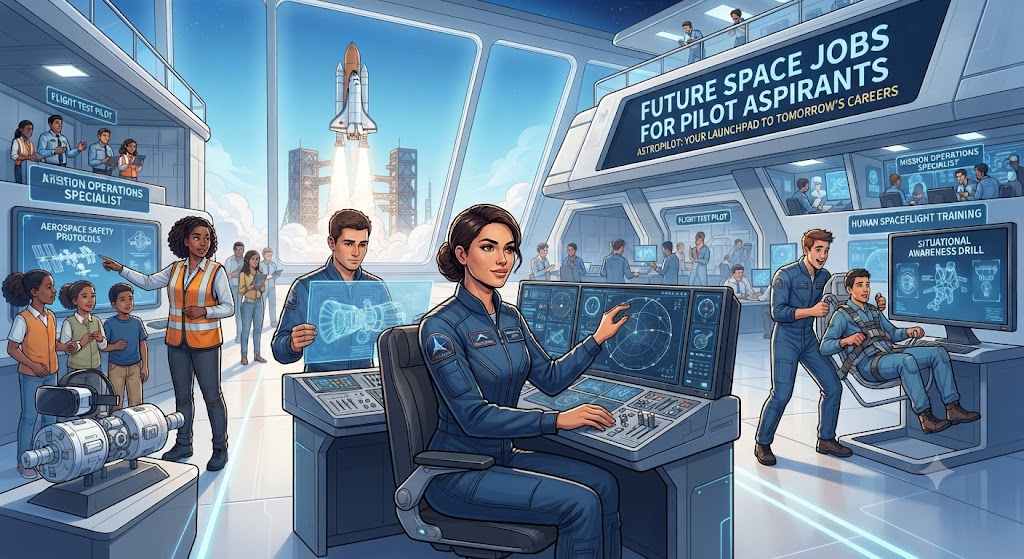
The aviation industry is no longer limited to airports, airlines, and traditional cockpits. A new career frontier is opening above the atmosphere, where pilots, engineers, instructors, mission specialists, and aviation-trained professionals may play important roles in human spaceflight and commercial space operations.
For pilot aspirants, this shift is exciting. The same qualities that make a strong pilot—discipline, situational awareness, communication, technical understanding, and calm decision-making—are also valuable in space-related careers. As commercial spaceflight, space tourism, satellite operations, and advanced aerospace systems continue to grow, future aviation professionals may find opportunities beyond conventional flight paths.
AstroPilot is built for learners who want to understand where aviation is going next. This guide explores future space jobs for pilot aspirants, the skills required, possible education paths, and how students can begin preparing for careers connected to space and advanced aviation.
Why the Space Industry Is Creating New Career Opportunities
Space is becoming more connected to commercial aviation, technology, defense, research, and tourism. Earlier, space careers were mainly linked with government space agencies and astronaut programs. Today, private space companies, research organizations, aerospace manufacturers, and training institutions are creating new types of roles.
Key areas driving future space careers include:
- Commercial spaceflight
- Space tourism
- Satellite launch and operations
- Reusable spacecraft development
- Space mission control
- Human spaceflight training
- Aerospace safety and testing
- Advanced simulation systems
- Orbital transportation planning
- Space research and exploration
This growth does not mean every pilot aspirant will become an astronaut. However, it does mean that aviation-trained professionals may have more career options in space-related fields.
Why Pilot Aspirants Have an Advantage
Pilots are trained to think clearly under pressure. They understand procedures, checklists, navigation, weather, aircraft systems, communication, and safety. These skills are valuable in spaceflight operations because space missions require extreme precision and teamwork.
Pilot aspirants may have an advantage because they often develop:
- Strong situational awareness
- Fast decision-making ability
- Discipline and checklist habits
- Communication skills
- Navigation knowledge
- Emergency response thinking
- Technical learning ability
- Crew coordination
- Physical and mental endurance
- Safety-first mindset
Space careers need people who can handle complex systems and high-pressure environments. Pilot training builds many of these foundations.
Top Future Space Jobs for Pilot Aspirants
Commercial Spacecraft Pilot
A commercial spacecraft pilot may operate or assist in operating spacecraft designed for suborbital or orbital missions. This role may involve launch preparation, flight monitoring, vehicle control, crew coordination, and safe return procedures.
This career would require strong flight experience, advanced technical knowledge, simulator training, and excellent emergency handling skills. Pilot aspirants interested in this path should focus on aviation fundamentals, aerospace systems, mathematics, physics, and advanced simulation.
Space Tourism Pilot
Space tourism is creating interest in short-duration space travel for private passengers. Space tourism pilots may support passenger safety, spacecraft operations, training briefings, and mission execution.
This role combines flying skills with customer safety, communication, and operational discipline. A space tourism pilot must understand both technical flight systems and passenger management.
Astronaut
Becoming an astronaut remains one of the most inspiring goals for pilot aspirants. Astronauts may conduct research, operate spacecraft systems, perform mission tasks, and support exploration programs.
Aviation experience can help, but astronauts usually need strong education in science, engineering, medicine, aviation, or related technical fields. Physical fitness, teamwork, leadership, and problem-solving are also essential.
Flight Test Pilot for Spacecraft
Flight test pilots help evaluate new aerospace vehicles, spacecraft systems, and advanced aircraft technologies. They test performance, safety, handling, and system behavior.
This is a highly technical role that often requires deep flight experience, engineering knowledge, and the ability to report precise observations. Pilot aspirants who enjoy both flying and technical analysis may find this path attractive.
Mission Operations Specialist
Mission operations specialists work behind the scenes to support space missions. They may monitor systems, coordinate mission timelines, communicate with crews, and help manage mission control activities.
Pilot aspirants can be suitable for this role because they understand operational discipline, communication, and real-time decision-making.
Spaceflight Instructor
Spaceflight instructors train future astronauts, commercial space crews, or passengers. They may teach safety procedures, spacecraft systems, emergency protocols, simulator sessions, and mission readiness.
This role is ideal for aviation professionals who enjoy teaching, mentoring, and simplifying complex concepts.
Space Simulator Instructor
Simulation will play a major role in future space training. Space simulator instructors may train learners on launch scenarios, orbital operations, docking, emergency events, and re-entry procedures.
Pilot aspirants familiar with flight simulators can build toward this career by learning advanced simulation tools, instructional methods, and spaceflight basics.
Aerospace Safety Specialist
Safety specialists help identify risks in spacecraft, flight systems, launch operations, and training programs. They may review procedures, investigate incidents, and improve safety frameworks.
This career suits people who value details, compliance, and risk management.
Space Mission Planner
Space mission planners help design mission timelines, crew activities, vehicle operations, communication schedules, and contingency plans.
Pilot aspirants with strong planning ability, technical understanding, and logical thinking can explore this role.
Orbital Flight Operations Specialist
Orbital flight operations specialists support spacecraft activity after launch. They may help monitor spacecraft position, systems, fuel usage, communication windows, and mission progress.
This role requires strong technical knowledge, attention to detail, and comfort working with data.
Human Spaceflight Trainer
Human spaceflight trainers prepare crews for the physical, psychological, and operational demands of space missions. Training may include emergency drills, communication practice, mission procedures, and simulator-based learning.
Pilot aspirants with leadership, communication, and training skills may find this career meaningful.
Re-entry Operations Specialist
Re-entry is one of the most critical phases of spaceflight. Re-entry specialists may help plan and monitor spacecraft return, heat protection performance, trajectory, landing, and recovery procedures.
This role requires precision, technical understanding, and strong safety awareness.
Spaceflight Systems Analyst
Spaceflight systems analysts study spacecraft systems, performance data, failures, and operational improvements. They help teams understand how systems behave during missions.
This role is suitable for pilot aspirants who enjoy technical problem-solving and data interpretation.
Flight Dynamics Engineer
Flight dynamics engineers work with spacecraft motion, trajectory, navigation, and orbital mechanics. This role is more engineering-focused but can be attractive for pilot aspirants with strong mathematics and physics skills.
Aerospace Research Pilot
Aerospace research pilots support experimental aviation and advanced aerospace programs. They may fly test aircraft, evaluate new systems, or support research missions related to future flight.
This role can connect traditional aviation with space-focused innovation.
Skills Future Space Employers May Look For
Future space employers will likely value a mix of aviation, technical, and human skills. Pilot aspirants should focus on building a strong foundation rather than chasing only one job title.
Important skills include:
- Advanced flight knowledge
- Strong communication
- Technical problem-solving
- Teamwork
- Leadership
- Simulator proficiency
- Safety awareness
- Data interpretation
- Adaptability
- Physical fitness
- Mental resilience
- STEM understanding
- Knowledge of autonomous systems
- Interest in aerospace technology
A successful space-career candidate must be ready to learn continuously. Space technology changes quickly, and professionals must stay updated.
Educational Path for Pilot Aspirants Interested in Space
There is no single path to a space career, but pilot aspirants can build a strong profile through aviation and technical education.
A practical roadmap may include:
- Build strong aviation fundamentals.
- Learn physics, mathematics, and basic engineering concepts.
- Gain flight simulator experience.
- Explore aviation safety and human factors.
- Study aerospace systems and spaceflight basics.
- Develop communication and leadership skills.
- Participate in aviation clubs, research projects, or technical competitions.
- Stay updated on commercial spaceflight and aerospace technology.
- Build physical fitness and mental discipline.
- Keep learning through structured aviation resources.
For students, the best approach is to combine curiosity with consistency. Space careers reward people who can learn deeply and adapt quickly.
Emerging Technologies Changing Pilot Careers
Future aviation and space careers will be shaped by advanced technologies. Pilot aspirants should become comfortable with digital systems and automation.
Important technologies include:
- Reusable spacecraft
- AI-assisted flight systems
- Autonomous spacecraft
- Advanced avionics
- Virtual and augmented reality training
- Digital twins
- Space robotics
- Electric propulsion
- High-fidelity flight simulation
- Remote mission operations
These technologies will not remove the need for skilled humans. Instead, they will change what aviation professionals must know.
Challenges of Pursuing Space Careers
Space careers are exciting, but they are also demanding. Pilot aspirants should understand the challenges clearly.
Common challenges include:
- High competition
- Strong educational requirements
- Medical and fitness standards
- Long training timelines
- Rapid technology changes
- Psychological pressure
- Need for continuous learning
- Limited entry-level openings in some areas
The best way to handle these challenges is to start early, build strong basics, and remain flexible about career options.
How AstroPilot Can Support Your Journey
AstroPilot can support aviation learners by helping them understand pilot careers, flight concepts, simulator learning, aerospace trends, and future aviation opportunities.
For pilot aspirants, AstroPilot can be a useful learning companion for:
- Aviation career awareness
- Pilot training guidance
- Space career exploration
- Flight simulation knowledge
- Aerospace education topics
- Future aviation trends
The goal is to help learners think beyond traditional career paths and prepare for the future of aviation with confidence.
Frequently Asked Questions
1. Can commercial pilots become astronauts?
Yes, commercial pilots can work toward astronaut careers, but flying experience alone is usually not enough. Astronaut candidates often need strong academic qualifications, technical knowledge, physical fitness, and leadership ability.
2. What degree is best for space careers?
Degrees in aerospace engineering, mechanical engineering, physics, computer science, aviation, mathematics, or related STEM fields can be useful. The best degree depends on the exact role you want.
3. Is military experience mandatory for becoming an astronaut?
Military experience is not always mandatory. Some astronauts come from civilian backgrounds such as science, engineering, medicine, aviation, or research.
4. How important are flight simulators for space careers?
Simulators are very important because they help learners practice procedures, emergencies, navigation, and system handling in a safe environment. Space training also relies heavily on simulation.
5. What companies hire space pilots or spaceflight professionals?
Private aerospace companies, space tourism companies, spacecraft manufacturers, research organizations, training centers, and government space agencies may hire spaceflight professionals.
6. How can students prepare early for space careers?
Students can prepare by studying STEM subjects, learning aviation basics, using flight simulators, improving communication skills, staying physically fit, and following aerospace developments.
7. What skills matter most for future space jobs?
Technical knowledge, decision-making, teamwork, communication, adaptability, safety awareness, and mental resilience are very important.
8. Are private space careers growing?
Yes, private space careers are becoming more visible as commercial spaceflight, satellite launches, space tourism, and reusable spacecraft programs expand.
9. What certifications can help pilot aspirants?
Flight training certifications, simulator training, aviation safety courses, technical certifications, and aerospace-related learning programs may help depending on the career path.
10. Is space tourism creating new pilot jobs?
Space tourism may create future roles in spacecraft operations, passenger training, safety, mission support, simulation, and commercial spaceflight management.
Conclusion
Future space jobs for pilot aspirants are no longer just science fiction. As aviation and aerospace technology continue to evolve, new career paths are opening for people who are willing to learn, train, and adapt. Pilot aspirants already have many valuable qualities, including discipline, focus, situational awareness, and a strong safety mindset.
The future of aviation may extend beyond Earth’s atmosphere. Whether your goal is to become a commercial pilot, astronaut, spacecraft operator, simulator instructor, or aerospace specialist, the journey begins with strong learning habits and curiosity. AstroPilot can help you explore aviation knowledge, understand future career options, and prepare for the next generation of flight