Introduction
Rocket science is often considered one of the most complex fields of science and engineering. However, its basic principles can be understood by anyone with curiosity about how rockets travel beyond Earth. Rockets use carefully designed engines, propellants, and scientific principles to generate enough force to overcome gravity. Understanding these fundamentals is a great first step toward learning about space exploration and aerospace technology.
What Is Rocket Science?
Rocket science is the study and application of scientific and engineering principles used to design, build, launch, and control rockets. It combines several areas of knowledge, including physics, mathematics, chemistry, mechanical engineering, and aerospace engineering.
The main purpose of rocket science is to understand how a vehicle can generate enough force to travel through Earth’s atmosphere and operate in space. Rocket scientists and engineers study everything from propulsion systems and fuel efficiency to navigation and orbital movement.
Although advanced rocket engineering can involve complex calculations, the basic idea behind a rocket is based on a simple principle: pushing mass in one direction creates movement in the opposite direction.
The Basic Principle Behind Rockets
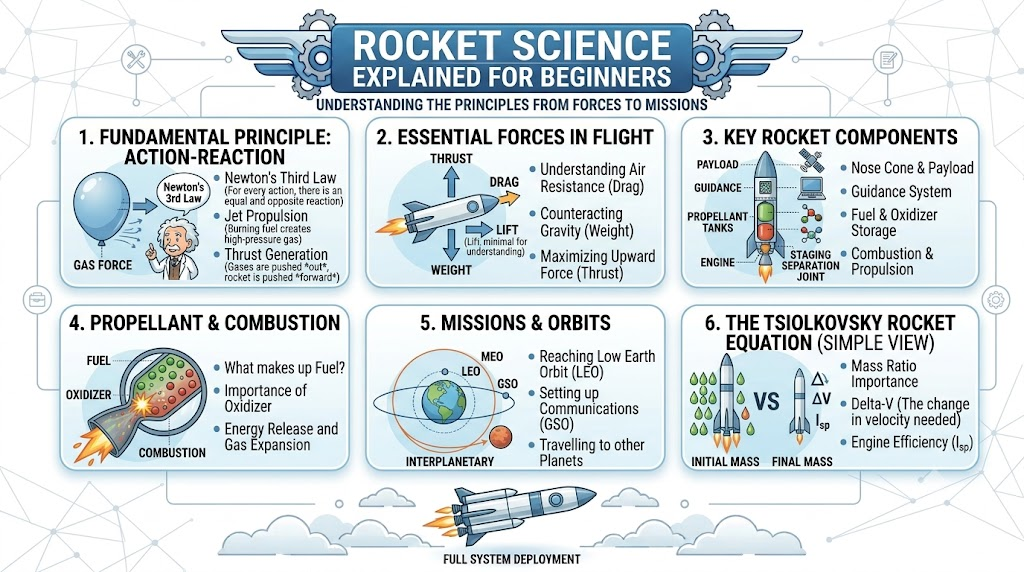
One of the most important concepts in rocket science is Newton’s Third Law of Motion.
This law states that every action has an equal and opposite reaction.
A rocket engine pushes hot gases downward at very high speed. In response, the rocket is pushed upward. This reaction force creates thrust, which allows the rocket to accelerate.
For example, imagine standing on a skateboard and throwing a heavy object forward. As the object moves forward, your body moves slightly backward. A rocket works on a similar principle, but with much greater force and speed.
This simple action-and-reaction principle is the foundation of rocket propulsion.
How Does a Rocket Generate Thrust?
Thrust is the force that pushes a rocket forward.
Inside a rocket engine, propellants undergo a controlled chemical reaction that produces extremely hot and high-pressure gases. These gases are forced through a specially designed nozzle at high speed.
As the gases leave the rocket in one direction, the rocket moves in the opposite direction.
The amount of thrust produced depends on several factors, including:
- The type of propellant used
- The temperature of the exhaust gases
- The speed at which gases leave the nozzle
- The efficiency of the rocket engine
- The design of the propulsion system
Unlike aircraft engines, rocket engines do not depend on oxygen from the surrounding atmosphere. Rockets carry their own oxidizer, allowing them to operate even in the vacuum of space.
Main Parts of a Rocket
A rocket contains several important systems that work together during a mission.
Rocket Engine
The rocket engine produces the thrust required to move the rocket. It converts the energy stored in propellants into high-speed exhaust gases.
Propellant
Propellant is the material used by a rocket to produce energy and thrust. It generally includes fuel and an oxidizer.
Fuel and Oxidizer
Fuel provides the energy needed for combustion, while the oxidizer supplies oxygen or another chemical that allows combustion to take place.
Since space does not contain enough atmospheric oxygen, rockets must carry their own oxidizer.
Combustion Chamber
The combustion chamber is where fuel and oxidizer react. This reaction creates extremely hot gases under high pressure.
Nozzle
The nozzle directs and accelerates the exhaust gases as they leave the engine. Its shape is carefully designed to improve thrust efficiency.
Payload
The payload is the object or equipment carried by the rocket. It may include satellites, scientific instruments, cargo, or spacecraft.
Guidance System
The guidance system helps control the direction and movement of the rocket. It uses sensors, computers, and navigation systems to keep the rocket on its planned path.
Rocket Stages
Large rockets are often divided into multiple stages. Each stage contains its own engines and propellant. When a stage has completed its task, it separates from the rocket, reducing unnecessary weight.
Understanding Rocket Propellants
Rocket propulsion systems use different types of propellants depending on mission requirements.
Solid Propellants
Solid-propellant rockets contain fuel and oxidizer in a solid form. Once the propellant is ignited, it burns until the available material is consumed.
These systems are relatively simple and can provide powerful thrust.
Liquid Propellants
Liquid-propellant rockets store fuel and oxidizer separately in tanks. Pumps or pressure systems deliver them into the combustion chamber.
Liquid propulsion systems allow greater control because engineers can regulate the flow of propellants.
Hybrid Propulsion Systems
Hybrid rockets use a combination of solid and liquid propellants. They attempt to combine some advantages of both propulsion methods.
| Propellant Type | Basic Characteristics |
|---|---|
| Solid Propellant | Simple design and continuous burning after ignition |
| Liquid Propellant | Greater control over thrust and engine operation |
| Hybrid Propellant | Combines features of solid and liquid propulsion |
Why Do Rockets Have Multiple Stages?
One of the biggest challenges in rocket design is weight.
A rocket must carry engines, fuel tanks, propellant, equipment, and the payload. As propellant is consumed, empty tanks and engines become unnecessary weight.
Multi-stage rockets solve this problem.
When a stage runs out of propellant, it separates from the remaining rocket. The next stage then continues the journey using its own engine and fuel supply.
This process reduces the rocket’s mass and improves efficiency.
Staging is especially important when launching satellites or spacecraft into orbit because reaching orbital velocity requires a tremendous amount of energy.
How Rockets Escape Earth’s Gravity
Earth’s gravity continuously pulls objects toward its surface. A rocket must generate enough thrust to move upward while also gaining the speed required for its mission.
Many beginners imagine a rocket simply traveling straight upward until it reaches space. In reality, reaching space is only part of the challenge.
To enter orbit, a spacecraft must also gain a large amount of horizontal velocity.
Escape Velocity
Escape velocity refers to the speed needed for an object to escape Earth’s gravitational influence without additional propulsion under ideal conditions.
Orbital Velocity
Orbital velocity is the speed required for an object to continuously fall around Earth rather than falling directly back to the surface.
A spacecraft in orbit is constantly affected by gravity. However, because it is moving sideways at a very high speed, it continues moving around the planet.
This is why rockets gradually change their direction during launch instead of traveling vertically throughout the entire mission.
From Launch to Orbit: A Simple Journey
A rocket launch involves several carefully planned stages.
Step 1: Pre-Launch Preparation
Engineers inspect the rocket, check weather conditions, load propellants, and test communication and guidance systems.
Step 2: Engine Ignition
The rocket engines are activated, producing large amounts of thrust.
Step 3: Liftoff
Once the thrust becomes greater than the forces holding the rocket down, the rocket begins to rise.
Step 4: Atmospheric Ascent
The rocket travels through Earth’s atmosphere while experiencing aerodynamic forces and atmospheric resistance.
Step 5: Stage Separation
After a stage uses most or all of its propellant, it separates from the rocket to reduce weight.
Step 6: Upper-Stage Operation
Upper stages continue accelerating the spacecraft toward its required altitude and velocity.
Step 7: Orbital Insertion
The rocket reaches the required speed and direction to place the payload into its planned orbit.
Step 8: Payload Deployment
The payload, such as a satellite, separates from the rocket and begins its mission.
Table 1: Important Rocket Science Terms
| Term | Simple Explanation |
|---|---|
| Thrust | The force that pushes a rocket forward |
| Propellant | Material used to produce rocket energy and thrust |
| Payload | Equipment or objects carried by a rocket |
| Orbit | A path followed by an object around another object |
| Escape Velocity | Speed associated with escaping a body’s gravitational influence |
| Combustion | A chemical reaction that releases energy and heat |
| Rocket Stage | A separate section of a rocket with engines and propellant |
| Guidance System | Technology used to control the rocket’s direction |
The Role of Physics in Rocket Science
Physics plays a central role in understanding how rockets work.
Motion
Motion helps explain how a rocket changes position and speed during launch.
Force
Forces determine whether a rocket can overcome gravity and atmospheric resistance.
Gravity
Gravity continuously pulls the rocket toward Earth, influencing its flight path.
Momentum
Momentum describes the relationship between mass and velocity. Rocket engineers must understand how momentum changes as propellant is expelled.
Energy
Chemical energy stored in propellants is converted into heat and motion.
Acceleration
Acceleration describes how quickly a rocket changes its velocity. Rockets experience different acceleration levels as their mass decreases during flight.
Together, these physical principles help engineers predict and control rocket behavior.
Common Challenges in Rocket Engineering
Designing and operating rockets involves many technical challenges.
Extreme Temperatures
Rocket engines produce extremely high temperatures. Materials must withstand intense heat without failing.
High Fuel Requirements
Rockets require large amounts of propellant because they must carry both their payload and the fuel needed for the mission.
Structural Stress
During launch, rockets experience vibration, pressure changes, acceleration, and aerodynamic forces.
Navigation Accuracy
A small navigation error can cause a spacecraft to miss its intended orbit or destination.
Atmospheric Resistance
The atmosphere creates drag that slows a rocket and generates heat during high-speed flight.
Communication Challenges
As spacecraft travel farther from Earth, communication signals become weaker and experience delays.
Common Misconceptions About Rocket Science
Rockets Need Air to Operate
This is incorrect. Rockets carry an oxidizer, allowing their engines to operate in space.
Rockets Only Travel Vertically
Rockets initially travel upward but gradually change direction to gain horizontal velocity for orbit.
Space Begins Immediately After Takeoff
A rocket must travel through different layers of Earth’s atmosphere before reaching the space environment.
Bigger Rockets Are Always Better
Rocket size depends on mission requirements. Larger rockets can carry heavier payloads, but they also require more materials and propellant.
Rocket Science Is Impossible Without Advanced Mathematics
Advanced mathematics is important for professional aerospace engineering, but beginners can understand the basic principles through fundamental physics and simple concepts.
Table 2: Rocket Launch Phases
| Launch Phase | What Happens |
|---|---|
| Pre-Launch Preparation | Systems, weather, fuel, and communication are checked |
| Engine Ignition | Rocket engines begin producing thrust |
| Liftoff | The rocket leaves the launch platform |
| Atmospheric Ascent | The rocket travels through Earth’s atmosphere |
| Stage Separation | Empty stages are released to reduce weight |
| Upper-Stage Operation | Upper engines continue accelerating the spacecraft |
| Payload Deployment | The satellite or spacecraft separates from the rocket |
| Orbital Insertion | The payload reaches its planned orbital path |
Practical Explanation: How to Start Learning Rocket Science
Learning rocket science does not require understanding every advanced concept immediately. Beginners can follow a step-by-step learning path.
1. Start With Basic Physics
Learn about force, motion, energy, acceleration, and gravity.
2. Understand Newton’s Laws of Motion
Newton’s laws provide the foundation for understanding how rockets accelerate and change direction.
3. Build Mathematics Fundamentals
Basic algebra, geometry, and later calculus can help students understand more advanced aerospace concepts.
4. Learn About Aerodynamics
Study how air interacts with moving objects and how atmospheric forces affect rockets during launch.
5. Explore Propulsion Systems
Understand how rocket engines convert chemical energy into thrust.
6. Study Orbital Mechanics
Learn how satellites and spacecraft move around planets.
7. Explore Aerospace Engineering Concepts
Once the fundamentals are clear, beginners can explore structural design, navigation, spacecraft systems, and mission planning.
The most effective approach is to build knowledge gradually rather than trying to understand every advanced topic at once.
Important Considerations for Beginners
Beginners interested in rocket science should remember the following points:
- Build strong fundamentals in physics before exploring advanced topics.
- Focus on understanding concepts instead of memorizing formulas.
- Learn complicated subjects step by step.
- Use diagrams and visual models to understand rocket structures and motion.
- Study real-world space missions to connect theory with practical applications.
- Remember that rocket science combines multiple scientific disciplines.
- Be patient with mathematical concepts and develop them gradually.
- Stay curious and continue exploring new developments in space technology.
Frequently Asked Questions
1. What is rocket science in simple words?
Rocket science is the study of how rockets are designed, powered, controlled, and used to travel through Earth’s atmosphere and space.
2. How does a rocket move in space?
A rocket pushes exhaust gases backward at high speed, creating an equal and opposite force that pushes the rocket forward.
3. Why do rockets need so much fuel?
Rockets need large amounts of propellant to overcome gravity, accelerate their own mass, travel through the atmosphere, and carry their payload.
4. What creates thrust in a rocket?
Thrust is created when high-pressure gases are expelled from the rocket engine through a nozzle at high speed.
5. Can rockets work without oxygen from the atmosphere?
Yes. Rockets carry an oxidizer along with their fuel, allowing them to operate in the vacuum of space.
6. Why do rockets have multiple stages?
Multiple stages allow rockets to discard empty tanks and engines, reducing weight and improving efficiency during flight.
7. What is the difference between orbital velocity and escape velocity?
Orbital velocity allows an object to travel around Earth, while escape velocity is associated with leaving Earth’s gravitational influence without further propulsion under ideal conditions.
8. Is rocket science difficult to learn?
Advanced rocket engineering can be challenging, but beginners can understand the basic principles by learning physics and mathematics step by step.
9. What subjects should I study to understand rocket science?
Important subjects include physics, mathematics, chemistry, computer science, and aerospace engineering.
10. How long does it take for a rocket to reach space?
The time depends on the rocket and mission profile, but many launch vehicles can reach the boundary of space within several minutes while continuing to accelerate for orbital missions.
Conclusion
Rocket science may sound complicated, but its fundamental principles are based on understandable scientific concepts. Rockets generate thrust by expelling gases, use propellants to produce energy, and rely on physics to overcome gravity and reach their destinations.
From Newton’s laws of motion to rocket staging and orbital mechanics, every part of a rocket mission follows carefully understood scientific principles. Beginners do not need to master advanced mathematics immediately. Starting with basic physics, motion, forces, and propulsion can provide a strong foundation for exploring more advanced aerospace topics.
As space exploration continues to develop, understanding the basics of rocket science can help students and enthusiasts appreciate the incredible engineering behind every successful launch.