Introduction
Aircraft and spacecraft are both designed to travel beyond ordinary ground transportation, but they operate in very different environments. Aircraft mainly function within Earth’s atmosphere, while spacecraft are designed to operate beyond the dense atmosphere and into space. These environmental differences affect how each vehicle produces motion, maintains control, and supports its mission. This article explains the key differences between aircraft and spacecraft in a simple and beginner-friendly way.
Understanding Aircraft and Spacecraft
What Is an Aircraft?
An aircraft is a vehicle designed to travel through the Earth’s atmosphere. It uses aerodynamic principles to generate lift, control movement, and maintain stable flight.
Aircraft come in different forms depending on their purpose and design. Common examples include airplanes, helicopters, gliders, and unmanned aerial vehicles.
Many fixed-wing aircraft generate lift when air flows over and around their wings. Helicopters use rotating blades to generate aerodynamic forces that allow them to lift and maneuver. Gliders use aerodynamic lift but generally rely on external or environmental sources of energy to maintain flight after launch.
Although aircraft designs vary, they generally depend on the presence of an atmosphere for normal flight operations.
What Is a Spacecraft?
A spacecraft is a vehicle designed to operate beyond Earth’s dense atmosphere. It may be used for activities such as orbiting Earth, studying distant objects, carrying people, exploring other planets, or collecting scientific information.
Spacecraft include many different types of vehicles, such as:
- Satellites.
- Space probes.
- Crewed spacecraft.
- Space stations.
- Planetary landers.
Unlike conventional aircraft, spacecraft cannot depend on normal aerodynamic lift when operating in the near-vacuum of space.
Their movement and trajectory are influenced by propulsion systems, momentum, gravity, and orbital mechanics.
Not every spacecraft performs the same mission. Some remain in Earth orbit, while others travel much farther into the solar system.
The Most Important Difference: Operating Environment
The most significant difference between an aircraft and a spacecraft is the environment in which it operates.
Aircraft are primarily designed for atmospheric flight. Air surrounding the vehicle plays an important role in generating lift, creating aerodynamic forces, and supporting certain types of propulsion.
Spacecraft operate beyond the dense atmosphere, where the environment is very different. Space has extremely low atmospheric density, which means conventional wings cannot generate lift in the same way they do during normal aircraft flight.
The operating environment also affects other aspects of vehicle design.
An aircraft must handle aerodynamic forces, weather conditions, air pressure changes, and atmospheric temperatures.
A spacecraft may need to operate under conditions involving vacuum, major temperature variations, radiation exposure, and the physical demands associated with launch and space operations.
The transition from atmosphere to space is not simply a sudden mechanical boundary. Atmospheric density gradually decreases with altitude, which progressively changes the conditions under which a vehicle can operate.
Key Differences Between Aircraft and Spacecraft
Lift and Flight
One of the clearest differences involves lift.
Many conventional aircraft use wings to generate lift. As the aircraft moves through the atmosphere, airflow creates aerodynamic forces that help support the aircraft.
Helicopters use rotating blades to generate aerodynamic lift.
Spacecraft operating in space cannot rely on conventional aerodynamic lift because there is very little atmospheric air available.
Instead, spacecraft follow trajectories influenced by velocity and gravity. A spacecraft in orbit remains in continuous motion while gravitational forces influence its path around a celestial body.
This is different from the way an airplane remains airborne through aerodynamic lift.
Propulsion
Aircraft and spacecraft also differ in how they generate propulsion.
Many aircraft use engines that interact directly with the atmosphere. Propeller-driven aircraft move air to generate thrust, while many jet engines depend on atmospheric air as part of their operation.
A spacecraft operating in space cannot depend on surrounding atmospheric oxygen.
For this reason, spacecraft propulsion systems are designed to function without relying on the atmosphere in the same way as conventional air-breathing engines.
The type of propulsion used depends on the mission, vehicle design, and operational environment.
It is also important to understand that spacecraft do not necessarily need to keep their main engines running continuously while traveling in orbit. Once a spacecraft has achieved a suitable trajectory, it can continue moving according to the laws of motion and gravitational forces.
Control and Maneuvering
Aircraft are generally controlled through aerodynamic systems.
Fixed-wing aircraft use control surfaces such as:
- Ailerons.
- Elevators.
- Rudders.
These surfaces change the airflow around the aircraft and help control its attitude and direction.
Helicopters use different control systems involving their rotor assemblies.
Spacecraft operating in space cannot rely on aerodynamic control surfaces in the same way because of the lack of a significant atmosphere.
Instead, spacecraft may use systems such as reaction control thrusters or momentum-based attitude control devices.
The control system can also change depending on the stage of a mission. A vehicle may use different methods during launch, atmospheric entry, and operations in space.
Structural Design
Aircraft structures are designed to operate under aerodynamic loads created during atmospheric flight.
Engineers consider factors such as air pressure, turbulence, maneuvering loads, vibration, and operational conditions.
Spacecraft face a different set of engineering challenges.
They may need to withstand:
- Launch forces.
- Vibration.
- Vacuum conditions.
- Thermal changes.
- Radiation exposure.
- Mission-specific environmental conditions.
The structure of a spacecraft must be designed according to its intended mission.
For example, a satellite designed for Earth orbit has different requirements from a spacecraft intended to land on another planetary body.
Life Support
Most conventional aircraft operate within Earth’s atmosphere.
Aircraft flying at certain altitudes may require environmental and pressurization systems to provide suitable conditions for occupants. However, they remain within an atmospheric environment.
Crewed spacecraft require much more extensive environmental support.
A human spacecraft must provide systems for managing factors such as:
- Breathable air.
- Internal pressure.
- Temperature.
- Water.
- Waste management.
Not all spacecraft carry people. Many satellites and space probes operate without human occupants and therefore do not require life-support systems.
Navigation
Aircraft navigation takes place within Earth’s atmosphere and aviation operating systems.
Pilots may use visual references, onboard instruments, navigation systems, communication systems, and air traffic procedures.
Spacecraft navigation can involve much larger distances and different reference systems.
Tracking a spacecraft may require information about its position, velocity, trajectory, and relationship with celestial bodies.
Ground-based support and onboard navigation systems can both play important roles depending on the mission.
Speed and Mission Profile
Aircraft are generally designed for atmospheric transportation, observation, training, research, or other aviation missions.
Spacecraft can be designed for very different mission profiles, including:
- Launch operations.
- Earth orbit.
- Scientific observation.
- Planetary exploration.
- Deep-space missions.
- Re-entry into the atmosphere.
The design priorities of an aircraft and spacecraft are therefore strongly influenced by their intended missions.
Practical Explanation: Why an Airplane Cannot Simply Fly Into Space
It may seem logical to imagine an airplane flying higher and higher until it eventually reaches space. In reality, the situation is much more complicated.
Aircraft Depend on the Atmosphere
Conventional airplanes depend heavily on the surrounding atmosphere.
Wings need airflow to generate aerodynamic lift. Many aircraft engines also depend on atmospheric air for normal operation.
The Atmosphere Becomes Thinner With Altitude
As altitude increases, atmospheric density decreases.
Thinner air changes the ability of wings and engines to operate effectively. A conventional aircraft cannot simply continue climbing indefinitely while maintaining normal aerodynamic flight.
Conventional Lift Becomes Limited
With very little surrounding air, wings cannot generate lift in the same way as they do at normal operating altitudes.
This means a vehicle designed for atmospheric flight eventually faces conditions outside its intended operating environment.
Space Vehicles Need Different Propulsion
A vehicle traveling into space requires propulsion systems capable of operating without depending on atmospheric oxygen in the same way as conventional air-breathing engines.
The vehicle must also be designed to survive the changing environmental conditions during ascent.
Reaching Space Is Not Simply About Flying Upward
Spaceflight also involves trajectory and velocity.
For orbital operations, a spacecraft must follow an appropriate path around a celestial body. Orbit is not simply a location where a vehicle stops flying upward.
A spacecraft in orbit remains under the influence of gravity while moving forward at a suitable velocity.
Therefore, reaching and operating in space requires principles that are different from conventional atmospheric flight.
Comparison Between Aircraft and Spacecraft
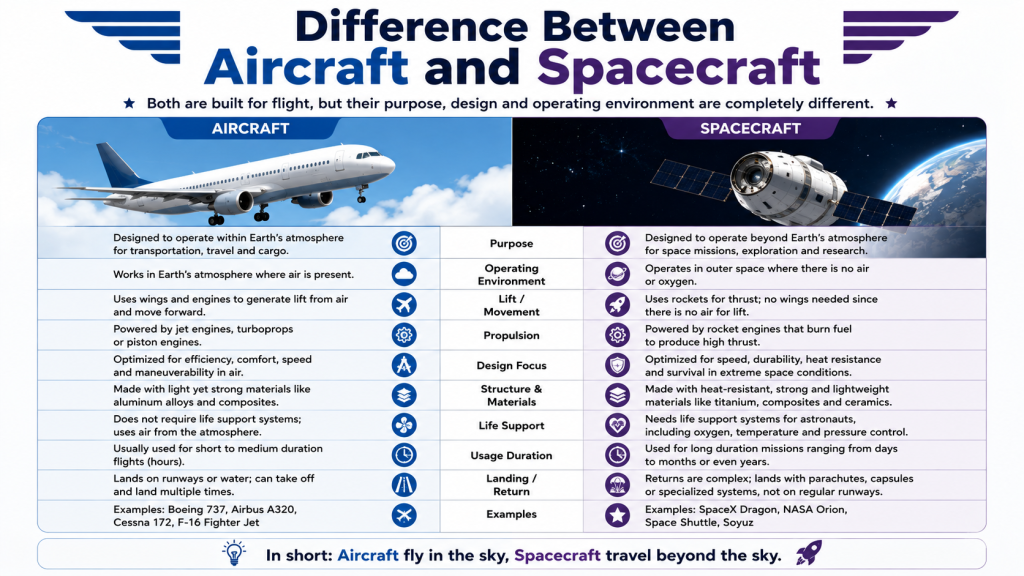
| Feature | Aircraft | Spacecraft |
|---|---|---|
| Primary operating environment | Earth’s atmosphere | Beyond the dense atmosphere |
| Lift | Often generated through aerodynamic surfaces or rotating blades | Conventional aerodynamic lift is generally unavailable in space |
| Propulsion | May use propellers or air-breathing engines | Uses propulsion systems designed for space operations |
| Control methods | Aerodynamic control surfaces or rotor systems | Thrusters, momentum-based systems, and other space control methods |
| Structural requirements | Designed for atmospheric and aerodynamic loads | Designed for launch loads, vacuum, thermal conditions, and mission needs |
| Life support | Environmental systems vary by aircraft and altitude | Crewed spacecraft require dedicated life-support systems |
| Navigation | Uses aviation navigation and operational systems | Uses trajectory, position, velocity, and mission navigation systems |
| Typical missions | Atmospheric transport and aviation operations | Orbit, exploration, research, and space missions |
Common Misunderstandings Students Should Avoid
Thinking Space Has No Gravity
A common misunderstanding is that gravity disappears completely in space.
Gravitational forces continue to act beyond Earth’s atmosphere. Spacecraft in orbit are still strongly influenced by gravity.
Orbit involves continuous motion under gravitational influence rather than the complete absence of gravity.
Assuming Rockets and Spacecraft Are Exactly the Same
The terms rocket and spacecraft are related but do not always mean the same thing.
A rocket may refer to a vehicle or propulsion system used to provide powerful thrust.
A spacecraft is a broader term for a vehicle designed for a mission in space.
A rocket can launch a spacecraft, while the spacecraft itself may later continue its mission separately.
Believing Aircraft Can Simply Continue Flying Upward Into Space
Conventional aircraft depend on atmospheric conditions for lift and many propulsion systems.
As the atmosphere becomes thinner, the conditions required for normal aircraft operation change significantly.
An airplane is therefore not simply a spacecraft that has not yet flown high enough.
Assuming Spacecraft Use Engines Continuously in Orbit
A spacecraft does not necessarily need to continuously fire its main engines to remain in orbit.
Once moving along a suitable orbital trajectory, it can continue traveling under the influence of inertia and gravity.
Propulsion may still be used for adjustments, maneuvers, orientation changes, or mission operations.
Thinking All Spacecraft Carry People
Many spacecraft are completely robotic.
Satellites, space probes, and many exploration vehicles operate without astronauts or other human occupants.
Crewed spacecraft represent only one category of space vehicle.
Assuming All Aircraft Use Wings in the Same Way
Different aircraft have different methods of generating lift and controlling movement.
Fixed-wing airplanes, helicopters, gliders, and other aircraft categories do not all operate using identical aerodynamic systems.
Believing Spacecraft Experience the Same Environment Everywhere
Space conditions can vary depending on mission location, altitude, destination, exposure, and duration.
A spacecraft near Earth may face different environmental conditions from one traveling toward another planet.
Vehicle design must therefore match the expected mission environment.
Confusing Weightlessness With the Absence of Gravity
Astronauts in orbit may experience the sensation of weightlessness, but this does not mean gravity has disappeared.
The spacecraft and its occupants are moving together along an orbital path under gravitational influence.
Common Vehicle Types and Their General Purpose
| Vehicle Type | Typical Operating Region | General Purpose |
|---|---|---|
| Commercial airplane | Earth’s atmosphere | Passenger and cargo transportation |
| Helicopter | Earth’s atmosphere | Vertical flight and specialized aviation operations |
| Glider | Earth’s atmosphere | Unpowered or minimally powered aerodynamic flight |
| Satellite | Earth orbit or other orbital regions | Communication, observation, research, or navigation |
| Space probe | Space beyond Earth | Scientific exploration and data collection |
| Crewed spacecraft | Space and orbital environments | Transport and support of human missions |
| Space station | Earth orbit or other orbital locations | Long-duration research and habitation |
| Planetary lander | Surface of another celestial body | Surface exploration and scientific investigation |
Important Considerations
Some Vehicles Operate Across More Than One Environment
Certain aerospace vehicles travel through both the atmosphere and space during their missions.
Launch vehicles begin their journey through the atmosphere before reaching space. Vehicles returning to Earth may also pass through the atmosphere during re-entry.
This does not mean such vehicles operate like conventional airplanes throughout the entire mission. Their design and operating principles change according to the environment and mission phase.
Vehicle Design Depends on Mission
Engineering decisions are closely connected to mission requirements.
An aircraft designed for passenger transportation faces different challenges from a spacecraft designed for scientific observation.
Similarly, a satellite in orbit has different requirements from a spacecraft intended to land on another world.
Understanding the mission is essential to understanding why a particular vehicle has a specific design.
Spaceflight Involves Orbital Mechanics
The movement of spacecraft is strongly influenced by gravity, velocity, and trajectory.
A spacecraft in orbit is continuously moving while following a path influenced by gravitational forces.
This is one of the fundamental differences between atmospheric flight and orbital space operations.
Atmospheric Flight and Spaceflight Use Different Principles
Both aviation and spaceflight depend on physics, engineering, mathematics, and careful operational planning.
However, the environmental conditions create major differences.
Atmospheric flight depends heavily on aerodynamic principles, while spacecraft operations involve propulsion, trajectory planning, orbital mechanics, and space-specific engineering challenges.
Human Spaceflight Requires Additional Systems
Carrying people into space creates additional engineering requirements.
Crewed spacecraft must provide an environment suitable for human survival and operations.
These requirements add complexity beyond what is needed for an uncrewed satellite or robotic probe.
Technology Continues to Develop
Aerospace engineering continues to develop new materials, vehicle concepts, propulsion approaches, and mission capabilities.
However, the basic difference between atmospheric and space environments remains central to vehicle design.
Understanding these environmental differences provides a useful foundation for studying both aviation and space science.
Definitions Can Depend on Context
Some aerospace technologies have characteristics that overlap between traditional categories.
Classification may depend on a vehicle’s design, mission, operating environment, and method of operation.
For beginners, the simplest distinction remains clear: aircraft are primarily designed for atmospheric operations, while spacecraft are designed for missions beyond the dense atmosphere.
Frequently Asked Questions
1. What is the main difference between an aircraft and a spacecraft?
The main difference is their operating environment. Aircraft are primarily designed to operate within Earth’s atmosphere, while spacecraft are designed to operate beyond the dense atmosphere and in space.
2. Can an airplane fly into space?
A conventional airplane cannot simply continue flying upward into space because it depends on atmospheric conditions for aerodynamic lift and normal engine operation.
3. Why do aircraft need wings?
Many aircraft use wings to generate aerodynamic lift. As air flows around the wings, aerodynamic forces help support the aircraft during flight.
4. Why do spacecraft not need wings in space?
Spacecraft operating in the near-vacuum of space cannot rely on conventional wings because there is very little air available to create aerodynamic lift.
5. Do spacecraft experience gravity?
Yes. Gravity continues to influence spacecraft in space. An orbiting spacecraft moves along a path shaped by its velocity and gravitational forces.
6. What is the difference between a rocket and a spacecraft?
A rocket can provide the propulsion needed to launch a vehicle, while spacecraft is a broader term for a vehicle designed to operate on a space mission. A rocket may carry a spacecraft during launch.
7. How do spacecraft move in space?
Spacecraft move according to momentum, velocity, gravitational forces, and trajectory. Propulsion systems can be used when changes in speed, direction, or mission trajectory are required.
8. Do all spacecraft carry astronauts?
No. Many spacecraft are robotic. Satellites, probes, and planetary exploration vehicles can operate without human occupants.
9. Can a spacecraft return to Earth?
Some spacecraft are specifically designed to return to Earth, while others remain in orbit, travel deeper into space, or complete missions without returning.
10. What subjects should students study to understand aircraft and spacecraft?
Useful subjects include physics, mathematics, aerodynamics, mechanics, engineering fundamentals, astronomy, and space science. The exact areas of study depend on the student’s specific interest in aviation or aerospace engineering.
Conclusion
Aircraft and spacecraft may both represent advanced forms of transportation and engineering, but they are designed for fundamentally different environments. Aircraft primarily operate within Earth’s atmosphere and depend heavily on aerodynamic forces for lift and control.
Spacecraft are designed to operate beyond the dense atmosphere, where conventional aerodynamic flight is generally not possible. Their movement, propulsion, control systems, structures, and mission requirements must account for the unique conditions of space.
The difference becomes easier to understand when the operating environment is considered first. Air creates the conditions necessary for conventional flight, while the near-vacuum of space requires different approaches to movement and vehicle design.
Both aircraft and spacecraft are important areas of aerospace technology. Understanding their differences provides students with a useful foundation for exploring aviation, aerospace engineering, and space science.